
A token can represent an infrastructure interest, but it can’t make an unbankable project viable or resolve unclear ownership rights. Understanding how to tokenize infrastructure projects starts with the asset, its legal structure, and the rights investors would actually receive, not with choosing a blockchain.
If you’re considering tokenization, the challenge is coordinating legal, compliance, technology, custody, and servicing decisions. These workstreams depend on the project’s fundamentals and on one another. Tokenization may change how interests are recorded or transferred, but it doesn’t replace financing, investor demand, or sound project economics.
This guide sets out a practical path from feasibility assessment and legal structuring to platform selection, issuance, and ongoing operations. It explains what to establish at each stage, how key decisions connect, and which provider roles may be needed. The goal is a realistic next-step plan that accounts for governance and servicing after issuance, as well as the conditions to address before moving forward.
Key Takeaways
- Separate the physical infrastructure asset from the ownership or financing vehicle, investor rights, and digital token before designing the structure.
- Assess project readiness by documenting its purpose, intended investors, ownership, contractual rights, cash-flow assumptions, liabilities, and existing financing.
- Compare structures and blockchain options based on rights, governance, transfer conditions, interoperability, security, and operational requirements, not token format alone.
- Learn how to tokenize infrastructure projects through a sequenced roadmap, resolving legal rights and project requirements before finalizing technical specifications.
- Use a provider matrix to assess scope, jurisdictional fit, integrations, accountability, and continuity, then verify credentials, references, and responsibilities directly.
What Does It Mean to Tokenize an Infrastructure Project?
Tokenization represents defined rights or interests in digital form, often using a blockchain to record and manage that representation. For an infrastructure project, the token is not the bridge, power plant, rail line, or other physical asset. Creating a token doesn’t, by itself, transfer ownership of the asset. The legal structure and governing documents establish what a holder’s rights mean, who is responsible for obligations, and how those rights may be exercised.
The word “tokenization” has different meanings across industries. In data security, for example, it can refer to replacing sensitive data with a token, as described in this overview of Tokenization. Infrastructure tokenization addresses a different question: how defined economic or governance rights are represented and administered digitally. The distinction matters because a record on a network cannot, by itself, define or enforce the underlying rights.
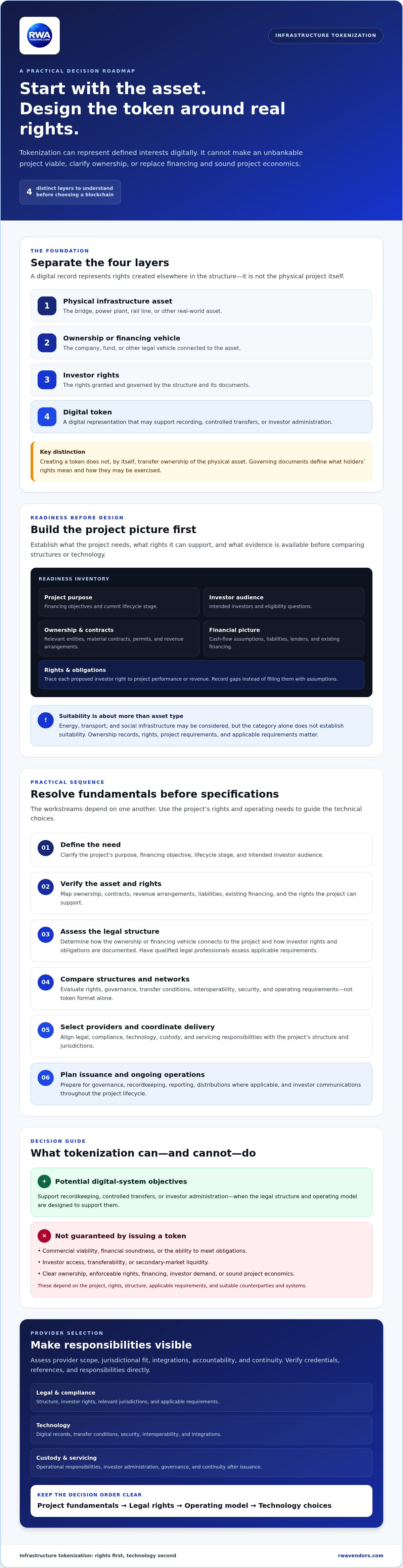
A useful way to frame how to tokenize infrastructure projects is to separate four layers: the physical asset; the company, fund, or other vehicle that owns or finances it; the rights granted to investors through that structure; and the digital token used to represent or administer those rights. A digital system may support recordkeeping, controlled transfers, or investor administration. Treat these as design objectives, not guaranteed outcomes such as greater liquidity or lower costs.
Which Infrastructure Assets and Rights Might Be Represented?
Potential project categories include energy, transport, and social infrastructure, but the asset type alone doesn’t establish suitability. A token might represent an interest in a legal vehicle connected to a project rather than direct ownership of the physical asset. Possible structures could involve ownership interests, debt, revenue participation, or other rights. Their meaning and availability depend on the project documents and applicable requirements, so qualified counsel should assess the proposed structure.
What Tokenization Does Not Solve by Itself
Digitizing a representation doesn’t establish that a project is commercially viable, financially sound, or capable of meeting its obligations. Nor does it guarantee investor access, transferability, or secondary-market liquidity. Those outcomes depend on the rights created, the project’s structure, investor eligibility, applicable requirements, and the availability of suitable counterparties and systems.
Technical records also don’t replace enforceable documentation or the work required to administer investor rights. Projects still need clear processes for governance, recordkeeping, reporting, distributions where applicable, and investor communications. The token should reflect a structure that can be operated over the project’s lifecycle, not stand in for one.
Assess Project Readiness Before Designing the Tokenization Structure
Before comparing structures or technology, establish what the project needs and what rights it can support. Define its purpose, financing objectives, current lifecycle stage, and intended investor audience. A project seeking construction capital may face different constraints from an operating asset considering a change to how existing interests are administered. Tokenization should address a defined financing or operational need, not become the objective by itself.
Readiness also depends on evidence. Map ownership, contractual rights, expected cash flows, liabilities, and existing financing arrangements. Identify relevant jurisdictions and investor eligibility questions, then have qualified legal professionals assess regulatory issues. The World Bank report on infrastructure tokenization offers additional context for evaluating blockchain’s role in infrastructure finance and the challenges involved.
Build an Asset and Rights Inventory
Assemble a working inventory of the entities that own or operate the asset, material project contracts, permits, revenue arrangements, existing lenders, and relevant obligations. For each proposed investor right, trace its relationship to project performance or revenue. For example, identify which entity receives operating revenue and whether agreements govern how funds may be used or distributed.
Record gaps instead of filling them with assumptions. Incomplete ownership records, potential consent requirements, conflicting contract terms, or unclear responsibility for obligations should be referred for professional review before a token structure is designed.
Set Objectives and Constraints Before Choosing Technology
Write down the problem the project intends to address and separate essential requirements from optional features. Specify intended investor types, transfer restrictions to assess, reporting needs, and the expected holding period. These choices shape the design. Selecting a network or platform first can lock the project into features that don’t match its legal structure or operating model.
Create a Readiness Checklist
For each material issue, classify the current position as confirmed, unresolved, or an assumption to validate. Include ownership and rights, cash-flow inputs, liabilities, existing financing, jurisdictional questions, investor eligibility, approvals or consents to investigate, and the project’s objectives. This gives legal, compliance, and technical workstreams a shared starting point and makes the next decisions visible.
This evidence-led assessment is the foundation for deciding how to tokenize infrastructure projects responsibly. Once requirements are documented, issuers can identify and compare relevant providers, then verify each provider’s scope, credentials, jurisdictional fit, and references directly. Providers in this sector can also review directory listing options to present their services to issuers.
Compare Tokenization Structures, Networks, and Provider Roles
Compare options against the project’s documented rights and operating requirements, not against a token format or platform demonstration. A structure should make clear who holds the underlying asset or financing vehicle, what investors are entitled to, how decisions are made, who administers those rights, and under what conditions interests may transfer. The same infrastructure project could be structured in different ways, but each option needs to be assessed for legal, economic, and operational fit.
Choose technology only after defining those requirements. Assess blockchain and smart-contract options for security controls, interoperability with required systems, ongoing support, and the ability to implement the project’s documented rules. A technically capable platform cannot make an unsuitable structure appropriate. Tokenization alone doesn’t create project quality, regulatory suitability, or investor demand.
Evaluate the Legal and Economic Structure Separately From the Technology
Ask qualified counsel to assess the proposed investor rights, issuance documents, transfer conditions, and jurisdictions involved. Separately, document the economic relationship between the project and those rights, including how project performance may affect investor outcomes. This helps prevent the technical design from implying rights that the legal documents don’t establish.
A smart contract may carry out defined functions, such as applying configured transfer controls or updating records. It doesn’t replace enforceable agreements, governance processes, or human administration. For broader compliance considerations, see this compliant asset tokenization guide.
Match Provider Capabilities to the Project Workstreams
Write down required deliverables and system interfaces before comparing vendor claims. Depending on the chosen structure, workstreams may include legal and compliance, tokenization technology, blockchain infrastructure, custody, payments, trading, and ongoing lifecycle management. Not every project needs the same mix of providers, and don’t assume one provider’s scope covers another’s responsibilities.
For each prospective provider, verify relevant experience, credentials, jurisdictional fit, security documentation, support arrangements, integration responsibilities, and references directly. Record who owns each handoff, who resolves operational exceptions, and how records and servicing will continue if a provider’s role changes. The digital asset infrastructure providers guide outlines key provider categories to consider.
- Structure: Rights, governance, administration, and transfer conditions.
- Technology: Security, interoperability, documented functions, and operational support.
- Providers: Scope, interfaces, accountability, and continuity across the project lifecycle.
This separation is central to how to tokenize infrastructure projects responsibly: define what the project needs, assign the work, then test whether each proposed structure and technology can support it.
How to Tokenize an Infrastructure Project: A Practical Sequence
A disciplined sequence keeps legal, operational, and technical decisions aligned. Resolve the project’s rights and requirements before finalizing technical specifications. Then move through defined decision gates, with accountable owners and documented approval at each stage.
- Confirm feasibility. Validate the project’s purpose, readiness, underlying documentation, and intended investor audience. Record material gaps that could affect the proposed structure.
- Approve the structure. Have qualified professionals assess the rights to be represented, issuance documents, transfer conditions, and relevant jurisdictions.
- Define requirements and select providers. Translate approved rights and operational needs into a scope of work. Identify the legal, compliance, technology, custody, payment, trading, and servicing capabilities required, then verify each provider’s responsibilities and interfaces.
- Specify and build. Convert approved legal, operational, and reporting requirements into technical specifications. Only then configure or develop the platform, token functions, integrations, and access controls.
- Test and approve. Run controlled tests before production use, covering issuance, eligibility checks, permitted transfers, records, transaction flows, operational handoffs, and exception handling.
- Issue and service. Proceed with issuance only after required reviews and production-readiness sign-offs. Put investor administration, reporting, monitoring, and incident procedures into operation.
Move From Requirements to Build and Controlled Testing
Testing should show that approved requirements work in practice, not just that the software executes as designed. Simulate expected transactions and exceptions, such as an attempted transfer that should be restricted, a record that needs reconciliation, or a provider handoff that requires follow-up. Document outcomes, defects, and remediation before production use.
Assign named sign-off owners for legal review, security review, operations, and production readiness. Each owner should know what evidence to review and which unresolved issues prevent approval. For security planning, consult this tokenization cybersecurity vendor guide.
Plan Issuance, Servicing, and Ongoing Oversight
Before issuance, document who handles investor onboarding, communications, records, payments, and corporate actions where applicable. Define monitoring and reconciliation routines, access controls, upgrade approvals, incident response, and vendor continuity procedures. These are operating responsibilities, not features that can be left to the token or platform by default.
Issuance is a milestone, not the finish line: post-issuance servicing keeps investor records, communications, and project operations aligned over time. A practical answer to how to tokenize infrastructure projects therefore includes an operating model with assigned responsibilities and documented processes after launch.
Providers can also review directory listing options to make their services discoverable to issuers.
Choose Providers and Prepare the Project for Launch
Provider selection should follow the project’s defined rights, requirements, and operating model. Build a comparison matrix before reviewing demonstrations or proposals. Use consistent criteria for every provider and record evidence rather than relying on broad capability claims.
A practical matrix can include:
- Scope and deliverables: What work is included, excluded, or dependent on another provider?
- Fit and evidence: Does the provider show experience relevant to the asset type, operating model, and jurisdictions involved?
- Integration and accountability: Which systems must connect, who owns each handoff, and who resolves issues?
- Security and continuity: What security documentation is available, and how will records and operations be handled if the provider’s role changes?
Run Due Diligence on Each Provider
Ask for evidence of relevant experience, then verify credentials and references directly. Confirm precise deliverables, integrations, support arrangements, and ongoing obligations in the proposed engagement. Clarify service boundaries, too. For example, don’t assume a platform provider covers legal analysis, custody, payments, or investor servicing unless those responsibilities are expressly included and appropriately assigned.
Review dependencies and exit arrangements before signing. Establish who can access project and investor records, how data or operational responsibilities would be handed over, and which other providers need to participate in that transition. These details help expose continuity risks before they become launch issues.
Set Launch Criteria and the Next Decision Gate
Define a documented go-live gate. Before launch, require relevant approvals, tested workflows, named operating owners, and investor-facing materials to be ready. Keep unresolved legal, regulatory, commercial, and technical assumptions visible in a decision log, with an owner and a clear next action for each item. If a material issue remains unresolved, pause the decision rather than treating a target date as approval.
For teams considering how to tokenize infrastructure projects, provider discovery is most useful once the scope is clear. RWA Vendors is a directory for identifying tokenization technology and professional-services providers, not a tokenization operator or adviser. A directory listing can support discovery, but issuers should independently assess each provider’s scope, credentials, jurisdictional fit, and references.
Turn Project Requirements Into a Clear Next Step
The practical answer to how to tokenize infrastructure projects is a disciplined sequence: establish project rights and readiness, choose a structure that fits its purpose, then select technology and providers against documented requirements. Treat issuance as one milestone in a longer lifecycle. Governance, investor communications, records, and servicing need clear owners after launch.
Keep the fundamentals in view. A digital representation doesn’t establish project viability, investor demand, or transferability. Those depend on the project, its legal structure, and applicable requirements. Before moving forward, confirm the responsibilities, evidence, and operating arrangements each provider will bring to the work.
Once your requirements are defined, the RWA Vendors global directory can help you discover tokenization technology and professional-services providers across legal and compliance, custody, trading, blockchain infrastructure, and payments. Browse and filter providers, then review their scope and verify credentials, jurisdictional fit, and references directly.
With careful preparation and accountable partners, your team can assess the opportunity clearly and make its next decision with confidence.
Frequently Asked Questions
How do you tokenize an infrastructure project?
Start by defining the project’s financing or operational objective, then assess its ownership, contracts, rights, liabilities, and existing financing. Have qualified professionals evaluate the proposed legal structure, investor rights, jurisdictions, and applicable requirements before selecting technology. Next, assign provider responsibilities, translate approved requirements into technical specifications, and test workflows before issuance. A complete plan for how to tokenize infrastructure projects also covers governance, investor communications, records, and servicing after launch.
What types of infrastructure projects can be tokenized?
Energy, transport, and social infrastructure projects may be considered, but an asset category alone doesn’t establish suitability. Readiness depends on factors such as ownership, project documentation, financing arrangements, commercial fundamentals, and the rights that can be represented. For example, a token could be linked to an interest in a project-related legal vehicle rather than the physical asset itself. Assess each project on its facts with qualified professionals.
Does tokenizing an infrastructure project give investors direct ownership of the asset?
Not automatically. A token may represent rights in a company, fund, or other legal vehicle associated with a project, rather than direct title to a road, energy facility, or other physical asset. The governing documents and legal structure determine what a holder is entitled to, including any economic or governance rights. Issuers should describe those rights precisely and have qualified counsel assess the structure and supporting documents.
What legal and regulatory issues should an infrastructure issuer assess before tokenization?
Have qualified counsel assess the proposed investor rights, issuance documents, transfer conditions, relevant jurisdictions, and investor eligibility considerations. The analysis should also consider the project’s ownership and financing arrangements, contractual restrictions, and any approvals or consents that may need review. Requirements can depend on the structure and where relevant parties are located. A digital token doesn’t determine legal treatment, so don’t rely on technical design as a substitute for legal analysis.
Which providers are needed to tokenize an infrastructure project?
The provider mix depends on the project’s structure and operating needs. Workstreams may involve legal and compliance professionals, tokenization technology, blockchain infrastructure, custody, payments, trading, and ongoing administration or servicing. Define deliverables and interfaces first, then confirm each provider’s scope, credentials, jurisdictional fit, security documentation, and references directly. RWA Vendors is a directory for discovering tokenization technology and professional-services providers, not a tokenization operator or legal, financial, or investment adviser.
Does tokenization create liquidity or guarantee investor demand?
No. Tokenization doesn’t guarantee liquidity, investor demand, financing, or a successful issuance. Transferability and any secondary-market activity depend on the legal structure, applicable requirements, investor eligibility, platform arrangements, and the presence of willing counterparties. Project fundamentals remain central. Issuers should assess demand independently and avoid treating a digital record or token format as evidence that investors will participate or that holders can readily sell their interests.
How do you choose a blockchain or tokenization platform for an infrastructure project?
Choose a platform against documented legal, operational, and reporting requirements, not a demonstration alone. Assess security controls, interoperability, support arrangements, integration needs, access permissions, and the platform’s ability to implement approved transfer and recordkeeping rules. Clarify responsibilities for upgrades, incidents, and ongoing operations. Test issuance, eligibility checks, permitted transfers, records, and exception handling in a controlled environment, with named owners for legal, security, operational, and production-readiness reviews.
Disclaimer
This article is provided by RWAVendors.com for general informational and educational purposes only. It does not constitute legal, financial, investment, tax, regulatory or other professional advice, or an offer, solicitation, recommendation or endorsement of any company, product, service, token, security or investment. RWAVendors.com is an informational vendor directory and does not sell, issue, broker, custody or facilitate transactions involving cryptocurrencies, digital tokens, tokenized assets, securities or investment products. Some vendor listings and references may involve paid advertising, sponsored placement or membership relationships. These relationships do not guarantee a vendor’s qualifications, regulatory status, performance or suitability. Information may be incomplete, outdated or subject to change. You should independently verify all information, conduct your own due diligence and consult qualified professionals before making any business or investment decision. RWAVendors.com is not responsible for the content, services, representations or actions of third-party vendors or linked websites.


