

There’s no universally suitable jurisdiction for a security token offering. Choosing a jurisdiction for a security token offering means aligning the token’s legal rights and issuer structure with the securities rules in the places where investors will be offered it.
A security token offering issues an investment whose rights are set out in legal documents and recorded using token technology. The blockchain format does not, by itself, put an offering outside securities regulation. The token’s substance matters more than its label.
This guide explains how investor locations, issuer structure, governing law, and securities requirements shape the decision. It also compares factors to weigh across jurisdictions, including offering restrictions, compliance controls, and post-issuance support, to help assess which framework fits an offering.
Key Takeaways
- Assess the rights a token grants and the legal substance of the offering, not just the label attached to it.
- Map investor locations early, since marketing, eligibility, and transfer rules can differ across borders.
- Align the issuer entity, governing law, asset structure, and offering documents so they support the same legal model.
- Compare jurisdictions by their applicable securities framework and practical needs, including banking, custody, and ongoing administration.
- Use RWA Vendors to find tokenization platforms and service providers across legal, compliance, technology, and other areas.
Choosing a jurisdiction for security token issuance
Jurisdiction affects how issuers structure an offering, distribute tokens, and administer investor rights. An STO must comply with applicable securities laws, including disclosure and investor verification requirements that vary by jurisdiction.
Start with the token’s legal rights, the underlying asset, and the issuer’s legal structure. Corporate and property law, securities regulation, contracts, and the connection between the token and its underlying asset can all shape the result. Even when a token is asset-backed, clear documents should explain what holders can claim and what happens if the issuer defaults.
Next, map the offering lifecycle: prepare disclosures and investor eligibility controls, accept subscriptions, issue tokens, and manage compliant transfers. The distribution model must fit the relevant rules, not just the technical design. Banking and custody availability also affect whether the structure can work in practice.
Jurisdiction Comparisons and Capital Raising
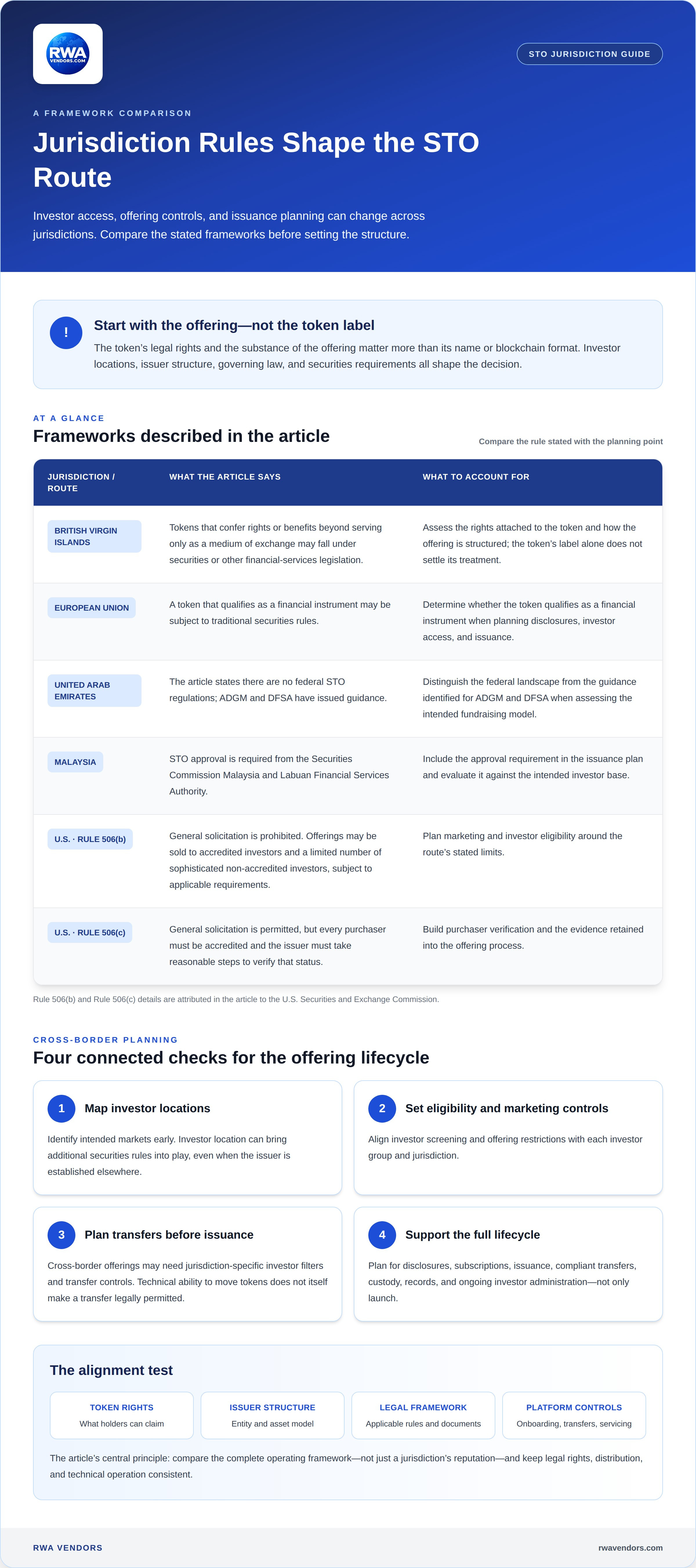
Comparing jurisdictions means assessing how each legal framework treats the token, issuer, investors, and capital-raising process. In the British Virgin Islands, an offering of tokens that confer rights or benefits beyond serving only as a medium of exchange may fall under securities or other financial-services legislation. In the European Union, a token that qualifies as a financial instrument may be subject to traditional securities rules. These differences shape disclosures, investor access, and issuance planning.
Compare the full operating framework, not just a jurisdiction’s reputation. The United Arab Emirates has no federal STO regulations, while ADGM and DFSA have issued guidance. Malaysia requires STO approval from the Securities Commission Malaysia and Labuan Financial Services Authority. These examples show why the fundraising model and intended investor base should guide the jurisdiction decision, where platforms like Pre-IPO Hype can assist issuers in connecting with institutional and retail investors once the appropriate legal pathway is established.
Transfer Restrictions and Secondary Markets
Transfer restrictions determine who may hold or receive a token after issuance. Secondary trading and exchange listings depend on the applicable securities framework. Cross-border offerings may need jurisdiction-specific investor filters and transfer controls. A token’s technical ability to move between wallets does not mean a transfer is legally permitted or that a trading venue can list it.
Plan transfer rules alongside issuance. STO platforms can coordinate identity checks, investor eligibility, token distribution, and transfer compliance, while the legal model determines which controls are needed. An STO does not automatically create liquidity. Permitted transfers and access to secondary markets are separate considerations.
Legal, Compliance, and Issuance Costs
STO costs vary by jurisdiction and structure, so there is no reliable single figure for every offering. Legal work, regulatory filings, disclosure preparation, investor verification, platform configuration, custody, and ongoing administration all affect the budget. The number of investor markets and complexity of asset-backed rights can also change the scope of work.
Build the cost plan around the full lifecycle, not just the launch. A structure involving several investor jurisdictions may require different eligibility settings and transfer restrictions. Include post-issuance servicing, such as records and investor administration, alongside initial legal and technical implementation.
Design compliance controls and legal structuring together from the outset. The STO platform should support the issuer’s legal model, including onboarding, transfer controls, and post-issuance administration. This alignment helps keep the token’s documented rights, distribution process, and technical operation consistent throughout the offering.
Investor locations and cross-border regulation
Investor location can bring additional securities rules into play, even when the issuer is established elsewhere. Map intended markets before setting eligibility, marketing, and transfer controls.
Investor Eligibility and Offering Exemptions
Investor eligibility defines who may participate, while an exemption sets conditions for an offering without registration. Under Rule 506(b) of Regulation D, general solicitation is prohibited, and offerings may be sold to accredited investors and a limited number of sophisticated non-accredited investors, subject to applicable requirements, according to the U.S. Securities and Exchange Commission.
Under Rule 506(c) of Regulation D, general solicitation is permitted, but every purchaser must be accredited and the issuer must take reasonable steps to verify that status, according to the U.S. Securities and Exchange Commission. These routes affect marketing, investor screening, and the evidence issuers retain. Select eligible investor groups and jurisdictions together, then align offering restrictions with each group.
The Howey Investment-Contract Test
The Howey test helps assess whether a token arrangement constitutes an investment contract under U.S. securities law. The U.S. Supreme Court articulated it in SEC v. W. J. Howey Company in 1946, in case 328 U.S. 293.
The test considers an investment of money in a common enterprise, an expectation of profits, and profits derived from the efforts of third parties. All four elements must be satisfied for an asset to qualify under this test. Calling a token a utility token does not settle its legal status. The arrangement’s economic substance and contracts matter, and the result can shape U.S. registration or exemption analysis.
Rules Across STO Jurisdictions
Regional rules differ, so an offering aimed at investors in multiple markets may need different controls and documents. In the European Union, financial instruments may be subject to MiFID II and prospectus rules. The regulatory treatment of security token offerings can vary across jurisdictions.
Singapore STOs must comply with the Securities and Futures Act. Switzerland’s FINMA approval is identified as an example for a public token sale. Regulatory requirements for security token offerings can vary across jurisdictions. These differences mean intended investor locations should inform the offer structure and compliance design.
Regulatory, Enforcement, and Cross-Border Risks
Cross-border risk arises when marketing, investor eligibility, or transfer restrictions fail to match the rules in a target market. Blockchain does not remove these regulatory considerations. Banking and custody availability also affect whether the proposed structure can function, so include both in the jurisdiction assessment.
Tax treatment may be affected by the issuer’s location and management. Preserve offering documents, investor-verification records, and marketing materials so the issuer can explain how its controls apply. For private sales, a SAFT or Token Sale Agreement can document terms, but the documents must reflect the arrangement’s rights and restrictions.
To structure the offering, identify intended investor jurisdictions, assess token rights under each applicable framework, and select an available registration or exemption route. Then align disclosure, eligibility checks, contracts, and technical transfer controls. Issuers evaluating provider support for cross-border compliance can explore tokenization vendor listings.
Issuer entity and governing law
The issuer’s legal entity and governing law define who issues the token and how its rights are documented. Treat them as connected design choices, not administrative details to add after the technical structure is set.
Start by identifying the entity responsible for the offering, the asset, and the obligations owed to each holder. For example, a company issuing equity tokens must connect the stated ownership or voting rights to its corporate records and offering documents. A debt token needs documents explaining the repayment claim, its terms, and the entity responsible for payment. The token records or represents rights; it does not replace the legal arrangements that create them.
Assess governing law across the full document set. Corporate law may govern the issuer’s authority to create an instrument, while property law may shape rights in the underlying asset. Securities rules and contracts can also apply. For example, a token representing interests in Spanish property may involve property law alongside securities rules relevant to investor markets. One governing-law clause does not necessarily resolve every legal relationship.
Choosing a jurisdiction for a security token offering means considering how the issuer’s entity, assets, management, and investors connect across locations. Those connections can affect legal and tax analysis. A tokenization project’s tax treatment may be influenced by the locations of its issuer and management, prompting teams to consult specialized firms such as CiDATax SRL to navigate cross-border tax and regulatory frameworks. Map these connections before settling the entity structure, then document which entity owns the asset, issues tokens, receives subscriptions, and handles obligations to holders.
Licensing, registration, and local-entity requirements depend on the jurisdiction and the activities performed. Issuers of security tokens or financial instruments must address relevant licensing and filings with public authorities overseeing securities and stock markets. The platform’s role matters too: distribution, investor onboarding, and transfer functions may raise different requirements from operating the issuer itself. An entity established in one jurisdiction should not be assumed to satisfy rules in every investor market.
Build the structure around clear outcomes if the issuer defaults. Documents should identify what happens if the issuer fails to meet its obligations, how holders’ claims relate to the asset, and which entity is responsible for administration. A token legal opinion, prepared by a qualified, licensed legal professional, can address the token’s legal status and issuance requirements. Its analysis should reflect the final contracts and entity structure, not an earlier technical draft.
Before issuance, align the entity documents, asset agreements, offering terms, and token functionality. For example, if a contract grants a holder a profit share, the smart contract’s distribution logic should reflect that documented entitlement. When choosing a jurisdiction for a security token offering, this alignment helps ensure the token’s operation is consistent with its documented rights and the issuer’s obligations.
How a token offering may qualify as a securities offering
A security token offering uses blockchain to issue and record an investment, not to create an exemption from securities rules. The legal question is what the token and transaction represent. A token may represent a conventional security or form part of an investment contract, so its crypto label or technical function does not determine its classification.
In the United States, the Securities Act of 1933 defines securities to include stocks, notes, bonds, evidence of indebtedness, and investment contracts. This matters when a token represents shares, repayment rights, or participation in an investment arrangement. The rights attached to the token and the surrounding contracts help explain the substance of the offering, while the blockchain records the instrument.
The Howey test is one U.S. method for assessing whether an arrangement is an investment contract. It applies to the transaction, not simply the token’s name. Calling a token a utility token does not prevent that analysis. Issuers should assess the economic arrangement, including how investors expect to benefit and the role of the issuer or other parties.
In the European Union, a token that qualifies as a financial instrument may fall under traditional securities rules. These rules can cover prospectuses, investment services, market infrastructure, and collective investment schemes. The token’s rights and the arrangement’s economic reality inform the analysis. Malta’s Financial Instrument test is another method used to help determine legal status.
Classification affects what the issuer must address before distribution. In the United States, a security token must be registered with the SEC or qualify for an applicable registration exemption. Regulation A offerings require an SEC-qualified offering statement and carry disclosure, financial statement, and possible ongoing reporting obligations. These conditions shape how an issuer prepares the offer and communicates its terms.
Review secondary transfers as part of the same classification exercise. Securities rules can affect who may acquire a token, how it may be transferred, and whether trading arrangements are permitted. A blockchain may execute a transfer technically, but that does not establish compliance with applicable rules. Plan transfer controls alongside the legal structure and offering documents.
The central takeaway is to classify the investment before finalizing the token design. Identify the rights represented, examine the transaction’s economic substance, and map the relevant securities framework to the intended distribution. This sequence helps issuers align contracts, disclosures, technical controls, and any registration or exemption route before tokens reach investors.
Which jurisdictions are commonly used for security token offerings, and how do they compare?
Jurisdiction comparisons help issuers match investor markets, token rights, and operating requirements. No location removes securities obligations simply because an instrument uses blockchain. Compare the relevant authority and framework, then consider whether the issuer can support the resulting disclosures, investor controls, and administration.
Switzerland is often considered for institutional tokenization because of legal certainty, financial expertise, and institutional reputation, not because it lacks regulation. In the United Kingdom, the FCA categorizes security token offerings as Specified Investments. These frameworks provide different legal contexts, so target investors and intended services matter more than a jurisdiction’s reputation alone.
Singapore’s Securities and Futures Act provides the framework for security token offerings there. Hong Kong regulates them under a framework provided by the SFC, while Japan uses the FIEA. These examples show why issuers should compare the laws governing the instrument and its distribution, rather than assume that regional proximity means regulatory alignment.
Other jurisdictions illustrate different regulatory approaches. Germany issues MiFID licenses through BaFin. Canada’s security token offerings must obtain approval from the CSA, while Brazil requires registration and approval from the CVM. In Australia, ASIC regulates security token offerings, and traditional and tokenized securities are treated differently. These distinctions can affect an offering’s approval requirements and operating model.
The United Arab Emirates has no federal STO regulations, while ADGM and DFSA have issued guidance. The page states that Malaysia requires security token offerings to receive approval from the Securities Commission Malaysia and Labuan Financial Services Authority. These examples make the comparison practical: examine the relevant authority, approval or registration route, investor eligibility, marketing rules, and permitted transfers.
Build the comparison around the project’s actual requirements. A fund token, property-linked token, and company equity token can involve different rights and documentation. For each candidate jurisdiction, map the issuer’s entity, target investors, asset location, banking and custody needs, platform support, and post-issuance administration. Then assess whether each framework supports the intended capital raise and token lifecycle.
For an issuer considering jurisdictions across several markets, design legal structuring and compliance controls together. Platform functionality must support the chosen model, including onboarding, eligibility settings, transfer restrictions, and audit records. A jurisdiction is a practical fit only when its legal framework and the project’s operating requirements work together.
RWA Vendors: Find companies that help tokenize real estate, funds, securities and other assets
RWA Vendors helps issuers identify tokenization platforms and service providers after they have defined their legal structure, investor markets, and operational needs. Use the directory to find relevant providers across technology, legal, compliance, and tokenization categories for assets such as real estate, funds, and securities.
This is a practical next step when an offering needs coordinated support across issuance, compliance, infrastructure, or ongoing administration. Compare provider categories with the needs of your planned structure, then identify relevant services for each stage. A Vendor Directory Listing and Founding Membership support participation in the marketplace, while Lead Generation and Referrals connect issuers and providers.
For help finding tokenization companies and professional services, contact RWA Vendors.
Move from jurisdiction planning to project design
Choosing a jurisdiction for a security token offering is a foundation for the project, not the final decision. The next step is to turn that choice into a coherent operating model, where the issuer’s structure, service-provider roles, and token functionality support the intended offering.
Use the project’s requirements to shape that model. Define the capabilities needed across technology, legal, and compliance work, then map how each role contributes to issuance and ongoing operations. Clear responsibilities help keep implementation aligned with the offering’s purpose as the project moves from planning to execution.
When you’re ready to explore providers for your project, connect with RWA Vendors.
A well-structured next step can turn a jurisdiction decision into a workable foundation for the offering.
Frequently Asked Questions
Does an STO Need SEC Registration?
A U.S. security token offering must be registered with the SEC or qualify for an applicable registration exemption. A token’s blockchain format does not create an exemption. For example, an issuer considering a private offering needs to assess investor eligibility, its solicitation approach, disclosures, and exemption conditions before distributing tokens. These choices shape the offer’s permitted scope and the records the issuer needs to maintain.
How should a project choose?
Choose a jurisdiction by matching the project’s token rights and operating model to the markets where it will seek investors. For example, a property-backed project should account for the asset’s location, issuer structure, intended investor markets, banking and custody needs, and post-issuance administration. Compare candidate frameworks with those requirements, then identify the legal, compliance, and technology capabilities needed to execute the selected structure.
Need Advice with Your STO?
RWA Vendors helps issuers find tokenization platforms and service providers, but does not provide legal or financial advice. Use the directory to locate listed providers across technology, legal compliance, custody, and tokenization. For example, an issuer planning a fund token can use these categories to identify potential partners for different project functions, then engage qualified professionals for project-specific advice.
What does STO compliance cover?
STO compliance covers the controls and documentation needed to manage an offering under its applicable securities framework. For example, a project may need to coordinate disclosures, investor eligibility checks, subscription handling, token distribution, and transfer rules. Compliance planning extends beyond launch: records, investor administration, and platform functions should remain consistent with the offering documents throughout the token’s lifecycle.
Where will the investors be located?
Identify the countries where investors will be solicited or allowed to participate, rather than relying only on the issuer’s place of incorporation. For example, a project targeting U.S. and European investors needs to consider each market’s rules for marketing, eligibility, and transfers. Documenting target markets early helps define the offering’s intended reach and informs the investor screening and distribution settings used for the sale.
Which entity will issue the token?
The issuing entity should be identified in the offering documents and clearly connected to the rights investors receive. For example, if one company owns an underlying asset while another issues tokens, the documents should explain how the token holder’s claim relates to the asset and which entity carries each obligation. This distinction supports clear accountability for subscriptions, investor records, and post-issuance administration.
Which law will govern the rights attached to it?
Specify the governing law in the relevant contracts, while recognizing that a token project can involve several legal relationships. For example, corporate law may govern the issuer’s authority, property law may concern an underlying asset, and securities rules may apply to the investment. Identify each relationship and document which law governs it. This helps investors understand the rights represented by the token and where contractual claims sit.
What U.S. securities laws and SEC exemptions apply to a security token offering?
U.S. offerings need SEC registration or an applicable exemption, based on the offering’s structure and conditions. Under Rule 506(b) of Regulation D, general solicitation is prohibited; eligible purchasers may include accredited investors and a limited number of sophisticated non-accredited investors, subject to applicable requirements, according to the U.S. Securities and Exchange Commission. Under Rule 506(c), solicitation is permitted, but every purchaser must be accredited, with reasonable verification steps.
Disclaimer
This article is provided by RWAVendors.com for general informational and educational purposes only. It does not constitute legal, financial, investment, tax, regulatory or other professional advice, or an offer, solicitation, recommendation or endorsement of any company, product, service, token, security or investment. RWAVendors.com is an informational vendor directory and does not sell, issue, broker, custody or facilitate transactions involving cryptocurrencies, digital tokens, tokenized assets, securities or investment products. Some vendor listings and references may involve paid advertising, sponsored placement or membership relationships. These relationships do not guarantee a vendor’s qualifications, regulatory status, performance or suitability. Information may be incomplete, outdated or subject to change. You should independently verify all information, conduct your own due diligence and consult qualified professionals before making any business or investment decision. RWAVendors.com is not responsible for the content, services, representations or actions of third-party vendors or linked websites.


