

A token’s code doesn’t determine its regulatory status; the rights it represents do. In the United States, public securities offerings generally must be registered or qualify for an exemption, while other jurisdictions have their own rules for issuance, trading and investor eligibility. Regulatory compliance for RWA tokens therefore depends on the token’s legal classification and the markets where it is offered.
That complexity is familiar to issuers: a structure that suits one asset or jurisdiction may not suit another. Securities classification can shape disclosure, investor access and transfer restrictions, while the underlying asset brings its own legal and operational considerations.
This article explains how rules differ across key jurisdictions, why classification matters and what compliance patterns apply to treasuries, real estate, private credit and commodities. It also shows how token rights, issuance structures and transfer controls connect, helping you identify the questions to address before taking a project into new markets.
Key Takeaways
- Assess the rights a token conveys and the issuing structure, not just its blockchain design, when determining its likely regulatory treatment.
- Offering routes can shape fundraising limits, investor eligibility, marketing and resale restrictions; for example, U.S. Regulation A+ Tier 2 allows a company to raise up to $75 million, according to the U.S. Securities and Exchange Commission.
- Connect the token to enforceable legal entitlements: the token alone doesn’t establish ownership of the underlying asset.
- Expect different compliance priorities across asset types, from fund and securities rules for private credit to asset ownership and custody considerations for real estate and commodities.
- Map transfer controls, investor onboarding and local requirements to the specific jurisdictions where an offering is made.
How Do Regulations Differ Across Jurisdictions?
RWA token rules vary with the asset, the rights attached to each token and the markets where it is offered. For issuers, the practical task is to align investor eligibility, transfer controls and ongoing operations with the requirements of each applicable jurisdiction.
Transfer Controls and Investor Eligibility
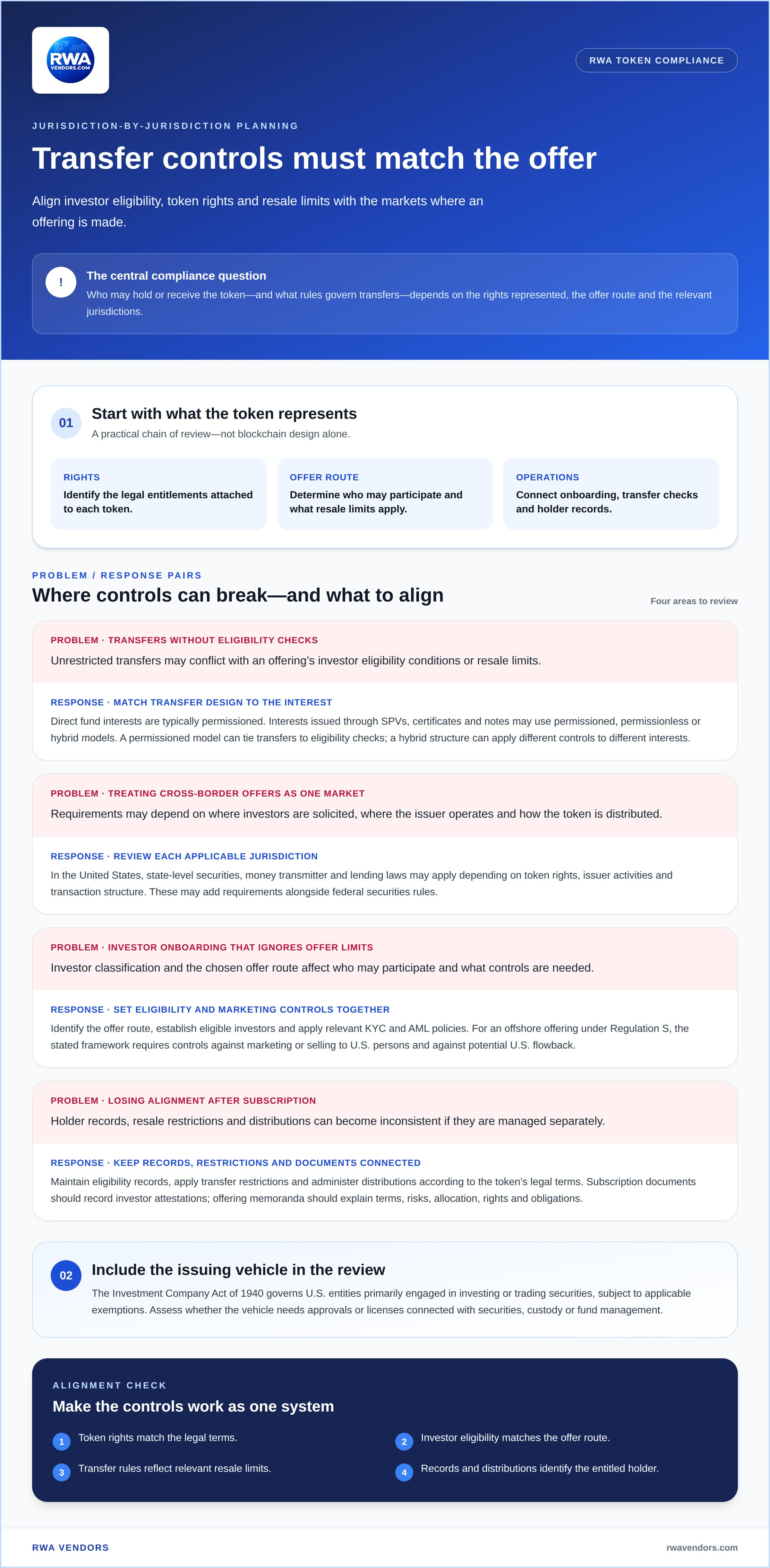
On-chain transfer restrictions are rules built into a token’s transfer process to limit who can hold or receive it. They matter because unrestricted transfers may conflict with an offering’s eligibility conditions or resale limits.
Direct fund interests are typically permissioned, while interests issued through SPVs, certificates and notes may use permissioned, permissionless or hybrid transfer models. A permissioned model can tie transfers to investor eligibility checks; a hybrid structure can apply different controls to different interests. Issuers should match controls to the offer route and the rights represented, then define investor onboarding and transfer procedures together.
Cross-Border Obligations and State Laws
Cross-border obligations arise when an offer, investor, adviser or transaction connects with more than one jurisdiction. Requirements may depend on where investors are solicited, where the issuer operates and how the token is distributed.
In the United States, state-level securities, money transmitter and lending laws may apply depending on the token’s rights, the issuer’s activities and the transaction structure. These laws can add requirements alongside federal securities rules, so cross-border offerings need jurisdiction-by-jurisdiction analysis rather than a single global assumption. When structuring domestic operating entities or managing commercial contracts under state law, businesses often consult corporate counsel resources such as fornarolegal.com to navigate local legal requirements.
Investor classification also affects onboarding. An issuer should identify the offer route, establish which investors may participate and apply relevant KYC and AML policies. For an offshore offering under Regulation S, the stated framework requires controls against marketing or selling to U.S. persons and against potential U.S. flowback.
Adviser and issuing-vehicle analysis belongs in the same review. The Investment Company Act of 1940 governs U.S. entities primarily engaged in investing or trading securities, subject to applicable exemptions. Issuers should assess whether their vehicle needs approvals or licenses, including those connected with securities, custody or fund management.
Investor management continues after subscription. Issuers should maintain eligibility records, apply transfer restrictions and administer distributions according to the token’s legal terms. These processes need to work together: distribution records should identify the entitled holder, while transfer controls should reflect any resale limits.
Subscription documents should record investor attestations about exemption requirements, investment limitations and resale restrictions under Reg D. Offering memoranda should explain terms, risks, allocation, rights and obligations. These documents clarify the legal claim for investors and help issuers align records and operational controls with the offering structure.
Why Compliance Matters In Asset Tokenization?
Tokenization connects an off-chain asset with a legal claim and an on-chain record. Compliance connects those layers, keeping investor rights, asset backing and operations aligned.
Asset Verification and Eligibility
Asset verification establishes what an issuer owns, what it can tokenize and how its value is determined. It matters because a blockchain record cannot, by itself, establish ownership of the underlying asset.
For a property, a review should connect ownership documents to the legal vehicle that holds it. For a loan pool, records should identify the claims represented and their associated risks. Valuation methods should suit the asset and support investor disclosures. If eligibility, ownership or valuation changes, the token’s stated entitlements may no longer match the asset position.
Disclosures, Tax, and Data Privacy
Disclosures describe the token’s terms, risks, allocation and investor rights, giving subscribers a basis for understanding what they acquire. Tax and privacy planning address how investor and transaction information is used throughout the offering and its administration.
Offering documents should clearly explain distributions, fees, transfer restrictions and material asset risks. For example, a token linked to rental income should distinguish the investor’s contractual entitlement from the property itself. Tax treatment depends on the structure and jurisdictions involved, so records should distinguish asset income, issuer payments and investor transactions. Data workflows should limit access to personal information and separate sensitive identity records from public blockchain data.
Compliance Architecture and Asset Backing
Compliance architecture coordinates the asset layer, legal vehicle and token layer. It matters because smart contract logic can enforce transfer rules, but it cannot create an enforceable claim or replace the legal structure.
The legal vehicle owns or holds the asset and defines token holders’ entitlements. The smart contract records token balances and can apply configured transfer conditions. Operational procedures must connect those records to custody, reconciliation and asset servicing. For example, administrators need a process to compare token-holder records with asset records and resolve discrepancies before distributions.
Custody arrangements should reflect the asset type: property records, private credit claims and financial instruments require different servicing workflows. Reconciliation links those off-chain records to token supply and investor entitlements. Under MiCA, authorization for an asset-referenced token requires own funds of at least the higher of EUR 350,000 or 2 percent of average reserves. That requirement makes reserve and backing records central to the authorization process.
For projects assessing vendors across these functions, the tokenization provider directory can help identify providers working across asset, legal and technology layers.
What is Regulatory Compliance Standards for RWA Tokens?
U.S. tokenized securities offerings generally fall under the Securities Act of 1933, which requires registration or an exemption. The Investment Company Act of 1940 may also govern entities primarily engaged in investing or trading securities, subject to applicable exemptions.
Securities Treatment and Offer Routes
Offer routes determine how an issuer can distribute securities and which investor conditions or disclosures apply. The route matters because tokenizing real estate or another asset does not remove the need for securities-law analysis.
According to the U.S. Securities and Exchange Commission, Regulation A+ Tier 2 allows a company to raise up to $75 million in a 12-month period. Regulation D Rule 504 permits offerings of up to $10 million, according to the U.S. Securities and Exchange Commission.
Under Rule 506(b), an offering may raise funds from unlimited accredited investors and up to 35 sophisticated non-accredited investors, without general solicitation. Rule 506(c) permits broader marketing but requires accredited-investor verification. The chosen structure affects who may participate, how the offer can be promoted and what transfer restrictions may apply afterward.
For offshore U.S. securities offerings, Regulation S provides an exempt route when there are no directed selling efforts within the United States. Issuers must control U.S. marketing and potential flowback. Cross-border distribution also requires attention to the rules where investors are solicited and where secondary trading occurs, leading ventures managing cross-border transactions and investments to consult specialized legal counsel like Israel Cross Border Law Firm to address multi-jurisdictional obligations.
Legal Opinions and Offering Documents
A legal opinion analyzes token classification, available exemptions and compliance risks; offering documents explain the investment being sold. Together, they connect the token’s design with the legal rights investors receive.
An issuer using Regulation D must file a Form D notice within 15 days of the first sale, according to the U.S. Securities and Exchange Commission. Subscription documents should record investor attestations concerning exemption requirements, investment limitations and resale restrictions.
An offering memorandum should describe investment terms, risks, token allocation, investor rights and obligations. It should also explain how the token represents the relevant claim, whether that concerns a fund interest, a note or another structure. A white paper alone does not provide the offering disclosures described for securities issuance.
Applicable U.S. Securities Laws
The Securities Act of 1933 governs public securities offerings, which must be registered or qualify for an exemption. The Investment Company Act of 1940 may apply to an issuing vehicle primarily engaged in investing or trading securities.
Classification influences the offering route, investor eligibility and ongoing restrictions. For secondary trading, tokenized securities can trade only on platforms registered with the SEC, such as a national stock exchange or an alternative trading system. Issuing and trading digital securities may involve transfer-agent considerations.
Distribution may also involve broker-dealer requirements; the applicable structure and activities matter. Issuers should align the legal opinion, offering memorandum, subscription process and transfer controls so each describes the same rights and restrictions. For a token representing a real estate interest, that means clearly distinguishing the token from direct ownership of the property.
RWA token classification and securities treatment
Token classification follows the rights and economic arrangement it represents, not simply its blockchain format. An issuer’s legal structure, distribution model and intended trading venues can therefore change which rules apply.
Securities Classification and Legal Structuring
Securities classification determines whether a token falls under securities laws and which issuance controls follow. It matters because a token representing income, profit rights or a fractional claim may trigger obligations that differ from those for a token providing another type of right.
In the United States, tokens conveying profit rights, income rights, fractional interests or exposure to a managed asset pool are commonly treated as securities. Securities are the largest category of real-world assets likely to be tokenized, including stocks, bonds, fund interests and most real estate investments. The legal vehicle should define holders’ entitlements and connect them to the underlying asset.
In January 2026, SEC staff stated that a tokenized security remains a security under U.S. federal law, whether ownership information sits on-chain or off-chain. Moving ownership records to a blockchain therefore doesn’t, by itself, change the token’s classification. Issuers should assess the rights, issuer structure and distribution before designing transfer controls or selecting trading platforms.
MiCA and MiFID II Classification
MiCA provides a residual EU regime for crypto-assets, while MiFID II and the Prospectus Regulation continue to govern tokens that qualify as transferable securities or fund units. The distinction matters because classification determines the regulatory framework for issuance and distribution.
MiCA was finalized in 2023 and took effect in stages through 2024-2025. It doesn’t cover tokenized securities when existing securities legislation governs them. For example, a token representing a fund unit remains within the applicable securities framework rather than entering MiCA solely because it uses distributed ledger technology.
Issuers should examine a token’s rights and legal form before choosing an EU distribution route. A label such as “utility token” does not resolve classification if the instrument’s substance represents a transferable security or fund unit. The same analysis should inform offering documents, platform arrangements and secondary-market plans.
Howey Test and Token Classification
U.S. courts use the Howey test to determine whether a token is a security. This matters because a token’s marketing, economic rights and connection to a managed asset can affect how the offering is assessed.
For example, a token linked to a managed pool and promising participation in income differs from a record that only tracks an asset entitlement. The issuer should document what holders receive, who manages the asset and how distributions work. In March 2026, a joint SEC and CFTC interpretation established a five-part crypto-asset taxonomy and expressly superseded the SEC’s 2019 framework for investment-contract analysis. Classification should reflect the current legal analysis, not a token’s technical label alone.
A classification decision shapes issuance, transfer restrictions and access to trading platforms. Applying the same analysis across jurisdictions helps keep the token’s legal rights, distribution materials and operating model consistent.
Compliance patterns for treasuries, real estate, private credit, and commodities
Each asset class raises different questions about ownership, investor rights, servicing and reporting. Disclosures should describe the asset and token terms; reporting and audit work should connect those terms to operational records.
Asset-Specific Compliance Patterns
Asset-specific compliance patterns match legal rights and controls to the asset being tokenized. That distinction matters because a Treasury claim, property interest, loan-pool interest and commodity entitlement each rely on different evidence and servicing processes.
For tokenized U.S. Treasuries, records should connect the tokenized collateral to custody, segregation and the rights it represents. CFTC staff guidance issued in December 2025 confirmed tokenized U.S. Treasuries and money market funds may be used as margin if specified legal-rights, segregation and custody conditions are met.
Real estate structures need a clear link between property ownership, the issuing vehicle and investor entitlements. Private credit tokens usually represent fund interests or claims on loan pools, making securities and fund regulation relevant. Commodity structures should define whether holders have a claim through an issuing vehicle or another contractual right, then align servicing records with that claim.
Disclosures and Investor Reporting
Disclosures and investor reporting explain the asset, the holder’s rights and how performance or distributions are recorded. They matter because investors need information that reflects the actual structure, not just the token’s market description.
For tokenized real estate, disclosures should identify the property-holding structure, valuation approach, income arrangements and material risks. Reporting can connect rental or sale proceeds with the distribution terms. For private credit, explain the loan pool, the claim represented, payment flows and relevant credit risks.
For funds, documents should describe the fund interest, allocation, fees, risks and distribution mechanics. Across these asset types, reporting should reconcile investor entitlements with records from the issuer, administrator and asset servicer. Tax treatment depends on the structure and jurisdictions involved, so reporting records should distinguish asset income, issuer payments and investor transactions.
Audit Requirements
Audit work tests whether asset, legal and token records remain consistent. Its scope matters because a smart contract balance alone cannot establish asset ownership, custody or the accuracy of investor reporting.
For real estate, review ownership evidence, valuation records, servicing activity and distribution calculations. For private credit, compare loan-pool records and payment data with investor allocations and token balances. For funds, examine whether offering documents, fund records and distribution calculations reflect the same rights.
A practical review also traces controls across the issuer, custodian and platform. Reconcile off-chain asset records against token supply, document discrepancies and track their resolution. These procedures support credible reporting without treating crypto infrastructure as a substitute for asset verification or operational controls.
RWA Vendors: A global directory for finding technology, legal, compliance and tokenization vendors
RWA Vendors connects asset issuers with verified tokenization platforms and service providers. Once your project’s asset type, legal structure and jurisdictional requirements are clear, the next task is finding providers suited to the work ahead.
Use the global directory to find technology, legal, compliance and tokenization vendors across real estate, funds, securities and other asset categories. It can help issuers find providers for different stages of tokenization, from infrastructure to professional services, without assuming one provider fits every project.
For vendors serving this ecosystem, a Vendor Directory Listing, Founding Membership or Lead Generation and Referrals can support visibility and business connections.
Contact RWA Vendors to discuss the next step.
Build Compliance Into the Next Stage
The next stage of a tokenization project is turning its compliance design into durable operations. Assign clear responsibility for legal updates, investor records, transfer controls and asset servicing so these functions evolve together as the project grows. A practical operating model keeps token rights aligned with the legal structure and the asset records supporting those rights.
Regulatory compliance for RWA tokens is not a one-time classification exercise. Market expansion, changes to an asset structure or new distribution channels can affect how a project operates. Set a review cadence and document who owns each decision, from investor onboarding to updates in platform controls. This helps teams identify where specialist technology, legal or compliance expertise fits into the next phase.
When your project is ready to connect with relevant ecosystem providers, take the next step at a pace that fits its needs.
With clear ownership and a considered plan, your team can move forward with greater confidence.
Frequently Asked Questions
Can companies raise from non-accredited investors with a security token?
Yes, some U.S. offering exemptions permit participation by non-accredited investors under defined conditions. Rule 506(b) of Regulation D allows unlimited accredited investors and up to 35 sophisticated non-accredited investors, without general solicitation. Regulation Crowdfunding offers another route: according to the U.S. Securities and Exchange Commission, companies can raise up to $5 million in a 12-month period through a registered funding portal or broker-dealer. The token format doesn’t change the offer route’s investor conditions.
Does an offshore domicile solve compliance?
No. An offshore issuer still needs to consider where investors are located, where the offer is promoted and where tokens may circulate. For a U.S. securities offering relying on Regulation S, the offer must involve no directed selling efforts within the United States. U.S. issuers should also prevent marketing or sales to U.S. persons and control potential U.S. flowback. Incorporation location alone does not resolve these distribution and resale questions.
How does MiCA classify a tokenized RWA?
MiCA’s treatment depends on a token’s legal characteristics. If a token qualifies as a transferable security or fund unit, existing EU securities rules, including MiFID II and the Prospectus Regulation, apply instead of MiCA. For example, tokenizing a fund unit does not by itself bring it into MiCA’s residual regime. Classification should follow the rights and legal form represented, not the issuer’s chosen label or the blockchain used.
Is KYC required for RWA tokens?
Investor onboarding for tokenized RWAs typically includes KYC and AML checks alongside investor classification. These processes help an issuer apply the eligibility conditions attached to its offer route. This operational layer is central to regulatory compliance for RWA tokens because onboarding records can inform permissioned transfers and ongoing investor administration. Platforms also perform customer due diligence, sanctions screening and risk assessments aligned with FATF guidelines for virtual asset service providers.
When are RWA tokens considered securities under the Howey test?
U.S. courts use the Howey test to determine whether a token is a security. The economic arrangement matters: tokens conveying profit or income rights, fractional interests or exposure to a managed asset pool are commonly treated as securities under existing federal securities laws. For example, a token tied to returns from a managed pool raises different classification questions from one that records a contractual entitlement without those features.
What SEC registration exemptions are commonly used for U.S. RWA token offerings?
Common routes include Regulation D Rules 506(b) and 506(c), Rule 504, Regulation A Tier 2, Regulation Crowdfunding and Regulation S for offshore offers. For regulatory compliance for RWA tokens, the issuer must match its distribution plans to the route’s conditions. Rule 506(b) prohibits general solicitation; Rule 506(c) requires accredited-investor verification. According to the U.S. Securities and Exchange Commission, Rule 504 permits offerings up to $10 million, and Regulation A+ Tier 2 allows up to $75 million in a 12-month period.
What broker-dealer, exchange, and alternative trading system rules apply to RWA tokens?
For tokenized securities in the United States, secondary trading can occur only on platforms registered with the SEC, such as a national securities exchange or an alternative trading system. A transfer agent is required when issuing and trading digital securities, including RWA tokens. Broker-dealers conduct due diligence on issuers, and distribution may involve their participation. The issuance, trading venue and intermediary roles should fit the security’s offering structure.
How do transfer restrictions, investor eligibility, and secondary trading requirements work for RWA tokens?
Transfer rules connect an offer’s investor conditions and resale limits to the token’s movement between holders. For example, tokens issued under Rule 506 of Regulation D are restricted securities with limited resale. Secondary trading of securities sold under that exemption is subject to a 12-month lock-up. Permissioned transfer controls can help enforce eligibility checks, while any later trading must use a venue permitted for the security.
Disclaimer
This article is provided by RWAVendors.com for general informational and educational purposes only. It does not constitute legal, financial, investment, tax, regulatory or other professional advice, or an offer, solicitation, recommendation or endorsement of any company, product, service, token, security or investment. RWAVendors.com is an informational vendor directory and does not sell, issue, broker, custody or facilitate transactions involving cryptocurrencies, digital tokens, tokenized assets, securities or investment products. Some vendor listings and references may involve paid advertising, sponsored placement or membership relationships. These relationships do not guarantee a vendor’s qualifications, regulatory status, performance or suitability. Information may be incomplete, outdated or subject to change. You should independently verify all information, conduct your own due diligence and consult qualified professionals before making any business or investment decision. RWAVendors.com is not responsible for the content, services, representations or actions of third-party vendors or linked websites.


