

The broadest platform may not be the right fit. Choose art and collectibles tokenization platforms based on what your project needs: issuance technology, blockchain infrastructure, compliance and custody support, or a directory to help identify providers across several functions. The right category depends on the asset, the rights each token represents, and how transfers will be managed.
It’s reasonable to expect tokenization to do more than create a digital record. Depending on the structure, it can support fractional participation and define how stakeholders share rights or proceeds, but the governing documents and transfer rules matter as much as the technology. This guide explains which provider categories may suit your project and how tokenization can affect artists, collectors, and investors.
You’ll also learn what to assess across legal structure, valuation, authentication, custody, and secondary-market restrictions. The aim is to provide a clearer basis for evaluating providers and understanding where technology ends and the project’s legal and operational arrangements begin.
Key Takeaways
- Match the provider category to your project’s needs, from issuance technology and blockchain infrastructure to compliance and custody support.
- Assess how token rights are defined and how any revenue or sale proceeds would be allocated before choosing a structure.
- Evaluate legal, valuation, authentication, custody, and smart-contract risks as connected parts of the project.
- Understand who can transfer tokens, where transfers can take place, and how compliance rules may limit secondary-market access.
- Use RWA Vendors to find verified tokenization platforms and service providers relevant to your project.
Benefits for artists, collectors, and investors
Tokenization can link an artwork or collectible to a digital record of defined rights. Those rights depend on the offering’s legal structure, not the token alone. For an artist, a smart contract can provide a share of future artwork sales when the governing terms establish that arrangement. It can also automate parts of the transaction record, while ownership and payment rights remain subject to the relevant documents.
Collectors may use fractional offerings to participate in an asset without acquiring it alone. In some structures, tokenholders hold interests in a special-purpose vehicle rather than direct title to the painting. Sale proceeds may then be distributed pro rata, according to the offering terms.
For investors, fractional participation can lower the amount needed to access a particular art investment and may help diversify a portfolio across asset types. It does not remove exposure to changes in valuation, sale timing, or market demand. Nor does tokenization itself create liquidity: resale depends on eligible buyers, transfer permissions, and access to a compliant secondary market. A digital record can document token transactions, but it cannot guarantee a buyer or a particular price.
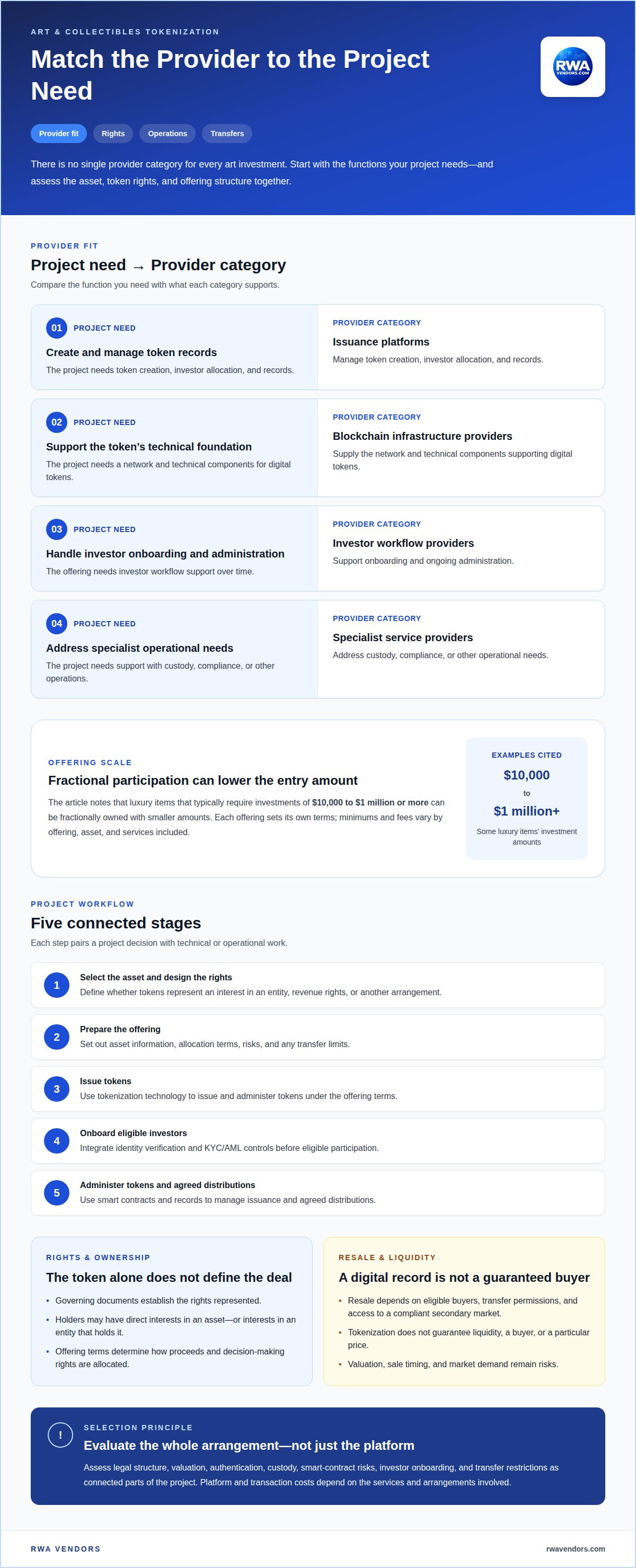
Benefits also depend on a well-defined offering workflow. A typical process moves from asset selection and rights design to documentation, token issuance, investor onboarding, and ongoing administration. Each stage connects a business decision with a technical or operational task:
- Define the rights: State whether tokens represent an interest in an entity, revenue rights, or another arrangement.
- Prepare the offering: Set out asset information, allocation terms, risks, and any limits on transfers.
- Onboard investors: Integrate identity verification and KYC/AML controls before eligible participation.
- Administer the tokens: Use smart contracts and records to manage issuance and agreed distributions.
Compliance is central to investor access. Art-tokenization platforms should account for securities regulations in relevant jurisdictions, including the SEC in the United States and the FCA in the United Kingdom. Some U.S. offerings use Regulation D, Regulation S, or Regulation A+. The appropriate route depends on the offering’s structure and investor eligibility. A platform’s onboarding workflow should reflect those terms rather than treat every purchaser alike.
NFTs can represent artwork, GIFs, songs, and sports highlights on a distributed ledger such as a blockchain, according to the University of Miami Law Review. That digital representation differs from a tokenized investment interest. Distinguishing the two helps artists, collectors, and investors assess what a token records, which rights it conveys, and how the offering handles future transactions.
Who Are the Top Asset Tokenization Service Providers for Art and Collectibles?
There is no single provider category that fits every art investment. The right choice depends on whether a project needs issuance technology, fractional ownership infrastructure, investor onboarding, or help coordinating several functions. When comparing art and collectibles tokenization platforms, assess their capabilities against the asset, rights, and offering structure rather than relying on a universal ranking.
Minimum investment amounts and fees vary by offering, asset, and services included. Luxury items that typically require investments of $10,000 to $1 million or more can be fractionally owned with smaller amounts, but each offering sets its own terms. Platform and transaction costs depend on the services and arrangements involved.
These platforms connect an asset and its legal structure to digital tokens. An issuer defines the rights represented, prepares offering documents, and uses tokenization technology to issue and administer tokens. Investor onboarding and transfer controls follow the offering’s terms. The token record does not, by itself, determine whether holders have direct ownership or an interest through an entity.
Fractional ownership divides economic participation into smaller units, potentially widening access to assets that would otherwise require substantial capital. Traditional ownership usually involves acquiring the entire asset or an established legal interest. A fractional offering can instead define how participation, proceeds, and decision-making rights are allocated. Lower entry amounts can broaden access, but they do not remove asset, market, or resale risks.
Ownership models matter. In a direct co-ownership structure, documents may grant holders defined interests in the physical asset. In another model, an entity holds the artwork, while tokens correspond to interests in that entity. The governing documents determine the rights; a digital token alone does not settle the question. Full ownership may remain with one owner even when tokens create other economic or contractual interests.
Provider categories serve different functions:
- Issuance platforms manage token creation, investor allocation, and records.
- Blockchain infrastructure providers supply the network and technical components supporting digital tokens.
- Investor workflow providers support onboarding and ongoing administration.
- Specialist service providers address custody, compliance, or other operational needs.
Assets can include fine art and collectibles such as sports cards, watches, and wine. Each type brings distinct documentation and handling considerations: a card’s condition, a watch’s provenance, and wine’s storage arrangements affect how an offering describes and administers the asset. A provider’s fit therefore depends on its role in the project, not simply on its ability to create a token.
For issuers building a provider directory, list a tokenization provider to help relevant businesses discover your services.
Legal, valuation, authentication, and operational risks
Tokenization changes how interests are recorded, but it doesn’t remove risks tied to the underlying artwork. Legal rights, provenance, valuation, and operations each affect what an offering represents.
Legal Structure and Rights
For art tokenization, governing documents and applicable law define ownership, revenue, and usage rights. A token’s description should align with those documents, including any interest held through an entity. The legal structure can influence how an offering is made and administered. Art-backed lending also relies on its security documents and applicable law for enforcement.
Authentication and Verification
Authentication assesses whether an artwork is genuine; verification examines supporting records, provenance, and related claims. Both matter because an on-chain record does not itself prove authenticity or title. A token can preserve transaction information while leaving questions about the physical object unresolved. For example, records describing an artwork’s history should be assessed alongside the asset and its supporting documentation.
Authenticity and Fraud Risks
Fraud risk arises when an offering misstates an artwork, its provenance, or the rights attached to a token. A blockchain entry can show that a token exists, but it cannot establish that the issuer owns the artwork or has authority to offer related rights. Distinguish the token record from evidence about the physical asset. Clear documentation helps investors understand what has been verified and what the token actually represents.
Valuation, Custody, and Capital
Valuation affects how much capital an offering seeks and how participation is represented. Art prices can depend on the asset’s condition, provenance, comparable sales, and demand; a token’s digital record does not establish fair value. Art-backed financing also depends on valuation, lender approval, and the legal security structure. Custody and insurance arrangements may be required, with responsibilities set out in the transaction documents.
Operational Controls
Operational safeguards address investor identity, token administration, and technical execution. KYC/AML processes verify users’ identities and connect onboarding to the offering’s eligibility rules. Smart-contract audits help identify errors or vulnerabilities before token functions are relied upon. These controls serve different purposes: identity checks concern participants, while audits examine contract code. Neither replaces documentation for ownership, asset condition, or rights.
For a project involving several parties, assign responsibility for maintaining asset records, handling custody, and administering investor communications. Align these tasks with the legal structure and token functions. If an artwork secures lending, enforcement follows the security documents and applicable law. Clearly divided duties help expose gaps between the physical asset, contractual rights, and digital records before those gaps affect investors.
Secondary-market access and transfer restrictions
A token’s resale depends on both the trading venue and the rules attached to the token. Tokenized artworks can be traded 24/7 across compliant trading platforms, but continuous platform access doesn’t mean every holder can sell at any time. A buyer must be eligible, the token must be transferable, and a market must support that asset and offering.
Permissioned token frameworks can encode transfer restrictions, forced transfers, and compliance checks. For example, a smart contract can restrict a transfer to an approved wallet or block a transaction that fails the offering’s eligibility rules. A forced-transfer function may support a transfer required under the governing documents. These controls connect digital transfer activity with the conditions established for the offering.
Distinguish between a token being technically transferable and being legally or operationally eligible for transfer. An artwork token may move between approved holders yet remain unavailable to a buyer who fails onboarding requirements. The offering documents and platform rules should explain who can transfer, which conditions apply, and how a restriction affects a proposed sale.
Secondary-market access also depends on where tokens may trade. A compliant venue may impose its own admission, asset, and transaction processes. If a token is supported on one platform but not another, holders may have fewer practical ways to sell. A transparent description of supported venues and transfer conditions helps investors understand access without treating a digital record as a guarantee of liquidity.
For a fractional ownership offering, transfer rules can apply to each token rather than the artwork itself. An investor might transfer an eligible token while the physical artwork remains in custody under the offering structure. That distinction matters: transferring a token does not necessarily confer direct possession, title, or unrestricted use of the artwork. The rights attached to the token remain central.
Assess the framework across these points:
- Eligibility: Identify which holders may receive tokens and how their status is assessed.
- Transfer conditions: Establish which checks must pass before a transaction can proceed.
- Venue support: Determine where eligible tokens can be offered for resale.
- Exceptional transfers: Understand how forced transfers interact with the offering documents.
These rules shape how accessible an artwork’s token market is in practice. A permissioned design may support compliant transfers while limiting the pool of potential buyers. A less restrictive framework may broaden technical transfer options, but it still operates within the offering’s terms and applicable requirements. Neither design creates buyers or guarantees a sale.
For issuers, align transfer logic, venue access, and investor disclosures before launch. For holders, the key question is whether a token can be transferred under its rules, not simply whether a marketplace displays it. Clear restrictions make the path from ownership to resale more transparent and help prevent assumptions about liquidity or the ability to convert tokens into cash.
Tokenization platforms and infrastructure providers
A tokenization platform coordinates issuance, investor workflows, and token administration. Infrastructure providers supply components that support those functions, such as blockchain networks, smart-contract development, custody, or compliance technology. For an artwork represented by digital tokens, the distinction matters: the platform may manage the offering, while separate providers support its technical and operational requirements.
Start by mapping the project’s required functions. An issuer may need software to create tokens, maintain ownership records, onboard investors, and administer transfers. A blockchain infrastructure provider supports the network on which tokens and contracts operate. A compliance technology provider can support identity verification or transaction controls. These are distinct roles, even when one platform combines several.
Smart contracts encode agreed functions, such as issuing tokens or applying transfer rules. Some security tokens use the ERC-1400 standard. A project’s chosen standard and contract design should match the rights represented by its tokens and the offering’s transfer conditions. Technical compatibility matters too: a contract, investor interface, and recordkeeping process must work together across the chosen platform.
Global offerings add coordination requirements. Legal and compliance providers address the offering’s jurisdictional structure and investor eligibility, while technology providers implement related workflows. Custody arrangements concern control and safekeeping of the artwork or relevant digital assets. Assigning each responsibility helps prevent gaps, such as a contract allowing a transfer that conflicts with the offering’s documented restrictions.
Compare providers by function and project fit, not by the label “tokenization platform.” Use a capability map to identify who is responsible for:
- Issuance: Creating tokens and recording allocations to investors.
- Contracts: Implementing token functions and agreed transfer controls.
- Blockchain: Supporting the network and technical operation of tokens.
- Compliance: Connecting investor onboarding and eligibility processes with offering rules.
- Operations: Coordinating records, custody arrangements, and ongoing administration.
Then assess how the components integrate. For example, investor onboarding should connect to the platform’s eligibility checks, while transfer controls should align with smart-contract logic and offering documents. A provider that handles issuance alone may suit a project with existing legal and operational partners. A project assembling several vendors may need closer coordination across contracts, records, compliance, and asset administration.
For infrastructure and tokenization providers, list your tokenization services.
RWA Vendors: RWA Vendors connects asset issuers with verified tokenization platforms and service providers
RWA Vendors helps issuers connect with providers across tokenization technology and professional services through its global directory. Use it when your project needs technology, legal, compliance, or tokenization vendors, or when you’re mapping providers across issuance and operations.
For art and collectibles projects, the directory can help identify providers whose roles align with the asset, offering structure, and transfer requirements. Vendor Directory Listing, Founding Membership, and Lead Generation and Referrals support provider visibility and connections with potential business partners. RWA Vendors connects asset issuers with verified tokenization platforms and service providers; it does not replace the legal, compliance, or technical work those providers perform.
Contact RWA Vendors to discuss finding or listing relevant tokenization providers.
Turn your provider criteria into a project plan
The next step is to turn your requirements into a clear provider brief. Define the asset, the rights the offering will represent, the jurisdictions involved, and the functions your team needs covered. Then map dependencies across technology, compliance, custody, and operations. This gives each prospective provider a defined role and makes gaps or overlaps easier to identify.
Use that brief to assess how art and collectibles tokenization platforms fit your project’s specific structure, rather than selecting technology in isolation. A well-scoped provider search can also clarify which capabilities need to work together before an offering moves toward launch. Focus on operational fit, documented responsibilities, and the investor experience you intend to support.
For issuers and providers ready to build relevant industry connections, Contact RWA Vendors.
A considered next step can turn a complex provider landscape into a practical plan.
Frequently Asked Questions
Types of Tokenization Providers: Which Category Fits Your Project?
Choose a provider category based on the functions your project needs. Issuance platforms support token creation and administration; blockchain infrastructure providers supply technical components; compliance and investor-workflow providers support onboarding and controls. A project with an established legal structure may prioritize technology integration, while one still assembling its operating model may need several provider categories. Compare responsibilities and dependencies before selecting a platform.
What platforms tokenize fine art and collectibles in the United States?
Art and collectibles tokenization platforms can include issuance technology, asset administration, investor workflows, and trading infrastructure. These roles differ from those of an investment marketplace offering a specific artwork. For a U.S. project, distinguish providers that supply infrastructure from entities that structure or distribute an offering. The provider’s role, the asset, and the offering documents determine what the platform actually supports.
Which art tokenization platforms are currently active and available to US investors?
Current U.S. investor access depends on whether a specific offering is open and on its eligibility terms, rather than on a platform’s general presence. RWA Vendors is a vendor directory, so its listings help issuers identify service providers; they do not establish that an artwork offering is available to investors. Distinguish an active vendor listing from an active investment offering, and assess each offering’s own access conditions.
How do tokenized art platforms handle ownership rights, custody, insurance, and authentication?
These responsibilities are addressed through different project arrangements. Governing documents define the rights associated with tokens; custody and insurance arrangements address safekeeping and coverage for the physical artwork. Authentication and provenance records support claims about the asset, while blockchain records document token activity. For example, an investor should be able to distinguish evidence about the painting from records showing token allocation.
How do leading art tokenization platforms compare on fees, asset selection, and investor protections?
Compare platforms using the same criteria, rather than relying on a headline fee or asset list. Review each offering’s disclosed charges, supported asset types, investor eligibility, rights, onboarding controls, and transfer terms. Separate platform charges from costs related to custody or administration where the offering discloses them. Assess investor protections through the documents and controls provided for that specific offering, not by inferring them from tokenization alone.
What should US investors check before choosing an art tokenization platform?
Start with the offering documents: identify what the token represents, who holds the artwork, and what rights investors receive. Then review the asset’s provenance, valuation basis, custody and insurance arrangements, and the conditions for transferring tokens. Check how investor eligibility and onboarding are handled, and whether smart-contract controls match the written terms. These details help distinguish ownership claims from digital transaction records.
Disclaimer
This article is provided by RWAVendors.com for general informational and educational purposes only. It does not constitute legal, financial, investment, tax, regulatory or other professional advice, or an offer, solicitation, recommendation or endorsement of any company, product, service, token, security or investment. RWAVendors.com is an informational vendor directory and does not sell, issue, broker, custody or facilitate transactions involving cryptocurrencies, digital tokens, tokenized assets, securities or investment products. Some vendor listings and references may involve paid advertising, sponsored placement or membership relationships. These relationships do not guarantee a vendor’s qualifications, regulatory status, performance or suitability. Information may be incomplete, outdated or subject to change. You should independently verify all information, conduct your own due diligence and consult qualified professionals before making any business or investment decision. RWAVendors.com is not responsible for the content, services, representations or actions of third-party vendors or linked websites.


