

A blockchain vendor’s code is only one part of the risk. Due diligence for blockchain technology vendors should also examine who owns and controls the company, how its technology integrates with your systems, what transaction limits and safeguards apply, which third parties it relies on, and how it addresses compliance in the jurisdictions where it operates. Assess these areas together, because a weakness in one can affect the others.
It is reasonable to start with technical security, but a thorough review also examines the vendor’s identity, leadership, ownership, data practices, and operational dependencies. Integration controls should clarify how information and transactions are handled, while defined limits can help contain exposure if an issue arises. The vendor’s policies and monitoring should reflect the legal and regulatory obligations relevant to its activities and locations.
This article explains what to examine, why each area matters, and how findings can inform a decision. It covers entity identity and beneficial ownership, technical integration and transaction controls, third-party risk, and jurisdictional compliance, helping you build a fuller picture than a code review alone can provide.
Key Takeaways
- Look beyond a vendor’s technical product: assess its legal identity, ownership structure, leadership, and operating locations.
- Evaluate how integrations handle data and transactions, including the safeguards and limits that help contain operational risk.
- Map the vendor’s reliance on service providers and consider how third-party risks are monitored and addressed over time.
- Assess privacy, information security, and compliance controls in the context of the vendor’s activities and the jurisdictions where it operates.
- Use findings across these areas to form a connected view of risk, rather than treating technical, operational, and regulatory reviews as separate checks.
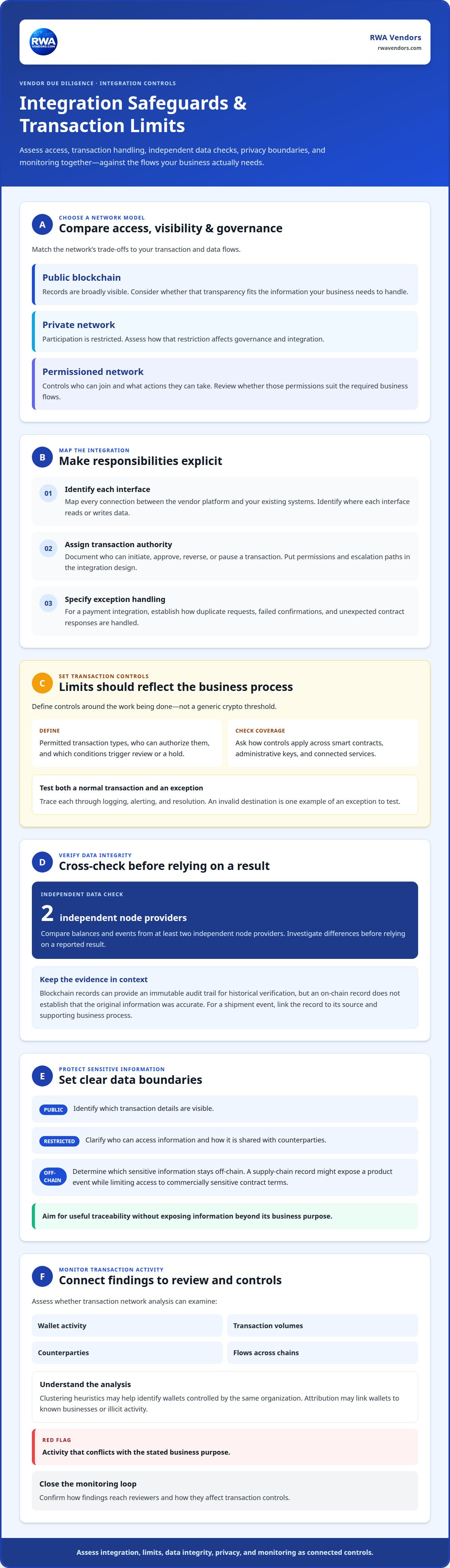
Integration safeguards and transaction limits
For enterprise use, compare how each network handles access, validation, and confidential data. Public blockchains offer broadly visible records, while private networks restrict participation. Permissioned networks control who can join and what actions they can take. Each model brings different trade-offs in transparency, governance, and integration. Assess these against the transaction and data flows your business actually needs.
Start by mapping the connection between the vendor’s platform and your existing systems. Identify each interface that reads or writes data, then establish who can initiate, approve, reverse, or pause a transaction. For example, a payment integration should specify how it handles duplicate requests, failed confirmations, and unexpected contract responses. Document permissions and escalation paths in the integration design rather than relying on informal assumptions.
Set transaction limits around the business process, not a generic crypto threshold. Define permitted transaction types, who can authorize them, and which conditions trigger a review or hold. Ask the vendor to explain how these controls apply across smart contracts, administrative keys, and connected services. During testing, trace a normal transaction and an exception, such as an invalid destination, through logging, alerting, and resolution.
Use independent data checks to assess integrity. Compare balances and events from at least two independent node providers, and investigate differences before relying on a reported result. Blockchain records can provide an immutable audit trail for historical verification, but an on-chain record does not establish that the original information was accurate. For a supply-chain shipment event, link the record to its source and supporting business process.
Transparency needs boundaries. Identify which transaction details are public, which are restricted, and which sensitive information stays off-chain. A supply-chain record, for example, might expose a product event while limiting access to commercially sensitive contract terms. Review how the vendor controls permissions and shares data with counterparties. The aim is useful traceability without exposing information beyond its business purpose.
Assess transaction network analysis as an integration safeguard. Review whether monitoring can examine wallet activity, transaction volumes, counterparties, and flows across chains. Clustering heuristics may help identify wallets controlled by the same organization, while attribution may link wallets to known businesses or illicit activity. Treat activity that conflicts with the stated business purpose as a red flag. Confirm how findings reach reviewers and affect transaction controls.
Regulatory requirements for third-party risk
A sound assessment links regulatory exposure with vendor dependencies, contract controls, and ongoing monitoring. Allocate review effort according to each provider’s role, access, and risk profile.
Compliance and Risk Assessments
A third-party risk assessment evaluates how a provider’s operations could affect your regulatory obligations and business continuity. Its findings help direct compliance resources toward the relationships with the greatest potential impact.
Map each provider’s service, data access, subcontractors, and operating jurisdictions. Then assess applicable obligations, regulatory uncertainty, cybersecurity practices, and concentration exposure. NIST’s Cybersecurity Framework 2.0 quick-start guide recommends setting supplier requirements through governance and managing them as a program. A risk-based framework can apply closer monitoring to providers whose services support critical operations, while maintaining proportionate oversight for lower-risk relationships.
Third-Party and Service-Provider Risk
Third-party risk includes exposure created by a vendor’s own providers, subcontractors, and operational dependencies. A blockchain platform may depend on infrastructure, wallet, or analytics services. Reviewing only the direct vendor can therefore leave connected risks out of view.
Build an assessment around the service chain: identify material subcontractors, the functions they perform, and the data or systems they can access. Establish how changes, incidents, and emerging risks are reported and monitored. The US banking agencies’ third-party risk guidance, issued in 2023, covers planning, due diligence, contracting, monitoring, and termination. These stages provide a useful structure for assessing vendor relationships across their lifecycle.
Platform Costs and Contract Terms
Enterprise platform and due diligence costs depend on scope, integration complexity, transaction requirements, jurisdictions, and assessment depth. Pricing depends on the case and is provided after a quote request; compare proposals by the services and controls they cover, not by a headline figure alone.
Contract terms should define service scope, operating locations, subcontracting conditions, incident notification, response responsibilities, and access to and return of customer data. Under DORA Article 30, written contracts must describe the service, where it is provided, subcontracting conditions, and access to and return of customer data. Ask how the platform scales under higher transaction demand, interoperates with required systems, and reports performance. Define service levels, uptime commitments, and incident response steps explicitly; don’t assume a guarantee exists without contract language.
Vendor Lock-In and Mitigation
Vendor lock-in arises when switching providers becomes difficult because data, integrations, or operating processes depend on proprietary systems. It can limit future choices and complicate continuity if the relationship ends.
Assess portability before committing. Identify exportable data, documented interfaces, migration support, and dependencies on proprietary components. Contractual exit terms should cover data access and return, while architecture planning can keep critical integrations modular. Ask how transaction histories and operational records can be transferred in usable formats. These measures can make a transition more manageable without assuming another platform will provide identical functionality.
Providers can also make their capabilities easier for asset issuers to assess through a vendor directory listing.
What is entity due diligence?
Entity due diligence examines a blockchain organization’s privacy, information security, and handling of sensitive data. For investors and other parties, the review connects technical controls with the nature of the organization’s operations.
Data Protection and Information Security
Assess how the vendor collects, stores, uses, and shares information across its platform. Review its privacy and information-security policies alongside the data protection measures applied to systems, employees, and service providers. A SOC 2 report describes a digital asset company’s systems and how they are controlled, giving reviewers structured information about those controls.
Map which parties can access personal, financial, and operational data, and identify where that data moves. A tokenization platform, for example, may pass investor records between onboarding, identity verification, and transaction systems. Documenting these transfers can reveal unnecessary access or unclear responsibility for protecting records.
Data-model standardization matters when organizations exchange information. Compare how each system labels fields such as investor identity, asset status, and transaction date. Consistent definitions make records easier to reconcile across platforms, while mismatched formats can cause reporting or integration errors. Where the business process allows, keep sensitive source data separate from shared records.
Funds-Flow and Data-Breach Risks
Funds-flow analysis traces how assets move through a vendor’s platform, connected wallets, and counterparties. Examine transaction paths, approval points, and controls around changes to payment instructions. For example, trace a test transaction from initiation through confirmation, recording which system creates each event and which party can authorize an exception.
Compare on-chain activity with the entity’s stated business purpose. Review transaction volumes, counterparties, and wallet activity for patterns that conflict with its declared operations. A breach can also expose sensitive information shared among transaction parties, so assess how access is limited and data is handled during diligence and routine platform use.
Separate two risk paths in the assessment: unauthorized movement of funds and unauthorized access to information. For each, identify the relevant systems, responsible teams, and escalation route. This distinction helps clarify whether a control failure could affect asset flows, confidential records, or both.
Vendor Security and Smart-Contract Testing
Assess vendor security by reviewing information-security practices, system controls, and independent testing. External penetration testing can examine whether systems withstand attempted intrusion, while smart-contract audits review code for vulnerabilities. These reviews provide additional evidence that systems and code have been independently tested, but do not replace assessment of the specific controls and risks relevant to your use.
Ask which systems and contract versions each test covered, which findings remain open, and how remediation was handled. Testing an earlier contract version does not show that later code received the same review. Match the test scope to the platform components that will support your operations.
Examine how the vendor manages changes to deployed contracts and related systems. Identify who can approve code changes, how their effects are tested, and how relevant records are retained. This connects security evidence to the configuration actually used, rather than treating an audit as standalone assurance.
Entity identity and beneficial ownership verification
Verify the legal entity behind the platform, its ownership, and its control structure. These checks help identify who is accountable for services involving digital assets. Due diligence for blockchain technology vendors should connect the stated business identity to the entities and individuals responsible for operations.
Entity Identity and Beneficial Ownership
Confirm the vendor’s legal name, place of incorporation, operating jurisdictions, and stated business activities. Then map direct and indirect ownership to the individuals or entities exercising control. Even a complex ownership chart should lead to identifiable beneficial owners; missing ownership disclosure is a due diligence red flag.
Assess leadership as well as corporate structure. Background checks on senior executives can help identify relevant connections, while politically exposed person screening can inform the risk assessment. Screen entities and relevant individuals for direct or indirect links to sanctioned actors. Include ongoing monitoring for changes in sanctions designations, since a vendor’s exposure can change after onboarding.
Custody requires a separate review of how assets are held and controlled. Verify that customer assets are properly segregated and that custody uses multi-party key management. Examine insurance, SOC 1 and SOC 2 reports, and proof of reserves as part of the assessment. SOC 1 focuses on internal control over financial reporting; a SOC 2 report describes a company’s systems and how they are controlled.
For key governance, examine how the vendor inventories, protects, and manages cryptographic keys. NIST SP 800-57 Part 1 Rev. 5 is a key-management recommendation referenced for blockchain key inventories. Compare the vendor’s documented inventory with the keys used in custody and operational processes. Gaps can indicate that control over customer assets is not fully represented in documented procedures.
Data Accuracy and Verification
Data accuracy verification tests whether records match their sources and remain consistent across systems. Blockchain can preserve a historical record, but recording information does not independently prove that the original input was accurate. Trace a sample asset record from source document to platform entry, then compare relevant fields and supporting evidence.
For custody balances and activity, compare reported records with independent evidence, such as proof-of-reserves materials and available transaction histories. Investigate discrepancies to determine whether they arise from timing, data mapping, or an incomplete record. Record the source, timestamp, and responsible system for each material data point. This creates a clear basis for review without treating a ledger entry alone as proof of ownership.
In due diligence for blockchain technology vendors, check that identity, ownership, and custody records use consistent entity names and identifiers. A vendor and its custodian may label the same organization differently, making relationships harder to trace. Aligning records helps reviewers connect the corporate entity, controlling parties, wallets, and assets without mistaking similar names for verified links.
Regulatory compliance across jurisdictions
Blockchain vendor compliance depends on the services performed, customer types, data handled, and places of operation. In the United States, assess whether activities trigger Bank Secrecy Act registration or anti-money-laundering obligations, alongside sanctions screening and applicable data-protection requirements.
KYC and AML Compliance
KYC and AML controls identify customers, assess financial-crime exposure, and monitor activity for suspicious patterns. They matter because a platform’s functions can affect which obligations apply to its operations and business relationships.
Review the vendor’s written policies, compliance officer, employee training, and independent audits. These are the four minimum components of a Bank Secrecy Act-compliant AML program. Also assess how customer identification, transaction monitoring, escalation, and record-keeping fit together. FinCEN published guidance on applying its regulations to certain convertible virtual currency business models on May 9, 2019. Money transmitters generally must register as money services businesses and meet reporting, record-keeping, and AML obligations, subject to limited exceptions.
Sanctions screening should cover relevant entities and connected parties against lists maintained by OFAC, the UN, and the EU. A compliance roadmap can assign responsibility for screening, monitoring, training, and independent review. Set review triggers around changes in services, customer activity, and operating jurisdictions, then document how governance responds to findings.
Jurisdictional Compliance Requirements
A jurisdictional compliance assessment maps a vendor’s activities to relevant local rules and regulatory uncertainty. This matters when a platform serves customers, handles data, or depends on providers across borders.
For US-facing operations, assess whether a digital asset could be an investment-contract security under the four-prong test articulated by the US Supreme Court in SEC v. W.J. Howey Co. in 1946. The Reves test may also be relevant to digital assets resembling notes. Under the Commodity Exchange Act, the CFTC’s jurisdiction generally covers derivatives, while its authority over underlying spot commodities is limited to anti-fraud and anti-manipulation matters.
Review whether the vendor’s activities create Bank Secrecy Act registration or AML obligations, and assess privacy and data-protection requirements in each relevant jurisdiction. Cross-border review should also consider local regulations, market conditions, and exposure to high-risk or non-cooperative jurisdictions. A complex operating model may require a jurisdiction-by-jurisdiction compliance roadmap with documented responsibilities and controls.
The EU Digital Operational Resilience Act has applied since 17 January 2025, according to the European Union. DORA Article 30(3) adds contract terms when an ICT service supports a critical or important function for an in-scope EU financial entity. Map the vendor’s role to the relevant service and contract controls. Digital asset companies should work with sector-experienced legal counsel to confirm requirements applicable to their operations in each jurisdiction.
RWA Vendors: Vendor Directory Listing
RWA Vendors connects asset issuers with verified tokenization platforms and service providers through its global directory. The listings span categories such as technology, compliance, legal, and tokenization. Use the directory when your assessment has clarified the capabilities, controls, and jurisdictions your project requires and you need to identify relevant vendors for further evaluation.
Use those requirements to narrow your search by the support you need, such as blockchain infrastructure or compliance expertise. The directory helps issuers explore providers listed for projects involving real estate, funds, securities, and other assets. It supports vendor discovery; your organization’s due diligence remains essential when evaluating each provider’s fit and risks.
Contact RWA Vendors to discuss a Vendor Directory Listing.
Turn your assessment into a clear next step
Use your findings to define the capabilities your project needs and the risks it can accept. This gives procurement, technology, and compliance teams a shared basis for engaging potential providers. A structured approach to due diligence for blockchain technology vendors can also keep future reviews aligned as your operating model evolves.
For issuers seeking suitable providers, RWA Vendors’ directory helps identify tokenization platforms and related professional services. Technology companies can use a Vendor Directory Listing to present their capabilities, while Founding Membership and Lead Generation and Referrals support participation in the ecosystem. Choose the next step that fits your role and objective.
With a defined assessment and relevant connections, your team can move forward with greater clarity and purpose.
Frequently Asked Questions
So, what are the key areas to look at in due diligence?
Prioritize the areas that could interrupt your operating model or expose assets and information. For a platform supporting investor onboarding, assess whether a failure would affect account access, transaction processing, or reporting, and identify who owns each response. Connect each material risk to evidence, an accountable internal reviewer, and a decision point. This helps teams distinguish essential controls from lower-impact capabilities.
What should a blockchain technology vendor due diligence checklist include?
Maintain an evidence register, not just a list of questions. For each review item, record the document or demonstration examined, its date or version, the reviewer, any gap, and the person responsible for resolving it. Set a decision gate for unresolved findings and a review trigger for material changes, such as a new subcontractor or platform function. This makes findings traceable across procurement, technology, and compliance teams.
How can you evaluate a blockchain vendor’s financial stability, ownership, and business continuity?
Review audited financial statements where available, then compare reported operations with the vendor’s stated business model and dependencies. Map ownership and control through the relevant entities, and note changes that could affect accountability. For continuity, examine documented recovery arrangements, responsibility coverage, critical service dependencies, and transition processes. Consider the loss of a key service provider: determine which operations would stop, who coordinates recovery, and how records remain accessible.
What data privacy, custody, and key management risks should buyers assess?
Assess whether sensitive information is collected only for defined business purposes, who can access it, and how access is recorded. For custody, examine customer-asset segregation and multi-party key management, then compare documented controls with operational procedures. Review the key inventory, access roles, backup arrangements, and recovery responsibilities. For example, a key person’s absence should not prevent the organization from applying its approved custody process or maintaining appropriate oversight.
Disclaimer
This article is provided by RWAVendors.com for general informational and educational purposes only. It does not constitute legal, financial, investment, tax, regulatory or other professional advice, or an offer, solicitation, recommendation or endorsement of any company, product, service, token, security or investment. RWAVendors.com is an informational vendor directory and does not sell, issue, broker, custody or facilitate transactions involving cryptocurrencies, digital tokens, tokenized assets, securities or investment products. Some vendor listings and references may involve paid advertising, sponsored placement or membership relationships. These relationships do not guarantee a vendor’s qualifications, regulatory status, performance or suitability. Information may be incomplete, outdated or subject to change. You should independently verify all information, conduct your own due diligence and consult qualified professionals before making any business or investment decision. RWAVendors.com is not responsible for the content, services, representations or actions of third-party vendors or linked websites.


