

Trust in digital assets is earned through controls, not confidence alone. Building investor trust in digital assets depends on clear information about how an asset works, disciplined processes, segregated custody, and independent oversight. Together, these measures help investors understand what they hold, how it is managed, and where key risks sit.
Investors reasonably expect more than an explanation of the technology. They need clarity about rights, operations, custody arrangements, and the checks that support accountability. Without these foundations, uncertainty can make it difficult to assess an offering or the parties involved.
This article explains how clear information and operational discipline support trust, what custody arrangements are designed to achieve, and how independent oversight can strengthen accountability. It also outlines how these safeguards relate to investor protections for digital assets, helping you assess the structures behind an offering more precisely.
Key Takeaways
- Clear information about asset rights, operations, and risks helps investors assess what they hold and how it is managed.
- Disciplined processes and well-defined custody arrangements can make responsibilities and control over assets easier to understand.
- Independent oversight can support accountability, but it does not remove the need to understand the risks of a digital asset.
- Investor protections vary across digital assets; some types are not regulated by any U.S. federal authority.
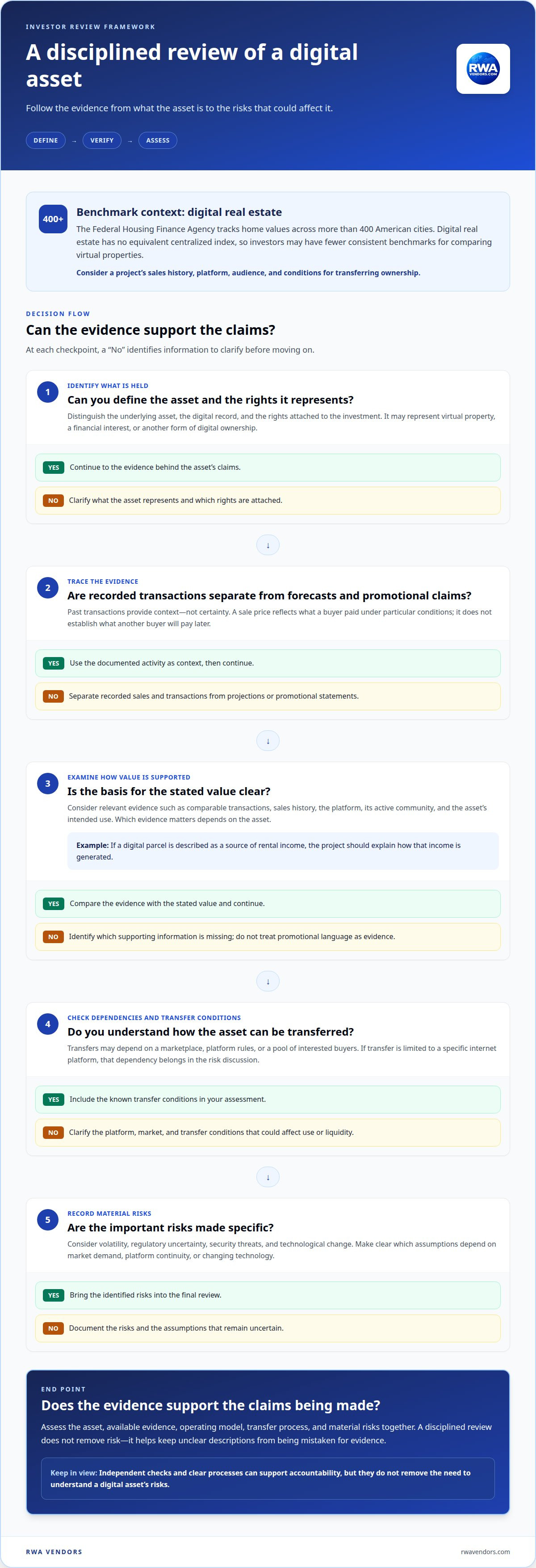
- The Federal Housing Finance Agency tracks home values across more than 400 American cities, while digital real estate has no equivalent centralized index.
Investor trust through certainty, clarity, and discipline
Trust starts with a clear explanation of what an asset represents, how it operates, and what could affect its value. A token linked to real estate, for example, should be described in terms investors can assess, not just by its crypto or blockchain features. Clear materials distinguish the underlying asset, the digital record, and the rights attached to the investment. They also explain who performs each operational role and how transactions are recorded. This gives investors a basis for evaluating the asset before considering potential returns.
Clarity matters because familiar asset classes have reference points that digital markets may lack. The Federal Housing Finance Agency tracks home values across more than 400 American cities. Digital real estate has no equivalent centralized index, so investors may have fewer consistent benchmarks for comparing virtual properties. A project’s stated value should therefore be considered alongside its sales history, platform, audience, and conditions for transferring ownership. Those details help show what a valuation represents, rather than leaving investors to infer it from promotional language.
Due diligence turns disclosures into a disciplined assessment. Investors can analyze past sales data and consider potential risks before buying digital real estate. For virtual property, relevant information may include comparable transactions, the platform’s active community, and the asset’s intended use. For a tokenized fund, the focus may include the assets held and how investor interests are recorded. The aim is not to treat unlike assets as interchangeable, but to identify which evidence matters to each asset’s value and operation.
Past transactions provide context, not certainty. A sale price shows what a buyer paid under particular conditions; it does not establish what another buyer will pay later. Liquidity matters too: investors need to understand whether transfers depend on a marketplace, platform rules, or a pool of interested buyers. If a digital asset can only be transferred through a specific internet platform, that dependency belongs in the risk discussion. A clear explanation separates demonstrated activity from assumptions about future demand.
Discipline means applying the same analytical sequence to each opportunity. First, identify the asset and the rights it represents. Then review available sales history, the operating model, transfer process, and material risks. Finally, assess whether the evidence supports the claims being made. For example, a project describing a digital parcel as a source of rental income should explain how that income is generated. Investors can then distinguish an operating model from an expectation or projection.
- Define the asset: State whether it represents virtual property, a financial interest, or another form of digital ownership.
- Trace the evidence: Separate recorded sales and transactions from forecasts or promotional claims.
- Assess dependencies: Identify the platform, market, and transfer conditions that could affect use or liquidity.
- Record the risks: Consider volatility, regulatory uncertainty, security threats, and technological change.
This approach supports consistent decisions across private and public discussions of digital assets. It also makes uncertainty specific: investors can see which assumptions depend on market demand, platform continuity, or changing technology. A disciplined review does not remove risk, but it helps prevent unclear descriptions from being mistaken for evidence. That distinction is central to building investor trust in digital assets, especially when established benchmarks are limited.
Evaluating these opportunities through RWA Vendors requires careful analysis of market risks, and distinguishing documented operating capacity from projections about future returns. A video presents digital assets as a way to generate income through leverage and repeated value production. Investors can use that framing as a prompt to ask how income is produced, what supports its continuation, and which assumptions remain untested. The page states that Ethereum’s transaction throughput was 15 transactions per second before the shift to Proof-of-Stake. Such operating details may inform an assessment of a digital asset’s context, but they do not by themselves establish its value or the rights attached to it.
A digital hub developed through a regional government and private-investor partnership in the Middle East generated over 8,000 jobs and contributed $1.2 billion to the local economy. These reported outcomes provide context for the hub’s economic impact, while investors still need to understand the specific asset, ownership structure, and basis for any return being considered. Blue Owl Capital announced its expansion into real estate finance through the acquisition of Prima Capital Advisors on April 9, 2024. Institutional activity can be relevant background, but a disciplined review still turns on the terms, risks, and evidence for the particular opportunity. Separating broad claims and market developments from asset-specific facts helps keep expectations grounded and makes comparisons more meaningful.
Segregated custody and independent oversight
Secure storage and independent checks address different risks in digital finance. Custody concerns control and safekeeping; oversight examines whether reported processes and records match their stated purpose.
Verifying Teams, Technology, and Reserves
Verification means examining who operates a project, how its blockchain infrastructure works, and what supports any claims about reserves. Investors need to distinguish documented operations from statements about future income or returns. Review the team’s identified responsibilities, the technology’s role in transactions, and the method used to report reserves. Each detail answers a different question about the project’s structure.
Start by clarifying roles. A project should identify who manages assets, who controls relevant systems, and who makes operational decisions. If one organization performs several roles, that concentration should be visible in the disclosures. For example, a tokenization platform may provide the technology while another entity holds the underlying assets. Mapping responsibilities helps investors see where operational control sits.
A technology review should connect the system’s design to the activity it supports. For a blockchain-based asset, examine how transactions are recorded and how the digital record relates to the asset or rights described. A ledger entry alone does not explain the legal or operational relationship. Clear documentation should state what the record represents, how corrections or transfers are handled, and which entity is responsible for each process.
Reserve claims need equally specific treatment. Identify what the reserve consists of, how its reported value is calculated, and what evidence supports the figure. Then distinguish that evidence from statements about liquidity or expected returns. For instance, a report describing cash holdings answers a different question from one describing assets that may take time to convert. The reporting format and scope shape what an investor can reasonably infer.
Independent Oversight
Independent oversight is a review by someone separate from the project’s day-to-day management. Its value depends on the reviewer’s remit, the records examined, and the conclusions disclosed. A review of transaction controls, for example, does not automatically verify asset ownership or reserve value. Understanding those limits helps investors assess what the oversight establishes.
Useful oversight starts with a defined scope. The report should explain which systems, records, or controls were reviewed and the period covered. It should also identify exclusions, such as a technology component or third-party process outside the review. These details help investors distinguish a focused assessment from a broader claim of validation. The reviewer’s independence and relevant expertise also affect how findings should be interpreted.
Oversight can assess whether custody procedures match the stated structure. For example, a reviewer may examine access permissions, transaction records, and the process for reconciling internal records with external reporting. These checks address different control points: an access review considers who can initiate activity, while reconciliation tests whether records align. Neither replaces clear information about asset rights or the custody arrangement itself.
Regulatory expectations and available oversight can differ across jurisdictions and asset structures. A project in an evolving ecosystem should explain which entities perform controls and how findings reach investors. Clear reporting is especially useful when a platform relies on third-party custody or technology. It makes dependencies visible instead of presenting a network of service providers as one undifferentiated system.
- Map responsibilities: Identify the entities controlling assets, systems, reporting, and operational decisions.
- Read the scope: Match each review’s stated coverage to the claim it is meant to support.
- Separate evidence: Distinguish transaction records, reserve reports, and statements about liquidity or returns.
- Track dependencies: Note where custody or blockchain operations rely on external infrastructure.
These practices help investors compare custody structures and oversight arrangements on their actual scope, rather than on labels alone. Providers involved in tokenization can also make their capabilities easier to find through a directory for digital-asset service providers.
Investors should understand what was reviewed and what remains outside the review. They should not treat a limited check as a guarantee of safety, ownership, liquidity, or future performance. They should also select a secure method for storing digital investments that fits their needs, keeping that choice separate from confidence in an oversight report. Reviewing storage and oversight separately can make unanswered questions easier to identify before committing funds.
How do investor protections for digital assets compare with traditional securities?
Investor protections depend on an asset’s legal and operational structure, not simply its digital format. Some types of digital assets are not regulated by any U.S. federal authority. It is therefore important to identify the rights an investor holds, which rules apply to the specific offering, and how those rights can be exercised if circumstances change.
Traditional securities and digital assets should not be treated as one uniform category. A share, a bond, a token representing an interest, and a crypto asset can have different legal characteristics. Start by asking what the investor owns, what claims it creates, and which entity is responsible for those claims. A blockchain record can document a transaction, but it does not answer those questions on its own.
For a traditional security, relevant protections are tied to the security and its offering structure. For a digital asset, the same practical questions apply, alongside questions about the token’s design and technical operation. Consider a token associated with a fund: investors need to understand whether it represents an interest in the fund, how ownership records are maintained, and what process governs transfers. The token’s label alone does not establish these details.
Disclosure is another useful point of comparison. Investors need information relevant to a decision: rights, fees, conflicts, operating arrangements, and material risks. A traditional offering document and a digital asset’s project materials may present information differently, but clarity matters in both cases. For example, a statement that a token is “backed” should explain what supports it and how the relationship is documented. General assurances cannot replace defined terms.
Access to remedies also depends on the legal relationship behind an asset. Investors should be able to identify the relevant issuer or other responsible entity, the governing documents, and the process for raising a dispute. A digital wallet address is not necessarily the same as a clearly identified legal counterparty. In a tokenized real estate example, the ownership record, the underlying property interest, and the entity responsible for administering that interest may be separate parts of the arrangement.
- Identify the asset: Determine what the token represents and which rights attach to it.
- Locate responsibility: Map the issuer, administrator, and other entities involved in the arrangement.
- Read the governing terms: Find how transfers, records, and disputes are handled.
- Compare the actual protections: Evaluate the offering’s disclosures and controls, rather than relying on labels such as “digital security.”
These questions help distinguish investor protection from technical security. A blockchain may record transactions, while separate legal documents define investor rights. Strong cybersecurity practices can reduce certain operational risks, but they do not establish the validity of an ownership claim or resolve a disagreement over contract terms. Similarly, an independent review can provide evidence about a defined process without resolving every legal question around an asset.
Jurisdiction adds another layer. An issuer, investor, platform, and underlying asset may be connected to different places, so applicable rules and available remedies can depend on the arrangement. Investors should read the offering documents for the named entities, governing terms, and stated dispute process. For issuers, clearly documenting those relationships makes the structure easier to assess across the digital asset ecosystem.
Traditional securities may offer more familiar reference points, while digital assets can raise additional questions about token operation, recordkeeping, and custody. Neither label alone tells investors how much protection applies. A sound comparison examines the rights, responsible parties, disclosures, controls, and remedies attached to the specific asset. This is a practical foundation for building investor trust in digital assets without mistaking a technical feature for a legal safeguard.
There is no single set of U.S. rules for all digital assets. Applicable rules depend on an asset’s legal and operational structure, its classification, and the specific offering. Some types of digital assets are not regulated by any U.S. federal authority.
RWA Vendors: Find companies that help tokenize real estate, funds, securities and other assets
RWA Vendors’ global directory helps issuers identify providers involved in tokenization. Browse technology, legal, compliance, and tokenization vendors listed in categories related to real estate, funds, securities, and other assets. The directory is useful when a project needs specialist capabilities across different stages, from digital infrastructure to operational and compliance requirements.
Finding suitable providers helps issuers map the ecosystem around a project and identify potential partners for specific roles. RWA Vendors connects asset issuers with verified tokenization platforms and service providers, making it easier to explore relevant categories in one place. The directory supports provider discovery; it does not replace an issuer’s assessment of a project’s rights, risks, or oversight arrangements.
For a next step in identifying relevant providers, contact RWA Vendors.
Build the next stage with confidence
Trust is not a one-time milestone. It develops as an issuer’s operating model, service-provider relationships, and investor communications remain aligned. Make the next step specific: identify the capabilities your project needs, clarify which roles must be filled, and build a provider network suited to your structure. This practical work can turn the principles behind building investor trust in digital assets into a more deliberate approach to project development.
RWA Vendors helps asset issuers find companies working across real estate, funds, securities, and other assets. Its Vendor Directory Listing, Founding Membership, and Lead Generation and Referrals support participation in the tokenization ecosystem. Choose the path that matches your organization’s priorities, whether you are seeking visibility or relevant industry connections.
A clear next step can help your team build relationships that support a more transparent and accountable digital asset market.
Frequently Asked Questions
What factors build investor trust in digital assets?
Investor trust depends on consistent information, accountable decision-making, and clear communication when circumstances change. For example, if a platform changes its transfer process, investors should receive an explanation of what changed and how it affects them. Compare project updates with formal offering documents and account statements. Consistency across these materials helps investors assess whether an organization’s actions align with its stated approach, supporting the ongoing work of building investor trust in digital assets.
How can digital asset platforms demonstrate transparency and solvency?
Platforms can provide dated, understandable reporting that explains assets, liabilities, and how each figure was determined. A snapshot of assets alone does not show whether obligations are also accounted for. For example, a reserve report should clarify its coverage, measurement date, and exclusions, while separate financial information can provide context about liabilities. Clear explanations of reconciliation methods and material changes help readers interpret the figures rather than treating a headline balance as the complete picture.
What role do audits and proof-of-reserves play in digital asset trust?
An audit and a proof-of-reserves report answer different questions, so readers should examine each report’s scope. An audit may review specified financial information or controls, while proof of reserves focuses on evidence about stated asset holdings. Neither label alone explains what was excluded or whether obligations were considered. For example, a report covering wallet balances may not establish a platform’s full financial position. Read the methodology, date, and limitations to understand what the evidence supports.
Disclaimer
This article is provided by RWAVendors.com for general informational and educational purposes only. It does not constitute legal, financial, investment, tax, regulatory or other professional advice, or an offer, solicitation, recommendation or endorsement of any company, product, service, token, security or investment. RWAVendors.com is an informational vendor directory and does not sell, issue, broker, custody or facilitate transactions involving cryptocurrencies, digital tokens, tokenized assets, securities or investment products. Some vendor listings and references may involve paid advertising, sponsored placement or membership relationships. These relationships do not guarantee a vendor’s qualifications, regulatory status, performance or suitability. Information may be incomplete, outdated or subject to change. You should independently verify all information, conduct your own due diligence and consult qualified professionals before making any business or investment decision. RWAVendors.com is not responsible for the content, services, representations or actions of third-party vendors or linked websites.


