

A ranking is only useful when its criteria are clear and recently reviewed. Compare security token marketing agencies by their STO experience, understanding of investor communications, geographic reach, and support before and after launch. No single ranking can determine the right fit for every offering.
It’s reasonable to want a current shortlist, but agency capabilities and areas of focus can change. A provider’s presence in a directory is a starting point, not a substitute for assessing how its work aligns with your offering, target investors, and launch plans.
This guide explains how to compare providers, assess the criteria that matter, and select an agency suited to your STO. It also covers marketing activities an agency may support and risks to consider, helping you make a more informed decision about your next step.
Key Takeaways
- Compare agencies by their STO experience, investor communications, geographic focus, and ability to support post-launch engagement.
- Assess whether proposed campaigns fit your target investors, offering structure, and relevant jurisdictional requirements.
- Look beyond launch-day promotion: without a retention plan, momentum can fade within 90 days after launch.
- Review campaign plans for clear messaging, coordinated channels, and meaningful ways to evaluate engagement and investor response.
- Use RWA Vendors to discover providers across the tokenization ecosystem when you need support identifying potential partners for your offering.
How agencies market security tokens to accredited investors
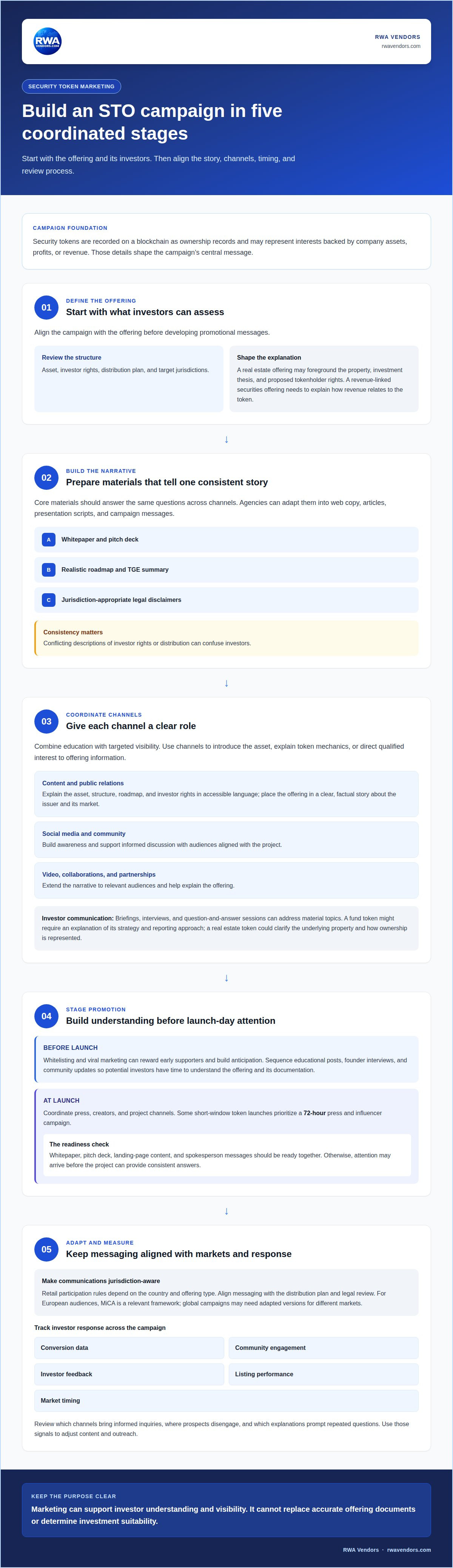
Marketing an STO starts with defining the offering and the investors it can reach. Agencies translate the issuer’s proposition into clear communications, then coordinate content, media, and investor outreach. Security tokens are recorded on a blockchain as ownership records and may represent interests backed by company assets, profits, or revenue. These details shape the campaign’s central message.
Build the investor narrative before promotion
First, align the campaign with the offering’s structure. An agency reviews the asset, investor rights, distribution plan, and target jurisdictions before developing messaging. For example, a real estate offering may foreground the property, investment thesis, and proposed tokenholder rights. A securities offering tied to company revenue may need a different explanation of how that revenue relates to the token.
Core materials should answer the same questions across channels. Prepare a clear whitepaper, a visually strong pitch deck, a realistic roadmap, a TGE summary, and jurisdiction-appropriate legal disclaimers. Agencies can adapt these materials into web copy, articles, presentation scripts, and campaign messages. Consistency matters: conflicting descriptions of rights or distribution can confuse investors.
Coordinate channels around investor intent
Campaigns combine education with targeted visibility. Social media and community programs can build awareness, while content marketing and public relations explain the project in greater depth. Video marketing, collaborations, and partnerships can extend the narrative to relevant audiences. Give each channel a defined role, such as introducing the asset, explaining token mechanics, or directing qualified interest to offering information.
- Content: Explain the asset, structure, roadmap, and investor rights in accessible language.
- Public relations: Place the offering within a clear, factual story about the issuer and its market.
- Community and partnerships: Create informed discussion and reach audiences aligned with the project.
Accredited investors often assess an issuer’s credibility alongside its investment proposition. Agencies can organize briefings, interviews, and question-and-answer sessions on material topics. For a fund token, that might mean explaining the strategy and reporting approach. For a real estate token, communications could clarify the underlying property and how ownership is represented.
Use staged promotion, not a launch-day burst
Before launch, whitelisting and viral marketing can reward early supporters and build anticipation. An agency may sequence educational posts, founder interviews, and community updates instead of releasing every message at once. This gives potential investors time to understand the offering and its documentation before deciding whether to engage.
Launch activity can then coordinate press, creators, and project channels. Some short-window token launches prioritize a coordinated 72-hour press and influencer campaign. That concentrated effort works best when the whitepaper, pitch deck, landing-page content, and spokesperson messages are ready together. Otherwise, attention may arrive before the project can provide consistent answers.
International campaigns need jurisdiction-aware messaging. The rules determining retail participation depend on the country and offering type, so agencies should align communications with the issuer’s distribution plan and legal review. In the United States, the GENIUS Act was signed into law in July 2025, according to The White House. Its existence does not replace offering-specific review or determine an STO’s investor eligibility.
For European audiences, MiCA is a relevant framework for token-project communications. Agencies should coordinate language, distribution, vesting schedules, liquidity planning, and TGE structure with regional compliance requirements. These elements affect what the campaign says, where it runs, and which audiences it addresses. A global message may need carefully adapted versions for different markets.
Finally, measure investor response across the campaign. Track conversion data, community engagement, investor feedback, listing performance, and market timing. Review which channels bring informed inquiries, where prospects disengage, and which explanations prompt repeated questions. Use those signals to adjust content and outreach. Marketing supports investor understanding and visibility; it cannot replace accurate offering documents or determine investment suitability.
What risks should issuers consider when hiring a security token marketing agency?
An agency can shape how investors understand an offering, so poor execution carries reputational and commercial risks. Assess its proposed work, reporting, and controls before signing. A polished pitch does not prove that the team understands your asset, audience, and distribution plan. Evaluate security token marketing agencies on evidence of delivery, not presentation alone.
Misaligned audience and unsupported claims
A campaign may attract attention without reaching suitable investors. Ask how the agency defines its intended audience and selects channels. For example, a campaign for institutional investors needs different content and outreach from one aimed at a broader audience. The plan should explain how each activity supports the offering’s actual investor profile.
Promotional language creates another risk. A post that implies guaranteed returns, understates uncertainty, or overstates tokenholder rights can mislead its audience. Compare every proposed claim with the offering documents. For example, if a token represents an interest in an asset, copy should not imply direct ownership of the underlying property unless the structure supports that claim. Set a documented review and approval process before publication.
Weak measurement and short-term thinking
Impressions and follower counts show visibility, not investor understanding or qualified interest. Ask for reporting that distinguishes reach from meaningful engagement, such as relevant inquiries, completed information requests, and recurring investor questions. Set these measures before launch. A clear baseline helps the issuer identify which channels generate useful engagement and which create activity without advancing investor consideration.
Launch-day attention can also fade. A campaign without post-launch retention work may lose traction within 90 days after launch. Define the agency’s post-launch scope before contracting. Specify whether it includes ongoing content, community engagement, investor feedback analysis, and communication around project updates. A launch-only plan may leave the issuer without a process for maintaining visibility.
Delivery, approval, and access risks
Unclear responsibilities can delay campaigns or create conflicting messages. Document who drafts, reviews, approves, and publishes each asset. For example, set separate approval steps for a founder interview, a social post, and an investor presentation. Agree on procedures for handling corrections, questions, and material changes to the offering.
Define control of campaign accounts and work product, too. Establish which party owns social profiles, mailing lists, creative files, and performance reports. Set access permissions for agency staff, and document how access changes when a contract ends. These steps reduce disruption if the agency team changes or the relationship concludes.
Gaps in scope can lead to unexpected costs or incomplete delivery. A proposal may mention public relations without specifying the number or type of deliverables. Ask for a written scope covering channels, deliverables, timelines, approval rounds, reporting, and exclusions. Compare the proposed work with the issuer’s launch calendar. Treat changes to the offering or launch date as explicit scope decisions, not assumed inclusions.
How to assess an agency before hiring
Use a structured review rather than relying on a single case study. Request examples relevant to your asset type and investor audience. Examine what the agency delivered, how it measured outcomes, and what role its team played. A campaign for a real estate offering may not demonstrate the capabilities needed for a fund or another security.
- Review the plan: Match proposed channels and deliverables to your investor profile and launch stage.
- Test the messaging: Compare sample copy with offering documents and confirm approval responsibilities.
- Set reporting expectations: Define meaningful engagement measures, reporting cadence, and post-launch activities.
- Clarify control: Record account access, data handling, work ownership, and transition steps.
These checks help issuers distinguish a defined campaign from a broad promise of exposure. If your organization provides services to token issuers, explore the vendor directory listing as a way to present your capabilities to the market.
Issuers should hire a token marketing agency six to twelve months before a TGE. This lead time gives both sides room to align the campaign with the offering, confirm responsibilities, and prepare review workflows before public activity begins. It also lets the issuer assess whether the proposed audience, messaging, and reporting approach fit its objectives, rather than rushing into a launch plan. State the timing expectation in the engagement scope, alongside approval ownership and post-launch support, so the agency’s role is clear from the outset.
RWA Vendors: Find companies that help tokenize real estate, funds, securities and other assets
RWA Vendors helps issuers find verified tokenization platforms and service providers when they need to build or expand a partner network. Use the directory to explore providers supporting real estate, funds, securities, and other assets across technology, legal, compliance, and tokenization categories.
For an issuer assessing marketing support, this broader ecosystem can help identify complementary providers involved in tokenization. It’s a practical next step when your project needs a clearer view of services across its lifecycle, beyond campaign planning alone.
Providers can use a Vendor Directory Listing to present their capabilities, while Founding Membership and Lead Generation and Referrals support visibility and connections within the marketplace.
To discuss getting listed, contact RWA Vendors.
Turn your STO priorities into a clear next step
Move from broad comparison to a selection brief tailored to your project. Define the audience you intend to reach, the campaign outcomes that matter, and the internal approvals that shape communications. Use those priorities to assess which security token marketing agencies can support your plans.
A focused brief also separates essential capabilities from optional activity. Identify what a provider needs to know about your offering, and explain how you’ll evaluate its proposed approach. If your project needs partners beyond marketing, map those requirements alongside the campaign so decisions support the wider tokenization process.
Take the time to make your next decision deliberately. A clear scope gives discussions direction and helps your team move forward with greater confidence.
Your STO’s next stage starts with a well-defined plan and the right connections.
Frequently Asked Questions
How current is this list?
Treat this list as a point-in-time guide, not a continuously updated ranking. Agency services and focus can change, so use the entries to build an initial shortlist. Compare each provider with your STO’s asset, intended investors, jurisdictions, and launch stage. A directory entry alone doesn’t establish current fit or campaign results. As your requirements evolve, revisit your shortlist and prioritize information directly related to the work you need.
How do I get contact information for these companies?
Browse and filter the RWA Vendors directory to identify companies in relevant categories, then use the available profile details to find a contact route. RWA Vendors also offers Lead Generation and Referrals for issuers and service providers who need help making connections. For example, an issuer seeking marketing support can narrow its search to relevant providers before pursuing a suitable introduction.
Disclaimer
This article is provided by RWAVendors.com for general informational and educational purposes only. It does not constitute legal, financial, investment, tax, regulatory or other professional advice, or an offer, solicitation, recommendation or endorsement of any company, product, service, token, security or investment. RWAVendors.com is an informational vendor directory and does not sell, issue, broker, custody or facilitate transactions involving cryptocurrencies, digital tokens, tokenized assets, securities or investment products. Some vendor listings and references may involve paid advertising, sponsored placement or membership relationships. These relationships do not guarantee a vendor’s qualifications, regulatory status, performance or suitability. Information may be incomplete, outdated or subject to change. You should independently verify all information, conduct your own due diligence and consult qualified professionals before making any business or investment decision. RWAVendors.com is not responsible for the content, services, representations or actions of third-party vendors or linked websites.


