

The right payment tokenization software fits your payment flows and keeps card details out of systems that do not need them. When comparing tokenization payment gateway providers, look beyond product-page features: assess how each provider creates, stores, manages, and revokes tokens. Tokenization replaces sensitive card information with a token, while the provider securely manages the actual payment credential.
Security is central, but integration, compliance support, scalability, geographic coverage, pricing, and customer support also affect provider fit. A platform may support saved cards, recurring payments, refunds, or mobile transactions, but suitable capabilities depend on how your business accepts and manages payments. This article explains how tokenization works and how it can reduce card-data exposure, then outlines practical criteria for comparing platforms and providers. It also covers the security and integration capabilities to assess and how to judge whether a provider meets your operational requirements.
Key Takeaways
- Tokenization keeps actual card credentials separate from the token used in payment workflows, helping limit how much sensitive data reaches merchant systems.
- Compare how providers create, store, manage, and revoke tokens, alongside the payment workflows and integrations they support.
- Assess security, compliance support, scalability, geographic coverage, pricing, and customer support together rather than relying on a single feature.
- Tokenization can reduce card-data exposure and support PCI DSS efforts, but it doesn’t remove the need to protect systems and control access.
- RWA Vendors connects asset issuers with verified tokenization platforms and service providers through a global directory.
Keeping card numbers and security codes off merchant systems
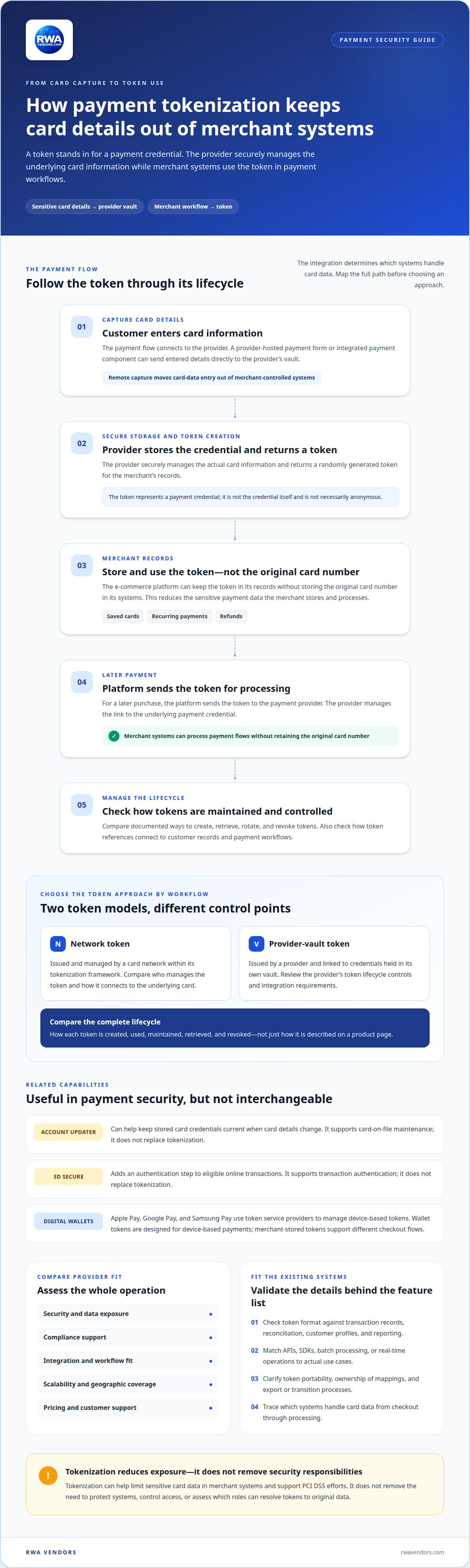
In a tokenized transaction, the customer enters card details through a payment flow connected to the provider. The provider securely manages the card information and returns a randomly generated token. The merchant’s e-commerce platform can use that token for later payment processing without storing the original card number in its systems. The distinction matters: a token represents a payment credential, but is not the credential itself.
For example, a customer saves a card at checkout. The payment provider stores the sensitive details in a secure data vault and returns a token for the merchant’s records. For a later purchase, the platform sends the token for processing. This can support saved cards, recurring payments, and refunds. It also reduces the sensitive payment data the merchant stores and processes, helping with PCI DSS efforts.
Network tokens are a related option. A card network issues and manages a network token within its tokenization framework. A provider may also issue tokens linked to credentials held in its own vault. The approaches differ in who manages the token and how it connects to the underlying card. Compare the full lifecycle: how each token is created, used, maintained, and revoked.
Account updater services and 3D Secure address different payment needs. An account updater can help keep stored card credentials current when card details change. 3D Secure adds an authentication step to eligible online transactions. Neither replaces tokenization: one helps maintain card-on-file credentials, and the other supports transaction authentication. A provider may combine these capabilities, but they remain separate parts of payment security.
Remote tokenization moves card-data capture out of merchant-controlled systems. For example, a provider-hosted payment form or integrated payment component can send entered details directly to the provider’s vault. The merchant receives a token for its records. Because the integration determines which systems handle card data, map the full path from checkout through processing before choosing an approach.
For card-on-file security, examine how a token works across real payment flows. Check whether it supports saved-card purchases, recurring transactions, refunds, and the customer experience when a card changes. Apple Pay, Google Pay, and Samsung Pay use token service providers to manage device-based tokens. Wallet tokens are designed for device-based payments, while merchant-stored tokens support different checkout flows. Choose based on how your customers pay.
Payment Tokenization Software Comparison: Which Payment Tokenization Software Is the Best?
The best platform is the one whose token model matches your data and payment workflows. A payment token substitutes a reference value for sensitive data, while authorized systems retain a way to resolve that reference to the original. It isn’t necessarily anonymous in the strict sense. Treat it as protected placeholder data, and compare how the platform generates, stores, retrieves, and revokes each token. Businesses comparing tokenization payment gateway providers should assess these lifecycle controls alongside integration fit.
Start by checking the data format. Some systems preserve a field’s structure to remain compatible with existing applications; others produce tokens with different lengths or characters. For example, a format-preserving token can replace a nine-digit Social Security Number with a token of a different length and characters. This matters when downstream software expects a particular field format. For payment card data, check that token values work with transaction records, reconciliation, customer profiles, and reporting without exposing original card details.
Tokenization can also apply to personal and health data, not just payment credentials. A healthcare workflow might replace a patient identifier with a token in an analytics dataset, while a separate authorized process retains access to the original. Assess which fields are tokenized, which roles can resolve them, and how access is logged. Sensitive health data requires attention to applicable compliance support; tokenization alone does not establish compliance.
Portability is another point to compare. A token created in one provider’s system may rely on that provider’s vault and integration. Migration can involve mapping token references, transferring or re-tokenizing credentials, and maintaining links to customer records. Clarify who controls the mapping and what export or transition processes the software supports. Data ownership, token portability, and access to the underlying credential are separate issues; assess each against your architecture.
Compare token lifecycle controls with integration options. Look for documented ways to create, retrieve, rotate, and revoke tokens, as well as support for APIs, SDKs, batch processing, or real-time operations. Match each capability to a real use case, such as card-on-file payments or protecting identifiers in a data pipeline. For tokenization payment gateway providers, a long feature list is of little use if tokens cannot move through your existing systems.
Comparison data also needs a date. G2 ratings and vendor-page pricing for the comparison were checked on October 8, 2026. Treat those details as a dated snapshot, not a permanent measure of fit. Reassess changes to platform capabilities, integrations, and pricing during procurement, and compare providers using the same requirements and workflow assumptions.
Security and data-breach risk reduction
A payment token does not contain the actual payment details and cannot, by itself, be used to make a fraudulent purchase. If a merchant database exposes tokens, this can limit card-data exposure compared with storing card numbers directly. The protection depends on the token’s design and the systems that can map it back to the original credential. A token service provider’s vault and access controls therefore remain critical security boundaries.
Assess the provider’s security architecture, not just its token output. AES-256 encryption is a security capability to consider, alongside controls for access to stored credentials and token mappings. Encryption protects data in specific states, but it doesn’t replace access restrictions, secure key handling, or a process for revoking compromised tokens. For example, a token that can no longer be used after suspected exposure helps limit its future role in payment processing.
Tokenization can reduce the sensitive card data a merchant stores and processes, but it does not remove every risk. A compromised checkout, account, or integration can still disrupt transactions or expose other customer information. Map where card data enters the infrastructure, which systems receive tokens, and which authorized parties can access the vault. Include payment forms, APIs, logs, and customer-service workflows in the review.
Fraud reduction requires controls beyond tokenization. A token cannot, by itself, establish that the person initiating a transaction is the cardholder. Authentication such as 3D Secure addresses a different part of the payment flow. Tokenization also doesn’t prevent every chargeback: disputes can involve delivery, billing, or service issues rather than stolen credit card details. Consider fraud controls and dispute processes alongside token security.
What risks and limitations should businesses consider when choosing a tokenization provider? Provider dependence, integration gaps, and limited token portability can complicate operations or a future migration. Assess how the provider manages vault access, token revocation, system interruptions, and the transition of stored payment credentials.
Compliance is another distinct consideration. PCI DSS includes 12 requirements, including securely storing cardholder data and restricting access to it. Tokenization can help reduce the payment data a merchant handles, but using tokens alone doesn’t establish compliance. Map which systems still collect or process card data, then assess the controls applying to those systems. A clear data flow helps identify where security responsibilities remain, even when a provider stores the original credentials.
Merchants may use selective masking to let a customer verify a cardholder by providing the last four digits of an SSN or PAN. This reveals only a limited detail for that purpose. When those digits are requested, keep the display to the last four rather than exposing more of the identifier.
Payment tokenization platforms and provider comparison
Providers that support tokenized credentials for subscriptions and recurring transactions can enable card-on-file payments; some also support digital wallets. Compare the specific payment flows each platform handles, including NFC, QR code, and in-app transactions. Apple Pay, Google Pay, and Samsung Pay rely on token service providers for device-based tokens, so wallet support depends on the relevant integration and use case.
Start by mapping your commerce environment. A subscription business may need recurring billing, account updates, and a consistent customer experience when payment credentials change. A retailer focused on mobile checkout may prioritize wallet support and real-time processing. A platform serving multiple regions may weigh geographic coverage and local payment methods. This map helps separate essential capabilities from features that do not affect your payment processing.
Next, compare how each option connects to your infrastructure. Well-documented APIs and SDKs can support application integration, while batch operations may suit scheduled data workflows. Real-time operations matter when token creation or retrieval is part of a live transaction. Consider direct network connectivity when the use case is latency-sensitive, involves high data volumes, or operates in a regulated environment. The right architecture depends on where tokenization occurs and which systems rely on it.
Compliance support is another comparison dimension, not a substitute for assessing your own obligations. Consider how a provider supports GDPR, HIPAA, and SOC 2 requirements relevant to your operating environment. For example, a business handling health information may evaluate HIPAA support differently from a general commerce platform. Also assess geographic coverage, scalability, customer support, and pricing structure against the same documented workflows. Don’t compare feature lists without linking each capability to an operational need.
Finally, assess resilience and operational fit. A token service provider is part of payment infrastructure, so evaluate how integrations behave during interruptions and how support handles implementation or transaction issues. For high-volume processing, test whether the connection model fits the transaction path. For a growing platform, consider whether the provider can accommodate additional channels and regions. A useful comparison records each provider’s fit across security, integration, compliance, scale, coverage, and support, then prioritizes the factors that matter most to your environment.
Apple Pay, Google Pay, and Samsung Pay use device-based tokens through token service providers. Support for subscriptions and recurring payments depends on whether the provider supports tokenized card-on-file credentials.
Which payment tokenization features support PCI DSS compliance?
PCI DSS is a compliance standard that token service providers can help businesses meet. It requires merchants to meet 12 requirements, including securely storing cardholder data and restricting access to it. Tokenization supports this work by limiting how much payment card data a merchant stores or processes. It doesn’t, by itself, establish compliance or remove every security responsibility.
Start with the data flow. Identify where customers enter card details, which systems receive them, and where tokens are used. For example, a hosted payment form can send card details directly to a provider, while the merchant’s order system receives a token. This separation can reduce exposure across merchant infrastructure, but systems that still handle actual card data remain relevant to compliance.
Access controls matter as much as tokenization. A provider’s platform should manage access to the vault and the link between tokens and original credentials. Assess which roles can retrieve or use cardholder data and whether access can be limited to operational needs. For example, customer-service staff may need to identify a payment without seeing the full card number. A widely accessible token still requires appropriate protections.
Selective masking can provide this limited visibility. A business may display the last four digits of an SSN or PAN so a customer can identify the relevant record. Masking should reveal only what the interaction requires, while protecting the full sensitive value. Compare how the provider and merchant systems handle masked values on screens, in exports and logs, and in support workflows.
Token lifecycle controls also affect compliance. Review how the provider creates, stores, manages, and revokes tokens, then document which internal systems use them. For instance, a reporting tool may need a stable token reference but not access to the card number. Clear separation helps teams understand where sensitive data remains and which controls apply at each point.
Finally, align provider capabilities with your procedures. Assess security controls, integration paths, access management, and compliance support together. A payment gateway can help reduce card-data exposure, but merchants still need to understand their systems and responsibilities. The useful comparison is not simply whether tokenization is available, but how it works across checkout, transaction processing, records, and customer support.
A provider review should also weigh security capabilities, integration options, compliance support, scalability, pricing, geographic coverage, and customer support. Considering these areas together prevents tokenization from becoming the only decision factor. Apply the same criteria to each provider and note where each option fits or falls short. This makes trade-offs easier to discuss before selecting a service and links the choice to the business’s operational and compliance priorities.
GDPR, HIPAA, and SOC 2 are also compliance standards to consider when choosing a token service provider. Businesses can assess these alongside PCI DSS when deciding whether a provider’s compliance support matches their requirements. Considering the full set of criteria gives decision-makers a clearer basis for comparing options and identifying which provider capabilities align with their needs.
RWA Vendors
RWA Vendors helps asset issuers find verified tokenization platforms and service providers as they plan a broader real-world asset initiative. If payment infrastructure is one part of a project involving tokenized real estate, funds, securities, or other assets, the global directory brings technology, legal, compliance, and tokenization vendors together in one place for discovery.
Use the directory to identify provider categories that may fit your project and potential partners across its different stages. RWA Vendors connects issuers with providers; it does not process payments or tokenize assets. Define your requirements using the comparison criteria above, then explore relevant vendors for the wider project.
Contact RWA Vendors to discuss your requirements.
Turn your provider criteria into a clear next step
Choosing among tokenization payment gateway providers is one decision within a broader technology strategy. As payment channels, partners, and asset-tokenization plans develop, keep provider requirements tied to the systems and workflows they need to support. A clear view of the wider ecosystem can help teams see where payment technology fits and which specialist relationships matter next.
RWA Vendors supports this provider ecosystem through Vendor Directory Listing, Founding Membership, and Lead Generation and Referrals. For issuers exploring the wider real-world asset landscape, the directory can connect payment considerations with relevant tokenization and professional-service categories.
Clarify your provider priorities, then explore the directory for a more connected view of your project.
Frequently Asked Questions
What is a token service provider?
A token service provider creates or manages payment tokens and the systems that link them to payment credentials. This role differs from a payment gateway, which facilitates transaction-data movement between a merchant and payment processing systems. One company may provide both functions, or a business may integrate separate services. Identify who manages token issuance, token status, and credential mapping before designing integrations.
What is payment tokenization and how does it work?
Payment tokenization replaces sensitive payment details with a reference value during a transaction. It differs from encryption: encrypted data is transformed and later decrypted, while a token refers to information held in a separate system. For example, a merchant database can retain a token reference for an order without retaining the original card number. The payment flow then uses the authorized token service to process the credential.
Which payment gateway providers offer tokenization in the United States?
Tokenization is available through payment gateway platforms and specialist token service providers serving U.S. businesses. The appropriate provider depends on the gateway, payment channels, and token functions required. Apple Pay, Google Pay, and Samsung Pay are mobile wallets, not payment gateways; they rely on token service providers for device-based tokens. Distinguish wallet support from gateway tokenization when comparing options, as they address different parts of a payment setup.
What fees do payment gateways charge for tokenization and card-on-file payments?
Fees vary by provider and commercial arrangement, so there is no standard tokenization charge. Pricing may depend on payment processing, card-on-file capabilities, transaction activity, integration requirements, and geographic coverage. A provider may bundle tokenization with other services or price related functions separately. Compare the full fee structure against your expected workflows, including saved-card purchases and recurring transactions, rather than focusing only on a headline processing rate.
Disclaimer
This article is provided by RWAVendors.com for general informational and educational purposes only. It does not constitute legal, financial, investment, tax, regulatory or other professional advice, or an offer, solicitation, recommendation or endorsement of any company, product, service, token, security or investment. RWAVendors.com is an informational vendor directory and does not sell, issue, broker, custody or facilitate transactions involving cryptocurrencies, digital tokens, tokenized assets, securities or investment products. Some vendor listings and references may involve paid advertising, sponsored placement or membership relationships. These relationships do not guarantee a vendor’s qualifications, regulatory status, performance or suitability. Information may be incomplete, outdated or subject to change. You should independently verify all information, conduct your own due diligence and consult qualified professionals before making any business or investment decision. RWAVendors.com is not responsible for the content, services, representations or actions of third-party vendors or linked websites.


