

The right sales model for a real-world asset launch isn’t always the one that reaches the most prospects. An effective RWA go-to-market strategy aligns the offer and its value proposition with a defined customer segment, then connects positioning, pricing, sales channels, and market entry to how that segment makes decisions.
That takes more than choosing between a sales-led, product-led, partner-led, or account-based approach. You need to understand the asset and offer, the problem they address, who influences a purchase, and what evidence each stakeholder needs to move forward.
This guide sets out a practical way to make those decisions. You’ll learn how to define your offer and target market, shape positioning and pricing, select channels and a sales model, and organize a market-entry plan. The aim is a coherent route from launch to early customer traction, grounded in buyers’ needs and your organization’s ability to serve them.
Key Takeaways
- Define the asset, customer problem, and target segment before shaping the offer or planning market entry.
- Map users, influencers, budget owners, and approvers so your sales process addresses the full buying group.
- Use customer research and competitive context to sharpen your value proposition and identify where your offer fits.
- Align pricing, messaging, and channels with buyer priorities, purchase journey, and business economics.
- Choose a sales-led, product-led, hybrid, account-based, or partner-led model based on your product and how customers buy.
Product, target market, customer problem, and market-entry plan
Start with the buyer and the asset, then shape the offer and launch plan around a specific customer problem. A disciplined RWA go-to-market strategy connects market evidence, product design, stakeholder needs, and a clear route to adoption.
-
Research the Target Market
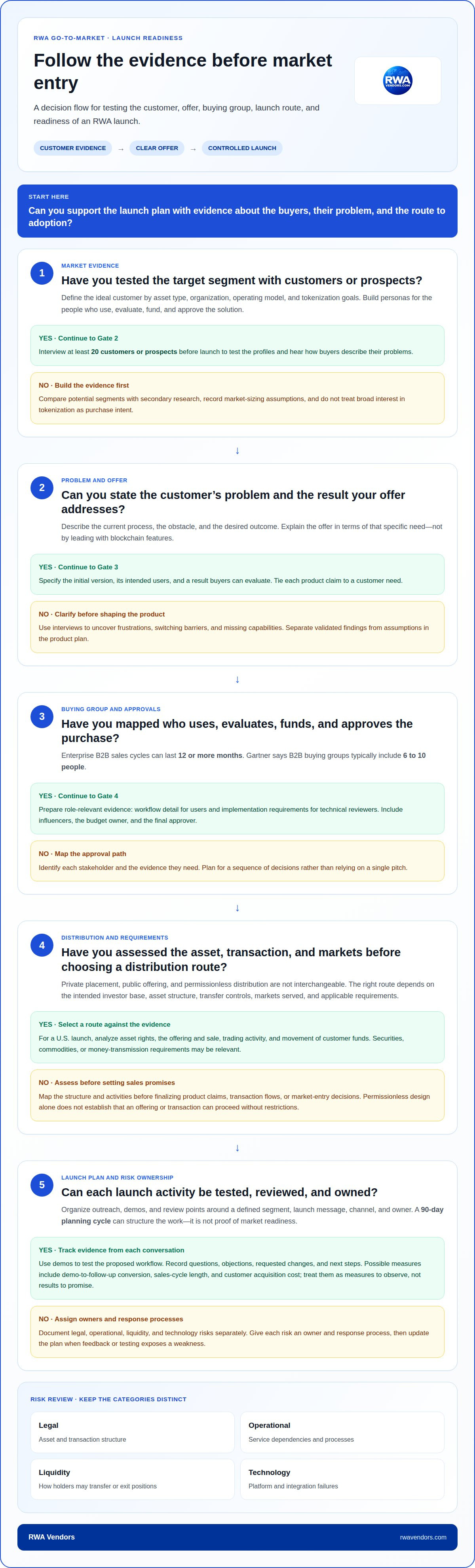
Define an ideal customer profile by asset type, organization, operating model, and tokenization goals. Then build buyer personas for the people who use, evaluate, fund, and approve the proposed solution. Interview at least 20 customers or prospects before launch to test those profiles and learn how buyers describe their problems.
Use secondary research to size and compare potential segments, then assess where your organization can add the most value. For example, an issuer of real estate interests may need a different provider ecosystem than a fund manager. Record the assumptions behind your market sizing, and don’t treat broad interest in tokenization as evidence of purchase intent.
-
Define the Customer Problem and Product
Write down the customer’s current process, the obstacle they face, and the outcome they want. Describe your offer in terms of that specific problem, rather than leading with blockchain features. A platform aimed at issuers, for example, should explain which issuance or investor-management task it addresses and how users would interact with it.
Set a defined target before deciding which features or services belong in the offer. Specify the initial version, its intended users, and the result buyers can evaluate. User interviews can reveal frustration with existing solutions, switching barriers, and missing capabilities. Tie each claim to a customer need, and separate validated findings from assumptions in the product plan.
-
Plan Market Entry and Customer Outreach
Build a marketing plan around a defined segment, launch message, channel, and owner for each activity. A 90-day planning cycle can organize outreach, demos, and review points without treating the calendar as proof of market readiness. Tailor sales conversations to the user first, then prepare materials that help users explain the value to budget owners and approvers.
Use demos to test whether the proposed workflow solves the stated problem. After each conversation, capture questions, objections, requested changes, and next steps. For a hypothetical fund issuer, track demo-to-follow-up conversion, sales-cycle length, and customer acquisition cost. These measures show where effort stalls; they aren’t performance results to promise before the launch produces evidence.
-
Assess Applicable Rules and Launch Risks
For a U.S. launch, tokenization alone does not determine which rules apply. Analyze the asset rights, offering and sale, trading activity, and movement of customer funds to assess whether securities, commodities, or money-transmission requirements may be relevant. The structure and activities matter, so map them before finalizing product claims, transaction flows, or market-entry decisions.
Document legal, operational, liquidity, and technology risks separately. Legal analysis concerns the asset and transaction structure; operational review covers service dependencies and processes. Liquidity planning examines how holders may transfer or exit positions, while technology review considers platform and integration failures. Assign an owner and response process to each risk, then update the launch plan when customer feedback or testing exposes a weakness.
B2B sales cycles and stakeholder approvals
Choose distribution based on the intended investor base, asset structure, transfer controls, and markets served. Private placement, public offering, and permissionless distribution are not interchangeable; the right route depends on these factors and applicable requirements.
- Map the buying group and approval path. Enterprise B2B sales cycles can last 12 or more months, so plan for a sequence of decisions rather than one pitch. According to Gartner, B2B buying groups typically include 6 to 10 people. Identify the user, technical and operational evaluators, influencers, budget owner, and final approver. Give each persona evidence relevant to its role, such as workflow detail for users and implementation requirements for technical reviewers.
- Select a distribution route against customer and asset requirements. Compare private placement, public offering, and permissionless distribution by intended investor access, jurisdiction, transfer controls, transaction process, and ongoing operating model. A permissionless design does not itself establish that an offering or transaction can proceed without restrictions. Align the route with the asset rights and applicable requirements before setting sales promises or opening access.
- Choose channels that reach the target customer. Match direct sales, intermediary relationships, platform integrations, and educational content to buyer behavior and approval needs. Direct outreach can support complex stakeholder discussions; a partner channel may provide access to an established issuer or investor network. Define each channel’s role, handoff, and follow-up action. Coordinate launches across sales, marketing, product, and operations so prospects receive consistent information.
- Document the sales motion and launch sequence. Use “sales motion” to describe how prospects move from initial engagement through evaluation, approval, and onboarding. Set stage criteria, owners, required materials, and the next action for each opportunity. For example, an issuer targeting fund managers might sequence an introduction, an operational review, a product demonstration, and stakeholder approval. Track stage progression and reasons for delay, then revise the playbook using evidence rather than anecdotal enthusiasm.
- Coordinate distribution partners and improve the process. Set clear responsibilities for referrals, prospect qualification, demonstrations, and ongoing communication. Establish shared messaging and escalation paths before joint launches. Review conversion between stages, sales-cycle length, and stakeholder objections to identify where the channel or approval process loses momentum. Providers supporting issuer launches can make their capabilities discoverable to RWA issuers.
What are the key components of a go-to-market strategy?
Build the competitive picture before committing resources to a segment or sales motion. Combine market evidence, competitor analysis, and direct audience research to identify where your offer can credibly stand apart.
Analyze Competitors and the Market
Map the competitive landscape by customer segment, asset type, and problem solved. Compare alternatives by their stated value propositions, target audiences, delivery models, and customer experience. Include existing providers and the processes customers use today, since an internal workflow can compete with a new product just as directly as another platform.
- Define the market boundary. Specify the asset category, customer type, and use case under review. For example, tokenized real estate and tokenized fund interests may involve distinct customer needs and provider ecosystems. Keep the comparison focused on the segment your offer intends to serve.
- Assess alternatives consistently. Record each alternative’s audience, core promise, route to market, and apparent gaps. Separate observable facts from assumptions. Avoid treating a competitor’s marketing language as proof of customer satisfaction or product performance.
- Identify a defensible opening. Look for unmet needs, underserved customer profiles, or friction in current processes. A useful opportunity connects a specific buyer problem to a capability your product or service can deliver. Don’t define differentiation as a feature list without explaining its value to the target market.
Conduct User and Brand Research
Use user research to understand how buyers describe their priorities, evaluate options, and decide whether to change. Secondary research helps size and assess markets, while brand research provides original data about your organization and competitors. Keep findings tied to a defined audience; broad conclusions can obscure the needs of a specific segment.
- Gather evidence from relevant users. Ask about current workflows, decision criteria, and reasons for staying with or switching from an existing approach. Compare responses across personas, such as an operational user and a budget owner. Note repeated concerns, but preserve meaningful differences between roles.
- Test brand perception. Explore which capabilities customers associate with your organization and where they see a difference from alternatives. Check whether intended messaging matches those perceptions. If a claim about expertise or service does not resonate with the audience, refine the proof and wording rather than repeating it more loudly.
- Translate findings into a market choice. Combine research with segment fit, customer need, and competitive position. Prioritize the audience where your offer can create the clearest value, then align messaging and investment with its requirements. Treat the resulting market view as a working input, and revisit it when buyer feedback or market conditions change.
Positioning, messaging, channels, and pricing
Turn the market choice into a clear value proposition, buyer message, channel plan, and pricing structure. Gartner Group identifies pricing, sales and channels, and the buying journey as go-to-market tactics.
Set Positioning and Messaging
- Define the position your offer can support. State which target audience you serve, what problem you solve, and why your approach fits. Tie each claim to a product capability or service outcome. For example, a tokenization platform serving fund managers might position its offer around simplifying a specific operational workflow, rather than claiming broad superiority.
Check that your position matches the service mix. A low-price position, for instance, should not rely on claims of superior client service unless the offer supports both. Avoid feature lists without customer value; explain how a capability addresses a buyer priority or market gap.
- Build messages for buyer priorities and journey stages. Connect the value proposition to the audience’s initiatives, challenges, and desired business outcomes. A technical evaluator may need integration details, while a budget owner may focus on business fit. Create consistent talking points for each persona, then adapt the evidence and detail to the buyer’s stage.
Use a values matrix to connect personas, business goals, and customer needs. For example, map an issuer’s operational objective to the concerns of its technology and finance stakeholders. Give users concise materials they can share internally, so they can explain the offer to decision-makers without changing its meaning.
Plan Channel Deliverables and Partnerships
- Choose channels for the audience and desired action. Combine inbound approaches, such as educational content and social media, with outbound approaches, such as paid marketing and direct campaigns. Select channels based on audience preference and their contribution to qualified engagement. For an institutional audience, technical explainers can support early research, while a live demonstration may serve later evaluation.
Coordinate each launch deliverable across web, email, communications, social media, paid marketing, and content. Assign an owner, deadline, and intended action to every item. A launch calendar should show which asset supports awareness, evaluation, or conversion, rather than treating publication as the outcome.
- Set partner roles and measure channel contribution. Define how a channel partner introduces prospects, shares approved messaging, and hands opportunities to the sales team. Align partner materials with the same value proposition and buyer-stage needs. Track which channels generate relevant conversations and move opportunities forward, then adjust effort toward the routes that contribute to pipeline.
- Structure pricing around value and buyer expectations. Consider what target customers are willing to pay, comparable competitor prices, and how well the offer addresses customer needs or market gaps. Specify whether payment is one-time or recurring; for subscriptions, define monthly or annual billing. Test the model against unit economics before using discounts as a differentiator, since low pricing can constrain later increases and invite price competition.
Sales-led, product-led, hybrid, account-based, and partner-led models
Select a sales model that fits the product, buyer journey, and organization’s capacity. Integrate product decisions with go-to-market planning so positioning, messaging, and budget support the same market choice.
- Assign clear cross-functional ownership. Bring product, product marketing, sales, communications, customer success, and content teams into launch planning as relevant. Product teams define the offer and user experience; marketing translates the value proposition; sales manages prospect engagement; customer success prepares for adoption. For example, a tokenization platform launch needs consistent product explanations across demos, sales materials, and onboarding.
- Match the model to how buyers evaluate the offer. A sales-led motion uses representatives to prospect, engage, and close opportunities. A product-led motion lets product use and experience drive evaluation. A hybrid approach combines self-guided discovery with sales support for complex decisions. An account-based model focuses personalized efforts on selected high-value accounts, while partner-led growth uses channel relationships to reach an audience.
- Connect product choices to the route to market. Decide which features, onboarding steps, and support elements matter for the selected buyer and sales motion. A platform selling to institutional issuers may need sales enablement and stakeholder resources alongside product access. Don’t treat product and go-to-market as separate workstreams; customer feedback from sales conversations should inform product priorities, while product capabilities shape positioning.
- Communicate asset backing and redemption precisely. Explain what asset or rights support the token, what evidence describes that backing, and what redemption terms apply. State eligibility, process, conditions, and limitations in clear investor-facing materials. For example, distinguish a token representing a contractual claim from direct ownership of an underlying asset, and keep sales messaging consistent with the documented structure.
- Build a playbook for each pathway and fund its execution. Specify target accounts or users, messaging, content, sales actions, partner responsibilities, and handoffs for each model. Set a budget that reflects the required effort, such as sales capacity for a sales-led launch or product education for a product-led motion. Review results across product, marketing, and sales, then adjust the playbook when buyer behavior reveals friction.
RWA Vendors: A marketplace connecting RWA issuers with tokenization technology and professional services
RWA Vendors can support the next stage of your go-to-market plan when you need to identify providers across the tokenization ecosystem. Its directory connects asset issuers with technology and professional services providers, including those working with real estate, funds, securities, and other assets.
Use the directory to explore relevant technology, legal, compliance, and tokenization vendors for different stages of a launch. Providers can use Vendor Directory Listing, Founding Membership, and Lead Generation and Referrals to participate in the marketplace. These offerings connect issuers seeking services with providers presenting their capabilities.
If you’re planning a launch or looking to make your services discoverable, contact RWA Vendors to discuss the next step.
Turn your market plan into a disciplined launch
A durable RWA go-to-market strategy is not a fixed document. Treat it as an operating framework: assign owners, set decision points, and use customer responses to refine execution. As the product moves from planning to market, keep commercial messaging aligned with the asset structure and the experience buyers encounter.
For the next step, make capability gaps visible. RWA Vendors connects issuers with tokenization technology and professional services providers. Its Vendor Directory Listing, Founding Membership, and Lead Generation and Referrals support provider visibility and connections with prospective issuer clients. These options suit organizations that want to present their capabilities within the RWA ecosystem.
Choose a focused next action, then keep the plan accountable to buyer evidence and operational readiness. A deliberate launch builds a stronger basis for learning and adjustment.
Move forward with a clear market focus and a sales model your organization can execute.
Frequently Asked Questions
How much should the product or service cost for each customer group?
Set a separate price for each customer group by matching willingness to pay with the offer’s value and delivery burden. Compare alternatives within that segment, then test whether expected revenue covers acquisition, onboarding, support, and infrastructure costs. For example, a self-service software tier may suit smaller issuers, while institutional buyers may need tailored implementation. Use buyer interviews and sales outcomes to refine packaging; don’t assume one price fits every purchasing process.
What are the main customer segments and use cases for tokenized real-world assets?
Common segments include asset issuers, fund managers, real-estate owners, financial institutions, and businesses building tokenization infrastructure. Their use cases vary: a real-estate owner may explore digital representations of asset interests, while a fund manager may focus on investor administration. Banks and capital-markets participants may evaluate infrastructure for issuance or trading workflows. Define the segment by its underlying asset, operational need, and intended users, rather than grouping every prospect as a single “RWA buyer.”
What are the costs, fees, and revenue models for an RWA go-to-market strategy?
Build the financial model from project-specific cost categories, not a generic launch estimate. Consider product development, integrations, compliance work, distribution, sales, onboarding, and ongoing operations. Potential revenue models include subscriptions, platform or service fees, transaction-based charges, and tailored implementation work. Their suitability depends on the offer, buyer preferences, usage pattern, and unit economics. Model expected revenue against acquisition and servicing costs, then test assumptions against actual sales and retention data.
Which custody, tokenization, compliance, and secondary-market providers support RWA launches?
Provider needs depend on the product structure and operating model. A launch may require tokenization technology, custody, compliance tools or services, and a secondary-market venue. RWA Vendors’ directory helps issuers find providers across categories including custody, tokenization, compliance, and trading. Shortlist candidates by role, supported asset and workflow, integration needs, and operating jurisdictions. Map how each provider connects to the others so handoffs, responsibilities, and customer experience remain clear.
What metrics should an RWA company track to measure go-to-market performance?
Track customer acquisition cost, sales expense per dollar of sales, conversion rate, and sales-cycle length to assess the commercial funnel. Add revenue, retention, customer feedback or satisfaction, and market share to understand outcomes beyond initial conversion. For example, compare conversion by channel and buyer segment to locate friction, then review retention after onboarding. Define each metric consistently and connect it to a decision, such as reallocating channel effort or improving a specific stage.
Disclaimer
This article is provided by RWAVendors.com for general informational and educational purposes only. It does not constitute legal, financial, investment, tax, regulatory or other professional advice, or an offer, solicitation, recommendation or endorsement of any company, product, service, token, security or investment. RWAVendors.com is an informational vendor directory and does not sell, issue, broker, custody or facilitate transactions involving cryptocurrencies, digital tokens, tokenized assets, securities or investment products. Some vendor listings and references may involve paid advertising, sponsored placement or membership relationships. These relationships do not guarantee a vendor’s qualifications, regulatory status, performance or suitability. Information may be incomplete, outdated or subject to change. You should independently verify all information, conduct your own due diligence and consult qualified professionals before making any business or investment decision. RWAVendors.com is not responsible for the content, services, representations or actions of third-party vendors or linked websites.


