

A custody provider can have strong security credentials and still be a poor institutional fit. Evaluating institutional custody providers means comparing how client assets are segregated, what insurance covers, how operational controls work, and whether audits, incident response, and jurisdictional compliance meet your organization’s needs.
Custody risk extends beyond private-key protection. Legal structure, access permissions, reporting workflows, recovery arrangements, and the treatment of tokenized assets all affect how a provider supports institutional operations. A feature list alone rarely shows how these elements work together.
This guide explains how to assess each area and compare providers using evidence relevant to your institution. You’ll learn what asset segregation and insurance terms mean in practice, which operational and audit materials clarify control effectiveness, how to evaluate incident readiness, and why licensing and regulatory scope vary by jurisdiction. The result is a structured way to judge fit, not a single score or security claim.
Key Takeaways
- Assess how client assets are separated and whether insurance terms clearly define covered assets, limits, and exclusions.
- Look beyond security tools to operational controls, independent audit evidence, and incident response arrangements.
- Compare licensing and compliance against the jurisdictions where your institution and assets operate.
- Weigh custody models against your governance, reporting, and workflow requirements, not just headline features.
- Use RWA Vendors to discover verified providers across custody, compliance, and other tokenization services.
Client asset segregation and insurance coverage
Onboarding typically establishes the institution’s account structure, authorized users, identity checks, and asset scope. Account opening defines approval rights and transfer instructions. Initial transfers go to designated custody accounts and are reconciled against account records.
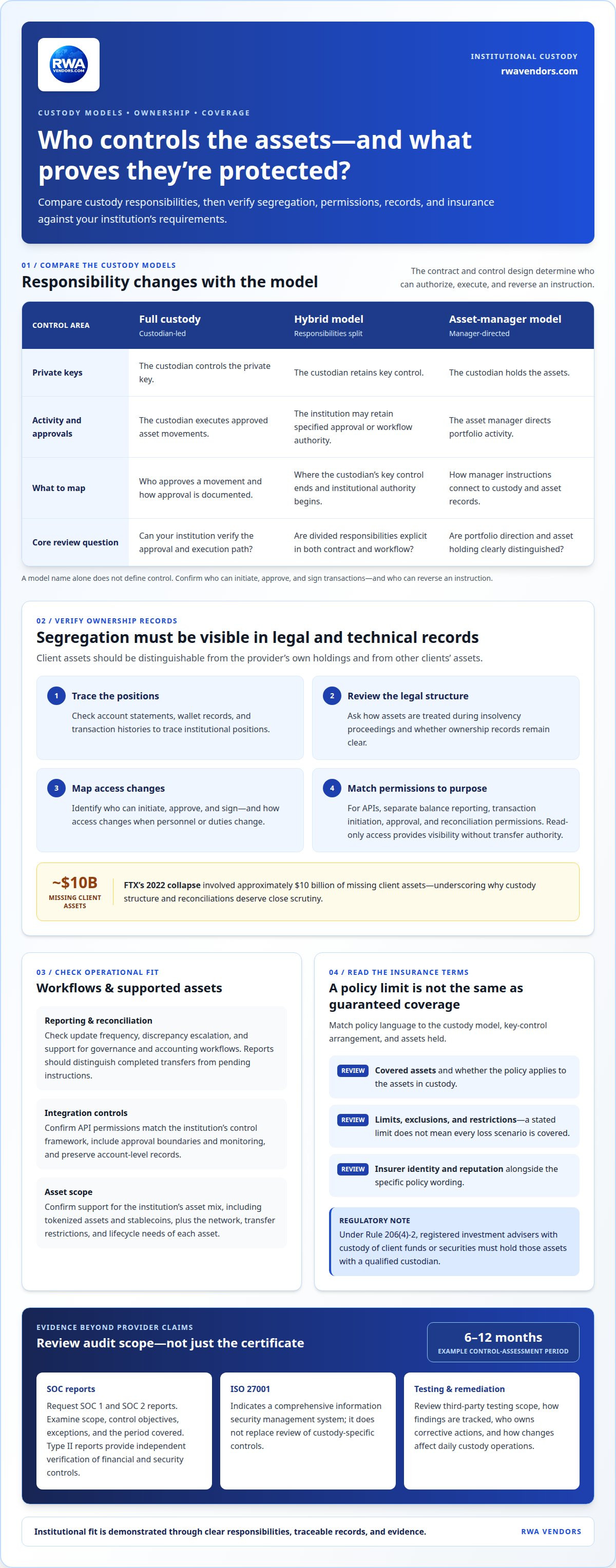
Start by identifying the custody model. With full custody, the custodian controls the private key and executes approved asset movements. A hybrid model divides responsibilities, such as a custodian retaining key control while the institution keeps specified approval or workflow authority. In an asset-manager model, the manager directs portfolio activity while a custodian holds the assets. The contract and control design determine who can authorize, execute, and reverse an instruction.
Segregation describes how client assets are separated from a provider’s own holdings and from other clients’ assets. Examine both the legal account structure and the technical records. An institution should be able to trace its positions through account statements, wallet records, and transaction histories. Ask how the provider handles assets during insolvency proceedings and whether the account arrangement supports clear ownership records. FTX’s 2022 collapse involved approximately $10 billion of missing client assets, underscoring why custody structure and reconciliations deserve close scrutiny.
Key control is separate from asset ownership. Identify who can initiate, approve, and sign a transaction, and how access changes when personnel leave or duties shift. Cold storage can limit online exposure, but institutions still need workable transfer procedures. Protecting a private key offline does not by itself establish that client assets are segregated or account permissions are appropriate.
For API integration, map each connection to its purpose: balance reporting, transaction initiation, approval, or reconciliation. Confirm that API permissions match the institution’s control framework. A read-only connection provides visibility without transfer authority; transaction permissions need clear approval boundaries and monitoring. Integration should preserve account-level records rather than blur custody positions across internal systems.
Supported assets also affect operational fit. Confirm whether the provider supports the institution’s digital asset mix, including tokenized assets and stablecoins, and how it handles onboarding new assets. A custody platform designed for established cryptocurrencies may not support a token’s network, transfer restrictions, or lifecycle requirements.
Insurance needs equally careful interpretation. Review covered assets, limits, exclusions, restrictions, and the insurers’ identities and reputations. A stated policy limit does not mean every loss scenario is covered. Match policy language to the custody model, key-control arrangement, and assets held. Under Rule 206(4)-2, registered investment advisers with custody of client funds or securities must hold those assets with a qualified custodian.
Operational controls, audits, and incident response
Cybersecurity combines private-key safeguards, access controls, monitoring, and tested recovery plans. Providers manage disaster recovery through business continuity planning, geographic redundancy, backup key management, and incident response procedures.
Reporting, Reconciliation, and Audit Infrastructure
Reporting and reconciliation systems connect custody activity, asset balances, and transaction approvals in a clear record. Institutional teams need a traceable view of positions and exceptions across internal and provider systems.
Assess how often records update, how discrepancies are escalated, and whether reports support your governance and accounting workflows. For example, uploading trade files through an online portal can reduce manual processing compared with sending individual email directives, while preserving approval controls. Reports should distinguish completed transfers from pending instructions, allowing operations teams to investigate mismatches instead of relying on a single balance snapshot.
Independent Audits and Security Certifications
Independent audits assess whether defined controls operate as intended, while security certifications evaluate an organization’s management framework. These materials give institutional investors evidence beyond a provider’s own description of its security program.
Request SOC 1 and SOC 2 reports, then examine the scope, control objectives, exceptions, and period covered. SOC 1 Type II and SOC 2 Type II reports provide independent verification of financial and security controls. A control assessment may cover a period usually lasting 6 to 12 months. ISO 27001 indicates a comprehensive information security management system, but it does not replace reviewing custody-specific controls.
Security Architecture and Third-Party Audits
Security architecture combines technical safeguards with oversight and defined staff responsibilities. Its design matters because private keys, transaction approvals, and system access can each create operational risks.
Map how key storage, permissions, monitoring, and transaction testing work together. Review whether access is restricted by role and unusual activity triggers escalation. Third-party security testing can reveal weaknesses in systems and procedures, but its value depends on scope and remediation. Ask how findings are tracked, who owns corrective actions, and how changes affect controls in daily custody operations.
Due Diligence and Audit-Report Review
Due diligence is a structured review of governance, controls, audit evidence, and operational resilience. It helps institutions assess whether a provider’s documented processes meet their risk management requirements.
Read audit exceptions alongside management responses, and identify any systems or services outside the report’s scope. Review leadership oversight, financial reporting standards, service-level commitments, disaster recovery, and uptime records. Incident response deserves the same scrutiny: establish how the provider detects, contains, communicates, and resolves an event. Explore custody-provider listing options for a structured way to present these capabilities to asset issuers.
Regulatory compliance and licensing by jurisdiction
Licensing, supervision, and compliance frameworks differ by jurisdiction. Evaluate the legal entity holding assets, its permitted activities, and the rules that apply to your institution.
Qualified Custodian Obligations
Qualified custodian status concerns which entities may hold client funds or securities for registered investment advisers. Under the Investment Advisers Act of 1940, that status affects how advisers structure custody arrangements and document oversight.
In the United States, Rule 206(4)-2 requires registered investment advisers with custody of client funds or securities to use a qualified custodian. The relevant question is not simply whether a provider calls itself a custodian. Consider the legal entity, the assets in scope, the account arrangement, and whether the custody relationship fits the adviser’s obligations.
Separate legal qualification from operational suitability. A provider’s permissions may cover some activities or assets but not others. Map the assets and services in your arrangement against the provider’s licensing scope, including any sub-custodian’s role. This helps clarify accountability if different entities handle custody, transfers, or key management.
Regulatory Supervision and Compliance
Regulatory supervision is oversight by a government authority under a licensing or charter framework. It matters because jurisdiction determines which rules and supervisory processes apply to the custody entity.
For US providers, the Office of the Comptroller of the Currency (OCC) affirmed in 2020 that banks can offer crypto custody through Interpretive Letter 1170. In 2025, OCC guidance expanded to allow federally chartered banks to custody crypto and use sub-custodians when sound risk management is in place. Interpretive Letters 1183 and 1184 form part of that guidance.
Distinguish federal charters from state trust company licenses, including licenses from the New York Department of Financial Services. In Asia, Hong Kong and Singapore have established licensing frameworks for digital asset custody. A provider operating across borders may rely on different regulated entities in different markets.
Compliance review should cover licensing scope, AML controls, KYC procedures, financial crime monitoring, data protection, and independent compliance audits. For a tokenized fund distributed across jurisdictions, map the issuer, custodian, investor locations, and asset network to the relevant regulatory relationships. This makes gaps in supervision or compliance responsibilities easier to identify.
The European Union’s MiCA regulation became fully applicable in December 2024, according to the European Union. Assess how a provider’s European activities and digital-asset services fit the applicable framework. Compare that scope with its US or Asian operations rather than assuming one license covers every entity or service.
Insurance and custody risk management
Insurance is one layer of custody risk management, not a substitute for operational oversight. Compare policy terms with the provider’s custody model and the assets your institution holds.
Insurance Coverage and Exclusions
Insurance coverage defines which losses and assets a policy addresses, subject to its limits, exclusions, and restrictions. A headline coverage amount alone cannot show whether a specific custody event qualifies for a claim.
Map each policy term to a concrete scenario. For example, examine how the wording treats a crypto asset held in cold storage, a tokenized asset transferred through an exchange, or an incident involving an authorized operator. These examples are prompts for interpreting policy language, not assumptions that coverage applies. Record which assets are covered and which conditions could affect a claim.
Review limits alongside exclusions and restrictions. A policy may describe a broad category while defining narrower conditions elsewhere in its wording. Note whether coverage applies to assets held directly, assets handled by another entity, and transfers between custody accounts. Identify the insurers and assess their identities and reputations as part of your review.
Keep a coverage schedule for the institution’s asset inventory. For each asset class, record the relevant policy wording, applicable limit, and any exclusion that could affect recovery. If a tokenized fund uses multiple custody arrangements, map each separately rather than treating the entire portfolio as one insured position.
Insurance in Custody Risk Management
Insurance supports custody risk management by addressing defined loss scenarios within a wider system of controls. Investors need to understand how policy coverage relates to key management, account structure, and day-to-day operations.
Build a risk map connecting each operational exposure to its control and policy treatment. For example, trace a transfer from instruction through approval and execution, then identify the records that show what happened. Compare that path with policy terms for covered assets, restrictions, and exclusions. This makes gaps between operational oversight and insurance scope visible.
Distinguish risks that insurance may address from those requiring preventive controls. Access reviews, transaction approvals, reconciliation, and incident procedures support oversight; policy language determines whether a resulting loss falls within coverage. An exchange-connected transfer, for instance, should be assessed against both the provider’s operational process and the relevant policy conditions.
Revisit the risk map when assets or custody arrangements change. Adding a tokenized security, changing an account structure, or introducing a new transfer workflow can alter the exposures under review. Keep a record linking each change to relevant coverage terms, the operational owner, and the escalation process. This gives investment committees a clear basis for discussing residual risk and the limits of insurance.
Institutional custody provider comparisons
Compare providers using the same asset profile, workflows, and governance needs. Custody fees and minimum balance requirements are set by each provider and depend on the custody model, asset mix, transaction activity, and reporting or integration needs. Compare proposals on equivalent terms, since a lower fee may reflect differences in services or controls.
When evaluating institutional custody providers, focus on operational fit rather than brand recognition. For each provider, record supported assets, custody arrangements, access permissions, reporting capabilities, and jurisdictional coverage. A provider suited to a portfolio of established crypto assets may not support the network or transfer restrictions of a tokenized fund. A stablecoin workflow may also require different operational handling from a security token.
Compare storage and transaction security as a connected system. Leading crypto custodians typically keep 90-95% of assets in cold storage. That figure is a comparison point, not a complete security assessment. Examine how the remaining assets are protected, how transfers are authorized, and whether multi-signature or MPC technology, hardware security modules, access controls, monitoring, and security testing fit your risk framework.
Governance distinguishes a credible proposal from a workable relationship. Assess how the provider supports your approval hierarchy, reporting requirements, stakeholder expectations, and operational workflows. For example, an investment manager may need portfolio-level reporting, while its operations team needs transaction-level records and clear escalation routes. Compare how well each provider can meet those requirements without creating manual workarounds.
Use a weighted scorecard to make differences visible. Set criteria for asset support, control design, audit evidence, regulatory scope, incident response, and service-level commitments. Record evidence and open issues beside each score so decision-makers can distinguish documented capabilities from broad claims. This framework for evaluating institutional custody providers keeps comparisons consistent across governance and operational requirements.
Assess how each provider improves its services over time. Ask how client feedback has changed reporting, workflows, or platform capabilities, and how the provider identifies operational trends and process improvements. Compare its approach to technology enhancements and long-term platform development. These questions help reveal whether the relationship can adapt as your tokenized asset program evolves.
Before selection, discuss the comparison with legal, compliance, technology, and operations stakeholders. A custody model that works for the investment team may still create integration or oversight gaps elsewhere. A shared assessment lets institutional investors weigh trade-offs across security, governance, supported assets, and service scope. Present your custody capabilities to asset issuers
Fees and minimum balance requirements vary by provider and depend on the custody model, asset mix, transaction activity, and reporting or integration needs. Compare proposals on equivalent terms, since lower fees may reflect differences in services or controls.
RWA Vendors
RWA Vendors helps asset issuers find verified tokenization platforms and service providers across the real-world asset ecosystem. Once you’ve defined custody requirements, use the directory to identify providers whose capabilities align with your asset type, jurisdiction, and operating model. The ecosystem also includes technology, legal, and compliance vendors involved in tokenization, so you can consider custody alongside related service needs.
This is useful when building a shortlist, mapping service-provider roles, or comparing options for tokenized real estate, funds, securities, and other assets. RWA Vendors connects issuers with providers across these stages, bringing relevant categories into view while leaving institutional due diligence in your hands.
Move from assessment to a stronger provider ecosystem
A disciplined process for evaluating institutional custody providers can also clarify what your tokenization program needs next. Use your assessment to align internal stakeholders, define unresolved requirements, and identify how custody connects with technology, legal, and compliance support. As your asset strategy develops, this wider view can keep provider decisions aligned with the program’s direction.
RWA Vendors connects asset issuers with verified tokenization platforms and service providers. Its Vendor Directory Listing, Founding Membership, and Lead Generation and Referrals offer different ways to participate in the ecosystem. For issuers, the directory is a starting point for discovering providers across real-world asset tokenization; for vendors, these offerings create routes to visibility and business connections.
Take the next step with a clear view of your requirements and the provider relationships your program needs to advance.
Frequently Asked Questions
What services do institutional custody providers offer?
Institutional custody providers generally safeguard digital assets and support authorized transfers, account administration, and portfolio reporting. Some also provide connectivity for trading or fund operations, while others focus on storage and transaction processing. Scope varies by asset type and arrangement. For example, a fund issuer may need position records and controlled distributions, while an investment manager may prioritize delegated approvals and consolidated reporting.
How are institutional custody providers evaluated and compared?
Compare providers against shared requirements, then record the evidence supporting each assessment. Include asset support, custody structure, control responsibilities, reporting formats, service scope, and jurisdictional coverage. For example, a provider that supports a particular token network may still lack the workflow your transfer agent needs. A comparison matrix helps decision-makers identify these differences and weigh them alongside governance and operational fit.
What security controls and certifications should institutional custodians have?
Assess whether security controls cover both technology and staff access, then examine independent evidence. SOC reports and ISO 27001 certification can inform the review, but their scope matters. For example, a report covering corporate systems may not address every custody workflow. Examine control exceptions and management responses, and map relevant findings to the processes your institution uses for transaction approvals, access changes, and escalation.
What regulatory requirements apply to institutional custodians in the United States?
In the United States, Rule 206(4)-2 requires registered investment advisers with custody of client funds or securities to use a qualified custodian. The Investment Advisers Act of 1940 is relevant to qualified-custodian status. This requirement concerns advisers and assets within its scope, not every digital-asset business. Review the custody entity’s legal status and the adviser’s specific arrangement when documenting compliance responsibilities.
How do institutional custody providers handle asset segregation and bankruptcy protection?
Providers use account structures and records to distinguish client assets from proprietary holdings and other accounts. Segregation supports clear ownership records, but does not by itself guarantee recovery in bankruptcy. Legal ownership, contractual arrangements, and the insolvency framework governing the custody entity are also relevant. For example, balances and transfers are easier to trace when account statements align with wallet records.
What insurance coverage do institutional custody providers offer, and what are its limits?
Coverage varies by policy and custody arrangement; no single scope applies to every provider. Review which assets and loss events are covered, along with limits, exclusions, restrictions, and insurer identity. A stated limit does not establish that a particular incident qualifies for a claim. For example, policy wording may treat directly held assets differently from assets handled through another entity.
What reporting, audit, and integration capabilities should institutions assess?
Assess whether reporting supports reconciliation across custody records and your internal systems. Confirm that exports or integrations distinguish completed transactions from pending instructions and preserve useful timestamps and account references. For example, operations teams may need to match custody balances against fund-administration records during a reporting cycle. Audit materials should also make control scope and exceptions clear enough for internal risk and compliance teams to review.
What risks and red flags should institutions look for when selecting a custody provider?
Look for unclear responsibility between the custodian and subcontractors, unsupported asset types, unexplained reconciliation differences, and procedures relying on informal approvals. A mismatch between the contract and the actual transfer workflow is another warning sign. For example, if operations teams cannot identify who owns an exception or how it reaches decision-makers, oversight may break down. Document unresolved issues and assess their governance impact before selection.
Disclaimer
This article is provided by RWAVendors.com for general informational and educational purposes only. It does not constitute legal, financial, investment, tax, regulatory or other professional advice, or an offer, solicitation, recommendation or endorsement of any company, product, service, token, security or investment. RWAVendors.com is an informational vendor directory and does not sell, issue, broker, custody or facilitate transactions involving cryptocurrencies, digital tokens, tokenized assets, securities or investment products. Some vendor listings and references may involve paid advertising, sponsored placement or membership relationships. These relationships do not guarantee a vendor’s qualifications, regulatory status, performance or suitability. Information may be incomplete, outdated or subject to change. You should independently verify all information, conduct your own due diligence and consult qualified professionals before making any business or investment decision. RWAVendors.com is not responsible for the content, services, representations or actions of third-party vendors or linked websites.


