

Tokenized real-world assets exceeded $24 billion in total value by February 2026. Asset tokenization represents ownership of assets through digital tokens, but the market’s significance goes beyond putting assets on a blockchain: it may also reshape how investment access, liquidity and settlement work. The global trends in asset tokenization for 2026 show a shift from experimentation toward practical questions about markets, infrastructure and regulation.
That shift creates opportunities, but also raises practical questions: What does a token represent? How can it be transferred or traded, and which rules apply across borders? This article explains how tokenization works and explores the forces shaping it, from blockchain-enabled liquidity to the tokenization of funds, debt, and property. You’ll gain a clearer view of where the market is moving and what these changes could mean for access to investment.
Key Takeaways
- Understand how a token can represent rights in an asset, and why the legal structure behind that representation matters.
- See how regulatory frameworks are developing while cross-border differences continue to shape market access.
- Compare market growth projections with the practical factors that influence adoption, including infrastructure and investor demand.
- Assess how blockchain may support fractional access, trading and settlement, while recognizing that liquidity depends on market conditions.
- Explore how RWA Vendors’ directory can help issuers find technology, legal, compliance and tokenization vendors for real-world asset projects.
What is Asset Tokenization?
Asset tokenization creates digital tokens that represent ownership or other rights in assets such as funds, securities, real estate, or commodities. A blockchain is a decentralized digital ledger that records transactions. It doesn't, by itself, establish the legal rights represented by a token. The structure linking token ownership to the underlying asset remains central. The global trends in asset tokenization 2026 are increasingly shaped by how institutions use that structure in established financial markets.
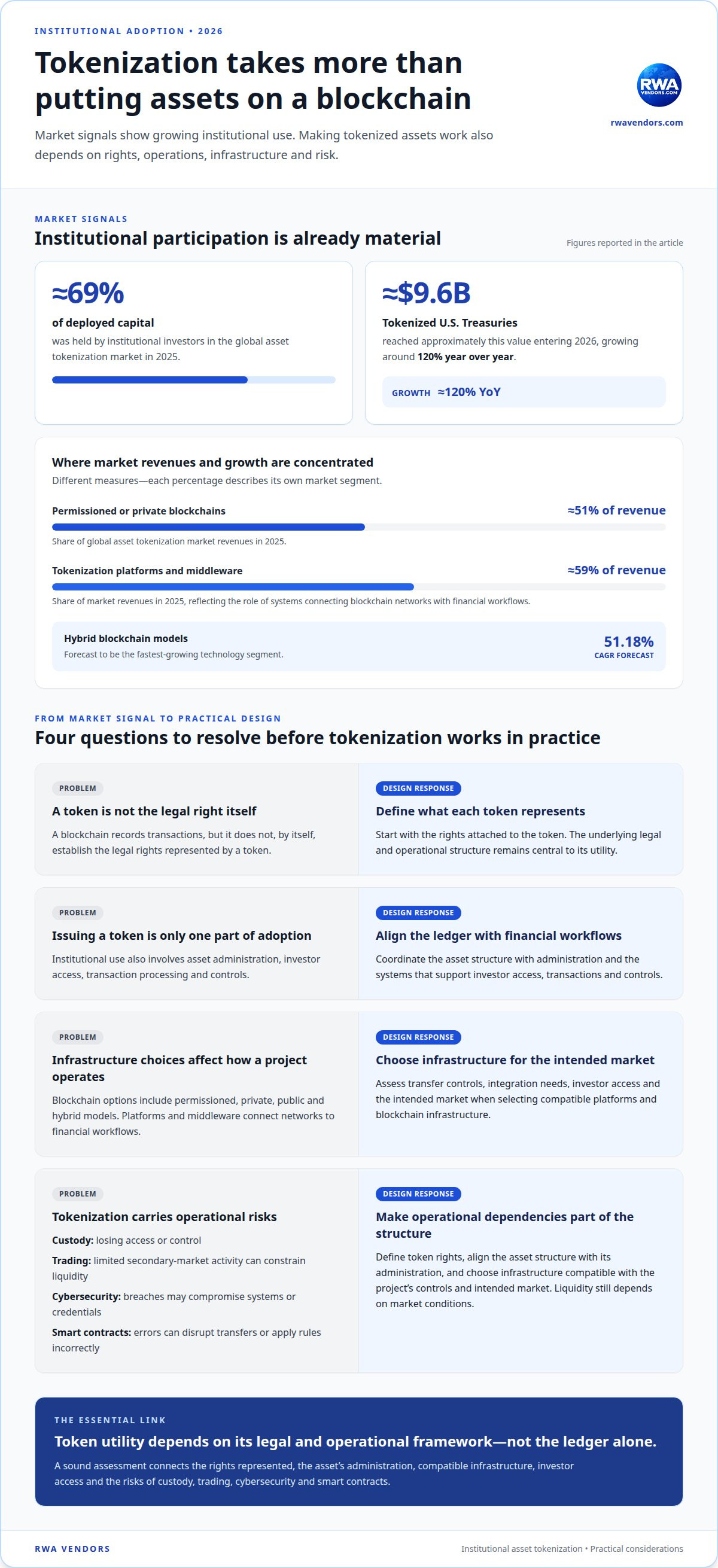
Institutional participation is already material. Institutional investors held approximately 69% of deployed capital in the global asset tokenization market in 2025. Tokenized U.S. Treasuries reached approximately $9.6 billion entering 2026, growing around 120% year over year. These figures point to adoption of familiar financial instruments, not only assets native to crypto markets. Institutional use is one of the global trends in asset tokenization 2026 that connects blockchain systems with existing capital markets.
Tokenized money market funds provide another example. In 2025, DBS integrated tokenized money market funds as collateral, showing how fund interests can connect with established financial activity. For asset managers, tokenization can digitize ownership records and transfers. It can also support new fund or equity structures. The rights represented by each token still depend on the fund’s legal and operational arrangements.
Institutional blockchain adoption involves more than issuing tokens. Firms must align the ledger with asset administration, investor access, transaction processing, and controls. Permissioned or private blockchains accounted for approximately 51% of global asset tokenization market revenues in 2025. Tokenization platforms and middleware accounted for approximately 59%, reflecting the importance of systems that connect blockchain networks with financial workflows.
The major platform categories in 2026 include tokenization platforms and middleware. Blockchain networks include permissioned, private, public, and hybrid models. Permissioned or private chains held approximately 51% of market revenues in 2025. Hybrid models are forecast to be the fastest-growing technology segment, with a 51.18% CAGR.
Risks span custody, trading, cybersecurity, and smart contracts. Custody arrangements can create risks of losing access or control, while limited secondary-market activity can constrain liquidity. Cybersecurity breaches may compromise systems or credentials, and smart-contract errors can disrupt transfers or apply rules incorrectly.
For managers assessing tokenization, start by defining the rights each token represents. Align the asset structure with its administration, then select compatible platforms and blockchain infrastructure. The choice depends on transfer controls, integration needs, investor access, and the intended market. A token’s utility depends on its legal and operational framework.
Regulatory clarity and cross-border fragmentation
Digital-asset regulation is developing through national frameworks, not one global rulebook. In July 2025, the United States passed the GENIUS Act, establishing a federal regulatory framework for payment stablecoins, according to U.S. Congress. The Act provides a clearer framework for U.S. dollar-pegged stablecoins, while issuers face reserve and disclosure expectations. For financial services firms, clarity in one market can support planning, but it doesn't automatically resolve requirements elsewhere.
The GENIUS Act requires U.S. dollar-pegged stablecoins to be backed by 100% reserves. According to U.S. Congress, issuers must also provide monthly disclosures substantiating reserve backing. These provisions give market participants concrete reference points for stablecoin reserves and reporting. They also illustrate why regulatory clarity must be assessed by asset type: rules for payment stablecoins don't by themselves define treatment of tokenized funds, securities, or other assets.
Another U.S. development concerns broader digital-asset market structure. In September 2026, the Senate released new text of the Digital Asset Market CLARITY Act concerning digital-asset market structure and regulatory oversight. Its focus signals ongoing policy work beyond stablecoin payments. For institutions, proposed frameworks can inform planning, but they should be distinguished from enacted rules when assessing opportunities or structuring a project.
Hong Kong offers a separate example of regulatory development. In June 2025, it unveiled a digital-asset strategy introducing a stablecoin licensing framework and a tokenized government-bond programme. That same month, Hong Kong released Policy Statement 2.0 on the Development of Digitized Assets, announcing steps to expand tokenized products and promote real-world asset tokenization. Together, these actions show how jurisdictions may combine licensing approaches with public-sector tokenization initiatives.
Regulatory fragmentation matters because a tokenized asset can involve multiple legal and operational relationships. The issuer, asset, investors, trading venue, and service providers may be connected to different jurisdictions. A workable cross-border plan starts by mapping where each party operates, what rights the token represents, and which markets the offering aims to serve. This map helps identify issues for jurisdiction-specific legal review.
Classification is another key step. A digital asset’s label alone does not determine its regulatory treatment; its structure, rights, and function matter. Firms should distinguish payment stablecoins from tokenized securities or fund interests, then assess the rules relevant to each activity and location. This helps legal, compliance, technology, and financial services teams have clearer discussions.
As 2026 approaches, regulatory clarity remains uneven. The U.S. framework for payment stablecoins, the Senate's market-structure text, and Hong Kong's initiatives illustrate distinct policy tracks. For issuers and institutions, the practical response is to connect each project decision to its asset, jurisdiction, and intended participants. That discipline can help teams pursue cross-border opportunities without assuming one country's framework applies everywhere.
Global market size and growth projections
Published estimates describe a fast-growing market, but they do not converge on one forecast. Published estimates of the global asset tokenization market vary, so they should be compared with care. Other forecasts estimate USD 45.40 trillion by 2034, at a 42.7% CAGR from 2026 to 2034. Other projections also anticipate substantial growth in the global asset tokenization market. These estimates indicate substantial expected expansion, but their different horizons and values matter when comparing them.
The BCG-Ripple report projects tokenized assets could reach approximately USD 18.9 trillion by 2033. Tokenized value had increased nearly 245-fold since 2022. Together, these indicators point to momentum beyond short-lived crypto trading. Growth is increasingly linked to practical uses, including moving assets between financial systems, recording ownership, and supporting settlement. Stablecoins also form part of this infrastructure: their market capitalization reached $307 billion entering 2026. The size of that market alone, however, doesn't measure tokenized asset adoption.
Asset types are growing at different rates. Financial instruments represented 34.08% of the global market in 2025, making them the leading segment. Real estate accounted for approximately 30% that year. These shares show demand across both financial and tangible assets. Forecasts also point to emerging categories: private equity is projected to be the fastest-growing asset type, with an approximately 49.62% CAGR over 2026-2035. Intellectual property is forecast to grow at a 49.11% CAGR over 2026-2034.
Regional projections show varied growth profiles. North America was the largest regional market in 2025. Europe is estimated to grow at a 40.26% CAGR during 2026-2034, while Asia-Pacific is forecast to grow at about 48.19% CAGR. For asset managers, these differences make regional infrastructure and market access important planning factors. A fast-growing regional forecast doesn't mean every asset or issuer will experience the same demand.
Use forecasts as scenarios, not as direct measures of realized market value. Check the reported base year, asset categories, and forecast period before comparing figures. A 2034 estimate and a 2035 estimate answer different questions, even when both describe global markets. The most useful signal is whether adoption is supported by repeatable activity, such as asset issuance, investor participation, and settlement processes, rather than projected market size alone.
That distinction helps explain growth driven by utility. Tokenization can connect an asset record with transfer processes and financial workflows, while stablecoins may support payment and settlement. These uses differ from crypto assets whose value is primarily tied to market trading. As frameworks develop, institutions can assess whether tokenization improves a specific process, such as collateral use or ownership administration. The opportunity lies in operational utility that can be measured, while forecasts remain estimates, not realized outcomes.
Blockchain-enabled liquidity and access to investments
Tokenization can divide an asset’s economic interests into smaller digital units. That structure can lower a minimum entry barrier: a $1 million asset, for example, may be represented through fractional ownership rather than one indivisible holding. The token does not change the asset’s underlying value or automatically grant every holder identical rights. Those rights depend on the offering’s legal and operational design.
Fractional models can broaden access to asset classes such as real estate, funds, and securities. Smaller units may allow investors to commit less capital to one asset and spread exposure across holdings. However, access still depends on the offering’s eligibility criteria and applicable securities rules. Tokenization does not remove accredited-investor requirements; relevant rules depend on the jurisdiction and asset structure.
Liquidity is a separate consideration. A token may be technically transferable without an active secondary market. Buyers, sellers, trading arrangements, transfer restrictions, and reliable asset information all affect whether an investor can exit. Blockchain can record transfers and support automated processes, but it cannot create market demand on its own.
Some token models are designed for 24/7 trading, unlike markets limited to set trading hours. In 2025, the NYSE announced a dedicated venue for trading and settling tokenized securities 24 hours a day, 7 days a week. The announcement illustrates how market infrastructure is adapting; continuous availability still depends on the venue, eligible participants, and functioning settlement arrangements.
Settlement is another potential advantage. Tokenization can connect transaction records and asset transfers on a shared ledger, supporting near-real-time settlement. In practice, the outcome depends on the systems handling payments, asset records, compliance controls, and custody. Faster processing may reduce delays between trade execution and settlement, but it does not eliminate the need for operational safeguards.
There is no single cost comparison that applies to tokenized and traditional assets. Issuance, platform, custody, compliance, and secondary-trading costs depend on the asset and operating model. A useful comparison weighs those costs against settlement speed, transfer processes, and investor access.
For U.S. funds, the SEC permits ETFs to include up to 15% illiquid holdings as of February 2018. This provides a reference point for understanding that access to an investment does not guarantee easy resale. Tokenized funds and other offerings still need clear liquidity arrangements and transfer rules.
Retail investors are forecast to be the fastest-growing investor type in the global asset tokenization market, at approximately 47% CAGR through 2035. That projection makes investor access an important innovation test. Issuers should distinguish lower entry thresholds from broad eligibility, and trading access from actual liquidity. Those distinctions help investors assess what token ownership provides.
Real-world asset tokenization
Real-world asset tokenization links digital tokens to rights in assets outside native blockchain markets. Examples include real estate, government debt, private credit, commodities, and corporate bonds. Tokenized real-world assets exceeded $24 billion in total value by February 2026, after growing 266% in 2025. The figures show a market moving beyond proofs of concept, though asset types and measurement methods differ.
A company starts by defining the asset and the rights its tokens will represent. It then maps the legal structure and relevant jurisdictions, selects blockchain and tokenization infrastructure, and plans issuance, custody, investor access, and ongoing asset administration. Legal and technical teams align these choices so the token record reflects the intended rights and operating processes.
Government debt has become a visible use case. Tokenized Treasury assets exceeded USD 7.4 billion in 2025. That activity illustrates how familiar instruments can be represented through blockchain infrastructure while retaining established asset structures. Corporate debt issuance is another potential application of tokenization beyond real estate and fund interests.
Private credit is another significant segment. It accounted for more than 58% of total tokenized real-world asset flows in the first half of 2025. The figure points to use of tokenization for financing structures that connect borrowers and capital providers. It doesn't mean every credit asset is suitable for tokenization; asset documentation, repayment administration, and investor rights remain central to the structure.
Commodities show a different pattern. Entering 2026, gold represented roughly 70% of the $7 billion in tokenized commodity value. This concentration suggests that established, identifiable assets can form a practical starting point. For real estate, tokenization can represent interests linked to property, but it doesn't make the underlying building or its ownership arrangements disappear.
Institutional activity continues alongside the possibility of broader retail access. These trends reflect different needs: institutions may prioritize operational integration, while retail participation depends on the offering’s eligibility and access model.
The key takeaway is to assess the relationship between the asset and its token, not just the technology. A sound project connects clearly defined rights, asset administration, investor processes, and blockchain infrastructure. Issuers considering real estate, funds, securities, or other assets can use a specialist directory to find providers across these stages.
RWA Vendors: A global directory for finding technology, legal, compliance and tokenization vendors
RWA Vendors connects asset issuers with verified tokenization platforms and service providers. Use its global directory to find partners for technology, legal, compliance, or tokenization needs involving real estate, funds, securities, and other assets.
For issuers, the directory helps identify companies supporting different stages of a tokenization project, from infrastructure to professional services. Vendors can use a Vendor Directory Listing or Founding Membership to participate in the ecosystem and connect with relevant market activity.
The directory is a practical next step once your team has defined its asset and needs to map the providers involved. Explore categories aligned with your project, then identify the services that fit its structure and operating needs.
Contact RWA Vendors to discuss your directory needs.
Turn tokenization priorities into a practical next step
The global trends in asset tokenization in 2026 make one priority clear: translate market interest into a defined project scope. Decide which asset rights the token should represent, which investors the project is intended to serve, and what capabilities the operating model requires. Those decisions help issuers identify relevant technology and professional-service partners without treating tokenization as a technology choice alone.
RWA Vendors helps asset issuers discover providers across the tokenization ecosystem. Vendors can use Lead Generation and Referrals to connect with businesses exploring real-world asset projects. Start by defining the role your organization needs to fill, then connect with participants whose capabilities match that need.
Well-scoped projects give teams a stronger basis for moving from exploration to execution. Start with clear requirements, purposeful partnerships, and a measured view of the opportunity.
With a clear mandate and relevant connections, your next step can be grounded in the needs of the asset and its investors.
Frequently Asked Questions
What is the global market size for tokenized real-world assets in 2026?
Tokenized real-world assets exceeded $24 billion in total value by February 2026. This figure refers to tokenized real-world assets, not every market forecast labeled “asset tokenization,” which may use a broader definition. For investors and issuers, the measurement scope matters: figures can vary depending on which asset types, token structures, and on-chain records are counted.
Which asset classes are growing fastest in tokenization in 2026?
Private equity is forecast to be the fastest-growing asset type, with an approximately 49.62% CAGR over 2026-2035. Intellectual property is also forecast to expand quickly, at a 49.11% CAGR over 2026-2034. These are projections, not guarantees of adoption. The asset’s legal structure, investor eligibility, administration, and ability to support transfers all affect whether tokenization fits its practical needs.
Which countries and regions lead in asset tokenization adoption in 2026?
North America was the largest regional market in 2025. Asia-Pacific has the highest regional growth forecast listed, at about 48.19% CAGR, while Europe is estimated to grow at 40.26% CAGR during 2026-2034. These measures answer different questions: current market size identifies an established leader, while growth projections indicate expected expansion. Country-level adoption also varies by asset type and market infrastructure.
How are tokenized assets being used by banks, asset managers, and investors?
Banks can integrate tokenized fund interests into collateral workflows, as DBS did with tokenized money market funds in 2025. Asset managers can use tokenization to represent and administer fund interests digitally. Investors may gain access through smaller units or digital transfer processes, subject to the offering’s terms. Each use case depends on how asset records, investor rights, payments, and operational controls work together.
How do asset-tokenization regulations compare across the U.S., EU, UK, Singapore, and Hong Kong?
Compare regulatory approaches by asset type and activity rather than assuming they are interchangeable. In the U.S., the GENIUS Act established a federal framework for payment stablecoins. Hong Kong introduced a stablecoin licensing framework and a tokenized government-bond programme. Across the five jurisdictions, a practical comparison considers token classification, issuance, distribution, and service-provider roles. These factors shape cross-border project planning.
What market forecasts and adoption trends do analysts expect for tokenized assets through 2030?
Forecasts point to continued expansion, but published estimates use different market definitions and time horizons. The BCG-Ripple report projects tokenized assets could reach approximately USD 18.9 trillion by 2033. Adoption indicators include institutional use of tokenized funds, debt issuance, and investor access models. For a 2030 outlook, distinguish projected market value from observed issuance and use; they measure different stages of market development.
Disclaimer
This article is provided by RWAVendors.com for general informational and educational purposes only. It does not constitute legal, financial, investment, tax, regulatory or other professional advice, or an offer, solicitation, recommendation or endorsement of any company, product, service, token, security or investment. RWAVendors.com is an informational vendor directory and does not sell, issue, broker, custody or facilitate transactions involving cryptocurrencies, digital tokens, tokenized assets, securities or investment products. Some vendor listings and references may involve paid advertising, sponsored placement or membership relationships. These relationships do not guarantee a vendor’s qualifications, regulatory status, performance or suitability. Information may be incomplete, outdated or subject to change. You should independently verify all information, conduct your own due diligence and consult qualified professionals before making any business or investment decision. RWAVendors.com is not responsible for the content, services, representations or actions of third-party vendors or linked websites.


