

The right tokenized Treasury platform provider is rarely a single all-in-one system. Providers may handle different parts of the lifecycle, from issuance and investor distribution to custody, trading, and blockchain infrastructure. The key is to identify which functions each platform supports and how those services fit together.
A provider should explain more than its tokenization technology. You also need a clear picture of how a Treasury or money market fund product is issued, who can access it, where assets are held, how transfers work, and which blockchain networks it supports.
This guide explains the main provider roles and the features that distinguish tokenized Treasury and money market fund products. You’ll learn how issuance, distribution, custody, secondary-market trading, and blockchain support fit into the broader platform landscape, so you can assess the infrastructure behind each offering.
Key Takeaways
- Separate the platform roles behind issuance, investor access, custody, and secondary-market activity to see where provider capabilities begin and end.
- Understand how blockchain support and token standards affect compatibility, transfer controls, and the way a product fits into digital asset infrastructure.
- Distinguish Treasury and money market fund token structures by how they represent ownership and deliver yield.
- Compare provider examples by function rather than assuming one platform covers every part of the operating model.
- Use the provider landscape to identify the infrastructure and professional services that may be relevant to your tokenization project.
Issuance, distribution, custody, and secondary-market infrastructure
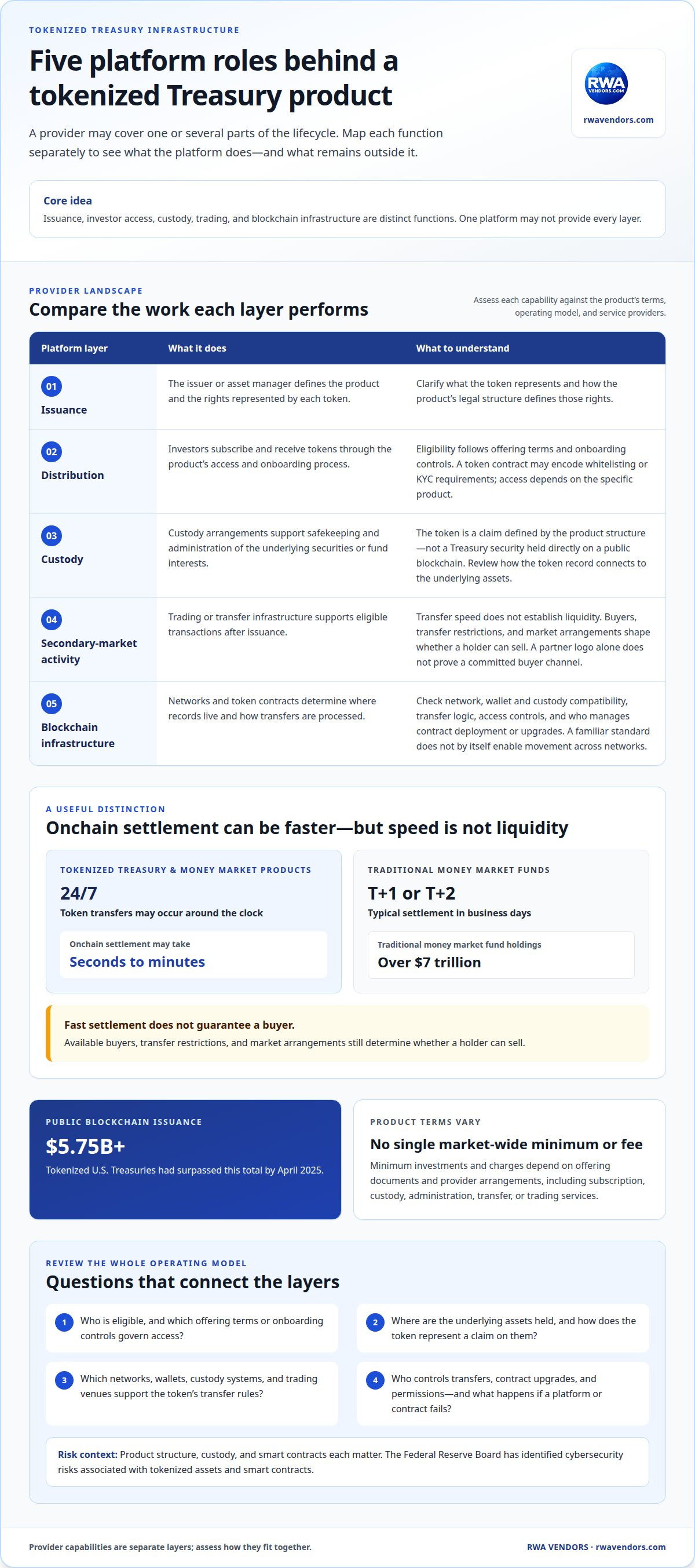
Tokenized Treasury infrastructure connects conventional government securities or money market fund interests with blockchain-based ownership records. Tokenized U.S. Treasuries had surpassed $5.75 billion in total issuance on public blockchains by April 2025. A provider may manage issuance technology, investor onboarding, custody arrangements, transfer controls, or trading access. These are distinct functions, so one platform may not cover every layer.
Issuance begins when an asset manager or issuer defines the product and the rights represented by each token. Distribution determines how eligible investors subscribe and receive tokens. In the United States, eligibility follows the offering terms and onboarding controls; a token contract may encode whitelisting or KYC requirements. Requirements therefore depend on the specific product, not simply on its use of blockchain.
U.S. rules relevant to a platform depend on the product’s legal structure and the activities involved, such as issuance, custody, distribution, or trading. A platform’s technical role alone does not describe the full regulatory picture. Consider the product and each function together.
Custody arrangements connect the token record to the underlying securities or fund interests. The token represents a claim defined by the product structure; it is not itself a Treasury security held directly on a public blockchain. Smart contracts can enforce transfer restrictions, while custodians and other service providers support safekeeping and asset administration. The Federal Reserve Board has also identified cybersecurity risks associated with tokenized assets and smart contracts.
Secondary-market infrastructure supports eligible transfers or trading after issuance. Token transfers may occur 24/7, while tokenized Treasury and money market fund products may settle onchain in seconds to minutes. That speed does not establish liquidity: available buyers, transfer restrictions, and market arrangements shape whether a holder can sell. A distribution feature or partner logo alone does not demonstrate a committed buyer channel.
Minimum investment amounts and fees vary according to product terms and provider arrangements. Relevant factors include the subscription process, custody, administration, and transfer or trading services. The product’s offering documents set out applicable minimums and charges; there is no single market-wide figure for every tokenized Treasury product.
The relationship between a token and a money market fund depends on the product’s structure. Traditional money market fund holdings total over $7 trillion and typically settle in T+1 or T+2 business days. By contrast, tokenized products can use onchain settlement and transfer infrastructure. Their structure may support digital distribution and collateral workflows, but investors still face issuer, custody, and smart-contract risks. Review how the token links to the underlying assets and what happens if a platform or contract fails.
Supported blockchain networks and token standards
A platform’s blockchain support determines where token records are stored and which wallets or applications can interact with them. For an issuer, network choice affects integration, custody workflows, settlement design, and how investors access the product. A token standard defines the common rules and functions that contracts use to represent ownership and process transfers.
Start by distinguishing network coverage from token-standard support. A provider may support a blockchain but use a particular contract design that limits compatibility with wallets, custody systems, or trading venues. Conversely, a familiar standard does not automatically make a token usable across separate networks. Cross-network movement requires its own technical and operational design.
Standards also differ in how they handle regulated assets. A basic token contract can record balances and transfers, while a permissioned design can apply investor eligibility rules. For example, a contract may restrict transfers to approved addresses. This can affect integrations: a wallet or trading venue must support the token’s transfer logic, not just the underlying blockchain.
ERC-7518 illustrates why standards maturity matters. On November 8, 2026, the proposal was in Review, not Final. Issuers assessing a standards-based design should distinguish a proposal’s status from an implemented specification. They should also establish how a provider handles contract upgrades, access controls, and compatibility if a standard changes.
Network selection is an infrastructure decision, not just a technology preference. Consider these factors together:
- Investor access: Which wallets and custody arrangements can support the token’s network and transfer rules?
- Settlement and liquidity: Which trading venues or counterparties can interact with that network?
- Integration: Can the issuer connect existing investor, reporting, and asset-administration systems?
- Operational control: Who manages contract deployment, upgrades, and permissions?
These choices matter for stablecoin settlement and onchain transfers, but network compatibility does not mean a token can move freely. Product-level restrictions and contract controls still apply. A token’s blockchain record also does not replace custody arrangements for underlying assets; ownership records and asset safekeeping are related but distinct parts of the structure.
For a project spanning several networks, map each required function to the supported chain and token standard. Then document dependencies between issuance, custody, investor access, and trading integrations. Providers can present their network and standard coverage through a vendor directory listing, helping issuers identify relevant tokenization infrastructure.
Map each required function to the supported networks, then check whether the token’s standard and permissions fit the intended wallet, custody, settlement, and reporting workflows. Keep that assessment tied to the full transaction path: issuance, holding, transfer, and any movement between networks. Where a function depends on another provider, confirm that its systems recognize the contract’s rules rather than assuming network support alone is enough. SIFMA's study of a blockchain-based Regulated Settlement Network was published in December 2024, offering a reference point for considering blockchain-based settlement design. Treat such material as context for infrastructure planning, while evaluating the chosen product’s own operating requirements and controls. The resulting network map should make dependencies and gaps visible before deployment.
Tokenized Treasury products and providers
Tokenized Treasury products give investors blockchain-based access to exposure linked to U.S. Treasury securities or money market funds. Their structures vary: a token may represent a fund interest, while the issuer and product documents define the holder’s rights. The token is part of the ownership and transfer system, not a universal substitute for understanding the underlying securities.
Product design shapes how holders receive yield. These examples show why a token’s price alone may not reveal how a product reflects returns.
Examples of issuers include traditional asset managers and crypto-native firms. BlackRock and Franklin Templeton, alongside Ondo and Superstate, have launched products that route Treasury yield to token holders. Their involvement illustrates varied participation in the ecosystem, but does not mean each firm provides the same platform services. Different providers may handle product issuance, investor distribution, custody, and trading infrastructure.
Scale is another part of the market context. Tokenized Treasury and money market fund assets represented $17.3 billion of onchain assets as of August 13, 2026. That figure describes a product category, not the liquidity of any specific token. Investors still need to distinguish assets represented onchain from the availability of buyers or a functioning secondary market.
For issuers, compare products and providers by the functions they perform:
- Product structure: Identify whether the token represents a fund interest or another defined claim, and how the product documents describe holder rights.
- Yield mechanics: Establish whether yield accrues through a changing token price or periodic balance adjustments.
- Distribution: Understand how investors access the offering and how eligibility controls affect transfers.
- Infrastructure: Map which parties support issuance, custody, administration, and trading.
These distinctions matter because one company’s product launch does not show that it supplies every layer of the technology stack. For example, BlackRock or Franklin Templeton may be associated with an issued product, while separate providers support tokenization or distribution. A platform’s stated networks and services also do not, by themselves, demonstrate committed investor demand.
Assess tokenized Treasury platform providers by their roles, not their labels. For each product, trace the relationships among the issuer, token, underlying assets, and service providers. Then examine how yield is reflected, which investors can hold or transfer the token, and what infrastructure supports it. This gives you a clearer view of product design without treating all tokenized assets as interchangeable.
Onchain Treasury assets totaled $4 billion, representing 1.5% of the overall stablecoin market capitalization. This comparison provides broader market context, but it does not establish how much of those assets belongs to any individual product or whether a particular token can be readily traded. Issuers and investors should therefore keep aggregate market size separate from product-level assessment, including structure, yield mechanics, distribution, and infrastructure when comparing offerings.
Examples of tokenized Treasury and MMF providers
Examples span asset managers and crypto-native issuers, but their products and infrastructure roles differ. This distinction helps issuers determine whether a company launches a product, supports distribution, or supplies platform technology.
Provider Examples
BlackRock, Franklin Templeton, Ondo, and Superstate illustrate the range of organizations associated with tokenized Treasury products. Their examples help frame the market, but a product issuer and a technology provider are not necessarily the same entity. For an issuer assessing a potential launch, the key is to map each organization’s role in product design, investor access, and ongoing operations.
Asset managers such as BlackRock and Franklin Templeton bring established investment-management operations to tokenized products. Crypto-native issuers such as Ondo and Superstate approach the category from within digital-asset markets. These labels describe organizational backgrounds, not a product’s risk level, liquidity, or suitability for a particular investor.
Provider capabilities can also vary within one organization. A firm may issue a tokenized product while relying on other entities for custody, blockchain infrastructure, or distribution. The token’s structure determines what investors hold and how transfers work. Product documents and service arrangements matter alongside the issuer’s name.
Institutional adoption depends on more than a product launch. For example, an established issuer may bring distribution relationships, while a crypto-native firm may emphasize integration with an onchain ecosystem. Neither characteristic establishes available liquidity or confirms that a specific network supports every investor workflow.
Comparing Provider Metrics
Compare assets under management, liquidity, and supported blockchains as separate measures. AUM indicates product scale at a stated date; liquidity depends on trading access and available counterparties; network support describes where the token can operate.
For AUM comparisons, use the same date and product scope. Distinguish assets in one tokenized Treasury product from an issuer’s broader fund or company assets. A larger figure does not, by itself, mean easier redemption or secondary-market trading.
Compare liquidity by the routes investors can use to enter or exit. Examine whether the product relies on primary issuance, secondary-market trading, or both. Distribution reach and a partner logo do not establish committed buyers. Tokenized assets may transfer onchain, but transfer capability alone does not create market depth.
For blockchain comparisons, record each product’s supported network and token implementation. A provider’s network coverage may differ by product or version. For a practical comparison, match the network to intended investor access, custody integrations, and settlement needs. Then assess whether the underlying assets are clearly described and the operating roles are transparent.
These measures help distinguish a regulated product’s institutional distribution from its technical footprint. Compare like with like: product-level AUM, actual trading pathways, and named blockchain support. This gives asset issuers a more useful view of provider fit than ranking firms by reputation or launch announcements alone.
Which companies offer tokenized U.S. Treasury products and platforms?
Examples include asset managers BlackRock and Franklin Templeton, alongside crypto-native issuers Ondo and Superstate. These companies have launched products that route Treasury yield to token holders. Their presence shows that the market includes organizations with different backgrounds, but does not mean they provide identical services.
Distinguish product issuers from the companies supplying tokenization infrastructure. A firm associated with an issued product may not provide every layer, including investor onboarding, custody, blockchain systems, and trading access. For asset issuers, this distinction helps define the operating model: identify the product sponsor, then map the technology and professional services needed around it.
BlackRock and Franklin Templeton are established asset managers; Ondo and Superstate are crypto-native issuers. These descriptions provide context, not a ranking of product quality or platform capability. The available facts establish that each has launched products routing Treasury yield to token holders, but not that each offers a complete third-party platform for other issuers.
Use these companies as examples of product activity, not interchangeable vendors. A Treasury product may involve an issuer and separate firms supporting distribution, custody, transfer controls, or blockchain infrastructure. A product launch shows market participation; the provider’s actual role depends on the arrangements behind the product.
Asset issuers can organize their provider research around distinct functions:
- Product issuance: Identify the entity responsible for the tokenized product and the underlying Treasury exposure.
- Technology: Establish which provider supports token creation, contract operations, and network integration.
- Investor access: Determine how distribution and onboarding connect eligible investors with the product.
- Post-issuance services: Map custody, administration, transfer processes, and any secondary-market infrastructure.
A function-based view also clarifies what a company’s public launch demonstrates. BlackRock, Franklin Templeton, Ondo, and Superstate are named examples of firms with products that route Treasury yield to token holders. That fact alone does not describe their complete technology stack, supported networks, investor eligibility terms, or market liquidity. Those details depend on each product’s structure and provider arrangements.
For a new issuance, compare potential partners by the specific role they can fill, rather than by issuer visibility alone. One provider may focus on tokenization technology, while another supports compliance, custody, or distribution. The right infrastructure map depends on the issuer’s product design, target investors, and required operating functions. This approach distinguishes product providers from service providers and makes gaps between roles easier to identify.
Asset issuers building a provider ecosystem can list a tokenization platform.
RWA Vendors: RWA Vendors connects asset issuers with verified tokenization platforms and service providers
RWA Vendors helps asset issuers identify technology and professional-service providers for tokenization projects. Its global directory covers vendors supporting real estate, funds, securities, and other assets, including tokenization, technology, legal, and compliance categories.
Use the directory when your project needs providers across multiple stages, such as infrastructure, compliance, or distribution. RWA Vendors connects issuers with relevant platforms and services, helping you map potential partners to your project’s needs. Vendors seeking a presence in this ecosystem can choose a Vendor Directory Listing or Founding Membership.
Build the right provider network for your next step
Turn your research into an operating map for the proposed product. Define the capabilities your team needs, assign responsibility for each function, and document how those responsibilities connect. This gives discussions with tokenized Treasury platform providers a clear focus: your project’s requirements, dependencies, and intended investor experience.
For issuers seeking relevant connections, RWA Vendors supports lead generation and referrals across the tokenization ecosystem. Use this pathway when you’re ready to build relationships with technology and professional-service providers suited to your project. A well-defined scope helps make those conversations more productive and keeps the next phase aligned with your issuance objectives.
With a clear provider map and focused conversations, you can move from market research toward a more structured project plan.
Frequently Asked Questions
What custody, reserve attestation, and audit practices do tokenized Treasury providers use?
Tokenized Treasury products do not share one custody, attestation, or audit model; these controls depend on product structure and provider arrangements. Assess each function separately: custody identifies who safeguards the underlying assets, reserve attestation describes which assets were examined and when, and an audit has a defined scope and period. For example, a smart contract audit covers code, not whether Treasury assets are held or accurately reported. Distinguish these records when evaluating a product’s controls.
Disclaimer
This article is provided by RWAVendors.com for general informational and educational purposes only. It does not constitute legal, financial, investment, tax, regulatory or other professional advice, or an offer, solicitation, recommendation or endorsement of any company, product, service, token, security or investment. RWAVendors.com is an informational vendor directory and does not sell, issue, broker, custody or facilitate transactions involving cryptocurrencies, digital tokens, tokenized assets, securities or investment products. Some vendor listings and references may involve paid advertising, sponsored placement or membership relationships. These relationships do not guarantee a vendor’s qualifications, regulatory status, performance or suitability. Information may be incomplete, outdated or subject to change. You should independently verify all information, conduct your own due diligence and consult qualified professionals before making any business or investment decision. RWAVendors.com is not responsible for the content, services, representations or actions of third-party vendors or linked websites.


