

Tokenization projects gain support when they connect a defined business need to a credible operating model. To understand how to get buy-in for a tokenization project, align technology, finance, and regulatory stakeholders around the use case, the risks, and the milestones that will show whether it works.
Each group will assess the proposal differently: technology teams focus on infrastructure and integration, finance leaders on commercial value, and regulatory stakeholders on compliance and investor protections. A persuasive case addresses those priorities together rather than relying on the technology alone. This article explains how to build that case, choose experienced tokenization partners, and present revenue potential with clear assumptions. It also covers how to explain the project to executives, investors, and employees so they can assess its opportunities and constraints.
Key Takeaways
- Build alignment by connecting technology decisions, financial objectives, and regulatory considerations to one clearly defined use case.
- Bring in experienced tokenization organizations to help address the capabilities and operational requirements your project depends on.
- Frame revenue potential around specific business opportunities, while making the assumptions behind the business case clear.
- Use milestones to assess progress, costs, and expected returns as the initiative develops.
- Tailor the explanation for executives, investors, and employees so each group understands the benefits, risks, and practical implications.
Collaboration among technology experts, finance leaders, and regulators
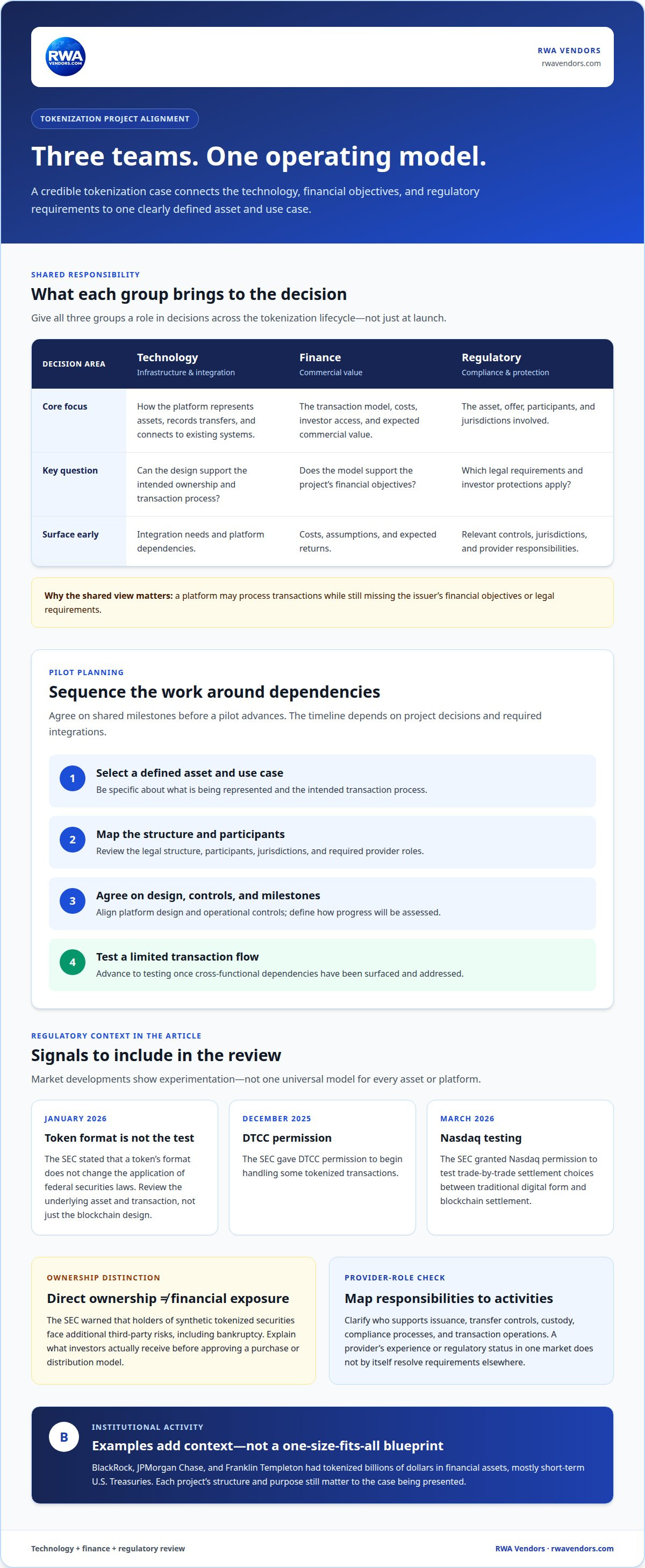
A tokenization project needs technology, finance, and regulatory teams to agree on the asset, operating model, and controls. Their decisions affect whether a digital representation matches the intended ownership and transaction process.
Cross-Functional Stakeholder Collaboration
Cross-functional collaboration means giving technology, finance, and regulatory experts shared responsibility for decisions across the tokenization lifecycle. It matters because a platform can process transactions while still failing to meet the issuer’s financial objectives or legal requirements.
Technology teams define how the platform represents assets, records transfers, and connects with existing systems. Finance leaders assess the transaction model, costs, investor access, and expected commercial value. Regulatory specialists examine the asset, the offer, the participants, and the jurisdictions involved. Set shared milestones so each group can surface dependencies before a pilot advances.
In the United States, the SEC stated in January 2026 that a token’s format does not change the application of federal securities laws. A project involving securities must therefore consider the underlying asset and transaction, not just its blockchain design. Requirements depend on the structure and activities involved, so cross-functional review should identify the relevant issues before launch.
Navigating Regulatory Uncertainty
Regulatory uncertainty can arise when rules, interpretations, or market arrangements differ across jurisdictions. This matters because cross-border transactions can involve issuers, purchasers, and service providers subject to different frameworks.
Market developments show both experimentation and continuing risk. In December 2025, the SEC gave DTCC permission to begin handling some tokenized transactions. In March 2026, it granted Nasdaq permission to test trade-by-trade settlement choices between traditional digital form and blockchain settlement. These developments do not establish a universal model for every asset or platform.
When evaluating regulated tokenization providers, map each provider’s role to the project’s activities and jurisdictions. Clarify who supports issuance, transfer controls, custody, compliance processes, and transaction operations. A provider’s experience or regulatory status in one market does not by itself resolve requirements elsewhere.
Regulatory risk also includes the structure investors actually receive. In January 2026, the SEC warned that holders of synthetic tokenized securities face additional third-party risks, including bankruptcy. Distinguish direct ownership from financial exposure to an asset, then explain that distinction to stakeholders before they approve a purchase or distribution model.
For a pilot, first select a defined asset and use case. Next, map its legal structure, participants, jurisdictions, and required provider roles. Then agree on platform design, operational controls, and success milestones before testing a limited transaction flow. The timeline depends on those decisions and the integrations required, so sequence work according to dependencies rather than promising a fixed launch date.
Successful examples can make the discussion more concrete: BlackRock, JPMorgan Chase, and Franklin Templeton had tokenized billions of dollars in financial assets, mostly short-term U.S. Treasuries. These examples demonstrate institutional activity, but each project’s structure and purpose still matter to the case being presented.
Partnering with experienced tokenization organizations
An experienced tokenization partner connects blockchain infrastructure with the asset’s legal, financial, and operational model. This matters because software must represent the rights attached to tokenized assets, not merely issue digital units. For a real estate project, for example, stakeholders need clarity about what holders own and how transactions relate to the underlying property.
Start by mapping the capabilities your project needs. A technology provider may support issuance and platform operations, while other specialists address compliance, custody, payments, or trading. Define each role in relation to the project’s asset, participant journey, and target markets. This makes gaps visible before separate systems and responsibilities become difficult to coordinate.
Assess relevant experience by asking for examples that resemble your use case. A partner with blockchain expertise in fund interests may have different operational experience from one supporting real estate. Examine how its infrastructure handles issuance, transfers, investor records, and restrictions on who can hold or receive tokens. The key is fit with the project, not a broad claim of tokenization experience.
Also distinguish tokenization infrastructure from crypto trading services. A project may use blockchain without making cryptocurrency trading its purpose. Clarify how the platform connects token records with existing financial processes, who maintains operational records, and how transaction exceptions are handled. These details help finance, technology, and compliance teams assess the model in practical terms.
Token standards can inform technical discussions. Ethereum’s ERC-3643 and ERC-1400 are standards used for real-world assets that can support transfer restrictions and compliance controls. A provider should be able to explain how its proposed architecture represents ownership rights and applies the controls relevant to the use case. The standard alone does not define the asset’s legal rights or operating model.
Partnerships can span digital-native firms and established financial institutions. Some banks are building blockchain technology stacks in-house for initiatives such as collateral settlement, multiparty trade finance, and interbank cash settlements. This illustrates why an issuer may need to coordinate external specialists with existing institutional systems, rather than treating tokenization as a standalone platform purchase.
- Match each provider’s role to a defined project requirement.
- Compare relevant asset and transaction experience, not general claims.
- Document system connections, responsibilities, and exception handling.
- Align the technology design with holders’ rights and transfer controls.
These criteria help stakeholders evaluate whether a partner can support the project’s actual operating model. Organizations offering relevant services can also explore a tokenization vendor listing to make their capabilities discoverable within the ecosystem.
When evaluating potential partners based on strategic priority, consider whether the wider partnership brings the right depth of digital-asset knowledge. Organizations pursuing tokenization initiatives are advised to ally with digital natives or other trusted organizations with deep experience in digital assets and tokenization. Such an alliance can complement the roles already identified and keep the partnership aligned with the initiative’s requirements. The organization’s experience can be considered alongside the responsibilities defined for each provider.
Tokenization's potential to unlock revenue
Revenue potential comes from changing how assets reach investors, how transactions operate, and which markets issuers can serve. In 2026, tokenized real-world assets held onchain crossed $40 billion. That activity provides context, but a market total alone does not show whether a specific project can generate revenue.
Tokenization can create commercial opportunities by making ownership interests divisible and easier to distribute. Fractional structures may broaden access to assets that traditionally require substantial commitments. For example, private-credit lenders can fractionalize loans into different sizes, potentially expanding the borrower pool. The revenue case depends on the underlying asset, investor demand, distribution model, and costs of operating the structure.
Liquidity is another possible source of value, especially for traditionally illiquid assets. A tokenized real estate interest, for example, may let holders transfer their interests through an appropriate market structure. That ability depends on the rights represented, eligible participants, available trading arrangements, and regulatory controls. Blockchain and smart contracts can support transaction processes, but they do not create investor demand by themselves.
Market projections indicate why executives are examining digital assets. McKinsey estimated tokenized assets could reach $2 trillion to $4 trillion by 2030. Boston Consulting Group projects the market could reach $16 trillion by 2030, while Standard Chartered projected $30 trillion by 2034. The different estimates reflect distinct assumptions and horizons, so present them as market scenarios, not forecasts for one issuer.
The revenue opportunity may extend beyond issuance. The industry report estimates tokenization could create $400 billion in additional annual revenue for the alternatives industry. Potential sources include broader distribution, transaction services, and operational efficiencies. Each depends on the project’s structure and execution. Nearly $1 billion in tokenized stocks were on blockchains as of March 2026, showing activity in another asset category without establishing a revenue model for every issuer.
To choose a use case, start with a specific business constraint, such as limited distribution or inefficient transfers, then assess whether tokenization addresses it. Define success metrics around that constraint, including investor reach, transaction processing, operating effort, and revenue generated. Assign each metric an owner and a measurement method before launch, so later decisions rely on observed performance rather than broad market projections.
For stakeholder decisions, separate potential value from prerequisites. Identify the asset’s ownership rights, target investors, distribution channels, and required platform capabilities. Then model how each revenue source depends on those elements. This helps teams evaluate the opportunity in context, distinguish a viable use case from a technology experiment, and communicate the commercial rationale without treating tokenization as an automatic source of growth.
How to build a business case for tokenization with costs and expected returns?
A credible business case links a defined operating problem to measurable outcomes. Start with one asset and one use case, then compare the current process with the proposed tokenized model. This gives finance, technology, and executive teams a shared basis for evaluating costs, benefits, and delivery milestones.
Specify the problem before estimating returns. A fund manager addressing limited wealth-manager distribution, for example, might test a feeder fund with one wealth manager. The case should explain which process changes, who benefits, and how the pilot will test the assumption. A technology-first proposal without a clear business constraint makes it difficult to assess whether the project creates value.
Build the cost model around project activities, not a single technology figure. Include platform configuration, integration with existing systems, legal and compliance work, custody arrangements, transaction operations, and ongoing maintenance. Assign an owner to each cost category and state the assumptions behind the estimate. For example, integration effort depends on the systems and workflows the tokenization model must connect.
Then identify potential returns and connect each one to a measurable mechanism. Distribution may broaden access to an asset, while streamlined transactions may reduce manual processing. For private credit, fractionalizing loans into different sizes may expand the potential borrower pool. Model the related revenue or operational benefit separately, and avoid counting the same effect in multiple categories.
Set success milestones before authorizing a pilot. Define what must be delivered at each stage, from confirming the use case to testing transaction workflows and reviewing results. Pair each milestone with an owner, evidence of completion, and a decision it enables. For example, a completed transfer test may inform whether the operating model is ready for a broader trial.
Use scenarios to make assumptions visible. A base case can reflect the expected operating model, while sensitivity analysis shows how changes in investor participation, transaction volume, or integration effort affect the business case. Avoid presenting market-wide projections as the issuer’s expected return. The decision should rest on the asset, distribution plan, operating costs, and evidence produced by the pilot.
Finally, define decision gates for continuing, revising, or stopping the initiative. Finance leaders can review costs and revenue assumptions; technology teams can report on integration and performance; compliance stakeholders can assess controls and process readiness. A milestone-based review gives each group a concrete basis for its decision and keeps the business case tied to observed project progress.
Review the evidence against the agreed criteria before approving further investment. The report recommends defining initiative success with clear milestones. At each gate, record whether delivery matched the plan, what the test established, and which assumptions remain untested. Keep the decision tied to documented results rather than expectations alone.
If results fall short, identify whether the cause was execution, cost, or the underlying use case, then decide whether to adjust the scope or stop. If results support continuation, use the same measures to assess the next stage and update cost and return assumptions. This gives finance leaders a traceable basis for releasing resources gradually and explaining the rationale to other decision-makers.
How to explain tokenization to stakeholders
For teams asking how to get buy-in for a tokenization project, explain the initiative through the decisions each stakeholder must make. Executives need to see how the proposal supports a business objective, such as reaching a new investor segment or improving a defined process. Distinguish the intended outcome from the blockchain technology used to pursue it. This framing helps leaders evaluate the business rationale without starting with technical terminology.
Investors need a clear description of the asset and the rights attached to each token. Explain the relationship between the token, the issuer, and any underlying ownership or financial exposure. For example, a token linked to an asset may represent different rights from a token that tracks its value. Plain descriptions help investors understand what they may acquire and what the token itself does not represent.
Use examples relevant to the audience. A real estate presentation might show how a token represents an interest in a property and describe the conditions for transferring that interest. Explain the roles of the issuer, platform, and transaction participants. Avoid implying that tokenization alone guarantees liquidity or changes the rights associated with the underlying asset.
Employees need to understand the practical effects on their roles. A transaction team, for instance, may need to use a new platform or follow updated procedures for recording and reviewing transfers. Identify which tasks change, who handles exceptions, and where existing processes remain. This helps departments prepare for operational changes rather than treating the initiative as a technology project separate from their work.
Address concerns directly. Stakeholders may ask who can access records, how errors are handled, and what happens if a service provider cannot perform its role. Give each concern an owner and a response grounded in the proposed operating model. A transparent account of dependencies helps participants assess the project without presenting tokenization as risk-free.
To make these conversations useful, tailor the emphasis without changing the underlying facts. An executive briefing can focus on strategic fit and decision points; investor materials can clarify rights and transaction mechanics; employee sessions can explain responsibilities and escalation paths. For teams considering how to get buy-in for a tokenization project, consistent core information across these formats helps prevent conflicting expectations.
- Executives: connect the initiative to its business objective and decision gates.
- Investors: explain the asset, represented rights, and transaction process.
- Employees: clarify workflow changes, responsibilities, and exceptions.
- All groups: address dependencies and concerns in direct, accessible language.
Explore tokenization provider listings to identify relevant ecosystem capabilities.
RWA Vendors
RWA Vendors helps asset issuers identify providers needed to advance a tokenization initiative. Its global directory connects issuers with vetted tokenization platforms and service providers across technology, legal, compliance, and other relevant categories.
Turn to the directory when your team has defined a use case and needs to identify potential partners for the next stage. Whether the project involves real estate, funds, securities, or other assets, finding relevant capabilities can help stakeholders move from an internal business case toward a coordinated provider ecosystem.
For organizations seeking visibility among issuers, Vendor Directory Listing, Founding Membership, and Lead Generation and Referrals support participation in the marketplace.
Contact RWA Vendors to discuss connecting your tokenization project with relevant providers.
Turn stakeholder alignment into a focused next step
Internal support becomes more durable when a tokenization initiative has an accountable owner and a defined decision process. Give stakeholders a clear way to raise concerns, resolve dependencies, and assess progress as the project develops. This keeps the proposal connected to business priorities instead of allowing it to become a technology effort without shared direction.
Ultimately, how to get buy-in for a tokenization project is about making informed participation possible. Executives need a basis for allocating resources, teams need clarity on responsibilities, and investors need to understand the asset and the rights involved. Keep those conversations active as assumptions are tested and decisions evolve. Transparent communication helps the organization adapt its approach as new information emerges.
When your next step is identifying relevant organizations for a project, RWA Vendors can help connect asset issuers with tokenization platforms and service providers. Use the directory to continue building the provider ecosystem around your initiative.
With a clear purpose and the right participants at the table, your team can move forward with greater focus.
Frequently Asked Questions
What business benefits and ROI can a tokenization project deliver?
A tokenization project may support broader distribution, more efficient transaction workflows, or new service revenue, depending on its design. Assess returns by comparing incremental revenue and operating savings with implementation and ongoing operating costs. For example, a fund manager could track whether a digital subscription process reduces manual handling and improves investor onboarding. Set a baseline before launch, then compare actual results against the same measures at agreed review points.
Which stakeholders need to approve a tokenization project, and what are their concerns?
Approval usually involves the executive sponsor, asset owner, finance, technology, legal and compliance, and operations leaders. The board or investment committee may also approve material strategic commitments. Their concerns differ: executives assess strategic fit, asset owners protect the integrity of the underlying rights, finance evaluates funding and return assumptions, and technology and operations teams assess integration and continuity. Establish a decision owner and document each group’s approval criteria before seeking formal authorization.
Disclaimer
This article is provided by RWAVendors.com for general informational and educational purposes only. It does not constitute legal, financial, investment, tax, regulatory or other professional advice, or an offer, solicitation, recommendation or endorsement of any company, product, service, token, security or investment. RWAVendors.com is an informational vendor directory and does not sell, issue, broker, custody or facilitate transactions involving cryptocurrencies, digital tokens, tokenized assets, securities or investment products. Some vendor listings and references may involve paid advertising, sponsored placement or membership relationships. These relationships do not guarantee a vendor’s qualifications, regulatory status, performance or suitability. Information may be incomplete, outdated or subject to change. You should independently verify all information, conduct your own due diligence and consult qualified professionals before making any business or investment decision. RWAVendors.com is not responsible for the content, services, representations or actions of third-party vendors or linked websites.


