

Self-custody does not mean managing digital assets without specialist support. A useful list of companies offering services related to self-custody asset management includes providers of multisignature wallets, multiparty computation (MPC), hardware-backed controls, and related operational tools. These providers supply infrastructure and support while the asset owner retains control of the private keys.
Choosing a service depends on how your organization manages key access, authorizes transactions, and oversees assets. A wallet provider may focus on key-management technology, while other specialists support monitoring or related workflows. These services can help asset owners and managers organize self-custody operations, but providers do not all perform the same role.
This guide explains how nonbank providers support self-custody, which service categories are available, and how these functions differ from traditional custody. It also shows where asset owners and managers can find relevant providers, helping you understand the service landscape before deciding which capabilities fit your operating model.
Key Takeaways
- Distinguish multisignature wallets, MPC and hardware-backed controls by how each approach structures key access and transaction authorization.
- Assess self-custody services by the operational functions they support, including asset records, access controls and monitoring.
- Separate technology providers that support self-custody from custodians that hold and administer assets on behalf of clients.
- Understand how traditional custody can include transaction settlement, asset reporting and related administration, beyond safekeeping.
- Use RWA Vendors’ Vendor Directory Listing to explore verified providers across tokenization technology and professional services.
Which providers offer multisignature wallets, MPC, or hardware-backed self-custody?
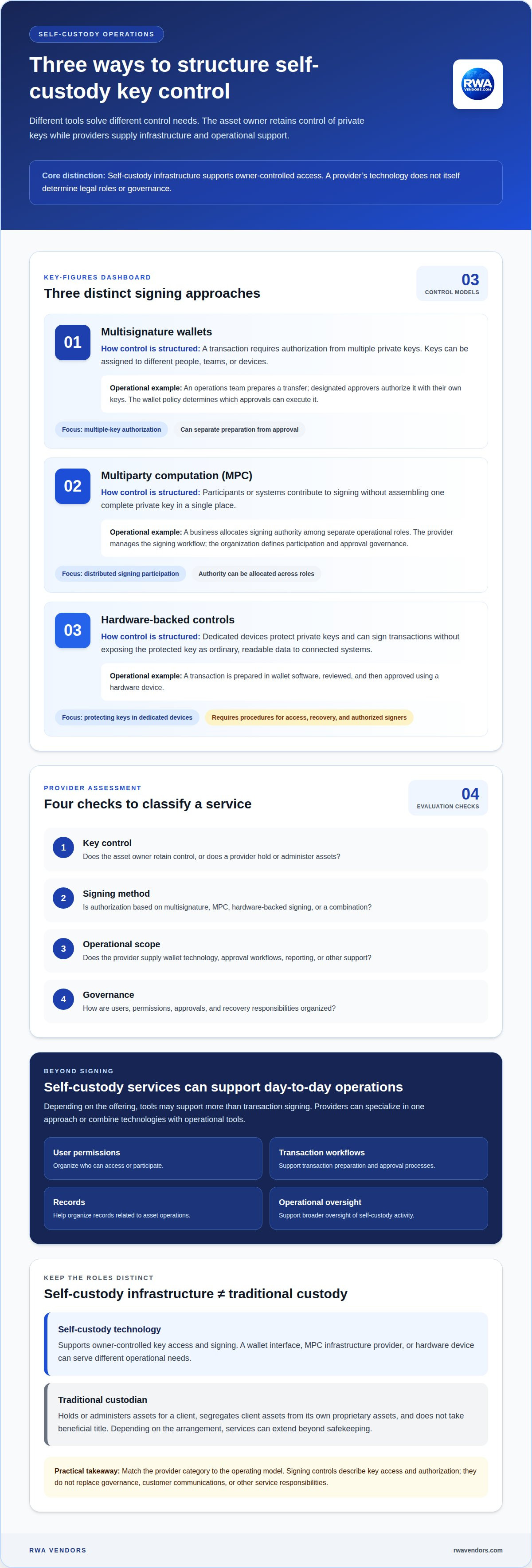
Self-custody providers generally supply wallet software, key-management infrastructure, hardware devices, or supporting controls. These categories describe different capabilities, not interchangeable products. A wallet provider may coordinate approvals, while a hardware vendor supplies a device to protect keys. Some firms combine technology with operational tools. For example, an asset manager might use wallet software to prepare transactions and a separate approval process to authorize them.
Multisignature wallet providers build systems that require authorization from multiple private keys before a transaction can proceed. Keys can be assigned to different people, teams, or devices, allowing an organization to separate transaction preparation from approval. For example, an operations team could prepare a transfer while designated approvers authorize it with their own keys. The wallet’s authorization policy determines which combination of approvals can execute the transaction.
MPC providers use multiparty computation to coordinate signing without assembling one complete private key in a single place. Each participant or system contributes to the signing process, supporting distributed control across an organization’s personnel or infrastructure. For example, a business could allocate signing authority among separate operational roles. The provider’s technology manages the signing workflow, while the organization defines who can participate and how approvals are governed.
Hardware-backed self-custody providers supply devices designed to protect private keys using dedicated hardware. The device can sign transactions without exposing the protected key as ordinary, readable data to connected systems. For example, a transaction might be prepared in wallet software, reviewed, and then approved with a hardware device. This separates transaction preparation from key use, but the organization still needs procedures for device access, recovery, and authorized signers.
These approaches address different control needs. Multisignature wallets organize authorization around multiple keys, MPC distributes participation in the signing process, and hardware-backed tools focus on protecting keys in dedicated devices. A provider may specialize in one approach or support several. For instance, an asset owner could use a wallet interface for approvals alongside hardware devices held by authorized personnel. Choose a service category based on your operating model, not just the technology label.
For asset owners and managers, provider services may extend beyond signing. Depending on the offering, tools can help manage user permissions, transaction workflows, records, and operational oversight. A fund manager, for example, may need a clear division between staff who initiate transfers and staff who approve them. Distinguish these functions from custody services, where a third party holds assets for clients. Self-custody infrastructure supports owner-controlled access, but does not itself determine legal roles or governance.
Use these questions to classify providers and their functions:
- Key control: Does the asset owner retain control, or does a provider hold or administer assets?
- Signing method: Does the service use multisignature authorization, MPC, hardware-backed signing, or a combination?
- Operational scope: Does the provider supply wallet technology, approval workflows, reporting, or other support?
- Governance: How are users, permissions, approvals, and recovery responsibilities organized?
A categorized company list is more useful than a collection of names alone. When looking for companies offering services related to self-custody asset management, sort providers by what they actually do. A wallet software vendor, an MPC infrastructure provider, and a hardware device supplier may all support self-custody, but they address different operational needs. Matching service type to control requirements helps asset owners decide which provider category fits their operating model.
For tokenized assets, the wider service ecosystem matters too. Technology providers may support wallet operations, while other specialists focus on tokenization infrastructure or professional services. For example, an issuer developing a tokenized fund may need to map its asset-management workflow alongside its wallet controls. Treating these as separate but connected functions helps clarify where self-custody ends and other operational requirements begin.
Multisignature wallet providers, MPC providers, and hardware-backed self-custody providers each offer distinct capabilities; some support more than one approach.
Investment advisers must provide customers with notices about certain activities conducted on their behalf and regular account statements. This requirement is separate from the arrangement of signing authority: multisignature, MPC, and hardware-backed controls describe ways to manage authorization or protect keys, while notices and statements provide information to customers. When evaluating a setup, advisers should account for both dimensions rather than treating a signing method as a substitute for customer communications.
Custody business
Traditional custody differs from self-custody because a custodian holds or administers assets for a client. Custodians segregate client assets from their own proprietary assets and do not take beneficial title. For example, an investment fund may appoint a custodian to hold securities while its fund manager makes portfolio decisions. Depending on the service arrangement, the custodian’s role can extend beyond safekeeping.
Custody businesses can support asset records, settlement, income processing, and reporting. A custodian may collect dividends and interest, distribute payments, administer accounts, manage foreign exchange, and settle transactions. It may also provide accounting and asset-status reports or support tax compliance. For a fund holding securities across markets, these functions help track holdings and related transactions within one operational relationship.
Some custody providers operate across jurisdictions. A global custodian coordinates services through networks of sub-custodians or agent banks, giving clients a central access point across markets. These networks can connect local asset-holding arrangements with consolidated reporting and administration. This is relevant to asset managers with portfolios spanning countries, since settlement and account infrastructure may differ by market.
Custodians also connect with market infrastructure. They maintain securities accounts with relevant central securities depositories and cash accounts with central banks. A custodian bank may take possession of assets when required, often under a power of attorney, to act for a client. This differs from self-custody, where the asset owner retains direct control over access rather than appointing an intermediary to hold or administer assets.
Provider types vary by client and asset. BNY Mellon, JPMorgan Chase, State Street, and Citigroup are among the largest custodian banks in the United States. The Bank of China, UBS, Deutsche Bank, Barclays, and BNP Paribas are well-known custodian banks outside the United States. Banks are not the only possible custodians: law firms and accounting firms can serve for certain assets. For investment advisers, a qualified custodian may include a bank, registered broker, registered dealer, or certain other entities.
Custody can also include related fund services. A mutual fund’s custodian may provide fund accounting, administration, or transfer-agent services. The custodian can handle settlements, track investor transactions, and ensure money reaches custodial accounts, investors, or brokerages. It may also pay expenses related to share transactions and monitor portfolio companies for compliance with U.S. Securities and Exchange Commission regulations. These examples show why it is important to distinguish a provider’s custody role from its broader services.
This distinction matters when organizing a provider search. An asset owner assessing custody options can separate the core asset-holding relationship from related administration, reporting, or settlement. For example, a fund that needs both asset safekeeping and investor transaction processing can consider whether to place those functions with one custodian or separate providers. Custodian fees depend on the services provided and may be based on asset value, so the service scope and assets involved shape the fee basis.
Self-directed retirement accounts in the United States, including Traditional IRAs, Roth IRAs, SEP IRAs, and 401(k) plans, require a qualified trustee or custodian to hold assets for the account owner. That relationship differs from an organization’s operational choice to control digital-asset keys directly. Custodial accounts for minors provide another distinct example: one beneficiary and one custodian, with the custodian remaining in place until the beneficiary reaches adulthood.
For vendors supporting tokenized asset projects, a provider directory listing can help present custody and related capabilities to asset issuers seeking services across the tokenization lifecycle.
Custodian banks are typically large firms that may manage assets worth hundreds of millions or billions of dollars. This scale helps explain why custody means more than safekeeping: it is an ongoing operational relationship involving records, settlement, administration, and reporting. An assets-under-custody figure describes assets held or administered for clients, not assets beneficially owned by the custodian. This reflects the distinction between custody and proprietary holdings.
In April 2010, Standard Chartered acquired Barclays' African custody business, which had $3.8 billion in assets under custody. The example places a specific acquisition alongside the broader picture of custody providers operating across jurisdictions and serving client assets at substantial scale. It also illustrates that a custody business can be acquired as an operation, rather than understood only as individual accounts or isolated safekeeping tasks. For clients, the defining issue remains the custodian’s role in holding or administering assets, while beneficial ownership stays with the client.
RWA Vendors: Vendor Directory Listing
RWA Vendors helps asset issuers move from understanding custody models to identifying providers across the tokenization ecosystem. Its Vendor Directory Listing connects issuers with verified tokenization platforms and service providers. The directory is a practical next step when a project needs to map technology and professional-service capabilities.
Use the directory to find companies that help tokenize real estate, funds, securities, and other assets. For example, an issuer planning a tokenized fund can explore providers working in technology, compliance, custody, or other stages of tokenization. This helps distinguish a self-custody technology requirement from the broader services a project may need.
For a closer look at providers supporting a real-world asset project, contact RWA Vendors.
Define Your Next Provider Search
As your operating model develops, turn its control requirements into a focused provider brief. Specify the capabilities your organization needs, the roles involved in approvals, and how the service should fit alongside asset administration. A clear brief makes a list of companies offering services related to self-custody asset management more useful by connecting provider capabilities to your organization’s needs.
For issuers and service providers building visibility in tokenized markets, RWA Vendors offers a Vendor Directory Listing, Founding Membership, and Lead Generation and Referrals. These options support different goals: appearing in the provider ecosystem, participating as a member, or developing relevant business connections. Choose the next step that matches your organization’s role and priorities.
A considered provider strategy gives your team a clearer foundation for moving forward.
Disclaimer
This article is provided by RWAVendors.com for general informational and educational purposes only. It does not constitute legal, financial, investment, tax, regulatory or other professional advice, or an offer, solicitation, recommendation or endorsement of any company, product, service, token, security or investment. RWAVendors.com is an informational vendor directory and does not sell, issue, broker, custody or facilitate transactions involving cryptocurrencies, digital tokens, tokenized assets, securities or investment products. Some vendor listings and references may involve paid advertising, sponsored placement or membership relationships. These relationships do not guarantee a vendor’s qualifications, regulatory status, performance or suitability. Information may be incomplete, outdated or subject to change. You should independently verify all information, conduct your own due diligence and consult qualified professionals before making any business or investment decision. RWAVendors.com is not responsible for the content, services, representations or actions of third-party vendors or linked websites.


