

AI tools for asset tokenization can support valuation, due diligence, compliance, and market monitoring. They help teams connect asset analysis with the systems used to issue and manage digital tokens, while the token structure and underlying rights remain central.
Tokenization is often associated with real estate, where fractional ownership can make an asset accessible through smaller digital units. The approach is also being explored in finance, energy, commodities, and other asset classes, each with distinct data, operational, and compliance needs.
This guide explains how AI can support the tokenization lifecycle, from asset assessment and transaction monitoring to investor eligibility and portfolio information. It also covers tokenized bonds, funds, private equity, credit, commodities, and infrastructure, showing where AI can improve workflows and where human oversight remains important.
Key Takeaways
- Understand how digital tokens can represent interests in real-world assets, and why the rights behind each token matter.
- See how AI can support valuation, due diligence, compliance workflows, and transaction monitoring across tokenization.
- Explore how fractional access can apply to real estate and extend to funds, bonds, private equity, commodities, credit, and infrastructure.
- Learn where AI can inform asset assessment and market activity, while human oversight remains important for sensitive decisions.
- Identify the technology and professional service categories involved in building and operating tokenization systems.
What is Real World Asset Tokenization?
Real-world asset tokenization records rights associated with a physical or intangible asset as digital tokens on a blockchain or distributed ledger. AI can support analysis and related workflows, but the asset rights and token design still determine what each holder owns.
Building an AI-powered RWA tokenization platform typically costs 100,000-500,000 for initial development. Transaction fees vary with the selected blockchain, network activity, and the platform’s issuance and transfer design.
Representing Assets as Blockchain Tokens
Asset tokenization represents ownership or other defined interests in an asset through blockchain-based digital tokens. The token’s rights, transfer conditions, and relationship to the underlying asset determine what holders can do.
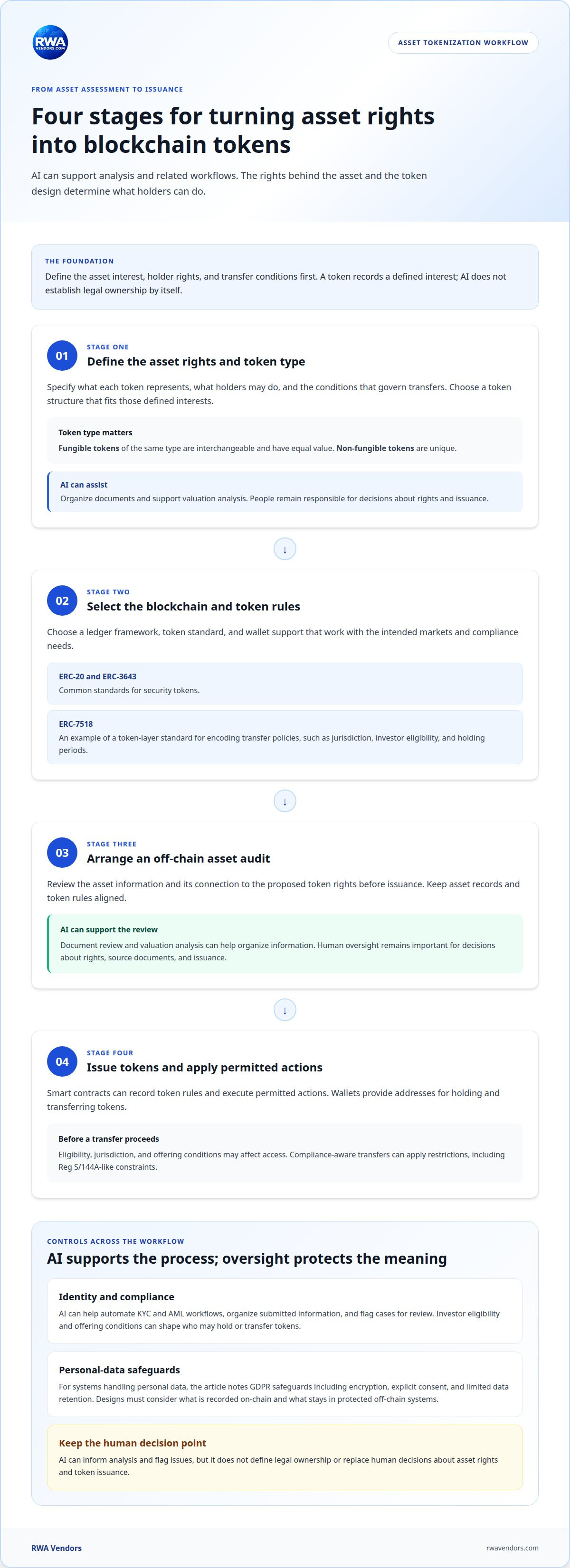
Fungible tokens of the same type are interchangeable and have equal value, while each non-fungible token is unique. A tokenized property interest, for example, can be divided into fungible units, while a unique collectible may be represented differently. Wallets provide addresses for holding and transferring tokens; smart contracts record token rules and execute permitted actions.
AI tools for asset tokenization can connect information across asset sourcing, valuation, compliance, issuance, trading, and portfolio management. For example, an AI system may organize valuation data while a smart contract applies a defined transfer policy. AI supports the workflow, but it does not establish legal ownership by itself.
Compliance and Identity Verification
Blockchain compliance brings together identity checks, transfer rules, and records of token ownership and activity. This matters because access to a tokenized asset may depend on investor eligibility, jurisdiction, or other offering conditions.
The Financial Action Task Force’s digital-identity guidance encourages risk-based remote customer due diligence using reliable digital identity systems. AI can help automate KYC and AML workflows, organize submitted information, and flag cases for review. Compliance-aware transfers can also apply restrictions, including Reg S/144A-like constraints, before a transaction proceeds.
Personal data needs separate safeguards. According to the European Union, GDPR applies to AI tokenization systems handling personal data and calls for encryption, explicit consent, and limited data retention. Blockchain designs must therefore account for which information is recorded on-chain and which remains in protected off-chain systems.
Blockchain Selection and Token Issuance
Blockchain selection means choosing the distributed ledger framework used to issue, record, and transfer tokens. The framework, token standard, wallet support, and compliance needs must work together across the intended markets.
To tokenize an asset using an AI-powered platform, define the asset rights and token type, select a blockchain, arrange an off-chain asset audit, and issue tokens. AI can assist with document review, valuation analysis, and smart-contract testing, while people remain responsible for decisions about rights and issuance.
ERC 20 and ERC 3643 are common standards for security tokens. ERC-7518 is an example of a token-layer standard for encoding transfer policies, such as jurisdiction, investor eligibility, and holding periods. These standards help translate defined rules into token behavior, while compatible wallets allow holders to access and transfer their tokens.
Fractional access to real estate and other assets
Tokenization can divide an asset’s represented interests into smaller units, giving investors access to defined fractions rather than requiring a whole-asset purchase. In real estate, the token structure, ownership records, and income-distribution process determine what each fraction represents.
Fractional real-estate ownership
Consider a hypothetical property valued at $1 million, represented by 1 million tokens. This example illustrates how an issuer might divide represented interests into units. It doesn’t establish that each token equals a specific legal share of the property; that relationship depends on the rights and structure behind the issuance.
For investors, fractional access changes how participation can be allocated. A token holder’s rights might relate to income, ownership interests, or another defined claim. Offering documents and operating arrangements explain those rights, while the token records transfers under its programmed rules. For example, distributing rental income requires accurate records of eligible holders and the amounts allocated to them.
Tokenization can make interests easier to transfer and support secondary trading, but it still depends on functioning markets and transfer rules. A platform must coordinate holder records, payment calculations, and permitted transactions. These operational details matter: a token transfer alone does not explain who manages a property, handles expenses, or makes decisions about the underlying asset.
AI, operational workflows, and oracle risks
In a real-estate workflow, AI can help verify property ownership information, conduct background checks, and support rental-income distribution to token holders. These tasks can reduce manual processing across records and payments, but they do not replace the need to define underlying rights or resolve inconsistencies in source documents.
Smart contracts may rely on oracles to receive real-world information, such as a valuation or an event affecting payments. If an oracle supplies inaccurate or inconsistent data, automated actions can reflect that error. AI can monitor oracle inputs for inconsistencies and flag unusual changes before they affect contract activity. Monitoring can strengthen scrutiny, but reliable source data remains essential.
For example, an income-distribution workflow could compare reported rental receipts with the data supplied to a smart contract. A mismatch can trigger review instead of an automatic payment action. Protecting sensitive records also requires separating information needed for blockchain actions from details that should remain in controlled systems.
Fractional models can also apply to funds, commodities, and other assets, with different rights and operating processes. Organizations assessing providers for these workflows can use the tokenization vendor directory to identify relevant service categories.
Applications across tokenized bonds, funds, private equity, commodities, credit, and infrastructure
Tokenization can represent interests in bonds, funds, private equity, commodities, credit arrangements, and infrastructure. Each asset class brings different records and operational needs. AI can help organize documents, compare transaction data, and support monitoring, while the token structure defines the represented ownership rights. The practical value comes from fitting tools to the asset, rather than applying one workflow everywhere.
For tokenized bonds, AI can help process issuance information, payment schedules, and transaction records. These inputs can support checks on whether recorded payments align with relevant terms. In private equity, analysis can bring company, ownership, and reporting information together for ongoing portfolio monitoring. Neither application replaces the underlying agreements; instead, it helps teams work with information that informs token activity.
Tokenized funds show how these systems are moving into operational environments. BlackRock’s BUIDL and Franklin Templeton’s BENJI are examples of institutional on-chain fund activity. Tokenized money-market funds and institutional pilots had pushed tokenization from proof-of-concept into live production through 2024 and 2025. In this context, AI can support document processing, transaction monitoring, and reporting workflows, with integration between fund records and blockchain activity remaining central.
Commodities create a different information challenge because physical goods move through supply chains. AI can track tokenized goods and support accurate delivery records and real-time inventory updates. For example, a commodity-linked token workflow can combine inventory information and transaction records, helping operators identify discrepancies for review. The digital record still depends on reliable information about the physical goods and their movement.
For credit and infrastructure, AI can help organize asset, ownership, and performance information used throughout a token’s lifecycle. Credit workflows can draw on borrower, collateral, and repayment records; infrastructure workflows can connect project documentation with operational and payment records. Automation may reduce repetitive data handling, but the quality and relevance of source information still shape the usefulness of the analysis.
Liquidity depends on more than token issuance. A secondary market needs eligible participants, usable transaction processes, and information that supports pricing and execution. AI can analyze transaction patterns and organize market data, but it cannot create buyers or guarantee liquidity. Across asset classes, a practical implementation sequence is to define the represented rights, map required records, integrate those records with token operations, and set review paths for exceptions.
This framework helps distinguish useful automation from unnecessary complexity. A bond’s payment schedule, a fund’s reporting process, a commodity’s inventory trail, and an infrastructure project’s operating records each require different data integration. Matching AI functions to those specific needs can make tokenized asset workflows more coherent without treating every asset as interchangeable.
Tokenized real estate, finance, energy, and digital securities
Tokenization is spreading across asset classes, but each sector has different data and operating requirements. In real estate, AI valuation engines can process market data, rental yields, zoning changes, and regional demand signals. These inputs support analysis; they do not determine an asset’s legal value or establish the rights represented by a token. Clear valuation methods and reliable source records remain important.
AI due diligence tools can assess title history, legal encumbrances, environmental exposure, zoning, and revenue predictability. For a property, these factors can highlight issues that affect its suitability for tokenization. Asset-origination systems can also assess revenue stability, legal simplicity, investor demand, and the feasibility of a proposed token structure. This can support more consistent screening before an issuance moves forward.
In finance, tokenized securities and funds require attention to investor eligibility, ongoing reporting, and transfer controls. AI compliance tools can help manage KYC and AML workflows, cross-border restrictions, and reporting obligations. MiCA is creating standardized rules for issuing and trading tokenized assets across EU member countries. Regulatory requirements can vary with the activity and jurisdiction, so automated checks should be tailored to the structure they support.
Energy assets bring their own operational data and contract considerations. A tokenization workflow may need to connect asset records with relevant performance or revenue information. AI can organize incoming data and flag inconsistencies for review, while smart-contract logic can act on defined inputs. Reducing manual handling is useful only when the underlying records and automated actions remain aligned.
Digital securities and secondary markets add another analytical layer. AI tools can assess market depth, buyer demand, and pricing trends, then help identify changes in price discovery or trading spreads. They can also flag smart-contract logic vulnerabilities and simulate revenue-distribution scenarios. These functions support review and operational planning, rather than replacing governance or independent assessment.
Cross-asset analysis can reveal relationships that separate workflows might miss. AI systems can analyze correlations between property yields and commodity prices, luxury asset demand and regional wealth trends, or intellectual-property revenue and real-estate cash flows. These comparisons can inform portfolio analysis, but correlation alone does not establish causation or justify an investment decision. Institutional adoption depends on usable data, clear controls, and accountable review.
Across real estate, finance, energy, and digital securities, tokenized assets can support cross-border trading 24/7. That capability doesn’t itself ensure liquidity or market access. The practical assessment is whether the asset’s rights, data integration, regulatory controls, and contract operations work together for the intended market.
What are the leading AI tools for asset tokenization?
No single AI product handles every tokenization task. Useful tools are defined by their role in a platform, from document analysis to post-issuance monitoring. For a real-estate issuance, for example, separate systems may review records, analyze valuation inputs, test smart-contract logic, and monitor trading activity.
Assess tools by the task they support and the evidence they produce. These are common functional categories, not a vendor ranking:
- Document analysis: Extracts relevant fields from asset records and offering documents, helping teams organize information for review.
- Valuation analysis: Processes market data, rental yields, zoning changes, and regional demand signals to support property valuation workflows.
- Compliance automation: Supports investor eligibility checks, KYC and AML workflows, cross-border restrictions, and reporting processes.
- Smart-contract development: Assists with code generation, testing, and post-deployment monitoring for tokenization systems.
- Transaction monitoring: Flags abnormal trading patterns and potential wash trading attempts for investigation.
- Investor and portfolio analysis: Analyzes risk tolerance and capital preferences, while portfolio engines can support rebalancing across asset classes.
- Simulation: Generative AI can create synthetic financial data resembling market conditions for platform stress tests.
These systems depend on data integration. A valuation model needs relevant property information; transaction monitoring needs access to activity records. If teams use different data definitions, outputs may be difficult to compare across workflows. Before connecting a tool to token operations, map its input data, intended decision, and review process.
Smart-contract tools deserve particular scrutiny because generated code can affect transfers and revenue distributions. Use testing and monitoring to identify logic vulnerabilities and model transaction scenarios. A flaw in smart-contract logic was exploited in the 2016 DAO hack on Ethereum, causing the loss of millions of dollars. The example highlights why automated code assistance should complement controlled development and review.
Model governance matters too. The NIST AI Risk Management Framework is a reference for documenting a model’s purpose, data lineage, performance, and monitoring. For sensitive outcomes, human-in-the-loop overrides can preserve review over investor reporting and investor experience. Record who reviews flagged outcomes and how corrections feed back into the platform.
For an issuer, a practical selection sequence is to identify a workflow bottleneck, define the data it requires, and test whether outputs support a clear decision. Then assess integration with token issuance, compliance controls, and reporting. This approach helps distinguish useful automation from tools that add complexity without improving a defined workflow.
RWA Vendors: Find companies that help tokenize real estate, funds, securities and other assets
RWA Vendors connects asset issuers with verified tokenization platforms and service providers. Use the directory when you have defined an asset class or workflow and need to identify relevant technology, legal, compliance, or tokenization vendors. Listings cover providers supporting real estate, funds, securities, and other assets, helping you explore the services involved at different stages of tokenization.
For vendors seeking visibility among prospective partners, RWA Vendors offers Vendor Directory Listing, Founding Membership, and Lead Generation and Referrals. These offerings are for vendor businesses seeking a place in the tokenized capital markets ecosystem.
Contact RWA Vendors to discuss the directory and its offerings.
Build the Next Stage of Your Tokenization Strategy
The next step is to turn a promising use case into a defined operating model. Identify the workflow that needs support, the data it depends on, and the decisions that require human review. This gives teams a practical basis for assessing AI tools for asset tokenization, rather than choosing technology before clarifying business and control requirements.
As the model develops, keep accountability visible. Assign ownership for data quality, system performance, and exceptions, then assess how each change affects the broader operating environment. A disciplined approach can help organizations adapt their tokenization strategy as asset classes, counterparties, and market needs evolve.
With clear priorities and the right ecosystem connections, your next tokenization initiative can move forward with greater focus.
Frequently Asked Questions
How Does AI Improve RWA Tokenization?
AI improves RWA workflows by helping teams process information and identify patterns across asset operations. For example, a model can flag differences between reported income and payment records, allowing staff to investigate before a distribution proceeds. Its value depends on relevant inputs and alerts reaching an accountable reviewer. AI supports decisions; it does not establish asset rights or replace operational controls.
What Is AI-Powered RWA Tokenization?
AI-powered RWA tokenization combines artificial intelligence tools with processes for digitally representing real-world asset interests. A platform might use document analysis to organize property records, then use an anomaly-detection model to flag unusual transactions after issuance. These functions can support separate stages of the workflow. The token structure, source records, and responsible parties still determine how the asset and its represented interests are managed.
Why AI Is Becoming Essential for Real Estate Tokenization?
AI is increasingly useful in real-estate tokenization because property workflows draw on varied records, including title history, rental information, zoning, and regional market data. A valuation team can use analytical models to surface changes across these inputs for review. This can help prioritize diligence, especially when assets have different data formats. The analysis should remain traceable to its inputs and the people responsible for decisions.
How do AI tools support asset valuation and tokenization?
AI tools support valuation by analyzing relevant inputs, such as rental yields, market data, zoning changes, and demand signals. For tokenization, document-processing systems can organize asset records, while scenario models can examine how different revenue assumptions affect distributions. A useful workflow preserves the source of each input and records adjustments, making it easier for reviewers to understand how an output informed a valuation or token structure.
Which platforms tokenize real estate, securities, and other assets?
Tokenization platforms provide technology for issuing and managing digital representations of asset interests; RWA Vendors is a directory that helps issuers find relevant providers. Its categories cover tokenization platforms, real estate tokenization firms, fund tokenization providers, and related infrastructure. The distinction matters: the directory helps users identify vendors, while the selected platform supplies its own technology and operating model for an issuance.
How do AI asset tokenization tools compare on features and supported blockchains?
Compare tools by function, data inputs, auditability, and integration requirements, then assess blockchain support separately. For example, one product may focus on document extraction, while another monitors smart-contract activity or supports investor onboarding. Check whether a tool works with the standards, wallets, and transfer controls required by the token design. A feature matrix can expose gaps that a broad “AI-enabled” label may conceal.
What are the risks of using AI tools for asset tokenization?
Key risks include inaccurate source data, model errors, privacy exposure, and vulnerabilities in connected smart contracts. An AI system may produce a plausible result from incomplete records, so governance should document the model’s purpose, data lineage, performance, and monitoring. The NIST AI Risk Management Framework provides a reference for this documentation. Define who can override outputs and how flagged cases are resolved before automating sensitive investor or transaction decisions.
How do AI tools verify ownership, assess risk, and detect fraud in tokenized assets?
AI can compare submitted ownership records, flag inconsistencies, and identify unusual transaction patterns for investigation. Risk models can also organize title, encumbrance, or revenue information to support due diligence. These signals assist reviewers; they are not independent proof of legal ownership or fraud. For example, a mismatch between an asset record and transaction history should prompt examination of the underlying documents and relevant operational records.
Disclaimer
This article is provided by RWAVendors.com for general informational and educational purposes only. It does not constitute legal, financial, investment, tax, regulatory or other professional advice, or an offer, solicitation, recommendation or endorsement of any company, product, service, token, security or investment. RWAVendors.com is an informational vendor directory and does not sell, issue, broker, custody or facilitate transactions involving cryptocurrencies, digital tokens, tokenized assets, securities or investment products. Some vendor listings and references may involve paid advertising, sponsored placement or membership relationships. These relationships do not guarantee a vendor’s qualifications, regulatory status, performance or suitability. Information may be incomplete, outdated or subject to change. You should independently verify all information, conduct your own due diligence and consult qualified professionals before making any business or investment decision. RWAVendors.com is not responsible for the content, services, representations or actions of third-party vendors or linked websites.


