

Vendor verification can strengthen fraud defenses by testing whether vendor-submitted data is consistent, matches authoritative sources, stays reliable over time, and preserves the integrity of banking and payment details. Assessing a verifiable data vendor means looking beyond the submitted information to how it is validated, updated, and shared.
Trust depends on more than a digital credential or security review. Verification also needs to support interoperability, create a clear evidence record, and account for changes in data access, permitted use, and risk. This article explains how vendor data verification works, what evidence and audit trails can demonstrate provenance, and how ongoing oversight supports data integrity as vendors and threats change. Use this framework to assess whether a verification process can support trustworthy data exchange and stronger fraud defenses.
Key Takeaways
- Assess vendor-submitted information for consistency, alignment with authoritative sources, and changes that could affect access, permitted use, or risk.
- Trustworthy data exchange depends on more than a valid credential; interoperability and sound cryptographic key management also matter.
- Auditable evidence can help establish where data came from, what changed, and when a vendor’s information may need re-verification.
- Vendor identity checks support confidence in a supplier’s credentials and legitimacy, but ongoing monitoring helps keep that confidence current.
- RWA Vendors’ Vendor Directory Listing connects asset issuers with verified tokenization platforms and service providers across the ecosystem.
Trust, integrity, and interoperability
Trustworthy vendor data must be reliable in its original system and usable across connected systems. A signed credential can help establish who issued a claim and whether it changed after signing. It does not, by itself, prove that every underlying detail is accurate or current. Link the claim to authoritative sources, record its owner, and define the checks that establish its status. For example, compare a supplier’s payment details with validated account information before accepting an authorized payment change.
Cryptographic keys support the signatures and registry operations behind verifiable records. According to the National Institute of Standards and Technology, NIST SP 800-53 Rev 5 identifies SC-12 as the control for cryptographic key establishment and management relevant to registry trust. Key ownership, access, rotation, and revocation therefore matter to the integrity of a verification process. If an obsolete key remains trusted, a previously valid record may continue to appear current. Monitoring key status and recording changes helps organizations identify when a credential or registry entry needs renewed checks.
Interoperability depends on shared ways to represent and exchange claims. W3C Verifiable Credentials is an emerging standard in the verifiable-data space. A credential issued in one system can be presented to another when both systems can interpret its structure and validate its proof. In practice, organizations still need to agree on the fields they exchange, the issuer they trust, and how they handle updates. A credential that identifies a supplier but omits data ownership or permitted use may not support the recipient’s decision.
Banking and payment details need controls that catch inaccurate submissions and unauthorized changes. A verification process can compare account details with authoritative sources, check whether the supplier’s identity matches the account holder, and flag changes that differ from established patterns. Route exceptions to an authorized reviewer rather than silently overwriting a trusted record. For example, a new account number can prompt a review of the change history and supporting evidence before payment instructions are updated. These checks reduce reliance on an email request alone.
A Salesforce integration should preserve the verification context of the source record. Map supplier identifiers, credential status, data ownership, and permitted use to defined Salesforce fields. Record where each verification result came from and when it was last refreshed. If an external source reports a status change, route the update for review rather than treating every incoming value as authoritative. Access controls can limit changes to sensitive payment fields to authorized roles, while monitoring can capture integration errors and exceptions.
The GLBA Safeguards Rule directs covered institutions to take reasonable steps to select service providers capable of maintaining appropriate safeguards, require safeguards by contract, and periodically assess providers based on risk and the continued adequacy of safeguards. This complements data-level checks: a valid credential does not replace an assessment of how a provider protects information. Organizations can bring contractual requirements, verification evidence, and ongoing monitoring into one review process. This gives reviewers a clearer view of which claims remain usable, which need rechecking, and which should no longer support a decision.
Keep the evidence used to validate claims so reviewers can see whether a Salesforce view reflects the source record. Provide a clear path for resolving discrepancies and reassessing claims when supporting information changes. This is especially important when vendor compliance affects connected services: cybersecurity incidents involving non-compliant vendors can cause financial losses, reputational damage, and operational disruptions.
For AI-related vendor services, organizations should check whether independent assessments cover the data-use commitments tied to a particular AI feature, because a general security assessment may not cover them. In the cited 2025 research, 47% of organizations reported a third-party access breach within a year. These findings support treating vendor verification as an ongoing trust practice, with evidence and review aligned to the specific use of each service.
Vendor-submitted data verification
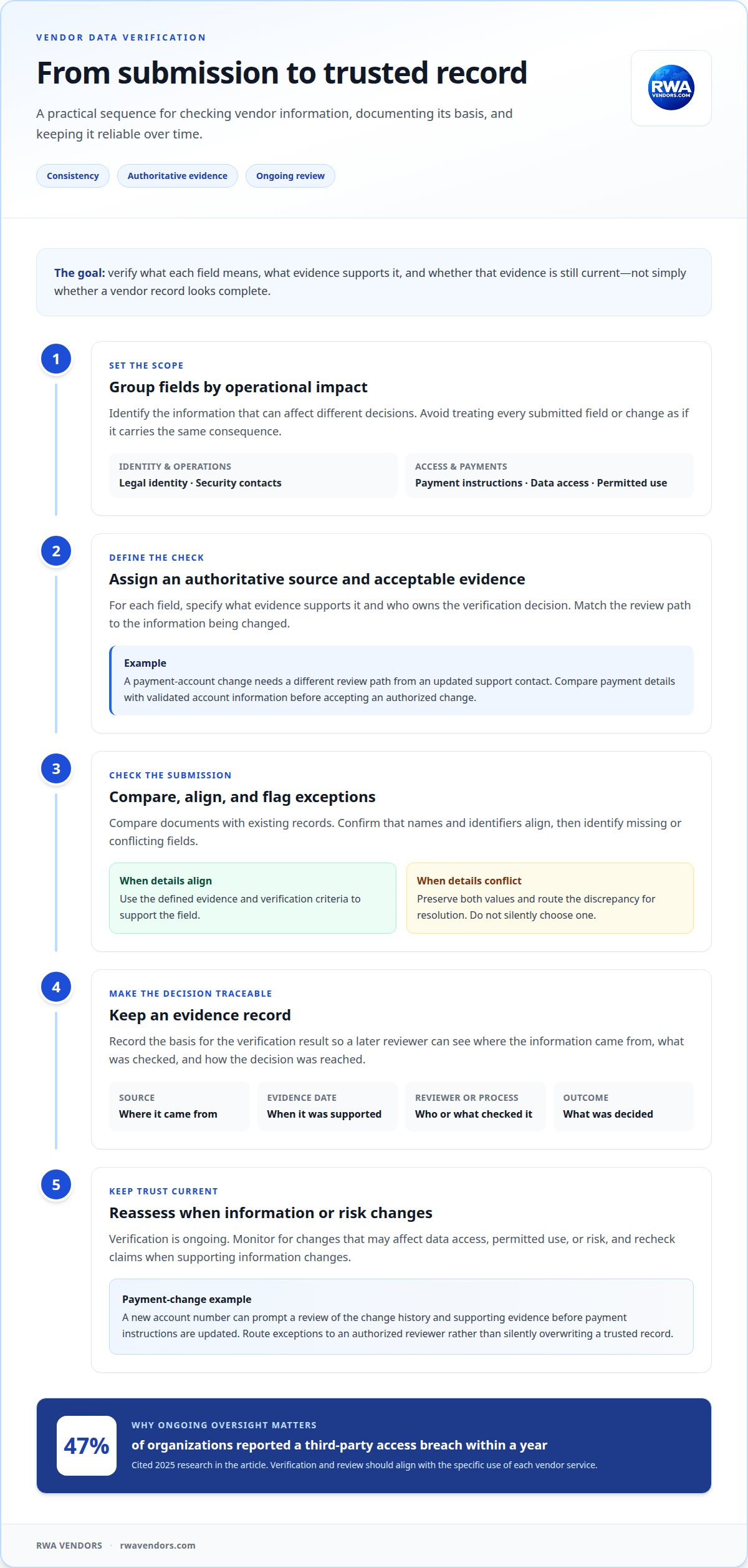
Vendor-submitted data enters an organization’s records through forms, documents, system feeds, or credential exchanges. Each channel creates different verification needs. A tax document may support a legal name, while a platform feed may report service status or access permissions. Effective governance defines what evidence supports each field, who owns the decision, and how the result remains useful after onboarding. Without this structure, a record can look complete while combining claims verified in different ways.
Start by grouping fields according to their operational impact. Legal identity, payment instructions, security contacts, data access, and permitted use can affect different decisions. Assign an authoritative source and acceptable evidence to each field. For example, a change to a vendor’s payment account should follow a different review path from an updated support contact. Documenting the difference helps teams apply the right checks instead of giving every submitted change the same broad approval.
Next, assess the submission. Compare documents with existing records, confirm that names and identifiers align, and identify missing or conflicting fields. If a certificate names one entity but the contract names another, preserve both values and route the discrepancy for resolution. Don’t silently choose one. Record the source, evidence date, reviewer or process, and outcome so later decisions can be traced to their basis.
Define review criteria for updates. Decide which vendor changes require scrutiny, especially changes affecting data access, permitted use, or risk. A changed administrator, new network connection, or revised data-retention commitment can alter the relationship even when the supplier’s legal name remains the same. Route material changes to the owner responsible for the decision. Routine corrections can follow a lighter process when governance rules set clear boundaries and retain the history.
Quality controls also apply to recurring data feeds. At DAMA-DMBOK Level 4, Quantitatively Managed, vendor feeds are monitored for volume, fields, and quality against defined thresholds. A feed that suddenly omits a required field, changes its format, or delivers an unexpected volume can then trigger investigation. Thresholds should reflect the data’s purpose and normal behavior. A supplier-status feed, for instance, needs checks that reveal missing status updates before downstream records treat old information as current.
Verification results should distinguish evidence from conclusions. A submitted document is evidence; an approved supplier status is a decision based on evidence and rules. Store them separately, assign ownership to the relevant record, and provide a process for corrections. If a vendor disputes a finding, the organization can revisit the source and decision instead of erasing the earlier result. This history supports consistent treatment during onboarding and later reviews.
Finally, connect verification to monitoring. Define events that prompt renewed review, such as expired documents, changed access, conflicting records, or a revised use of data. A vendor’s status should reflect the latest relevant evidence, not just the initial onboarding date. When an update is pending, downstream teams need a clear status that distinguishes current, under-review, and restricted information. This keeps operational decisions aligned with evidence while preserving an auditable record of corrections and approvals.
Vendor audit trails for verifying data provenance
Data provenance means tracing a claim to its source and following what happens afterward. A vendor identity network can centralize and automate verification, create an auditable trail, and monitor for changes that require re-verification. That trail is useful only if it captures evidence and decisions, not just a final “approved” status. For example, a reviewer should be able to trace a supplier’s current credential to its issuer, validation event, and latest recorded change.
Evidence may include signed credentials, source documents, registry records, and confirmations from authoritative sources. Each supports a different part of a claim. A signed credential can show who issued information and whether the signature validates. A supporting document may establish the basis for a field. A registry record can show whether the issuer or credential status changed. Keep each evidence type connected to the claim it supports, so an auditor can distinguish an assertion from its source.
A useful audit trail records key events in sequence. For a vendor identity update, this could include the submitted claim, source checked, validation result, decision, and any later correction. Record when each event occurred and which system or authorized process performed it. If the supplier’s status changes, preserve the earlier value alongside the new one. This history shows whether a decision relied on current information or a record later superseded.
- Source evidence: the document, credential, or authoritative record supporting a claim.
- Validation events: the check performed, its outcome, and the evidence examined.
- Change history: prior and current values, with the event that prompted an update.
- Decision records: the approval, rejection, or escalation tied to a responsible process.
- Access and registry events: changes to entries, permissions, or resolution results.
Event logging makes registry activity easier to reconstruct. AU-2 is an event-logging reference relevant to registry changes and resolution events. A registry log can show when an entry changed, which identity or process initiated that change, and how a lookup resolved at that time. Pairing these events with the relevant credential helps explain why a relying system accepted a claim. Without that context, a valid signature alone may not reveal whether the record was current when used.
Automated verification can reduce fragmented evidence, but it should preserve the path from input to result. If a system matches a supplier record against an external source, the trail should identify the source and outcome. If the match fails or returns conflicting values, record the exception and how it was resolved. For example, keep a legal name mismatch visible after correction rather than making it disappear when the vendor profile is updated.
Monitoring makes provenance useful beyond initial onboarding. Define which changes trigger re-verification, such as a revoked credential, altered registry entry, expired supporting document, or changed data permission. Route those events to the owner responsible for the affected decision. A refreshed status should retain its evidence and event history. This helps operational teams distinguish a recently validated claim from one whose source has changed since its last review.
Auditability also depends on access controls and key administration. CIS Controls v8 identifies CIS-6, Access Control Management, as relevant to governing registry administration. Restricting registry changes to authorized roles helps reduce untracked edits. The OWASP Non-Human Identity Top 10 identifies NHI-01 as Improper Offboarding, a risk when obsolete identities or keys remain published. Removing outdated access and recording the change helps keep the trail aligned with the identities still authorized to act.
Provenance evidence should let a reviewer reconstruct a decision without relying on the vendor’s current screen alone. Link the claim, source, validation event, decision, and subsequent changes through durable records. That chain supports investigations when systems show different values and makes re-verification more targeted. It also clarifies what the vendor’s evidence demonstrates and which parts of a claim still need a separate review.
Vendor identity
Vendor verification validates suppliers’ credentials and legitimacy to help support secure transactions and regulatory compliance. Identity is more than a single field. It can include a legal entity, its representatives, operational contacts, and the accounts or systems acting on its behalf. A reliable identity record connects these elements without treating them as interchangeable. For example, a person authorized to submit documents may not be authorized to change payment instructions.
Begin with the legal entity. Record its official name, jurisdiction of registration, and identifiers used in relevant business records. Compare those details across the supplier’s submitted documents, contract, and authoritative business sources. If “Northbridge Systems LLC” appears in a contract but “Northbridge System” appears on an invoice, preserve the discrepancy and resolve it before linking the records. Consistent entity identifiers help prevent similarly named organizations from being treated as the same supplier.
Then establish who can act for that entity. Map each representative to a role and permitted action, such as submitting information, approving an update, or managing technical access. Keep evidence of that authority connected to the identity record. A supplier administrator might be allowed to maintain service contacts, while a separate authorized representative approves changes to contractual details. Distinct roles clarify responsibility when records change or an issue requires investigation.
Digital credentials can make identity claims portable between systems. The receiving organization needs to validate the issuer, credential signature, relevant claims, and current status. A signed credential can establish that a claim came from its issuer, but the claim’s meaning still depends on context. For example, proof that a person belongs to a supplier does not automatically establish authority to administer the supplier’s network access.
Vendor identity also includes machine accounts and integrations. An API identity used by a supplier should have a named owner, defined purpose, and access limited to required functions. If a vendor changes its integration account, connect the replacement identity to the same supplier record only after reviewing its authority and scope. Separating a service identity from an employee account makes system activity easier to attribute.
Identity records need lifecycle governance. Capture initial evidence, changes to representatives and access, and the reason for each update. When a relationship ends or a representative loses authority, update the relevant identity and access records. If a supplier’s legal entity changes after a corporate restructuring, retain the prior record’s history and establish how the successor relates to it. This prevents historical decisions from being overwritten by a new name.
Apply risk-based review to identity elements that support sensitive actions. A change to a public support contact may need a different approval path from a change to a payment approver or privileged system account. Set review triggers for mismatched entity details, unexpected role changes, or credentials whose status changes. Escalate unresolved conflicts to the owner of the affected decision, and retain the evidence and outcome.
For organizations assessing potential providers in tokenized capital markets, identity checks are one part of a broader provider review. Compare each provider’s stated role with the stage of work it supports, such as technology, compliance, or tokenization infrastructure. Keep the legal entity distinct from the operational contact in procurement records. This helps teams understand which organization they are engaging and which individual or system can perform each action.
RWA Vendors: Vendor Directory Listing
RWA Vendors’ Vendor Directory Listing helps asset issuers identify providers across the real-world asset tokenization ecosystem. Use the directory to explore technology, compliance, legal, or tokenization vendors for projects involving real estate, funds, securities, or other assets. RWA Vendors connects asset issuers with verified tokenization platforms and service providers, helping organize discovery across different stages of the market.
For providers, a Vendor Directory Listing offers a way to present their organization within this ecosystem. Founding Membership and Lead Generation and Referrals are also available to businesses seeking directory and connection opportunities. The directory supports discovery; it does not replace your organization’s due diligence or the verification processes described above.
Contact RWA Vendors to discuss the Vendor Directory Listing.
Build trust into the next decision
A verifiable data vendor assessment can become an ongoing part of how your organization manages business relationships. Start by assigning clear ownership for decisions about vendor information, so updates and exceptions have a responsible path instead of sitting between teams. This makes verification part of everyday operations, not just an onboarding checkpoint.
For asset issuers, finding the right capabilities is also part of building a strong tokenization ecosystem. RWA Vendors’ Vendor Directory Listing, Founding Membership, and Lead Generation and Referrals support discovery and connections between issuers, verified tokenization platforms, and service providers. Explore these options when developing your provider network or making your organization visible to prospective partners.
Take the next step by identifying the partners and capabilities your work requires.
Frequently Asked Questions
Vendor verification: an effective defense against fraud?
Yes. Vendor verification can help defend against fraud when built into onboarding and payment workflows. For example, if an invoice arrives from a familiar supplier but names a different contracting entity, verification can stop it from moving forward until the discrepancy is resolved. Pair verification with defined approval roles and escalation paths, so staff know how to handle suspicious requests instead of relying on familiarity or email history alone.
What is a verifiable data vendor?
A verifiable data vendor is a supplier whose identity and relevant business claims can be supported by evidence that another party can validate. For example, a prospective provider may submit an organizational credential that a business can validate before adding the provider to procurement records. The term describes the supplier and the verifiability of its claims, not a guarantee that every submitted detail is accurate or suitable for every business decision.
Disclaimer
This article is provided by RWAVendors.com for general informational and educational purposes only. It does not constitute legal, financial, investment, tax, regulatory or other professional advice, or an offer, solicitation, recommendation or endorsement of any company, product, service, token, security or investment. RWAVendors.com is an informational vendor directory and does not sell, issue, broker, custody or facilitate transactions involving cryptocurrencies, digital tokens, tokenized assets, securities or investment products. Some vendor listings and references may involve paid advertising, sponsored placement or membership relationships. These relationships do not guarantee a vendor’s qualifications, regulatory status, performance or suitability. Information may be incomplete, outdated or subject to change. You should independently verify all information, conduct your own due diligence and consult qualified professionals before making any business or investment decision. RWAVendors.com is not responsible for the content, services, representations or actions of third-party vendors or linked websites.


