

Custody is one part of the provider landscape for real-world asset projects. Tokenization custody providers work alongside issuance platforms, token operations tools, and market infrastructure, so choosing one involves more than comparing names or locations. The right fit depends on the asset, jurisdiction, regulatory status, security controls, and wallet model.
It makes sense to focus on custody: private-key management and transaction approvals affect how an asset is controlled and transferred. But the custody arrangement must also fit the project’s legal structure, issuance process, and operating model.
This guide compares providers by region and explains how to assess the differences across real estate, funds, securities and commodities. It covers regulatory context, key-management controls, custody integrations and custodial versus non-custodial wallets, then shows how custody fits into the wider tokenization infrastructure stack.
Key Takeaways
- Match custody arrangements to the asset and project workflow, since real estate, funds, securities, and commodities can have different operational needs.
- Compare key controls such as approval workflows, key management, recovery procedures, and audit trails, not just security labels.
- Assess provider status within the relevant jurisdiction and distinguish crypto-asset custody from custody of financial instruments.
- Understand how custodial, non-custodial, MPC, and multisignature wallet models allocate control and operational responsibility.
- Look beyond custody to the issuance, token operations, compliance, and market infrastructure a project needs to function.
Custody for tokenized real estate, funds, securities, and commodities
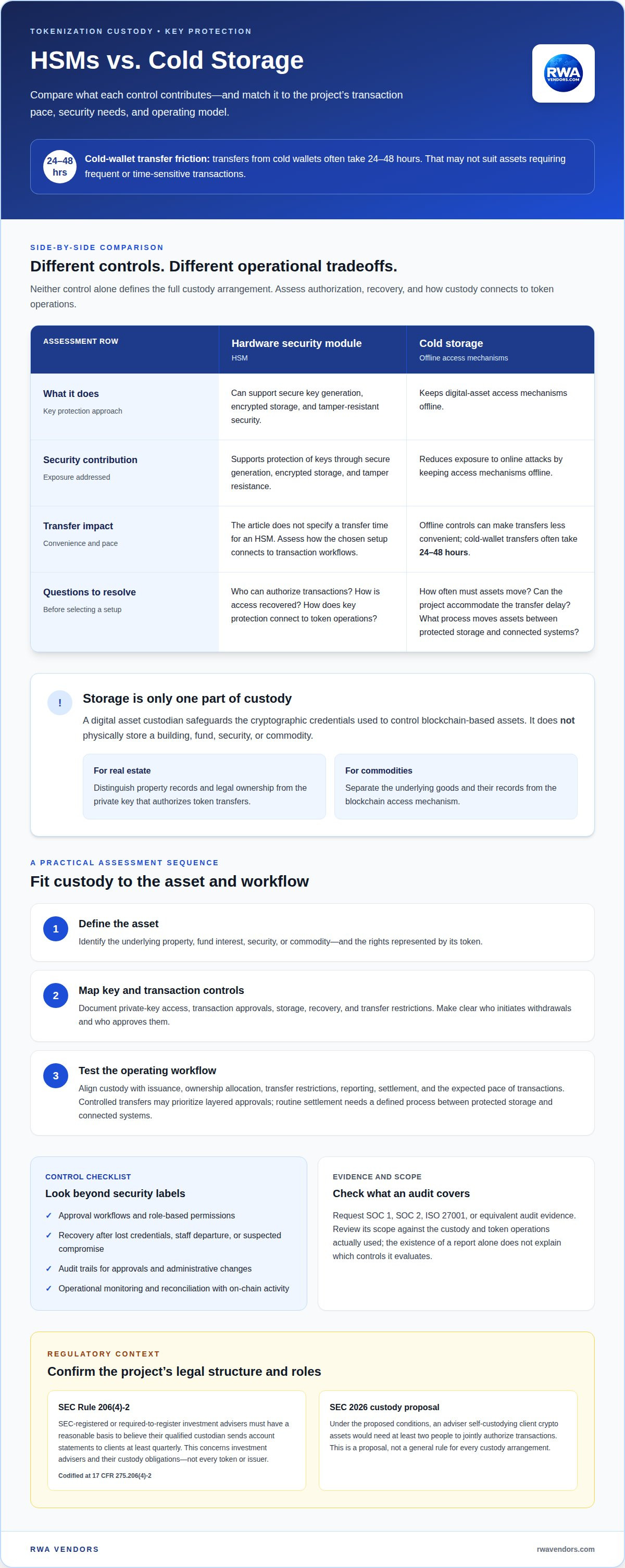
Start by identifying what the token represents and what custody needs to protect. A digital asset custodian safeguards the cryptographic credentials used to control blockchain-based assets. It does not physically store a building, fund, security, or commodity. For tokenized real estate, distinguish property records and legal ownership from the private key that authorizes token transfers. For commodities, separate the underlying goods and their records from the blockchain access mechanism.
Next, match the custody arrangement to the asset’s legal wrapper and transfer rules. A token may represent an interest in a fund or security, while operating on a blockchain. The custody design should support issuance, ownership allocation, transfer restrictions, reporting, and settlement. In a real estate project, for example, restricted transfers may matter more than immediate circulation. Define these needs before selecting storage or transaction workflows.
Tokenized securities and fund interests also require attention to the adviser’s custody obligations. Under SEC Rule 206(4)-2, codified at 17 CFR 275.206(4)-2, SEC-registered or required-to-register investment advisers must have a reasonable basis to believe their qualified custodian sends account statements to clients at least quarterly. This rule concerns investment advisers and their custody obligations; it shouldn’t be treated as a universal rule for every token or issuer. Identify the project’s legal structure and the parties’ roles before mapping custody controls.
To assess key protection, compare hardware security modules with offline storage. A hardware security module can support secure key generation, encrypted storage, and tamper-resistant security. Cold storage keeps digital asset access mechanisms offline, reducing exposure to online attacks. Neither control alone defines the full custody arrangement. Assess who authorizes transactions, how access is recovered, and how custody connects to token operations. Wallets linked to operational systems may support routine transfers, while offline controls can make transfers less convenient.
That friction is a deliberate security and speed tradeoff. Transfers from cold wallets often take 24-48 hours, so this model may not suit assets requiring frequent or time-sensitive transactions. Match storage to transaction frequency, security requirements, operational complexity, and regulatory obligations. A project with controlled transfers can prioritize layered approvals; one with routine settlement needs a defined process for moving assets between protected storage and connected systems.
Use this sequence to assess fit across asset types:
- Define the asset: identify the underlying property, fund interest, security, or commodity and the rights represented by its token.
- Map the controls: document private-key access, transaction approvals, storage, recovery, and transfer restrictions.
- Test the workflow: align custody with issuance, reporting, settlement, and the expected pace of transactions.
Custody, key management, and token operations controls
Assess asset custody as a chain of permissions, systems, and operational responsibilities. A digital asset custodian manages blockchain access credentials for a business, while token operations govern issuance, transfers, and lifecycle events. Map who can create an asset, approve a transaction, change restrictions, and recover access. For example, an issuer may approve investor eligibility while a separate operations team executes permitted transfers.
Private-key management should make authorization explicit. A private key can authorize blockchain asset transfers, so a provider’s wallet controls should define who initiates withdrawals and who approves them. Look for role-based permissions, approval hierarchies, and segregation of duties. Multiple approvals can reduce reliance on one person’s access. The SEC’s 2026 custody proposal would require at least two people to jointly authorize transactions when an adviser self-custodies client crypto assets under the proposed conditions. That is a proposal, not a general rule for every custody arrangement.
Wallet management also needs a clear recovery process. Document how access is restored after a lost credential, staff departure, or suspected compromise, and who can authorize recovery. Then connect the wallet workflow to the project’s operational controls. Enforce transfer restrictions consistently through approval procedures and token operations, rather than relying on informal instructions outside the blockchain process.
Blockchain connectivity brings its own operational dependencies. Identify how the custody environment reads network activity and submits signed transactions. For a permissioned transfer, trace the process from an eligibility decision to transaction submission and a recorded outcome. Clarify who monitors node or connectivity failures, how pending transactions are handled, and how operational records are reconciled with on-chain activity. These controls help distinguish a delayed network response from an incomplete approval.
Security review should cover threats and evidence, not just key storage. Phishing, malware, and social engineering can target staff with legitimate permissions. Examine access monitoring, incident handling, recovery procedures, and audit trails that record approvals and administrative changes. Request SOC 1, SOC 2, ISO 27001, or equivalent audit evidence as part of the assessment. Review its scope against the custody and token operations actually used; a report’s existence alone doesn’t explain which controls it evaluates.
Use a practical control map before implementation:
- Assign roles: identify initiators, approvers, administrators, and recovery decision-makers.
- Trace transactions: link each approval to its authorization, submission, and recorded result.
- Test exceptions: document responses to compromised access, connectivity interruptions, and disputed transfers.
For providers building these capabilities, a vendor directory listing can connect their services with issuers seeking tokenization infrastructure.
Provider comparisons by country and regulator
Compare the legal entity providing custody, its regulator, and the specific activities it is authorized to perform. A provider’s presence in a country does not establish authorization for every custody service or asset type. “Qualified custodian” also has a jurisdiction-specific meaning, so assess the legal basis for the claim rather than treating the label as universal.
In the European Union, MiCA treats custody and administration of crypto-assets on behalf of clients as a crypto-asset service under Article 3(1)(16)(a). Under Article 59(1), an entity generally must be authorized as a crypto-asset service provider or be a permitted financial entity to provide that service. MiCA also requires client crypto-assets to be kept separate from the provider’s assets, including on the distributed ledger, under Article 75(7).
Use the regulator’s records to compare authorization and service scope. ESMA publishes a register under MiCA Article 109. According to ESMA’s interim register, 227 entities were registered to provide custody and administration of crypto-assets on behalf of clients as of October 13, 2026. The same register listed 11 entities in Spain for that service on that date. These figures describe register entries, not a quality ranking or confirmation that every entity supports a particular RWA structure.
Supported assets and blockchain networks differ by provider. Compare whether each service covers the project’s asset category, the networks needed for issuance and transfers, and integrations with compliance or reporting workflows. For tokenized securities, distinguish custody of crypto-assets from custody of financial instruments: under MiFID II, custody of financial instruments is an ancillary service listed in Annex I, Section B, point 1. One authorization shouldn’t be assumed to cover both activities.
Fees and minimums depend on the custody model, supported assets, transaction frequency, integration requirements, and operational scope; pricing is provided after a quote request. Compare fees with the service scope, since a low headline fee may not include the controls the project requires.
For institutional use, assess whether the provider can meet current operating needs and planned growth. Regulatory status is only part of the assessment. Evaluate service availability, recovery processes, audit evidence, and private-key controls. Use an orderly onboarding process:
- Define scope: document the asset, jurisdiction, network, legal structure, and required custody activity.
- Map authorization: match the contracting entity and regulator record to that activity.
- Test operations: align onboarding, transfer restrictions, custody integration, and audit trails before launch.
This comparison separates a provider’s regulatory standing from its practical fit. Select the entity whose authorized activities, asset coverage, network support, and operational controls align with the project’s requirements.
Qualified custodians, MPC, multisig, and wallet-as-a-service
Choose a wallet model by defining who controls access, approves transactions, and takes operational responsibility. A custodial wallet is managed by a third party that holds or manages its private keys. A non-custodial wallet is managed directly by the user, such as an investor controlling their own access credentials. Wallet-as-a-service can provide wallet infrastructure, but the label alone does not establish who holds keys or authorizes transfers.
Institutional tokenization custody differs from exchange custody in purpose and operating context. Exchange custody typically supports assets held for trading within an exchange environment. Institutional custody must fit an issuer’s governance, asset controls, transfer rules, and reporting workflows. Compare the service’s actual scope rather than assuming an exchange wallet meets an RWA project’s needs.
Multi-party computation, or MPC, lets multiple parties authorize transactions collectively without exposing a complete private key in one location. Multisignature, or multisig, requires multiple keys to approve a transaction. Both distribute control, but differ in implementation and network support. For example, an issuer may require separate treasury and compliance approvals before a token transfer proceeds.
Storage models also affect access. Hot wallets use keys in systems connected to online services, supporting operational access but increasing exposure to online threats. Cold storage keeps access mechanisms offline and disconnected from internet-connected systems. Warm wallets can describe an intermediate operational arrangement, but providers may use the term differently. Define the actual connectivity, approval process, and transfer path instead of relying on the label.
MetaMask and WalletConnect may appear in user access flows, but their presence does not determine custody. A connected wallet may let an investor initiate or approve an interaction while a separate custodian manages the private keys. Map each step: who connects, who signs, which party can reject the transaction, and where final authorization resides. This distinction matters when an issuer needs controlled investor transfers.
For projects spanning jurisdictions, define governance for each entity and user group. Specify which team controls wallet permissions, how approvals work across entities, and how access changes when responsibilities shift. EUR-Lex states that issuers of asset-referenced tokens must use due skill, care, and diligence when selecting, appointing, and reviewing custodians of reserve assets. This requirement concerns reserve assets for asset-referenced tokens.
Use a decision sequence before selecting a model:
- Assign control: identify key holders, transaction approvers, and recovery authority.
- Match access: align hot, warm, or cold storage with transaction needs and security controls.
- Map jurisdiction: document the responsible entity, governance process, and custody scope.
Tokenization custody and infrastructure providers
Digital asset custody is one layer of an RWA project’s infrastructure, not the whole operating stack. An issuance platform can manage asset onboarding and compliance rules, while custody systems secure access credentials and support transaction controls. Market infrastructure can connect these functions to settlement and distribution. For a tokenized fund, consider how investor eligibility, custody, and transfer processing work together.
Map the asset lifecycle before selecting vendors. Custody infrastructure can support ownership management from issuance and allocation through transfers, reporting, and settlement. Assign each stage to a responsible system and operator. For example, record which platform creates ownership allocations, which system applies transfer restrictions, and where completed transactions appear in reporting. This map can reveal operational gaps before they affect issuance or investor servicing.
Provider categories can overlap, but their roles differ. An issuance platform may offer compliance rails and token operations tools. A custody provider manages digital asset access and transaction authorization. Market infrastructure connects projects to regulated financial services. One provider may cover several functions, or an issuer may integrate separate vendors. Compare the actual functions and handoffs rather than relying on broad labels such as “end-to-end.”
Integration determines whether these functions work as one workflow. Digital asset custody solutions can connect with portfolio management systems, trading platforms, compliance tools, and enterprise APIs. Trace a sample event, such as an approved investor transfer, through each integration. Identify where the eligibility decision occurs, how the custody system receives the instruction, and how the resulting ownership record reaches reporting tools. Missing or duplicated handoffs can create reconciliation work.
Assess infrastructure against the project’s operating model and growth plans. Institutional systems should support current needs and evolving use cases while remaining transparent and scalable. That does not mean choosing the broadest platform by default. A project launching with controlled transfers may need strong custody integration and reporting before secondary-market connections. Prioritize launch requirements, then assess how additional workflows can be added.
Use this sequence to compare providers:
- Map the workflow: document issuance, allocation, custody, permitted transfers, reporting, and settlement.
- Assign system ownership: identify which provider controls each action and which system records its outcome.
- Trace integrations: follow a transaction across custody, compliance, portfolio, and market systems.
- Test project fit: align the selected infrastructure with asset type, distribution plans, and operational priorities.
The key is to evaluate custody as part of connected asset infrastructure. A provider may secure keys effectively yet leave gaps between issuance, compliance, and settlement. Compare the full workflow, define responsibilities at each handoff, and prioritize integrations that support the project’s operating model.
RWA Vendors
RWA Vendors connects asset issuers with verified tokenization platforms and service providers, including providers across custody and related infrastructure. Use the directory when you have defined your asset, jurisdiction, wallet model, and operating requirements and need to identify relevant vendors across technology, legal, compliance, and tokenization categories.
The directory helps you map the provider ecosystem around custody, rather than treating key management as the project’s only infrastructure decision. Issuers can discover companies supporting real estate, funds, securities, and other asset tokenization workflows. Service providers can use Vendor Directory Listing, Founding Membership, and Lead Generation and Referrals to build visibility and connections within the ecosystem.
Contact RWA Vendors to discuss your project or provider needs.
Move from provider review to project readiness
A provider decision should support a clear operating plan, not sit apart from it. Before implementation, align internal owners on how custody fits the project’s launch sequence, investor access, and ongoing operations. A shared decision record can capture the rationale, responsibilities, and assumptions that will guide future changes.
Treat your assessment of tokenization custody providers as one input to broader project readiness. The next phase may involve coordinating technology, compliance, and tokenization partners around a shared workflow. Keeping responsibilities visible helps teams manage handoffs as the project develops, rather than treating custody selection as a standalone technical task.
RWA Vendors helps issuers identify relevant providers across the tokenization ecosystem as they prepare for the next phase. Bring your project requirements and explore vendor connections that fit your direction.
With a defined path forward, your team can approach implementation with greater clarity and coordination.
Frequently Asked Questions
Are these the only credible providers?
No. Credible options extend beyond any short list because custody services differ by jurisdiction, asset coverage, wallet design, and operating model. A provider suited to a fund’s controlled transfers may not fit a securities project with different reporting or investor access needs. Compare the legal entity, service scope, controls, and integration fit for your project. Inclusion in a list is not an endorsement or a final decision.
Which providers offer custody for tokenized assets in the United States?
US projects should consider providers whose legal entity and service scope match the custody activity and assets involved. RWA Vendors’ directory lists 128 Institutional Custody Providers within its Custody, Wallets & Security category, which has 245 listings. Those are directory counts, not a US-only roster or confirmation that every listed provider supports a particular asset or project. Compare each provider’s jurisdictional coverage and supported services.
What security certifications and controls do tokenization custody providers offer?
Available evidence and controls vary by provider. Ask what the provider’s SOC 1, SOC 2, ISO 27001, or equivalent audit evidence covers, including whether the reviewed systems include the custody environment and relevant operational processes. Then assess access permissions, withdrawal approvals, monitoring, recovery, and incident records. For example, a report covering corporate systems may not describe controls for a specific wallet workflow, so match evidence to the service being assessed.
Which U.S. licenses or regulations apply to tokenized asset custodians?
Applicable requirements depend on the asset, service, provider entity, and client relationship. For investment advisers, SEC Rule 206(4)-2 is the custody rule, codified at 17 CFR 275.206(4)-2; its application depends on the adviser’s role and the assets involved. Custody of financial instruments and custody of crypto-assets are distinct activities. A provider’s general registration or license shouldn’t be treated as authorization for every asset or custody service.
What are the risks of using a third-party custodian for tokenized assets?
Third-party custody can create dependence on another organization’s access controls, systems, staff, and recovery procedures. A security incident, operational disruption, or access failure could affect a project’s ability to authorize transactions or maintain records. Insurance may exclude some losses, so review the coverage schedule and exclusions against relevant custody risks. Also define responsibility for incident escalation, data access, and continuity if the provider relationship or service arrangement changes.
Which tokenization custody providers support qualified custody and insurance?
No single label establishes qualified-custodian status and insurance coverage for every project. Assess the contracting entity and applicable legal status in the relevant jurisdiction, then review the insurance schedule, covered risks, limits, and exclusions. Coverage may not apply to every type of loss. Compare the documents with the project’s assets, custody arrangement, and operational exposures; a provider’s general statement about qualification or insurance does not establish that the project’s specific risks are covered.
Disclaimer
This article is provided by RWAVendors.com for general informational and educational purposes only. It does not constitute legal, financial, investment, tax, regulatory or other professional advice, or an offer, solicitation, recommendation or endorsement of any company, product, service, token, security or investment. RWAVendors.com is an informational vendor directory and does not sell, issue, broker, custody or facilitate transactions involving cryptocurrencies, digital tokens, tokenized assets, securities or investment products. Some vendor listings and references may involve paid advertising, sponsored placement or membership relationships. These relationships do not guarantee a vendor’s qualifications, regulatory status, performance or suitability. Information may be incomplete, outdated or subject to change. You should independently verify all information, conduct your own due diligence and consult qualified professionals before making any business or investment decision. RWAVendors.com is not responsible for the content, services, representations or actions of third-party vendors or linked websites.


