

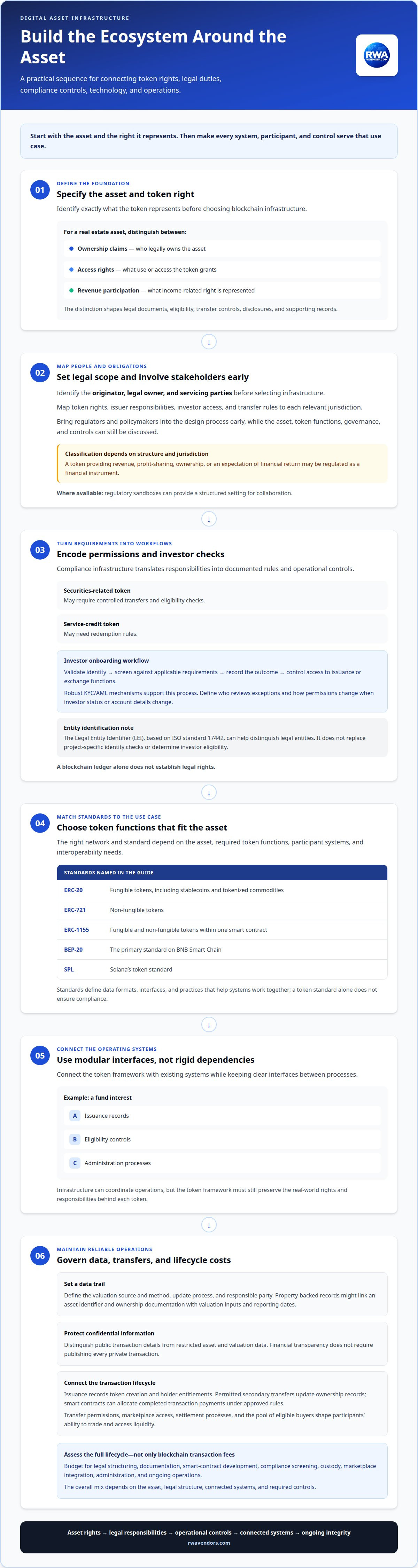
A tokenization ecosystem brings together the legal and compliance framework, regulators, asset and ownership data, technology, custody, market participants, audits, and cybersecurity around a clearly defined use case. To understand how to build a tokenization ecosystem, begin with the asset or right being represented, then determine how each participant, system, and control supports it.
Technology is only one part of the design. A blockchain can record transactions, but the ecosystem also needs reliable information about the underlying asset, clear governance, secure smart contracts, and processes for managing access, transfers, and disputes. Each element must work together to support trust and operational continuity.
This guide explains how compliance infrastructure and regulator collaboration shape the model, why participant adoption matters, and how custody, data verification, independent audits, and cybersecurity support integrity. It also covers how standards and modular systems connect ecosystem participants while preserving the real-world rights and responsibilities behind each token.
Key Takeaways
- Define the asset, rights, and purpose first so the technology and compliance controls serve a clear use case.
- Bring legal, compliance, regulatory, and policy stakeholders into the design process early.
- Use a focused minimum viable ecosystem to demonstrate value and build participant engagement.
- Align custody and wallet arrangements with participant roles, access needs, and operational controls.
- Support trust with reliable asset data, independent audits, secure smart contracts, privacy protections, and clear governance.
Compliance infrastructure for digital assets
Start with the asset and the right the token will represent. A real estate issuer, for example, must distinguish ownership claims from access rights or revenue participation. That distinction shapes legal documents, investor eligibility, transfer controls, disclosures, and the records needed to support each token. Identify the originator, the asset’s legal owner, and the parties responsible for servicing it before choosing blockchain infrastructure.
Compliance infrastructure turns those responsibilities into rules and operational controls. Tokenization protocols implement processes based on standards and frameworks designed for specific use cases. A securities-related token may require controlled transfers and eligibility checks, while a service-credit token may need redemption rules. Encode applicable permissions in system workflows and supporting documentation. A blockchain ledger alone does not establish legal rights.
Which blockchain networks and token standards are best for asset tokenization? The right choice depends on the asset, required token functions, participant systems, and interoperability needs. ERC-20 supports fungible tokens, including stablecoins and tokenized commodities; ERC-721 supports non-fungible tokens; ERC-1155 supports fungible and non-fungible tokens within one smart contract. BEP-20 is the primary standard on BNB Smart Chain, while SPL is Solana’s token standard.
Standards define data formats, interfaces, and practices that help systems work together consistently. Choose a modular design that connects the token framework with existing systems without creating rigid, one-to-one dependencies. For a fund interest, for example, connect issuance records, eligibility controls, and administration processes while maintaining clear interfaces between them. Infrastructure can coordinate these operations, but a token standard alone does not ensure compliance.
What are the costs of building and operating a tokenization ecosystem? Assess the full lifecycle, not just blockchain transaction fees. Budget planning should account for legal structuring, documentation, smart-contract development, compliance screening, custody, marketplace integration, administration, and ongoing operations. The overall mix depends on the asset, its legal structure, the systems it must connect to, and the controls required throughout its lifecycle.
Valuation data needs a defined source and method, an update process, and a responsible party. For a property-backed token, records might link the asset identifier and ownership documentation with valuation inputs and reporting dates. Keep commercial information confidential where needed: financial transparency does not require publishing every private transaction. Distinguish public transaction details from restricted asset and valuation data.
How do tokenized assets support issuance, secondary trading, settlement, and liquidity? Issuance records token creation and holder entitlements. Permitted secondary transfers update ownership records, while smart contracts can allocate completed transaction payments under approved rules. A shared blockchain ledger can reduce separate recordkeeping across organizations. Transfer permissions, marketplace access, settlement processes, and the pool of eligible buyers all shape participants’ ability to trade and access liquidity.
Legal compliance and regulator collaboration
Legal design starts by mapping the token’s rights, issuer responsibilities, investor access, and transfer rules to each relevant jurisdiction. A token that provides revenue, profit-sharing, ownership, or an expectation of financial return may be regulated as a financial instrument, depending on its structure and jurisdiction. That classification can shape offering documents, marketing, investor onboarding, and permitted secondary trading.
Involve regulators and policymakers early in ecosystem development. This gives project teams a chance to explain the proposed asset, token functions, governance, and operational controls before systems and commercial arrangements become difficult to change. Regulatory sandboxes can provide a structured setting for collaboration where available. Legal design thinking also connects requirements with the product’s technical architecture, rather than leaving compliance until a late-stage review.
Investor identity validation should link onboarding information to eligibility decisions and transaction permissions. A compliance workflow can establish an investor’s identity, screen against the project’s applicable requirements, record the outcome, and control access to issuance or exchange functions. Robust KYC/AML mechanisms support this process. Define who reviews exceptions, how decisions are documented, and how permissions change when an investor’s status or account details change.
Legal Entity Identifiers can support consistent identification across organizations. The LEI is based on ISO standard 17442 and identifies legal entities participating in financial transactions and other official interactions. For an institutional investor, recording its LEI alongside authorized representative and account information can make entity records easier to distinguish. It doesn’t replace project-specific identity checks or determine whether an investor is eligible.
Compliance and regulatory services can support legal structuring, documentation, investor screening, policy analysis, and ongoing control design. Their scope should reflect the project’s asset, token rights, target participants, operating jurisdictions, and planned exchange or trading model. A tokenized fund and a token granting access to a service, for example, have different rights to document and compliance questions to resolve. Clear terminology and a shared taxonomy help issuers, technology teams, investors, and regulators discuss those differences precisely.
Translate the legal analysis into clear operational responsibilities. Assign ownership for approving investor access, updating offering disclosures, handling transfer exceptions, and maintaining compliance records. A permissions matrix can link each role to the actions it may perform, while governance documents explain who can change those permissions. This alignment makes control gaps easier to identify before issuance and helps teams manage change as the ecosystem evolves.
For organizations providing these capabilities, a listing for tokenization service providers can make their role discoverable to ecosystem participants.
Change management and participant adoption
Adoption depends on whether tokenization improves a defined workflow, not simply on whether blockchain is available. Start with one use case and identify the participants whose work will change: issuers, investors, administrators, and market operators. Map each group’s current process, such as recording ownership, updating a register, or approving a transfer. Then show how the proposed process changes those tasks and who remains accountable.
A minimum viable ecosystem can demonstrate value before a broader rollout. Keep its scope narrow: one asset type, a defined participant group, and a clear transaction or recordkeeping process. For example, a pilot could test whether authorized participants can review ownership records and complete permitted transfers through connected systems. Use the pilot to uncover workflow gaps, unclear responsibilities, and integration needs before expanding the model.
Make adoption practical by preparing role-specific materials and support:
- Issuers: explain how issuance, servicing, and ownership records fit existing operations.
- Investors: describe onboarding, account access, and the steps involved in permitted transactions.
- Administrators: document record updates, exception handling, and reporting responsibilities.
- Market operators: clarify how trading workflows connect with eligibility controls and settlement processes.
Use the same terminology in legal documents, the user interface, and operating procedures. If a contract defines a transfer restriction, the platform’s transaction flow should explain when it applies. Consistent language helps participants understand what a token represents and prevents teams from describing ownership or access rights in conflicting ways.
Change management also requires clear decision rights. Name the team responsible for approving process changes, communicating updates, and resolving operational disputes. For instance, a governance procedure can specify who reviews a proposed smart-contract change and how affected participants are notified. A documented escalation path gives staff a practical way to handle an account, ownership record, or transaction that requires review.
Gather feedback from pilot users and prioritize issues according to their effect on the core workflow. If investors struggle to understand transfer steps, revise the instructions before adding features. If administrators need clearer records, refine reporting and responsibilities. This keeps innovation tied to user needs rather than the number of features.
Expand only after the pilot shows that participants can complete their assigned tasks and that the operating model supports them. Set review points for training, workflow issues, user feedback, and unresolved decisions. This staged approach makes adoption an ongoing operating discipline and helps the ecosystem evolve without requiring every participant to change processes at once.
Token rewards should reflect real economic activity and clear rules, not recruitment or token-price growth. Tokenization can divide assets or projects into smaller units, lowering participation minimums and broadening access for qualified participants. Blockchain design determines whether participants can see complete transaction histories or only information relevant to their roles.
Custodians and wallet solutions
Custody and wallet design determine how participants control the keys used to access digital assets. A custodian manages key-related operations for an organization, while a wallet provides an interface for authorized actions on a network. Define each component’s purpose before connecting it to issuance or trading. For example, an investor wallet may support holding and transferring tokens, while an issuer’s operational wallet may handle approved distributions.
Choose a custody model that suits the ecosystem’s users and governance. Institutions may need defined roles for preparing, authorizing, and releasing transactions. A workflow could require one team to prepare a transfer and another authorized role to approve it. The priority is operational clarity: document who can initiate and authorize actions, and how access changes when responsibilities change.
Wallet access should match token permissions and participant responsibilities. If a smart contract restricts transfers to eligible holders, the wallet and related systems need to support the required identity and permission checks. For a fund token, for example, an investor’s ability to hold or transfer it must align with the project’s eligibility rules. A wallet alone does not establish legal ownership or prove rights to an underlying asset.
Network compatibility matters, too. A wallet must support the network and token standard selected for the asset, and connected custody and administration systems need compatible transaction data. Map these dependencies before deployment. A network change or token migration can affect wallet access, transaction records, and participant instructions, so define how the ecosystem will handle such changes in advance.
Translate key management into documented operational controls:
- Access: assign wallet permissions to roles, not informal team assumptions.
- Authorization: define approval steps for issuance, transfers, and distributions.
- Recovery: establish how access is restored when credentials are lost or an authorized user leaves.
- Records: retain transaction approvals and related operational evidence.
- Review: reassess permissions when responsibilities or participation change.
Connect these controls to the ecosystem’s governance and incident procedures. For example, if a wallet is suspected of unauthorized use, designated staff should know how to restrict affected activity, preserve relevant records, and escalate the event. The process should also identify who communicates with participants and who approves a return to normal operations.
Test the complete path before live use. Simulate an approved transfer from wallet initiation through smart-contract execution and record updates. Confirm that the intended roles can complete the workflow and that relevant participants can understand the outcome. Testing custody, wallet, network, and administration connections together can reveal integration gaps that isolated component reviews miss.
Data verification, audits and cybersecurity
Value tokenized assets using a defined method, documented inputs, and a named data owner. Link each valuation record to supporting evidence and an update process. An independent audit can assess these controls and compare token records with relevant asset documentation. A blockchain entry alone does not prove that a physical asset exists or that a holder has legally recognized ownership.
Connect on-chain records to off-chain evidence through legal agreements, ownership registers, and asset data. For a property, the platform could link a token identifier to title documentation, valuation records, and servicing updates. Record who provides each input, who approves changes, and how corrections appear in the transaction history. This creates traceability without treating the ledger as proof that the original information was accurate.
Independent audits help test whether processes work as designed. Auditors can review smart-contract logic, access controls, ownership records, and the handling of valuation updates. Robust KYC/AML mechanisms and transparent ownership records also support integrity, particularly in carbon-credit markets. Bringing these checks together helps participants identify gaps between asset evidence, digital records, and actual operating practices.
The main risks span several areas. Security weaknesses can expose keys or smart contracts; legal gaps can separate token records from enforceable rights; operational failures can create inaccurate data or disrupt transactions; and market conditions can limit trading or liquidity. For example, a platform may record a transfer correctly while relying on outdated asset information.
- Data risk: incorrect source information can be recorded immutably, so define validation and correction procedures.
- Contract risk: a smart-contract defect can apply transfer or payment rules incorrectly.
- Cybersecurity risk: weak access controls can expose systems, transaction approvals, or sensitive records.
- Legal and operational risk: unclear agreements or dispute processes can leave participants uncertain about rights and remedies.
- Market risk: restricted access, limited trading activity, or changing demand can constrain liquidity.
Build a security program around specific controls, not a single audit. Assign responsibility for access management, incident escalation, privacy protections, and contract changes. Test whether authorized personnel can respond to a compromised account or incorrect asset record. Restrict sensitive commercial information to relevant roles while preserving enough transparency for participants to understand transactions and ownership records.
Review controls whenever the asset, data provider, smart contract, or participant workflow changes. A new valuation source, for instance, should trigger a review of its evidence, approval path, and effect on reporting. Document findings and remediation so governance teams can track unresolved issues and maintain a clear record of control decisions.
RWA Vendors
RWA Vendors connects asset issuers with verified tokenization platforms and service providers. Use the directory when your ecosystem design calls for partners in technology, legal, compliance, custody, or other tokenization functions. It helps issuers find providers relevant to real estate, funds, securities, and other assets, while project teams retain responsibility for decisions about legal structure, controls, and operating models.
For teams planning how to build a tokenization ecosystem, the directory can help turn requirements into provider discovery. Explore providers across the tokenization lifecycle and identify potential partners for the capabilities your model needs.
Contact RWA Vendors to connect with providers for your tokenization ecosystem.
Turn your ecosystem plan into action
Deciding how to build a tokenization ecosystem ultimately means aligning the right capabilities with a defined asset and operating model. Turn that design into a clear map of the providers and participants you need. Identify the gaps your team must address, then focus your partner search on those capabilities.
RWA Vendors helps asset issuers connect with verified tokenization platforms and service providers. Its Vendor Directory Listing, Founding Membership, and Lead Generation and Referrals support visibility and connections across the ecosystem. These options are relevant to providers seeking to reach issuers and businesses looking for partners across tokenization functions.
A well-defined plan gives every participant a clearer role and a stronger foundation for collaboration. Take the next step with confidence, keeping your ecosystem focused on practical needs.
Frequently Asked Questions
What is a tokenization ecosystem and what are its core components?
A tokenization ecosystem is the connected set of organizations, systems, and operating processes that issue and manage digital representations of assets or rights. For a fund interest, for example, it may involve the issuer, fund administrator, investor onboarding provider, tokenization platform, custody provider, and trading venue. The ecosystem also needs clear agreements about how records and responsibilities connect, so each participant understands which part of the asset lifecycle they support.
What types of real-world assets can be tokenized?
Real estate, fund interests, securities, and other assets can be represented through digital tokens, depending on the rights and structure involved. A token may represent ownership, a claim, participation rights, or access to a service. These are distinct economic and legal functions, not interchangeable labels. For instance, a token connected to a fund interest represents a different arrangement from one that grants access to a service.
What U.S. securities laws and regulations apply to tokenized assets?
U.S. securities requirements depend on the token’s rights and structure, the offering, and the participants. A token providing revenue, profit-sharing, ownership, or an expectation of financial return may be treated as a financial instrument, depending on its structure and jurisdiction. Issuers need to assess the offering and planned transfers in context, including how investor eligibility and disclosures are handled. The blockchain format alone does not determine a token’s legal classification.
How do tokenization platforms handle custody, identity verification, and investor accreditation?
Platforms typically connect these functions through specialist providers and defined workflows. Identity verification can establish who is applying, while compliance screening supports access decisions. Custody arrangements determine how authorized users control or access digital assets. Investor accreditation is a separate eligibility question, and its use depends on the offering’s structure and applicable requirements. For example, onboarding can pass an approval status to the transaction system before a restricted transfer is permitted.
What successful tokenization ecosystems and business models can serve as examples?
Digital securities issuances and blockchain-based loans illustrate models that connect traditional financial rights with digital transaction records. For example, UBS AG completed a transnational digital securities issuance using distributed ledger technology in December 2022. A business model may center on issuing an asset, administering investor records, and supporting permitted transfers. Treat individual transactions as examples of implementation, not proof that another asset or ecosystem will achieve the same results.
Disclaimer
This article is provided by RWAVendors.com for general informational and educational purposes only. It does not constitute legal, financial, investment, tax, regulatory or other professional advice, or an offer, solicitation, recommendation or endorsement of any company, product, service, token, security or investment. RWAVendors.com is an informational vendor directory and does not sell, issue, broker, custody or facilitate transactions involving cryptocurrencies, digital tokens, tokenized assets, securities or investment products. Some vendor listings and references may involve paid advertising, sponsored placement or membership relationships. These relationships do not guarantee a vendor’s qualifications, regulatory status, performance or suitability. Information may be incomplete, outdated or subject to change. You should independently verify all information, conduct your own due diligence and consult qualified professionals before making any business or investment decision. RWAVendors.com is not responsible for the content, services, representations or actions of third-party vendors or linked websites.


