

Legal advice should shape an asset tokenization project before its structure is finalized. Asset tokenization law firms can assess what rights a token represents and how the project’s legal, commercial, and operational elements fit together.
That matters whether the underlying asset is real estate, art, a fund interest, or another form of value. A token may represent ownership, contractual rights, economic exposure, or participation in an entity. Those distinctions affect how the project is designed and offered.
This article explains where legal support can help, from structuring and regulatory analysis to income distributions, redemptions, and cross-border considerations. It also covers how the issues differ across asset classes and what to consider when identifying legal expertise for a tokenization project.
Key Takeaways
- Clarify what rights each token represents and how holders receive income, redeem, or exit.
- Identify the distinct legal and operational questions raised by real estate, art, fund interests, and other assets.
- Assess a law firm’s relevant experience by the project’s asset type, structure, and intended markets.
- Understand how project scope, transaction structure, and regulatory analysis can shape legal fees.
- Determine whether an offering requires SEC registration or may rely on an available exemption based on its specific structure.
Need Legal Advice on Asset Tokenization?
Yes. Legal advice helps define what a token represents, how holders exercise their rights, and which rules may apply to the offering. A token linked to an apartment, an artwork, or a fund interest can raise different legal questions.
Token-to-Asset Legal Relationships
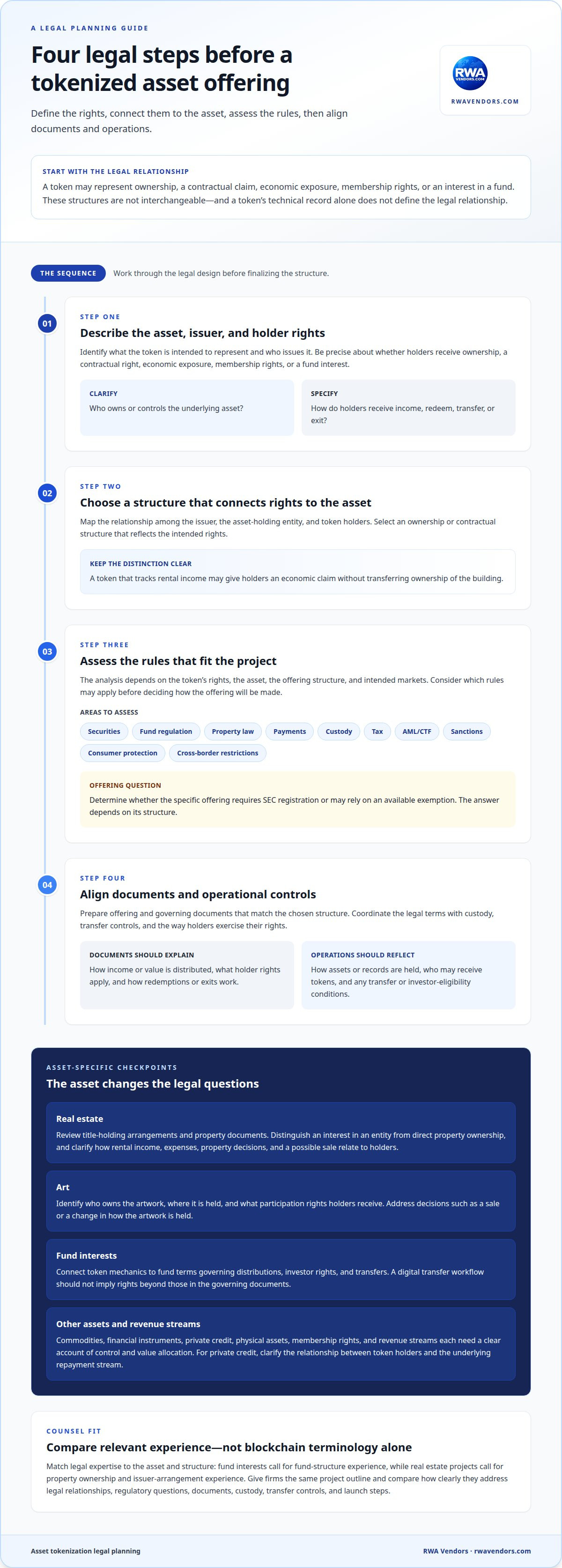
Start by identifying the legal right behind each token. It might represent direct ownership, a contractual claim, economic exposure, membership rights, or an interest in a fund. These structures are not interchangeable. For example, a token that tracks rental income may give holders an economic claim without transferring ownership of the building.
Asset tokenization law firms can help map the relationships among the issuer, the asset-holding entity, and token holders. Review the governing documents alongside the token’s stated rights. They should explain how income or value is distributed and how redemptions or exits work. The token’s technical record alone does not define these legal relationships.
What state and federal rules apply to tokenized real estate and other assets? The answer depends on the token’s rights, the asset, and how the offering is structured. Federal securities rules and state rules concerning securities, property, or entities may be relevant. A real estate interest and an artwork-linked claim can raise different issues.
How do custody, transfer restrictions, and investor accreditation affect tokenized assets? Custody arrangements determine how the asset or related records are held, while transfer controls govern who can receive tokens and under what conditions. Investor eligibility, including accreditation where relevant to an offering structure, can shape distribution and resale procedures.
What legal steps are involved in launching a tokenized asset offering? Issuers generally define token rights, select an ownership or contractual structure, analyze applicable rules, prepare offering and governing documents, and align transfer and custody processes. For a fund interest, the documents should connect token-holder rights with the fund’s established terms.
- Describe the asset, issuer, and intended token-holder rights.
- Choose a legal structure that connects those rights to the asset or issuer.
- Assess securities, fund, property, payment, custody, and cross-border considerations.
- Prepare documents and operational controls that reflect the structure.
What legal and regulatory risks should issuers consider when tokenizing assets? Review securities laws, fund regulation, AML/CTF requirements, custody, payments, tax, property law, consumer protection, sanctions, and cross-border offering restrictions. For a property project offered across borders, local property rights and the intended investor locations can affect the analysis.
Counsel Selection and Industry Experience
Compare asset tokenization counsel by relevant experience, not blockchain terminology alone. A firm advising on fund interests should understand fund structures; a real estate project calls for experience with property ownership and issuer arrangements. Ask how its legal analysis connects token rights, offering documents, custody, and transfer controls.
Use the project’s actual design as a comparison framework. Give each firm the same outline, such as an artwork held by an entity with tokens linked to contractual rights. Compare how clearly each firm identifies legal relationships, regulatory questions, and launch steps. This makes differences in industry focus and practical approach easier to assess.
Tokenized real estate, art, funds and other assets
The asset class changes which questions a tokenization project must resolve. A building, a painting, a fund interest, and a revenue stream each involve different ownership records, income sources, and transfer processes. Legal counsel should assess the asset itself and the proposed participation structure, rather than treating tokenization as a standard model.
For real estate, begin with the title-holding arrangement and the property’s governing documents. If an entity owns an apartment building, distinguish interests in that entity from direct ownership of the property. Counsel can examine how rental income, expenses, property decisions, and a possible sale relate to token holders. The structure also needs to fit the property’s location and intended offering markets.
Art presents a different set of practical questions. A project involving a painting should identify who owns it, where it is held, and what rights token holders receive. Those rights could relate to economic proceeds or another form of participation. Documents should also address decisions affecting the artwork, such as a sale or a change in how it is held, so participants understand how the project operates.
Fund interests require coordination between token mechanics and fund documents. A token may represent participation in a fund, but the fund’s terms govern matters such as distributions, investor rights, and transfers. Counsel should map those terms to the digital process. For example, a transfer workflow must not imply that a holder has rights beyond those granted by the fund’s governing documents.
Other potential assets include commodities, financial instruments, private credit, physical assets, membership rights, and revenue streams. A tokenization project can provide greater access through partial ownership, but fractional participation does not by itself determine how the asset is controlled or value is allocated. A private-credit project, for instance, needs a clear relationship between token holders and the underlying repayment stream.
Use this sequence to compare legal work across asset types:
- Identify the asset, its owner, and the records that evidence ownership or control.
- Define the intended participation, such as ownership, income exposure, or fund membership.
- Match project documents and operating procedures to that participation.
- Review how income, decisions, transfers, and exits work for the specific asset.
Issuers planning projects across these categories can use a directory of tokenization providers to identify relevant legal and technology expertise.
Pair that asset-by-asset review with a broader check of the rules and obligations relevant to the project. A tokenized real-world asset project may raise issues under securities laws, fund regulation, VASP or crypto-asset rules, AML/CTF requirements, payment regulation, custody rules, tax, property law, consumer protection, sanctions, and cross-border offering restrictions. The precise questions depend on the asset, the rights offered, and the markets involved. Counsel can use the proposed structure and operating procedures to identify which areas require attention, then check that project documents, transfer processes, custody arrangements, and communications are consistent with the intended participation. Reviewing these considerations alongside the asset’s ownership, income, decision-making, and exit arrangements keeps the legal analysis connected to how the project is meant to work.
How do I choose a law firm for a tokenization project?
Start with the asset, proposed token rights, and markets where you plan to offer them. A firm’s experience should match those features. Counsel for a fund-interest project may need different experience from counsel handling a building, artwork, or private-credit arrangement. Compare the firm’s work against your project structure, not its use of blockchain terminology.
Look for demonstrated knowledge of both the legal and operational parts of the transaction. For example, a firm advising an issuer should be able to connect the ownership structure with offering documents, holder rights, transfer processes, custody arrangements, and distributions. If a project involves a real estate entity, ask how its advice addresses both entity interests and the underlying property relationship.
Test industry fit with a short project brief. Include the asset type, issuer structure, intended token-holder rights, distribution model, and planned markets. Ask each firm to identify the key legal questions and explain what work it would do first. Compare the substance and clarity of the responses, rather than relying on general claims of digital-asset experience.
Use these prompts to assess the proposed counsel:
- Which asset classes and token structures has the team advised on?
- How will the firm analyze the relationship between tokens, issuers, and assets?
- Which securities, fund, property, custody, and cross-border issues does the project raise?
- What documents and operational processes fall within the engagement?
- Who will lead the work, and how will legal questions be communicated?
Clarify the engagement scope before work begins. A project may require forming or reviewing an asset-holding entity, analyzing offering documents, and coordinating with token-platform or custody providers. The firm’s written scope should distinguish included deliverables from separate work, such as tax analysis or advice on another jurisdiction.
Check whether the firm can explain difficult issues in terms the business team can use. For example, counsel should connect a transfer restriction to the actual token-transfer process, rather than treating it as document language alone. Ask how legal conclusions will be reflected in platform rules, holder onboarding, and ongoing administration.
Finally, compare proposals using the same criteria: relevant asset experience, identified legal issues, deliverables, team responsibilities, and communication process. A clear comparison helps an issuer select counsel whose capabilities align with the project’s legal structure and execution needs.
What do asset tokenization lawyers charge, and how are fees structured?
Legal fees depend on the case and are provided after a quote request; key cost factors include the asset structure, offering scope, legal analysis, documents, and jurisdictions involved. A real estate project with an existing ownership entity may require different work from a fund launch or an artwork-linked offering.
Firms may propose hourly billing, a fixed fee for defined work, or staged fees tied to project milestones. Hourly billing links charges to time recorded. A fixed-fee proposal sets a price for specified deliverables, such as reviewing an offering document. Staged fees can separate initial structuring from later launch support.
Compare proposals by scope, not by the billing label alone. A fixed fee may cover only initial structuring, while another proposal may include document revisions and coordination with a tokenization platform. An hourly engagement may offer flexibility as the project changes, but the total depends on the work performed. Ask each firm to describe its assumptions and exclusions in writing.
For a useful comparison, request a scope that identifies:
- Whether the work covers structure analysis, offering documents, and issuer arrangements.
- Whether securities, fund, property, custody, or cross-border issues are included.
- How many document review stages or revision rounds the proposed scope covers.
- Whether coordination with technology, compliance, or custody providers is included.
- Which later services, such as ongoing updates or additional markets, fall outside the engagement.
Project complexity can affect the work required. An issuer planning a domestic offering around one asset may need a narrower review than a project involving multiple asset-holding entities and cross-border distribution. Changes to token-holder rights can also require revisions to legal documents and operational procedures.
Address scope changes early. If an issuer adds a new asset class or expands to another market, ask the firm to describe the additional work and billing basis before proceeding. This keeps legal work aligned with the revised project instead of leaving new deliverables implicit.
Review the engagement letter for billing rates or fixed amounts, billing frequency, expenses, payment terms, and the process for approving additional work. If the firm proposes a retainer, clarify how it is applied and reported. For hourly work, ask for regular time summaries by task, such as structuring, document drafting, or platform coordination.
Use a written comparison table to evaluate proposals. Record deliverables, exclusions, billing method, change procedures, and responsible team members. This lets the issuer weigh legal scope against project needs without relying on an unsupported industry-wide fee estimate.
When must tokenized assets be registered with the SEC or qualify for an exemption
SEC analysis begins with the rights and economic arrangement represented by the token, not its blockchain format. A token linked to real estate, a fund interest, or a revenue stream may raise securities questions depending on its legal structure and offering. The asset category alone does not settle the analysis.
For a U.S. offering, counsel should assess whether the token represents a security and whether registration or an available exemption is the relevant route. The project’s documents, marketing, distribution plan, and holder rights all inform that analysis. Calling a token a digital collectible or membership unit does not resolve its legal character.
Build the review around the actual offering. For a token connected to a property-owning entity, identify what buyers receive, how returns may arise, and what role the issuer or manager performs. For a fund interest, compare the token’s description with the fund documents. Differences between promotional materials and legal terms can create avoidable uncertainty.
An exemption is not a general waiver from securities-law analysis. It is a potential route for an offering whose structure and conduct meet applicable conditions. Counsel should identify the intended investor group, distribution channels, transfer limits, and resale approach before the issuer selects a route. These features affect both the documents and the token’s operating rules.
Ask counsel to provide a written analysis covering these points:
- What rights does the token grant, and who owes those rights?
- Does the proposed arrangement raise federal securities questions?
- Does the project contemplate registration or a specific exemption pathway?
- How do investor eligibility and transfer controls fit that pathway?
- What offering documents and ongoing processes need to match the structure?
Keep the legal analysis consistent across the token interface, offering materials, subscription documents, and issuer records. For example, a transfer restriction described in offering documents should align with platform controls. A change to investor access or distribution plans should prompt a review of the existing analysis and materials.
SEC review is only one part of the legal map. A tokenized real estate or fund project can also raise state securities, property, entity, custody, AML/CTF, tax, and cross-border questions. Map those issues by asset, issuer, investor location, and transaction flow. This helps counsel identify where separate legal analysis is needed and how it connects to the U.S. offering.
Prepare a concise project brief before engaging counsel. Include the asset, issuer structure, token rights, planned investors, marketing channels, and transfer model. This gives counsel a concrete basis to assess the registration question and outline the legal work needed for the proposed offering.
Keep the technical use of “tokenization” distinct from encryption. Encrypted data can be decoded with a key, while tokenization replaces the original form with a token. That distinction describes how information is represented; it does not determine what rights an asset token carries or whether the offering raises securities questions. Legal review should focus on the token’s underlying rights and arrangement, rather than treating a technical label as an answer.
RWA Vendors: Vendor Directory Listing
RWA Vendors connects asset issuers with verified tokenization platforms and service providers through its Vendor Directory. For issuers who have defined their project requirements, the directory can help identify legal, compliance, technology, and tokenization vendors relevant to real estate, funds, securities, and other assets.
Use the directory to explore providers by project need, such as legal structuring or tokenization infrastructure. Firms and service providers can also explore Founding Membership and Lead Generation and Referrals. The platform helps issuers discover providers; legal advice and project decisions remain with the professionals engaged for the work.
Visit rwavendors.com to explore the directory or contact RWA Vendors.
Move Your Tokenization Project Forward
The next step is to turn legal analysis into a coordinated execution plan. Align the issuer, counsel, and chosen service providers around the same project structure, rights, and operating assumptions. This gives the team a clearer basis for decisions as the project moves from concept toward implementation.
Use your defined requirements to identify relevant ecosystem participants. Asset tokenization law firms may address legal structuring, while technology and compliance providers support other parts of the project. RWA Vendors helps issuers find providers across these categories, offering a practical way to continue building a project network.
A considered project plan and the right professional relationships can help turn a complex concept into a clearly structured initiative.
Frequently Asked Questions
What legal services do asset tokenization law firms provide?
They can advise on project structure, token-holder rights, offering documents, and the legal relationship between an issuer and an underlying asset. For example, counsel may help an issuer document whether a token confers a fund interest or a contractual claim. Legal work can also address transfer procedures, custody arrangements, and investor onboarding. The engagement’s scope depends on the asset, intended offering, and markets involved.
Which U.S. law firms advise on asset tokenization and digital securities?
Dickinson Wright PLLC is listed by RWA Vendors as legal counsel for digital securities and tokenized assets. That listing offers a concrete starting point, not a ranking or a complete comparison of U.S. firms. To assess fit, compare a firm’s relevant asset and securities experience with your project, then review its proposed scope, deliverables, and team responsibilities before engaging counsel.
Which U.S. securities laws apply to tokenized assets?
Federal and state securities laws may apply when a token represents a security or is offered as one. The analysis depends on the rights represented, the issuer’s structure, and how the offering is conducted. Counsel assesses whether SEC registration or an available exemption is relevant, then considers related distribution and transfer requirements. A token’s technical format alone does not determine its securities treatment.
Disclaimer
This article is provided by RWAVendors.com for general informational and educational purposes only. It does not constitute legal, financial, investment, tax, regulatory or other professional advice, or an offer, solicitation, recommendation or endorsement of any company, product, service, token, security or investment. RWAVendors.com is an informational vendor directory and does not sell, issue, broker, custody or facilitate transactions involving cryptocurrencies, digital tokens, tokenized assets, securities or investment products. Some vendor listings and references may involve paid advertising, sponsored placement or membership relationships. These relationships do not guarantee a vendor’s qualifications, regulatory status, performance or suitability. Information may be incomplete, outdated or subject to change. You should independently verify all information, conduct your own due diligence and consult qualified professionals before making any business or investment decision. RWAVendors.com is not responsible for the content, services, representations or actions of third-party vendors or linked websites.


