

For a U.S. registered investment adviser holding client digital assets, the Investment Advisers Act requires use of a qualified custodian. Finding a qualified custodian for digital assets starts with understanding which providers qualify: banks, registered broker-dealers, and registered futures commission merchants are included under Rule 206(4)-2(c)(3). The key decision is not just where assets are held, but who controls access to them.
That distinction matters because digital-asset custody centers on private keys that control assets recorded on a blockchain, not the storage of a physical asset in a vault. A provider’s regulatory status is only one part of the assessment. Security practices, financial controls, asset segregation, and incident procedures also shape the custody arrangement.
This guide explains what qualified custody means, when it may apply, and how to compare provider types and safeguards. It also explains how digital-asset custody differs from traditional custody, helping you assess the operational and legal questions that matter before selecting a custodian.
Key Takeaways
- Distinguish digital-asset custody from traditional safekeeping by focusing on who controls the private keys and how access is governed.
- Assess whether the custody agreement separates client assets from the provider’s assets and explains ownership if the provider becomes insolvent.
- Look beyond security certifications: review independent control reporting, key management practices, and incident response procedures.
- Compare provider types by their regulatory status and the custody functions they perform, rather than relying on the institution’s name alone.
- Use a structured due-diligence process to connect regulatory, operational, and security checks before selecting a custody arrangement.
Custody risks, asset segregation, and receivership
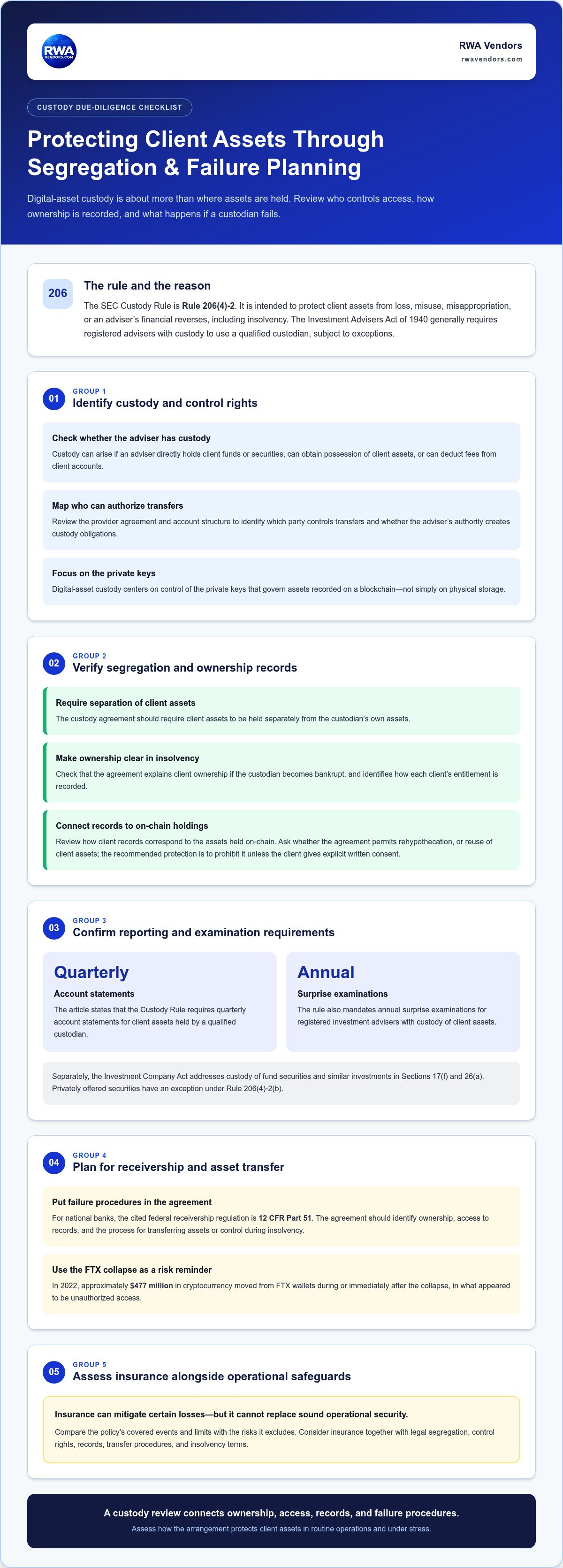
Digital-asset custody combines legal, operational, and insolvency risks. Under the Investment Advisers Act of 1940, investment advisers are typically required to register with the SEC and hold client funds or securities with a qualified custodian in segregated accounts, subject to exceptions. The SEC Custody Rule is Rule 206(4)-2. Its purpose is to protect client assets from loss, misuse, misappropriation, or an adviser’s financial reverses, including insolvency.
Custody can arise without physically holding assets. An adviser has custody if it holds client funds or securities directly, can obtain possession of client assets, or can deduct fees from client accounts. These control rights matter when institutions assess a crypto arrangement. The provider’s agreement and account structure should make clear which party controls transfers and whether the adviser’s authority creates custody obligations.
Segregation is a core contractual safeguard. The custody agreement should require client assets to be held separately from the custodian’s own assets and make ownership clear if the custodian becomes bankrupt. Review how the provider records each client’s entitlement and how those records connect to on-chain holdings. Ask whether the agreement permits rehypothecation, or reuse of client assets. The recommended protection is to prohibit it unless the client gives explicit written consent.
Reporting and examinations provide additional oversight, but they address different risks. According to the U.S. Securities and Exchange Commission, the Custody Rule requires quarterly account statements for client assets held by a qualified custodian. The rule also mandates annual surprise examinations for registered investment advisers with custody of client assets. Separately, the Investment Company Act addresses custody of fund securities and similar investments in Sections 17(f) and 26(a). Privately offered securities have an exception under Rule 206(4)-2(b).
Receivership planning tests what happens when a custodian fails. For national banks, the cited federal receivership regulation is 12 CFR Part 51. The agreement should identify ownership, record access, and the process for transferring assets or control during insolvency. The 2022 FTX failure illustrates the operational stakes: approximately $477 million in cryptocurrency moved from its wallets during or immediately after the collapse, in what appeared to be unauthorized access.
Insurance can mitigate certain losses, but it cannot replace sound operational security. Compare the policy’s covered events and limits with the risks it excludes. A custody review should connect legal segregation, control rights, records, transfer procedures, and insolvency terms. These checks show whether the arrangement protects client ownership during routine operations and under stress.
Security certifications and incident response
Security documents help institutions assess how a custodian protects digital assets and securities. Ask about SOC 2 and ISO 27001, both identified as credentials to review during due diligence. These labels are starting points, not substitutes for examining the controls behind custody. A registered provider should explain how its security framework applies to the systems and services handling client assets.
A Type II SOC report, or an equivalent report from an independent public accountant, can help assess a custodian’s internal controls. Review its scope and identify the systems and processes examined. Check that it covers the custody services in your arrangement, rather than relying on a general corporate report. Note exclusions, control exceptions, and management responses. This evidence helps distinguish relevant operational controls from broad claims about an organization’s security program.
ISO 27001 certification concerns information security management. Ask how the certified scope relates to custody, including key-management operations. For SOC 2, review the controls described, testing period, and reported exceptions. Comparing these details offers more value than comparing certificate names alone. Record the documents reviewed and the custody functions each one covers. The process of finding a qualified custodian for digital assets should weigh this evidence alongside the provider’s operational controls.
Incident response deserves as much scrutiny as preventive safeguards. Ask the provider to explain its escalation process for a suspected key compromise, unauthorized transfer, or service interruption. Identify who assesses the incident, who can authorize protective action, and how the event is documented. The response plan should distinguish a confirmed compromise from an operational alert. It should also define communication with affected institutions and preservation of relevant records.
Test the plan with a practical scenario. For example, ask what happens if an on-chain transfer appears that the client didn’t authorize. The provider should explain its investigation, access-management response, recordkeeping, and communication process. Review how security, operations, and client-facing teams coordinate. The Mt. Gox exchange hack in 2014 resulted in approximately 650,000 Bitcoin being stolen from internet-connected systems. Such incidents underscore why a documented, usable response process matters.
- Examine the evidence: Compare SOC 2 and ISO 27001 materials with the custody service’s actual scope.
- Review independent controls: Use a Type II SOC report or equivalent to understand tested processes and exceptions.
- Test response readiness: Trace a sample incident from detection through investigation, action, and communication.
Security due diligence can narrow the field when finding a qualified custodian for digital assets. For teams assessing custody alongside tokenization requirements, identify providers across the tokenization ecosystem.
Banks, broker-dealers, and other qualified custodians
Provider type matters because legal status and custody functions differ. The custody rule identifies eligible categories, but institutions still need to establish which entity actually holds the assets.
Types of Qualified Custodians
Under Rule 206(4)-2(c)(3), qualified custodians include banks, registered broker-dealers, and registered futures commission merchants. Certain foreign financial institutions also fit when they customarily hold and properly segregate customer financial assets. This classification matters because a provider’s familiar name or crypto focus alone doesn’t establish that it falls within a qualifying category.
A bank may provide custody through a trust structure, while broker-dealers may use sub-custodians for fiat currency or equities. In those arrangements, custody may represent ownership of the underlying asset. Digital-asset custody has a different operational focus: the custodian manages private-key information connected to blockchain-recorded assets. Compare the legal entity providing custody with the company handling the technical operations.
The national trust bank pathway has also developed for digital-asset firms. Anchorage Digital Bank received the first national trust bank charter for a digital asset firm in 2021. In December 2025, the OCC conditionally approved five additional national trust bank charters for digital asset firms. These developments show why an institution should assess the precise charter and status, not rely solely on labels such as “digital bank.”
Verifying Regulatory Status
Regulatory verification means identifying the legal entity, its authorization, and the custody activity that authorization covers. It matters because a provider may offer several services through related entities, while only one entity holds assets. Match the name in the custody agreement to the institution’s official records and the category relied on under Rule 206(4)-2(c)(3).
For a state-chartered trust company, confirm authorization from its State Banking Authority to provide crypto custody. On September 30, 2025, the SEC Division of Investment Management issued a no-action letter concerning state-chartered trust companies serving as qualified custodians for crypto assets. Read the letter’s context alongside the company’s specific charter and permitted activity.
Separate registration from the service being assessed. For example, evaluate a registered broker-dealer as the actual custody counterparty, not merely as an affiliate or technology partner. Map the provider’s legal name, charter or registration category, and responsibilities across the custody arrangement. If another entity controls keys or holds assets, include it in the review.
For a structured comparison, record each candidate’s category, regulator, custody role, and asset type in one matrix. Then compare banks, broker-dealers, futures commission merchants, and qualifying foreign institutions against the same criteria. This helps distinguish regulatory eligibility from operational fit without assuming every provider in a category offers identical custody services.
Differences between traditional and digital-asset custody
Traditional custody usually concerns safekeeping financial instruments, records, or physical property. Digital-asset custody centers on private-key information that controls assets recorded on a blockchain. This changes the operational focus: the custodian’s key controls and transfer processes become central, alongside legal ownership and account records.
For a traditional security, an institution may rely on account statements and records maintained through a broker or sub-custodian. A digital asset also has an on-chain record, but the private key enables control over transactions. The key itself is not the asset; it authorizes activity associated with it. A custody review must therefore connect the institution’s legal entitlement with the custodian’s control over keys and transaction approvals.
Reconciliation works differently, too. Traditional account records can be compared with statements from a bank or broker. For digital assets, an institution can compare the custodian’s account records with blockchain activity and transaction records. This can help identify discrepancies, but does not by itself establish legal ownership or authority. Agreements should explain how records are maintained and how corrections or disputed transfers are handled.
Insolvency planning also takes a distinct form. A traditional custodian’s failure can affect access to records, accounts, and property held through the institution. A digital-asset custodian’s failure can also raise questions about who controls the private keys and whether assets can be transferred. The custody agreement should define asset ownership and explain how records and control move during insolvency. Those terms matter even if the custodian operates normally.
Fees and minimum balances vary by arrangement. Qualified digital-asset custodians typically charge annual fees of 0.25% to 1% of assets, while many require minimum account sizes of $25,000 to $100,000. These figures differ from traditional custody pricing structures and should be compared alongside service scope, supported assets, and account requirements.
To transfer assets safely, first confirm the receiving custodian supports the asset and network, then verify the destination details through its approved process. Send a small test transfer before moving the remaining balance, and reconcile the completed transaction against both the custodian’s records and the blockchain.
The practical distinction is control. Traditional custody focuses heavily on safeguarding property and maintaining account records; digital custody adds private-key governance and blockchain transaction controls. When comparing the two, map legal ownership, operational control, recordkeeping, and insolvency procedures to the specific asset and custody arrangement.
How can I verify a crypto custodian’s licensing, registration, and regulatory status?
Start with the legal entity named in the custody agreement, not its brand name. Record its jurisdiction, charter or registration category, and specific custody role. This matters because a group may use separate entities for custody, technology, and related services. The entity holding the assets must match the regulatory status relied on for the arrangement.
Next, compare the stated category with the Investment Advisers Act definition. Rule 206(4)-2(c)(3) includes banks, registered broker-dealers, and registered futures commission merchants. Certain foreign financial institutions also qualify when they customarily hold and properly segregate customer financial assets. Use the category as a verification starting point, then examine the named entity’s authority and custody responsibilities. For institutions finding a qualified custodian for digital assets, this check helps distinguish regulatory eligibility from commercial fit.
For a state-chartered trust company, establish that its State Banking Authority authorizes it to provide crypto custody. The SEC Division of Investment Management issued a no-action letter on September 30, 2025, concerning state-chartered trust companies serving as qualified custodians for crypto assets. Read that development in context: the company’s charter, state authorization, and actual custody activity still need to align.
National trust bank status is another distinct category. Anchorage Digital Bank received the first national trust bank charter for a digital asset firm in 2021. In December 2025, the OCC conditionally approved five additional national trust bank charters for digital asset firms. These examples show why “bank” or “trust” in a company name isn’t enough. Identify the chartered entity and distinguish conditional approval from the entity’s operating status.
Use a consistent record for each candidate. Capture the following details from official records and the custody agreement:
- Legal identity: Match the entity name across the agreement, charter, and registration records.
- Regulatory category: Note whether it relies on bank, broker-dealer, futures commission merchant, or foreign financial institution status.
- Authority: For state-chartered trust companies, identify the State Banking Authority and crypto-custody authorization.
- Custody function: Map which entity holds assets, controls private keys, and handles transfers.
Then compare the documented authority with the services offered to your institution. A registered affiliate does not establish that a separate custody entity has the same status. If a technology partner participates, record its role without confusing technical support with legal custody. This entity-by-entity review gives institutions a clearer basis for selecting a provider. Finding a qualified custodian for digital assets means matching regulatory eligibility with operational responsibility.
RWA Vendors: Vendor Directory Listing
RWA Vendors is a practical next step for asset issuers comparing providers after defining their custody requirements. Its Vendor Directory connects issuers with vetted providers across tokenized capital markets, including custody and related services. Use the directory to find companies supporting real estate, funds, securities, and other asset projects, then assess each provider against your legal, operational, and security criteria.
This resource is most relevant when your organization needs to map custody alongside other tokenization capabilities, rather than evaluate a custodian in isolation. RWA Vendors brings provider categories together in one discovery process; it does not provide custody or legal advice.
Visit rwavendors.com to explore the directory or contact RWA Vendors.
Turn your custody review into a confident decision
A disciplined approach to finding a qualified custodian for digital assets should lead to a clear internal decision, not just a completed provider review. Translate your assessment into an operating record: identify who owns the relationship, who approves changes, and how custody decisions connect to your organization’s asset strategy. This gives legal, finance, and operations teams a shared basis for managing the arrangement as needs evolve.
Keep the next step focused on fit. Compare the custody requirement with the wider capabilities your project needs, such as tokenization technology, compliance, and other professional services. RWA Vendors offers a Vendor Directory Listing, Founding Membership, and Lead Generation and Referrals to support connections across the tokenization ecosystem.
With a documented decision and relevant ecosystem connections, your organization can move forward with greater clarity and purpose.
Frequently Asked Questions
What exactly is a qualified custodian, and do I need one?
A qualified custodian is an eligible financial institution that safeguards client funds or securities under the applicable U.S. custody framework. A registered investment adviser holding digital assets for clients generally needs to use one, subject to exceptions. Start by identifying who owns the assets and who can control or access them. Then assess whether the adviser’s role and the asset arrangement trigger custody obligations.
Does this apply to digital assets and crypto?
Yes, digital assets and crypto can fall within custody analysis when an adviser holds them for clients or has authority over them. The assessment depends on the asset, the adviser’s control, and the arrangement’s legal structure. For example, a provider may manage private keys while another entity handles administration. Map each entity’s role and the specific assets involved before assessing the custody requirements.
What constitutes “custody”?
Custody can include directly holding client assets, having authority to obtain possession, or being able to deduct fees from client accounts. The practical question is whether the adviser can access or control client property, even if another company performs daily operations. Document who can initiate transfers, approve transactions, or change access permissions. Those details help clarify whether an adviser has custody.
Where do client assets really live?
For crypto, the blockchain records transactions and balances associated with wallet addresses; the custodian manages private-key information that enables transaction authorization. An institution’s contractual claim and account records are separate from the public blockchain record. For example, a ledger entry can show a transfer, while custody records identify the client’s entitlement. Reconcile both records to understand how on-chain activity relates to the client account.
What is a qualified custodian for digital assets under U.S. law?
Under Rule 206(4)-2(c)(3), the qualified-custodian categories include banks, registered broker-dealers, and registered futures commission merchants. Certain foreign financial institutions also qualify when they customarily hold and properly segregate customer financial assets. For digital assets, assess the specific legal entity and its role in the arrangement. A provider’s crypto focus or branding alone doesn’t establish that it meets a qualifying category.
Which digital asset custodians meet SEC qualified custodian requirements?
Eligible categories include banks, registered broker-dealers, registered futures commission merchants, and qualifying foreign financial institutions. Whether a particular provider qualifies depends on its legal entity, regulatory status, and custody activity. For instance, a technology affiliate may support wallet operations without being the legal custodian. Identify the counterparty in the agreement, then match that entity to the applicable category and its actual responsibilities.
What security controls and insurance should I look for in a digital asset custodian?
Assess how private keys are generated, stored, and managed, and review independent evidence such as a Type II SOC report or equivalent. Ask how access is restricted, how transactions are authorized, and how incidents are handled. Treat insurance as risk mitigation, not a substitute for operational security. Compare policy coverage with the custody risks and exclusions relevant to your arrangement.
What questions should I ask before choosing a crypto custodian?
Ask which legal entity holds the assets, who controls private keys, and which assets and networks the service supports. Clarify how transfers are authorized, how account records are reconciled, and what happens during an incident or insolvency. Ask whether client assets may be reused and how ownership is documented. These answers help reveal gaps between the provider’s legal role, operational processes, and your organization’s requirements.
Disclaimer
This article is provided by RWAVendors.com for general informational and educational purposes only. It does not constitute legal, financial, investment, tax, regulatory or other professional advice, or an offer, solicitation, recommendation or endorsement of any company, product, service, token, security or investment. RWAVendors.com is an informational vendor directory and does not sell, issue, broker, custody or facilitate transactions involving cryptocurrencies, digital tokens, tokenized assets, securities or investment products. Some vendor listings and references may involve paid advertising, sponsored placement or membership relationships. These relationships do not guarantee a vendor’s qualifications, regulatory status, performance or suitability. Information may be incomplete, outdated or subject to change. You should independently verify all information, conduct your own due diligence and consult qualified professionals before making any business or investment decision. RWAVendors.com is not responsible for the content, services, representations or actions of third-party vendors or linked websites.


