

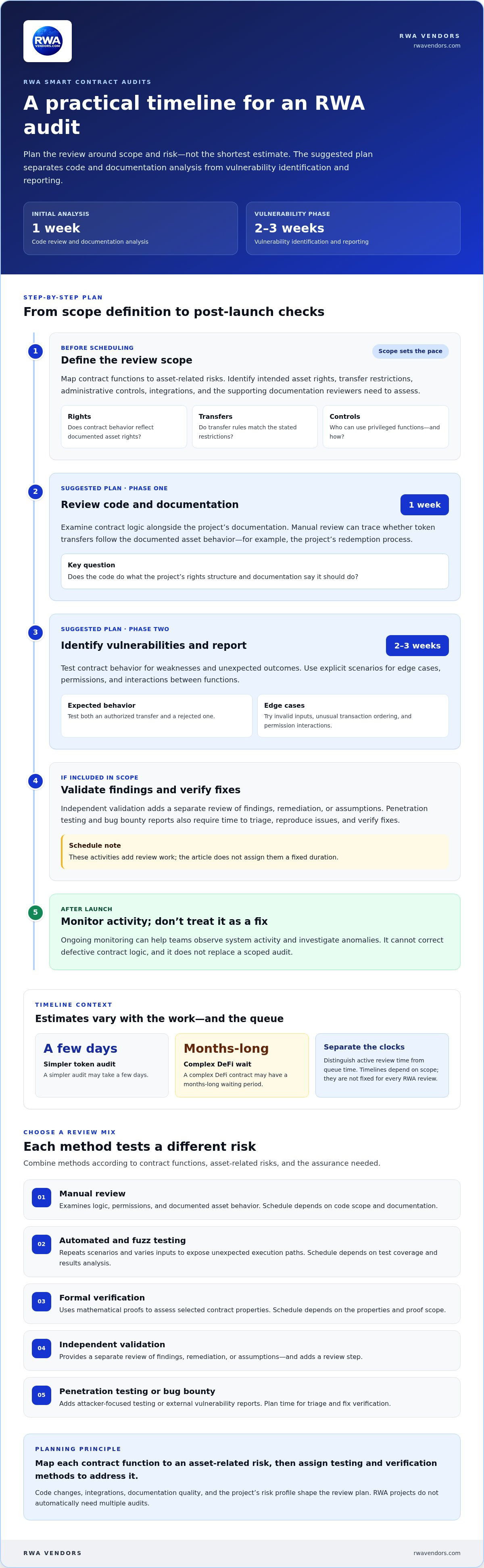
A simpler token audit may take a few days, while a suggested RWA review plan allows one week for code and documentation analysis, followed by two to three weeks for vulnerability identification and reporting. Timelines depend on scope, so when comparing smart contract audit providers for RWA, look beyond the shortest estimate.
A clear schedule matters, but timing is only one part of the decision. The provider’s scope, finance and blockchain expertise, compliance coverage, and ability to address institutional requirements all affect how useful the review will be.
This comparison explains how audit timelines and service types differ, what to assess in a provider’s RWA experience, and how compliance and scalability factor into selection. Use these criteria to identify the expertise your project needs, then explore RWA Vendors’ directory to connect with vetted tokenization platforms and service providers.
Key Takeaways
- Compare audit timelines by scope and project complexity, not by the shortest estimate alone.
- Assess how manual review, independent validation, and fuzz testing contribute to a more complete security review.
- Look for expertise that connects blockchain behavior with the asset’s rights structure, financial operations, and compliance needs.
- Use a consistent set of criteria to compare provider services, technical experience, and readiness for institutional requirements.
- Explore RWA Vendors’ directory to find verified tokenization platforms and service providers relevant to your project.
How long does an RWA smart contract audit typically take?
A simpler token audit may take a few days, while a complex DeFi contract may have a months-long waiting period. These timelines reflect different project conditions, not a fixed schedule for every RWA review. A suggested tokenization audit plan allows one week for initial code review and documentation analysis, followed by two to three weeks for vulnerability identification and reporting. Treat these phases as planning guidance, and distinguish active review time from queue time.
Scope drives the schedule. A manual review examines contract logic against the intended asset rights, transfer restrictions, and administrative controls. For example, reviewers can trace whether token transfers follow the project’s documented redemption process. Independent validation adds a separate review of findings, fixes, or assumptions. Fuzz testing uses varied inputs to expose unexpected behavior, such as a transfer failing at an unusual boundary. Each method tests different risks, and combining them can require more review work.
Functional correctness and edge-case testing need explicit scenarios. Map each contract function to an expected result, then test invalid inputs, unusual transaction ordering, and interactions between permissions. For an asset token, test both an authorized transfer and a rejected one. Automated testing can repeat scenarios consistently, while manual analysis checks whether expected behavior matches the project’s real-world rights structure. Formal verification uses mathematical proofs to assess contract correctness, making it relevant when critical logic requires stronger assurance.
Penetration testing examines how an attacker might exploit a deployed system or its connected components. A bug bounty program can invite external researchers to report vulnerabilities under defined rules. Neither replaces a scoped audit: each offers a different testing approach and takes time to triage findings, reproduce issues, and verify fixes. After launch, monitoring can help teams observe system activity and investigate anomalies, but it cannot correct defective contract logic.
RWA projects don’t automatically need multiple audits. Formal verification can prove selected contract properties, while ongoing monitoring supports detection after launch. Code changes, integrations, and the project’s risk profile shape the review plan.
| Review option | Primary focus | Schedule consideration |
|---|---|---|
| Manual review | Logic, permissions, and documented asset behavior | Depends on code scope and documentation |
| Automated and fuzz testing | Repeated inputs and unexpected execution paths | Depends on test coverage and results analysis |
| Formal verification | Mathematical proofs of selected properties | Depends on properties and proof scope |
| Independent validation | Findings, remediation, or assumptions | Adds a separate review step |
| Penetration testing or bug bounty | Attacker-focused testing and vulnerability reports | Includes triage and fix verification |
Choose the review mix by mapping each contract function to an asset-related risk, then assigning testing and verification methods to address it.
Security, regulatory compliance, and institutional scalability
An RWA smart contract audit should assess custody-related controls, compliance logic, transfer restrictions, and whether contract behavior matches the rights structure. Within the defined scope, it should also examine relevant agreements, user-data handling, oracle feeds, and third-party contract interactions.
Security review starts with the paths that could expose assets or bypass controls. In the first half of 2025, RWA-specific exploits caused $14.6 million in losses; the Curio Invest exploit caused $16 million in losses in March 2024. These figures underscore why reviewers should map privileged functions, upgrade mechanisms, external calls, and failure handling. For example, if a contract pauses transfers, test who can trigger the pause and how operations resume.
Compliance work connects legal documentation to on-chain behavior. Reviewers can compare the rights described in agreements with token functions, eligibility controls, and transfer restrictions. For a security token, test whether the contract enforces the project’s stated transfer rules. Assess custody arrangements and control flows within the system boundary, while distinguishing technical review from legal advice. An audit can identify mismatches between documentation and code, but cannot establish that an asset or legal structure is valid.
Regulatory considerations depend on the project’s jurisdictions, asset type, and user information. The U.S. SEC’s review standards for tokenized securities and Hong Kong Securities and Futures Commission considerations for security token offerings are relevant examples. GDPR may matter when the system handles personal data. AML and KYC controls also need clear boundaries: identify whether checks happen on-chain, through an integrated service, or in the issuer’s process, then test how the contract responds to approved or rejected status data.
Institutional scalability means more than processing transfers. Review role separation, administrative approvals, audit trails, oracle dependencies, and third-party contract interactions. A system supporting multiple asset classes may need distinct permissions and transfer logic rather than one universal rule. The review should also consider how upgrades or new integrations affect previously tested controls.
Audit cost follows scope and complexity, not the asset label alone. Contract size, function count, protocol interactions, documentation quality, and remediation testing all affect the work involved. A token contract with few functions presents a different workload from a system integrating custody workflows, oracles, and multiple contracts. Define these boundaries before comparing proposals; otherwise, differences in scope can make estimates misleading.
Teams mapping these requirements to ecosystem specialists can explore the RWA vendor directory for technology, legal, and compliance providers.
Smart contract audit providers and service types
RWA audit providers differ in protocol expertise, testing methods, and token-standard coverage. Specialist firms focus on smart-contract security; broader providers may combine code review with integration and formal verification work.
Provider Specializations
For RWA tokenization, compare specialist auditors by experience with permissioned transfers, issuer controls, and securities-oriented token standards. ERC-3643 and ERC-1400 are useful indicators when a project uses those standards. Firms with broader protocol coverage may also assess DeFi interactions, oracle integrations, and external contracts, while security-focused teams may center their work on code vulnerabilities and exploit paths.
Rather than treating a label as proof of fit, map the audit scope to the project’s asset model. A token representing fund interests, for example, may involve different transfer logic from a token representing property. Match the provider’s documented technical focus to the protocols, rights, and integrations in your implementation.
RWA Audit Services
Audit services can include manual code review, automated testing, fuzz testing, and formal verification. Some engagements also cover oracle and API integrations, third-party contract interactions, and remediation review. Each service examines different aspects: code review traces logic, fuzz testing explores varied inputs, and integration testing focuses on how connected systems exchange data.
Define deliverables before comparing providers. Specify the contracts and interfaces in scope, required testing methods, how findings will be ranked, and whether fixes will receive another review. For example, a token contract that reads external eligibility status needs review of both its transfer logic and the integration supplying that status.
Networks and Token Standards
Which blockchain networks and token standards do RWA audit providers support? Coverage depends on the provider and the project’s implementation, so compare support for the actual network and standards used in the code. ERC-3643 and ERC-1400 are relevant examples for securities-oriented tokenization; ERC-6065 is associated with real-estate and property-based RWA.
Other standards represent different asset patterns. ERC-4519 and ERC-7765 relate to physical assets, equipment, and commodity batches, while ERC-6960 addresses yield-rights and structured-asset RWA. ERC-20 and ERC-777 may also matter when a system uses their token mechanics. Ask the comparison to distinguish direct standard experience from general familiarity with the underlying blockchain.
Which firms specialize in smart contract audits for real-world asset tokenization? Look for smart-contract audit firms with relevant RWA protocol and token-standard experience, then compare the services each includes. A provider’s fit depends on whether its review covers your project’s standards, integrations, and asset-specific transfer logic.
Use a scope matrix to compare providers consistently: list each contract, network, token standard, integration, and requested testing method. Mark whether each item receives review, testing, or verification. This makes gaps visible before an engagement and distinguishes a narrowly scoped code audit from a broader review of a tokenized system.
Auditor expertise in traditional finance and blockchain
An RWA auditor needs to understand both contract execution and the financial process represented by tokens. For a fund, that means tracing how investor eligibility, subscription records, distributions, and redemptions relate to platform functions. Blockchain expertise helps identify code and integration risks; traditional finance knowledge helps assess whether those functions reflect the intended operating model.
Map the asset’s lifecycle before reviewing code. A real-estate token may represent defined ownership or economic rights, while a fund token may support subscriptions and distributions. Ask how the auditor connects those documented rights to issuance, transfer, and redemption logic. This can expose gaps a code-only review might miss, such as a transfer function that conflicts with the issuer’s stated process.
Technical depth matters at the protocol level. The reviewer should understand the project’s blockchain, contract architecture, and dependencies, including any oracle or API integration. For example, if a contract uses external data to represent an asset-related value, assess how the data enters the system and how the contract responds to missing or unexpected inputs. Automated testing can exercise known scenarios, while manual analysis examines design assumptions.
Financial systems also rely on operational controls. Examine who can authorize issuance, change permissions, pause transfers, or initiate an upgrade. Then trace each role through the code and compare it with the project’s documented workflow. If an administrator can alter transfer restrictions, for instance, the review should explain that capability and its implications for the token’s intended use.
Use a practical expertise matrix to assess coverage:
- Asset and finance model: Can the reviewer follow issuance, servicing, distributions, and redemption for the specific asset?
- Blockchain implementation: Can the team inspect the selected network, contract design, and protocol interactions?
- Rights-to-code mapping: Can reviewers compare documented rights with transfer rules and administrative functions?
- Integration testing: Can they examine data feeds, APIs, and third-party contracts connected to the platform?
- Findings and remediation: Does the report connect each issue to affected functions and explain how fixes are retested?
Expertise is strongest when these disciplines work together. A finance specialist can clarify the intended transaction sequence, while a blockchain reviewer checks whether contract behavior implements it correctly. For example, both should understand what happens when a transfer is rejected, how the event is recorded, and which authorized process allows the transaction to proceed.
Compare evidence of relevant work, not broad labels alone. Match the auditor’s experience to your asset type, blockchain platform, and operating model, then confirm that the proposed review covers each critical function. This alignment helps distinguish technical familiarity from the combined financial and engineering expertise an RWA system requires.
Smart contract audit provider comparisons
Compare providers by the risks they examine, not reputation labels alone. The profiles below are comparison lenses, not rankings of named firms. Match each profile to your network, token standards, integrations, and launch requirements.
| Provider profile | Primary focus | Useful comparison criterion |
|---|---|---|
| RWA tokenization specialist | Asset rights and token behavior | Experience with the project’s transfer model |
| Security audit firm | Contract vulnerabilities and attack paths | Depth of manual code review |
| Formal verification team | Proofs for selected contract properties | Properties and assumptions included |
| Automated testing specialist | Repeated tests across contract functions | Coverage of edge cases and inputs |
| DeFi protocol auditor | Protocol interactions and composability | Coverage of external contract calls |
| Oracle security reviewer | External asset data and feeds | Checks for faulty or manipulated inputs |
| Cross-network auditor | Contracts deployed across networks | Support for each deployment environment |
| Token-standard specialist | Standards such as ERC-3643 and ERC-1400 | Relevant implementation experience |
| Penetration testing team | Adversarial testing of exposed systems | Defined scope and findings process |
| Remediation reviewer | Fixes made after audit findings | Retesting and closure documentation |
These profiles can overlap. A provider may combine manual review, automated testing, and integration analysis, while another focuses on one technical layer. Compare actual deliverables: contracts examined, methods applied, findings documented, and fixes retested. A short service label does not show whether custody-related integrations or transfer controls fall within the review.
Use a consistent project brief for every comparison. Identify the network and token standard, list contract dependencies, and describe the asset’s transfer and administration model. For example, a project using ERC-3643 should evaluate whether the proposed audit examines its implementation and related permissions, rather than relying on generic token experience.
Then compare how each provider assesses threats before launch. Look for analysis of privileged functions, external calls, and exploit paths, alongside a clear process for reporting and resolving findings. An audit is a scoped review, not a guarantee that a contract is safe. Set the scope according to the system’s functions and risk exposure.
Make the decision in three steps: remove profiles that don’t cover your network or standard, compare service scope with the project’s threat model, then assess whether findings and remediation review support your launch process. Prioritize a fit-for-purpose review over the broadest service list.
The section identifies RWA tokenization specialists as providers focused on asset rights and token behavior, but names no specific firms.
RWA Vendors: Vendor Directory Listing
RWA Vendors connects asset issuers with verified tokenization platforms and service providers. After defining your audit scope, use its Vendor Directory Listing to find technology, legal, compliance, and tokenization vendors relevant to your project. An issuer preparing a real-estate token, for example, can explore providers across the tokenization ecosystem, while a fund issuer can focus on expertise relevant to fund structures.
The directory supports provider discovery; it doesn’t replace the technical comparison or audit-scope decisions outlined above. Use it when you need to identify potential partners for a specific stage of real-world asset tokenization. Visit rwavendors.com to explore the directory or contact RWA Vendors.
Build the right provider relationships for your next stage
Selecting smart contract audit providers for RWA is part of building a durable project ecosystem. Next, translate your technical requirements into relationships that can support development, governance, and future market participation. For providers seeking visibility among asset issuers, RWA Vendors offers a Vendor Directory Listing, Founding Membership, and Lead Generation and Referrals.
Let your project priorities guide those connections. An issuer preparing a deployment may need to identify relevant service providers, while a vendor may want to present its expertise to businesses building tokenization projects. Clear positioning helps both sides find relevant opportunities across the RWA ecosystem.
Take the next step with a defined scope, a clear view of your project’s needs, and the right professional relationships in place. Thoughtful preparation can help your team move forward with greater confidence.
Frequently Asked Questions
How much does an RWA protocol audit cost?
The price depends on the case and is provided after a quote request. Cost factors include the number of contracts, code complexity, protocol interactions, testing methods, documentation quality, and remediation review. A contract with external data feeds may require a different scope from a standalone token. Compare proposals only after aligning the covered code, testing deliverables, and retesting terms, so differences reflect scope rather than inconsistent assumptions.
What proof should buyers request?
Request a written scope, a sample report, and evidence of how findings move from discovery to closure. A useful report identifies affected components, explains severity, gives reproduction steps, and records remediation status. For example, a finding involving an administrator function should identify the affected permission and its impact. Buyers can also request the reviewed code version or commit to distinguish the audited release from later changes.
What should buyers ask before hiring?
Ask which contracts, networks, and integrations the review includes, and which testing methods the team plans to use. Clarify who performs the review, how findings are prioritized, and whether fixes receive retesting. For a token with an eligibility API, ask whether the interface and its failure behavior are in scope. Also establish how scope changes will be documented if development adds functions during the engagement.
What specific vulnerabilities are commonly identified during RWA audits?
Reviewers may find access-control mistakes, unsafe external calls, flawed transfer restrictions, or incorrect handling of oracle data. For example, a contract might accept a transfer without enforcing the intended eligibility condition, or rely on stale asset data. Upgrade permissions can also create risk if authorization logic is too broad. These are examples of areas to examine, not claims that every RWA contract contains them.
How do leading RWA smart contract audit providers compare by expertise, reputation, and services?
Compare providers by evidence of relevant work, technical scope, and reporting quality, not broad reputation claims. Providers may specialize in token standards, protocol security, integrations, or formal verification. Smart contract audit providers for RWA are easiest to compare against the same project brief. Use criteria such as network support, asset-related logic, methods applied, report detail, and remediation review.
What are the typical costs and timelines for an RWA smart contract audit?
Costs depend on scope and are provided after a quote request; contract complexity, integrations, testing depth, and remediation review affect the estimate. Timelines vary with code readiness, reviewer availability, project dependencies, and the time needed to resolve findings. A late interface change can require additional analysis. For planning, separate review work from issue remediation and deployment preparation, then coordinate those milestones with the development team.
How can I verify an audit firm's credentials, methodology, and past RWA audit reports?
Review named auditor roles, published methodology, and past reports relevant to the project’s standards and asset model. Check whether reports identify scope, code version, testing approach, findings, and remediation status. A public report may redact sensitive details, but its structure should still explain what was examined. Compare stated experience with the specific network and token implementation, not just general blockchain work.
Disclaimer
This article is provided by RWAVendors.com for general informational and educational purposes only. It does not constitute legal, financial, investment, tax, regulatory or other professional advice, or an offer, solicitation, recommendation or endorsement of any company, product, service, token, security or investment. RWAVendors.com is an informational vendor directory and does not sell, issue, broker, custody or facilitate transactions involving cryptocurrencies, digital tokens, tokenized assets, securities or investment products. Some vendor listings and references may involve paid advertising, sponsored placement or membership relationships. These relationships do not guarantee a vendor’s qualifications, regulatory status, performance or suitability. Information may be incomplete, outdated or subject to change. You should independently verify all information, conduct your own due diligence and consult qualified professionals before making any business or investment decision. RWAVendors.com is not responsible for the content, services, representations or actions of third-party vendors or linked websites.


