
Privacy in a tokenized asset is an architectural decision, not a feature to leave until launch. Tokenization privacy solution providers help issuers protect sensitive information while supporting blockchain-based asset workflows. Their solutions may include token vaults, access controls, and privacy-conscious data handling, depending on the system and information involved.
The distinction matters: a token can represent sensitive data, but the systems linking tokens to original information still need protection. For real-world assets, issuers must also consider how privacy controls fit with transaction visibility, operational access, and compliance obligations throughout an application’s lifecycle.
This guide explains how privacy solutions work in digital asset environments, which security and compliance considerations shape provider capabilities, and how approaches vary across enterprise applications. You’ll learn what technical and operational features to assess, where tokenization can reduce exposure to sensitive data, and how to connect those requirements with the wider infrastructure for issuing and managing blockchain-based assets.
Key Takeaways
- Assess privacy controls alongside transaction visibility so asset workflows can protect sensitive information without overlooking operational needs.
- Map how blockchain-based assets interact with identity, ownership, and transaction data to identify where privacy measures matter most.
- Compare enterprise solutions by their architecture, integration requirements, scalability, and approach to access control.
- Evaluate token vault security, key management, auditability, and secure data transfer as connected parts of a provider’s design.
- Use your asset and application requirements to narrow the provider landscape and identify the capabilities your implementation needs.
Security, compliance, and privacy benefits
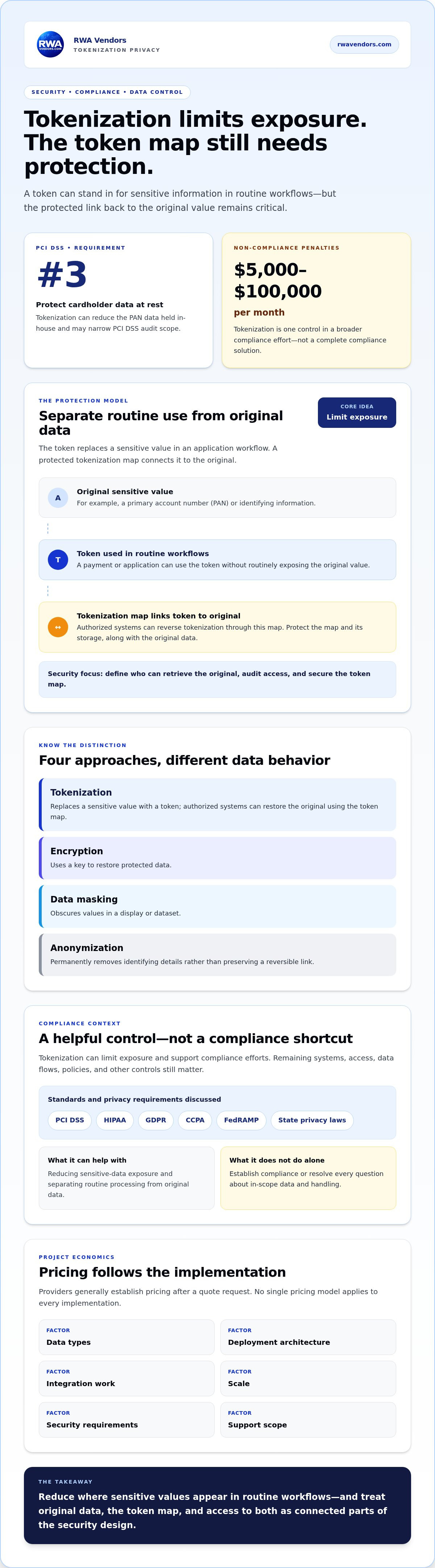
Tokenization substitutes a sensitive value with a token, limiting where the original data appears. A payment system, for example, can use a token for processing while keeping the primary account number (PAN) outside routine application workflows. The tokenization map links each token to its original value, so that map and its storage require strong protection.
Tokenization differs from encryption, data masking, and anonymization. Encryption uses a key to restore protected data, while authorized systems can reverse tokenization through the token map. Data masking obscures values in a display or dataset; anonymization permanently removes identifying details instead of preserving a reversible link.
For payment environments, the Payment Card Industry Data Security Standard (PCI DSS) applies to organizations that accept, transmit, or store cardholder data. Its requirement set #3 addresses protecting cardholder data at rest. Tokenization can reduce the PAN data an organization stores in-house, potentially narrowing PCI DSS audit scope and reducing audit work. It does not, by itself, establish compliance: remaining systems, access, and data flows still matter.
Tokenization can support compliance with PCI DSS, HIPAA, and state privacy laws by limiting exposure to sensitive information and separating routine processing from original data. It can help align data handling with PCI, HIPAA, GDPR, and CCPA, but does not replace applicable policies or other controls. Organizations should define what data is tokenized, who can retrieve the original, how access is audited, and how token maps are secured.
Payment data, personal information, and health data can all be protected through tokenization. For example, a payment workflow can use a token instead of a PAN, while healthcare systems can use tokenized data for analysis without revealing original patient information.
Pricing depends on the data types, deployment architecture, integration work, scale, security requirements, and support scope. Providers generally establish pricing after a quote request based on those project factors; no single pricing model applies to every implementation.
Tokenization is one way to protect sensitive payment cardholder data in support of industry standards and government regulations, including PCI DSS. It is also a strongly recommended security control for PCI, HIPAA, GDPR, and FedRAMP. That does not mean tokenization alone settles every compliance question: organizations still need to understand which data remains in scope and how it is handled. PCI and other security standards do not require organizations to safeguard tokenized data, but original sensitive data and the map linking it to tokens still warrant protection.
Tokenization is one means of protecting sensitive payment cardholder data for compliance with industry standards and government regulations, including PCI DSS. It is also a strongly recommended security control for PCI, HIPAA, GDPR, and FedRAMP. That recommendation does not mean tokenization alone settles every compliance question: organizations still need to understand which data remains in scope and how it is handled. PCI and other security standards do not require organizations to safeguard tokenized data, but original sensitive data and the map linking it to tokens still warrant protection.
Keeping tokenization maps secure is central because they connect tokens to original sensitive data. Reducing the amount of PAN data held in-house can potentially reduce compliance requirements and audit time, while the map itself remains protected. Non-compliance penalties range from 5,000 to $100,000 per month, underscoring why organizations should treat tokenization as one component of a broader compliance effort.
Blockchain-based asset tokenization
That connection involves more than minting tokens. An issuer defines asset data, identifies relevant participants, and determines which events the blockchain records. A fund token might reference an issuance, transfer, or distribution event. The application also needs a reliable way to associate those events with authoritative records without placing every sensitive document directly on-chain.
Data tokenization can separate a public or shared blockchain record from sensitive information stored in controlled systems. A token replaces a direct identifier in an application workflow, while authorized systems preserve the link to original data. For instance, an investor identifier could be represented by a token in a transaction process, while identity records remain in a restricted environment.
This design requires careful choices about what the blockchain should reveal. A transaction may show that a token moved between addresses, while the parties’ identities and supporting documents remain off-ledger. Issuers should consider whether repeated transactions or associated metadata could expose sensitive information. Preserving privacy means reviewing the entire data flow, not just the token format.
Regulations and contractual obligations can shape where asset records are stored and who can access them. A cross-border fund workflow, for example, may involve an issuer, administrator, transfer agent, and technology platform, each handling different data. Mapping those roles helps the issuer define access permissions, record retention, and processes for responding to legitimate requests.
Blockchain design also affects operational control. A permissioned network can restrict participation, while a public network may provide broader access to transaction records. Issuers should assess how updates, corrections, and access changes work within the chosen architecture. They should also define which records stay off-chain and how each connects to its on-chain reference.
Start with the asset and its lifecycle. For a property-backed token, map issuance, investor onboarding, transfers, and reporting requirements. Then identify sensitive fields at each stage, decide which systems need them, and document how tokens connect to source records. This gives you a practical basis for comparing privacy approaches across blockchain applications.
Digital asset applications handle more than blockchain transactions. Investor onboarding, account management, reporting, and analytics can all involve personal information. Map these application flows and identify where a token can replace a sensitive value. This prevents routine systems from handling original data when they need only a reference.
Providers developing solutions for these workflows can explore tokenization provider directory listings as a way to reach asset issuers researching the ecosystem.
Digital assets and blockchain applications
Consider an investor portal that verifies identity before allowing an asset transfer. The portal can use a tokenized identifier to connect a verified user with the relevant transaction record. An authorized identity service retains the information needed to resolve the identifier. The portal and blockchain application can then perform defined tasks without displaying personal information to every system involved.
Database design shapes how this separation works. An organization might store token-to-record mappings in a controlled database and transaction references in a blockchain application. Access rules should distinguish staff who can view operational data from services that can resolve tokens. Clear permissions and audit records help show which application accessed a record and why.
Analytics create another use case. A digital asset platform may need to study transaction patterns, user activity, or asset servicing without exposing each participant’s identity. Tokenized datasets can support those analyses while limiting direct access to original personal information. Teams should still examine whether combinations of transaction details could identify individuals or reveal commercially sensitive activity.
Token format also affects integration. Format-preserving tokenization retains the structure and length of the original data, which can help applications that expect a specific field format. A payment workflow, for example, may use a token formatted like a card number. That can reduce changes to connected applications, but format alone does not establish privacy or security.
In blockchain applications, the network and off-chain systems need a coordinated data model. A smart contract may process a token or permission signal, while an external application manages identity checks and supporting records. Define which system creates tokens, which can resolve them, and how permissions change when a user’s status changes. These choices clarify application behavior during routine transactions and servicing events.
Organizations should also plan for analytics exports, application logs, and backups. A token that protects a production database may still appear alongside identifying details in a report or diagnostic record. Map those secondary copies, restrict access, and apply consistent handling rules. This extends data tokenization beyond the primary transaction path and helps assess privacy across the application lifecycle.
Organizations should also plan for analytics exports, application logs, and backups. A token that protects a production database may still appear alongside identifying details in a report or diagnostic record. Map those secondary copies, restrict access, and apply consistent handling rules. This extends data tokenization beyond the primary transaction path and helps teams assess privacy across the full application lifecycle.
Enterprise tokenization providers
Compare providers by how their platforms generate, store, and resolve tokens, then assess how each design supports data protection. For a credit card workflow, examine whether applications can use tokenized data without routinely accessing card details.
Provider Feature and Security Comparisons
Compare providers by how their platform generates, stores, and resolves tokens, then assess how each design supports data protection. For a credit card workflow, examine whether applications can use tokenized data without routinely accessing card details.
Enterprise deployment options include cloud, on-premises, and hybrid architectures. Cloud deployments place tokenization capabilities in a hosted environment; on-premises deployments run them within an organization’s infrastructure. A hybrid approach divides components across environments. Providers differ in the models they support, so compare the available architecture with data location, integration needs, and operational ownership.
Enterprise deployment choices include cloud, on-premises, and hybrid architectures. Cloud deployments place tokenization capabilities in a hosted environment; on-premises deployments run them within an organization’s infrastructure. A hybrid approach divides components across environments. Providers differ in which models they support, so compare the available architecture against data location, integration needs, and operational ownership.
Choosing and implementing a provider means matching the tokenization design to the protected data, system architecture, scale, integration needs, compliance requirements, and operational expertise. Start by mapping data flows, then define which applications need tokens and which authorized roles need access to original values.
Provider Selection and Implementation
Next, compare deployment models with existing operations. A financial organization with internal infrastructure may prioritize local control, while a distributed application may need services across environments. The right fit depends on where sensitive data is handled, how connected systems integrate, and which teams will maintain the platform.
Plan implementation around the full data lifecycle. Identify source fields, token creation points, mapping storage, and every application that consumes tokenized data. Test routine processing, access changes, audit events, and recovery procedures before expanding use. For example, replacing a credit card number in a payment application means confirming that downstream reports and logs do not reintroduce the original value.
Provider selection also involves scalability, availability, support, and industry track record. Managing a token vault can require performance planning, encryption key rotation, and availability across data centers. Align these operational requirements with the organization’s resilience plans, integration capacity, and security procedures. A structured comparison makes trade-offs visible before the platform becomes part of critical operations.
Compare providers against the same requirements, not feature counts alone. For an RWA issuer, relevant differences include supported data types, system architecture, integration demands, scalability, compliance needs, expertise, support, and industry track record. A clear comparison shows whether a provider’s technical controls suit the asset workflow and operational environment.
How do tokenization providers compare on features, security, and compliance?
Start with the token vault. Assess how each solution protects the mapping between tokens and original sensitive data, and whether its design supports secure storage, authentication, authorization, and audit. Strong key-management procedures matter when token data stores rely on encryption. Secure communication channels should also protect data moving to and from the vault.
Review token generation separately. Methods should be proven and validated, not designed arbitrarily, because weak random-number generation or exposed mapping tables can undermine privacy. Ask how the system controls access to mappings and records activity. For example, an issuer should be able to distinguish routine token use from an authorized request to resolve a token.
Operational resilience can distinguish architectures that look similar on a feature list. Managing a vault may require performance and scalability planning, encryption key rotation, and availability across multiple data centers. Compare these needs with the issuer’s transaction patterns and recovery requirements. Organizations should evaluate encryption practices as part of securing token vaults.
Assess compliance capabilities against the issuer’s actual obligations and data flows. A provider may support audit evidence, access controls, and separation of sensitive data, but the issuer still needs policies for how its own systems handle information. Compare each provider’s approach with the relevant compliance framework, integration boundaries, and records needed for internal oversight.
Then test a representative workflow, such as investor onboarding followed by a token transfer. Trace sensitive fields, token creation, vault access, and the audit trail. This can reveal integration gaps that a feature sheet may not show. Compare tokenization privacy solution providers across this complete lifecycle, not just one isolated security function.
A practical evaluation can use a common matrix:
- Data and architecture: Record the information protected, deployment fit, and systems requiring integration.
- Security controls: Compare vault protection, encryption, key management, token generation, authentication, authorization, and audit.
- Operations: Review scalability, performance, key rotation, availability, support, and expertise.
- Compliance fit: Map capabilities to the issuer’s policies, audit needs, and regulatory obligations.
Use the results to compare operational fit as well as stated capabilities. Confirm that the provider’s design and support align with the issuer’s requirements, then document unresolved gaps for review before selection. This keeps the decision grounded in the asset workflow and the organization’s compliance needs.
Systems should accurately process every routine token use and authorized request to resolve a token, checking that controls and audit records behave as intended. Secure communication channels should be built between sensitive data and the token vault so data is not compromised in transit to or from storage. Run the workflow across the systems that exchange or store protected information, and note where integration boundaries require clear ownership. Organizations selecting a tokenization solution should consider the data types to protect, architecture, scalability, integration, regulatory compliance, vendor expertise, support, and industry track record.
Explore companies in the RWA Vendors directory that support real estate, funds, securities, and other asset types. It gives your team a focused starting point for matching project needs with technology and professional services, without replacing your own technical or compliance assessment.
RWA Vendors: Vendor Directory Listing
RWA Vendors helps asset issuers identify verified tokenization platforms and service providers through its Vendor Directory Listing. Turn to the directory when you have defined requirements for privacy, infrastructure, compliance, or other tokenization capabilities and need to locate relevant providers across the ecosystem.
The next step is to turn your privacy priorities into a decision framework your technical, compliance, and operations teams can use together. Define the essential capabilities, how they fit your asset lifecycle, and what evidence will show that a provider’s approach meets your needs. This keeps procurement focused on practical fit rather than feature volume.
For providers seeking visibility among issuers, RWA Vendors also offers Founding Membership and Lead Generation and Referrals. To explore the directory or discuss how RWA Vendors can support your next step, contact RWA Vendors.
Move from requirements to a provider decision
The next step is to turn your privacy priorities into a decision framework your technical, compliance, and operations teams can use together. Define which capabilities are essential, how they fit your asset lifecycle, and what evidence will demonstrate that a provider’s approach meets your needs. This keeps procurement focused on practical fit rather than feature volume.
As you assess tokenization privacy solution providers, consider how each option supports your long-term architecture and the responsibilities your organization will retain. A well-defined evaluation can help teams compare proposals consistently, identify integration questions early, and prepare for implementation with clearer ownership.
Use RWA Vendors to continue exploring the provider landscape and identify potential partners for your requirements. A focused conversation can help clarify the next step in your search.
Your privacy strategy can evolve with your digital asset program. Begin with clear requirements, and move forward with confidence.
Frequently Asked Questions
What is data tokenization and how does it protect privacy?
When comparing tokenization privacy solution providers, assess the complete data flow, from token creation and storage to authorized resolution and downstream use. RWA Vendors’ global Vendor Directory connects issuers with providers across tokenization, compliance, custody, trading, and infrastructure. Explore the directory to find potential partners for your requirements.
Disclaimer
This article is provided by RWAVendors.com for general informational and educational purposes only. It does not constitute legal, financial, investment, tax, regulatory or other professional advice, or an offer, solicitation, recommendation or endorsement of any company, product, service, token, security or investment. RWAVendors.com is an informational vendor directory and does not sell, issue, broker, custody or facilitate transactions involving cryptocurrencies, digital tokens, tokenized assets, securities or investment products. Some vendor listings and references may involve paid advertising, sponsored placement or membership relationships. These relationships do not guarantee a vendor’s qualifications, regulatory status, performance or suitability. Information may be incomplete, outdated or subject to change. You should independently verify all information, conduct your own due diligence and consult qualified professionals before making any business or investment decision. RWAVendors.com is not responsible for the content, services, representations or actions of third-party vendors or linked websites.


