

A token doesn’t automatically give you ownership of the asset it represents. Real world asset tokenization for beginners starts with a simple distinction: a blockchain token records a digital representation, while the rights it gives its holder depend on the governing documents and applicable law. Tokenization describes how those rights are represented and managed digitally; it doesn’t, by itself, determine what the holder legally owns.
It’s natural to associate a token with a share of a property, fund, or other asset. But a token may instead represent an interest in a company that holds the asset, a contractual right to receive payments, or another defined claim. The structure behind the token matters as much as the technology.
This guide explains which real-world assets can be tokenized, how tokens relate to ownership, and where smart contracts fit. It also compares tokenization with securitization, which helps clarify an important point: the two aren’t opposites. A securitized instrument can itself be issued as a token, while the underlying legal and financial structure still determines the holder’s rights.
Key Takeaways
- Identify the asset and its legal classification first, since applicable obligations depend on the asset and jurisdiction.
- Read the governing documents to understand whether a token represents ownership, an interest in an entity, or a right to payments.
- Compare tokenized real estate, commodities, funds, and securities by the rights each token conveys, not just the blockchain used.
- Understand how smart contracts can enforce transfer rules and automate selected processes, while the legal structure defines the underlying rights.
- Distinguish tokenization from securitization, and see how a securitized instrument can also be issued as a token.
What are Real World Assets (RWAs)?
Real-world assets, or RWAs, include tangible property and intangible rights with value outside a blockchain. Examples include cash, commodities, real estate, equities, artwork, bonds, and intellectual property. Tokenization creates digital representations of these assets or related claims. It doesn’t make every token direct ownership of the underlying item. A token linked to a building, for example, may represent rights in a company that owns the property instead.
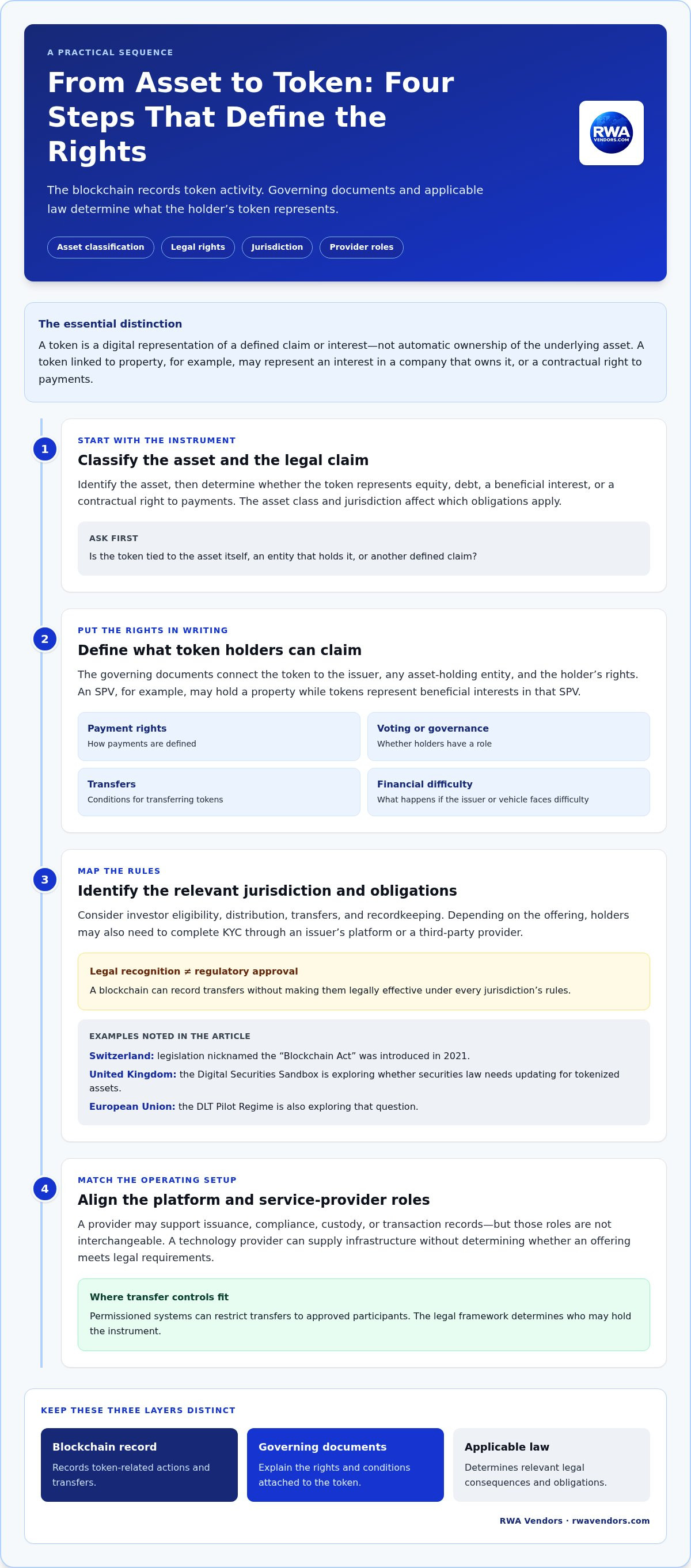
Legal classification determines which rules apply. A token may represent equity, debt, a beneficial interest, or a contractual right to payments. Each category has different legal consequences. The blockchain record shows token-related actions and transfers, but the holder’s rights come from the governing documents and applicable law. If a token description names a property, distinguish the asset itself from the legal claim the token conveys.
An issuing vehicle can separate an asset from the company arranging its tokenization. For example, a special purpose vehicle, or SPV, may hold a property while tokens represent beneficial interests in the SPV. The issuing documents define the relationship between token holders, the SPV, and the asset. They should clarify payment rights, voting or governance rights, transfer conditions, and what happens if the issuer or vehicle faces financial difficulty. The blockchain entry alone doesn’t establish these terms.
Compliance depends on the asset class and relevant jurisdiction, not on a universal rule for all crypto tokens. A token representing a security may face obligations associated with securities, while a token linked to another type of claim may be treated differently. Issuers must consider the legal structure, investor eligibility, distribution, transfers, and recordkeeping. Token holders may also need to complete KYC through an issuer’s platform or a third-party provider before purchasing or receiving tokens.
Legal recognition and regulatory approval are related but distinct. A blockchain system can record transfers without making those transfers legally effective under every jurisdiction’s rules. Switzerland introduced legislation nicknamed the ‘Blockchain Act’ in 2021 to regulate technologies such as tokenization. The UK Digital Securities Sandbox and the EU DLT Pilot Regime are exploring whether securities law needs updating for tokenized assets. These examples show why location and instrument classification matter.
Regulated tokenization providers may support issuance, compliance, custody, or transaction records, but these roles aren’t interchangeable. A technology provider can supply infrastructure without determining whether an offering meets legal requirements. For an issuer, the practical sequence is to classify the instrument, define rights in governing documents, identify applicable jurisdictions, and align the platform and service-provider roles with those obligations. Permissioned systems can restrict transfers to approved participants, while the legal framework determines who may hold the instrument.
How blockchain tokens represent asset ownership
A blockchain token records a digital claim, but its legal meaning comes from the governing documents. To assess ownership, custody, and redemption rights, compare the token terms with the issuer’s legal records and the custodian’s role. Then identify the process holders can use to claim or redeem value.
Tokens as Ownership Records
A token is a blockchain entry representing a defined interest or right, not automatic title to an asset. The distinction matters because the ledger records token balances and transfers, while the underlying documents explain the rights those records correspond to. For example, a token may represent a beneficial interest in an SPV holding property, or a contractual right to receive payments derived from an asset.
Verifying ownership means connecting the on-chain record to the legal structure. Review the offering documents for the issuer, the asset-holding entity, and the rights attached to each token. Then compare the holder’s wallet balance with the issuer’s records and any stated transfer conditions. A blockchain can make transactions traceable, but it can’t establish by itself that the named asset exists or that a holder has direct title to it.
Custody is a separate question. Determine whether an SPV, custodian, or another entity holds the asset, and which records document that arrangement. The token holder may own an interest in the vehicle rather than control the asset directly. Redemption also depends on the contract, which may define payment rights, redemption conditions, or a process for making a claim. Read those terms alongside the token balance, not as a substitute for it.
Blockchain Networks and Token Standards
A blockchain network is the system that stores and processes token transactions, while a token standard defines how a token behaves on that network. Selection matters because network access, smart-contract functions, and compliance controls affect how tokens can be issued and transferred. ERC-20 is a common standard for fungible tokens, where each unit follows the same basic format.
Public blockchains let users view transactions on a shared ledger, while private or permissioned networks restrict participation or access. An issuer may prioritize public visibility, controlled access, or integration with existing systems. Smart contracts can apply defined transfer rules, but their code must match the legal terms and operational procedures. A token standard alone doesn’t guarantee that a transfer is legally recognized or that a token can be redeemed.
For a holder anywhere in the world, network choice can also affect wallet compatibility and transaction visibility. Confirm which network identifies the official token and how the issuer handles records when balances change through an approved transfer. Keep the token address, holder wallet, issuer documentation, and custody information aligned. These details help distinguish the recognized asset record from an unrelated token with a similar name.
Issuers assessing technology and service-provider roles can use a tokenization vendor directory listing to present relevant capabilities across the ecosystem.
Tokenized real estate, gold, funds, and securities
Tokenization can represent different legal and economic claims across asset classes. For real estate, a token might represent an interest in an entity holding a property. A gold token might instead correspond to a contractual claim connected to gold. Fund and securities tokens may represent interests in a fund, equity, or debt. In every case, the documents define the holder’s rights, not the asset label displayed by a marketplace.
For rental property, income depends on the property’s revenue and the token’s terms. Documents may describe how rental proceeds are handled, which expenses are deducted, and how distributions reach holders. They should also explain whether token holders have governance rights or simply a claim to payments. A token linked to an apartment building, for example, doesn’t by itself give the holder a right to manage tenants or sell the property.
Commercial real estate illustrates how a structure can divide exposure into units. In an example, a building valued at €4 million is held by an SPV, which issues 40,000 tokens representing its equity; each token has a denomination of €100. The numbers describe the example’s structure, not a universal property-token formula. The SPV documents determine what equity rights those tokens convey.
Fractional ownership can make a specific property’s economic exposure divisible into smaller interests. According to the Federal Reserve Board, real-estate tokenization can let investors buy a fraction of a specific property, unlike a REIT, which gives investors shares in a portfolio of real-estate investments. That distinction affects what the investment represents: one property or an interest in a portfolio. Neither label alone explains voting, income, or transfer rights.
Minimum investment amounts, fees, and other costs depend on the offering’s denomination, structure, and transaction terms. The minimum may reflect how the issuer divides interests, while charges can come from platform operations, administration, or asset management. Compare these terms in the offering documents before deciding whether the token’s cost structure suits your intended exposure.
For beginners, a practical sequence is to identify the underlying asset, read the offering documents, and establish the token’s legal claim. Then review the issuer, any asset-holding entity, income or redemption terms, transfer restrictions, and custody arrangements. A fund token and a property token may look similar in a wallet but convey materially different rights.
Real-estate token marketplaces present offerings and related information through digital interfaces. A listing can help readers compare the asset category, issuer, token structure, and stated terms. For a gold, fund, or securities token, use the same comparison: identify what the token represents, which entity issues it, and what process governs payments or redemption. Blockchain records can show transfers, but the governing documents explain the claim.
Smart contracts and programmable compliance
Smart contracts execute predefined actions on a blockchain, including transfers and distributions. For tokenized assets, their rules can connect investor eligibility, ownership records, and income payments.
Identity and Compliance on Chain
On-chain identity controls connect a wallet address with an approved investor record, helping enforce access and transfer rules. For example, an issuer may require investors to complete KYC and submit wallet addresses for whitelisting before receiving tokens. Approval links the permitted address to the token’s transfer controls. Investors should understand what identity information is checked and how the issuer manages approvals, because wallet access alone doesn’t establish eligibility.
Transparency and Auditability
Transparency means relevant transactions and contract actions can be reviewed against the token’s rules and related records. ERC-3643 is a permissioned Ethereum token standard that can encode investor eligibility and transfer restrictions in a smart contract. A transfer to a non-approved wallet can be configured to fail. This helps enforce stated controls, while investors still need the offering documents to understand legal rights and obligations.
Smart contracts can also automate dividend distributions, governance actions, and ownership transfers. For example, a contract may distribute income according to token balances recorded at a defined point. Its code applies programmed conditions consistently, but the issuer must provide accurate asset and payment information. A contract can execute a distribution rule; it can’t independently establish whether the underlying asset generated the reported income.
Permissioned tokens can restrict transfers to whitelisted addresses. If a token holder submits a new wallet, the issuer or its designated process may need to approve that address before a transfer. A transaction can fail if the receiving wallet isn’t on the permitted-holder register. This affects practical liquidity: the holder’s ability to transfer depends on the token’s rules and the recipient’s eligibility.
For fractional interests in real estate, funds, securities, or commodities, the same controls may govern transfers and investor access. The contract’s structure should align with the offering terms, including distribution logic, eligibility rules, and governance procedures. Investors can compare those written terms with the contract’s documented functions to see which actions are automated and which remain operational responsibilities.
Auditability has limits. A public blockchain can show transaction histories, but it doesn’t automatically verify off-chain valuations, custody, or the existence of an asset. For example, a token balance may be visible while rent records or commodity inventory remain in separate systems. Effective review connects on-chain activity with issuer reports, custody evidence, and relevant legal documents.
Smart contracts are programmable controls, not a replacement for compliance oversight. Issuers must maintain the information that eligibility and payment rules depend on, while investors need to understand how exceptions, failed transfers, and corrected records are handled. These operational details determine whether automated actions remain consistent with the asset’s legal structure.
Asset tokenization compared with securitization
Tokenization represents an asset-related claim digitally; securitization is a financial structure that pools assets and issues securities. They aren’t alternatives: a securitization’s notes can themselves be issued as tokens. For investors, the key distinction is the underlying legal and financial claim, not whether the records sit on a blockchain.
Traditional securitization groups assets, such as loans, into a pool and issues notes tied to that pool. The notes define what holders can claim, and traditional securitization settlements occur on T+1 or T+2. Fixed structuring, rating, and legal costs mean traditional securitization typically requires issuance in the tens or hundreds of millions. Tokenization changes the way an instrument is represented and transferred; it does not remove the pool or its financial structure.
Tokenization can represent a direct asset-related claim, a beneficial interest in an issuing vehicle, a contractual payment right, or debt secured by an asset. A tokenized securitization adds a digital record and transfer mechanism to securities created through securitization. In either case, offering documents determine the rights holders receive. The token format alone doesn’t establish a claim to the underlying assets or change the instrument’s credit characteristics.
Compared with traditional investing or owning an asset directly, tokenization changes how a claim is recorded and may enable fractional interests. It doesn’t necessarily give holders direct control of the asset or the same rights as its legal owner. For example, a tokenized Treasury can have different credit characteristics from the original Treasury, according to the Board of Governors of the Federal Reserve System. Investors should distinguish the token issuer’s obligations from those of the underlying instrument.
Blockchain infrastructure can support transfer records and settlement processes, while traditional financial systems use established intermediaries and records. Tokenization may make interests easier to divide or transfer, but liquidity depends on buyers, permitted transfers, and market structure. A token that can be transferred on a network doesn’t by itself ensure an active market or a buyer. Review both the instrument’s terms and the rules governing transfers.
The practical comparison is about structure, rights, and operations. Ask what assets support the claim, who owes payments, what holders can enforce, and how transfers settle. Then identify whether the instrument is a direct tokenized claim, a securitized instrument, or a securitization issued in token form. This distinction helps investors compare exposures without confusing digital infrastructure with ownership or credit risk.
RWA Vendors: Vendor Directory Listing
RWA Vendors connects asset issuers with verified tokenization platforms and service providers through its Vendor Directory Listing. Use the directory when your organization has defined its asset, intended token structure, and required capabilities, and needs to identify relevant providers across technology, legal, compliance, or tokenization. For example, an issuer developing a real-estate or fund project can use the directory to find companies supporting different stages of tokenization. The listing helps structure provider discovery; it doesn’t replace the issuer’s legal analysis or project decisions. RWA Vendors also offers Founding Membership and Lead Generation and Referrals. If you’re looking for ecosystem providers or exploring a directory listing, visit rwavendors.com.
Turn a tokenization concept into a defined project
A useful next step is to turn the concept into a project brief: identify the asset class, intended holder rights, operating model, and capabilities your team needs. Include the legal, compliance, custody, and infrastructure functions that shape execution. A defined scope makes provider discussions more focused than starting with a network or token standard.
For readers exploring real world asset tokenization for beginners, this is where learning becomes practical. RWA Vendors connects asset issuers with verified tokenization platforms and service providers. Its Vendor Directory Listing, Founding Membership, and Lead Generation and Referrals support provider discovery and ecosystem visibility.
Use the directory to map providers for a defined initiative or present your capabilities to potential issuer partners. A focused conversation can help clarify how RWA Vendors fits your next step.
Move forward with a clearer brief and a stronger foundation for provider discussions.
Frequently Asked Questions
What Is Tokenization?
Tokenization converts information about an asset or legal claim into digital units recorded on a blockchain. For example, an issuer might create tokens linked to interests in a property-holding entity. Each token’s meaning depends on the offering documents: it could represent equity, debt, or a payment claim. The digital record helps track token balances and transfers, but it doesn’t independently establish ownership rights or verify the asset.
What are RWAs?
RWAs are real-world assets with value outside a blockchain, including physical items and financial or intellectual property rights. Examples include a building, a quantity of gold, shares, bonds, or copyrighted work. Tokenization can create a digital representation of an asset or a related legal interest. The distinction matters: a token connected to a building might represent an interest in an entity that owns it, rather than direct title to the building.
What is real-world asset tokenization in simple terms?
It’s a way to represent an asset-related claim as digital tokens recorded and transferred on a blockchain. Think of a token as a digital entry tied to defined rights, not a digital deed by default. For anyone learning real world asset tokenization for beginners, a useful starting point is to identify the claim: an ownership interest, debt, or a right to payments.
How does real-world asset tokenization work on a blockchain?
An issuer defines the rights represented, creates tokens through a smart contract, and records them on a blockchain. The contract can track balances and apply transfer conditions, such as limiting transfers to approved wallets. For example, an investor’s wallet may need approval before receiving a permissioned token. Issuer records and legal documents remain essential because blockchain transactions alone don’t establish the asset’s ownership or value.
What types of real-world assets can be tokenized?
Potential categories include real estate, cash, commodities such as gold, artwork, equities, bonds, funds, and intellectual property. The token’s structure depends on the asset: a property token may relate to an ownership interest, while another token may represent a contractual payment claim. Before comparing offerings, identify the underlying asset and the rights attached to its token. Similar labels can describe materially different legal and economic interests.
What are examples of real-world asset tokenization projects and platforms?
Examples include tokenized Treasury products, property interests held through an SPV or LLC, and tokens representing fund or securities interests. These examples describe structures, not endorsements of a specific offering. A platform may provide issuance technology, investor management, or transaction infrastructure, while a marketplace may simply present listings. Before treating projects as comparable, distinguish the asset issuer, the platform’s role, and the legal claim represented.
What U.S. laws and regulations apply to tokenized real-world assets?
In the United States, applicable obligations depend on the asset and the legal nature of the token, including whether it represents a security or another claim. Relevant rules can affect issuance, transfers, investor eligibility, and intermediaries. SIPC protection for customers of failed U.S. brokerage firms covers securities and cash up to $500,000, but doesn’t extend to tokenized equity holdings. A token’s blockchain record doesn’t itself determine regulatory treatment.
What are the risks of investing in tokenized real-world assets?
Risks include unclear or limited legal rights, issuer or asset failure, cyber threats, and technology or compliance problems. Liquidity also matters: as of July 2025, most projects operated as buy-and-hold investments, with investors buying from the issuer and selling only back to it. A token’s transferability doesn’t ensure buyers are available. Review the issuer’s obligations, asset records, transfer rules, and redemption terms before assessing exposure.
Disclaimer
This article is provided by RWAVendors.com for general informational and educational purposes only. It does not constitute legal, financial, investment, tax, regulatory or other professional advice, or an offer, solicitation, recommendation or endorsement of any company, product, service, token, security or investment. RWAVendors.com is an informational vendor directory and does not sell, issue, broker, custody or facilitate transactions involving cryptocurrencies, digital tokens, tokenized assets, securities or investment products. Some vendor listings and references may involve paid advertising, sponsored placement or membership relationships. These relationships do not guarantee a vendor’s qualifications, regulatory status, performance or suitability. Information may be incomplete, outdated or subject to change. You should independently verify all information, conduct your own due diligence and consult qualified professionals before making any business or investment decision. RWAVendors.com is not responsible for the content, services, representations or actions of third-party vendors or linked websites.


