

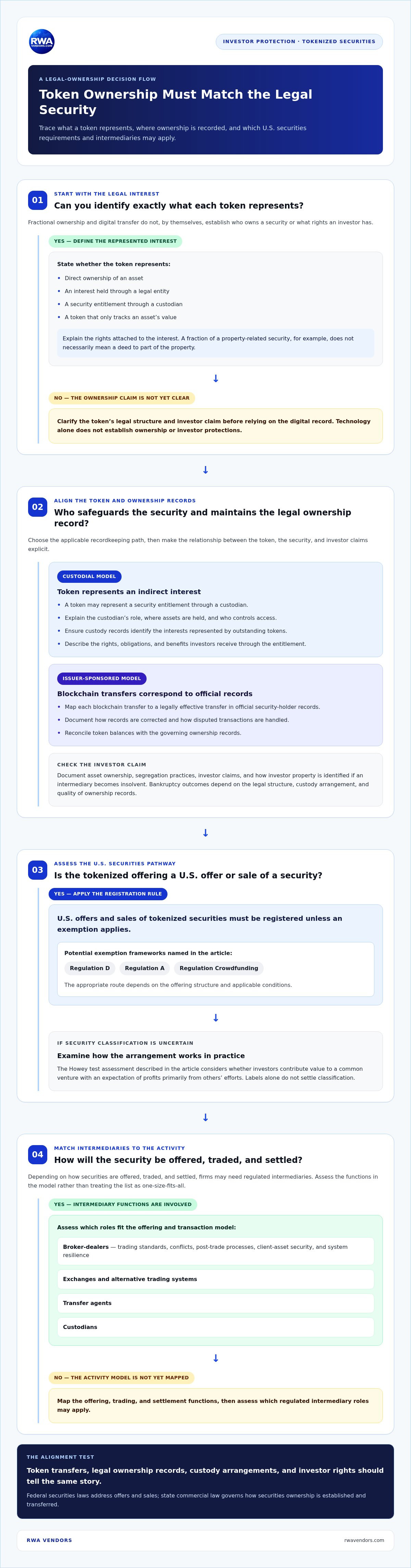
Tokenization does not replace securities protections. Investor safeguards depend on clear legal ownership, appropriate intermediaries, transparent market practices, and reliable operational controls. To understand how to ensure investor protection in tokenization, first align the token’s rights and transfer records with the legal security it represents. In the United States, the SEC says offers and sales of tokenized securities must be registered unless an exemption applies.
Fractional ownership and digital transfers can widen access, but they also make it essential to define custody, recordkeeping, investor disclosures, and transfer restrictions. Technology alone does not establish who owns a security or how investors are protected if a transaction, system, or issuer encounters difficulty.
This article explains how intermediary requirements, fractional ownership, market-integrity safeguards, and operational oversight work together. It also distinguishes a token that represents a security from one that merely tracks its value, helping you assess the protections built into a tokenized offering.
Key Takeaways
- Match token transfers to legally effective ownership records, and make custody, recordkeeping, and investor rights clear.
- Determine which regulated intermediaries fit the offering, trading, and settlement model, including broker-dealers, exchanges, transfer agents, and custodians.
- Fractional ownership can broaden access, but investors still need clear information about the rights represented and the risks involved.
- Support market integrity with transparent disclosures, KYC and AML controls, transfer restrictions, and safeguards against conflicts of interest.
- Build operational resilience through smart-contract security reviews, liquidity planning, and oversight suited to the market’s trading hours.
Broker-dealer, exchange, and custodian requirements
Investor safeguards depend on how tokenized securities are issued, held, traded, and settled. The legal ownership record, custody arrangement, and functions performed by each intermediary should be aligned.
Custody Protections and Qualified Institutions
Custody protections are controls for safeguarding securities and maintaining reliable records of who holds them. Qualified institutions provide established custody services within capital markets. SIFMA describes these services as supporting modern capital markets for more than 80 years, and says tokenized markets need certainty around custody protections. For an issuer, that means defining where assets are held, who controls access, and how investors’ interests are recorded.
A token in a wallet does not, by itself, show who safeguards the underlying security. Document the custodian’s role and the relationship between the token, the security, and investor claims. If the model uses custody, explain how investors receive the benefits and assume the obligations associated with the represented security. This clarity helps investors understand what token ownership means in practice.
Ownership Rights and Recordkeeping
Ownership rights describe the legal interest attached to a token, while recordkeeping identifies who holds that interest. In a custodial model, a token can represent an indirect interest through a security entitlement, carrying the same rights, obligations, and benefits as a traditional shareholder. Issuers should explain this relationship in offering materials and ensure custody records identify the interests represented by outstanding tokens.
Issuer-sponsored tokenization requires a different alignment: blockchain transfers should correspond to legally effective transfers in official security-holder records. Map each transfer process to the governing records, including procedures for corrections and disputed transactions. If a transfer appears complete on-chain but does not update the official ownership record, the investor may be uncertain about the holding’s legal status.
Regulatory Oversight of Tokenized Products
In the United States, the SEC oversees federal securities-law requirements, while state commercial law governs securities ownership and transfers. The relevant rules depend on the activity: federal securities laws address offers and sales, while state commercial law governs how ownership is established and transferred.
To assess whether a token is a security under the Howey test, examine the economic arrangement, including whether investors contribute value to a common venture with an expectation of profits primarily from others’ efforts. Labels alone do not settle the question. The SEC says classification depends on how an instrument works in practice.
The SEC says U.S. offers and sales of tokenized securities must be registered unless an exemption applies. Regulation D, Regulation A, and Regulation Crowdfunding are potential exemption frameworks. The appropriate route depends on the offering structure and applicable conditions.
Depending on how securities are offered, traded, and settled, firms may need regulated intermediaries such as broker-dealers, exchanges, alternative trading systems, transfer agents, and custodians. SIFMA describes broker-dealer regulation as covering trading standards, conflicts, post-trade processes, client-asset security, and system resilience.
Insolvency and Asset Segregation
Asset segregation separates investor property from an intermediary’s own assets in custody and recordkeeping systems. Clear records can help identify which securities or interests belong to investors if an intermediary becomes insolvent. For tokenized real-world assets, investors need to understand whether they hold the asset directly, an interest through a legal entity, or a security entitlement through a custodian.
Bankruptcy outcomes depend on the legal structure, custody arrangement, and quality of ownership records. Issuers can make the structure easier to assess by documenting asset ownership, segregation practices, investor claims, and how token balances are reconciled with official records. These details help distinguish a claim to an underlying asset from a token that only tracks its value.
Fractional ownership and investor access
Fractional ownership divides an investment into smaller interests, allowing retail investors to gain exposure without committing large amounts upfront. Tokenization can make it operationally easier to issue, service, and trade assets digitally. This may broaden investment choices to include historically illiquid or operationally complex assets. But smaller purchase sizes do not automatically make an offering suitable, liquid, or easy to understand.
Start by identifying exactly what each fraction represents. A token might represent direct ownership, an interest held through an entity, or another contractual claim. Each structure carries different rights. Offering documents should explain voting, distributions, redemption terms, and transfer limits in plain language. For example, owning a fraction of a property-related security does not necessarily mean holding a deed to part of the property.
Access also depends on who may participate and how interests can change hands. A digital transfer may be technically straightforward but still subject to eligibility criteria or legal restrictions. Issuers and platforms should explain those conditions before purchase and apply them consistently to later transfers. This helps investors distinguish the ability to view or hold a token from the legal right to trade it.
Fractional interests can support portfolio diversification by giving investors exposure to different assets. That benefit depends on the offering’s structure and the investor’s overall circumstances, not tokenization alone. Clear disclosures should help readers assess the underlying asset, issuer, rights, fees charged within the offering, and conditions for resale or redemption. Fractional access does not remove underlying investment risks.
Market access is another protection issue. SIFMA says eligible participants should have fair access to market services, including listing and trading. Issuers should consider whether access criteria are transparent and whether qualified investors can use relevant market services on consistent terms. Investors should understand eligibility rules and the venue’s trading process before relying on the possibility of a later sale.
- Define the interest: State whether each token represents direct ownership, an entity interest, or a contractual claim.
- Explain investor rights: Describe voting, distributions, redemption, and transfer conditions in the offering materials.
- Make access criteria clear: Explain who can acquire or trade the interest and how eligibility is applied.
- Separate access from liquidity: Smaller fractions may broaden participation, but don’t establish that buyers or resale opportunities will always be available.
Issuers assessing the infrastructure behind fractional offerings can explore a directory of tokenization providers to identify relevant ecosystem services. The key is to connect the token’s design, investor eligibility, and transfer process with the rights described in the offering.
Investor and market-integrity protections for tokenized securities
Protection depends on aligning legal obligations with a token’s features and trading process. Disclosure, eligibility controls, and market safeguards need to work together.
Applicable Securities Laws
Applicable securities laws govern the offering and market activities connected to a tokenized security. The SEC says an instrument’s status as a security does not change because it is represented traditionally or as a crypto asset. U.S. offers and sales must be registered unless an exemption applies. Better Markets argues that tokenized securities should follow the same rules as traditional securities.
The SEC’s Investor Advisory Committee opposes a blanket exemption from investor-protection rules. SIFMA says trading and client-interaction functions built into decentralized software may still have centralized features. A useful way to understand how to ensure investor protection in tokenization is to assess the activity performed, not just the technology used.
Eligibility, Disclosure, and Resale Restrictions
Eligibility, disclosure, and resale restrictions define who may participate and what information investors receive. Requirements depend on the offering’s registration or exemption route. The applicable framework may require prospectuses, KYC and AML processes, and compliance with transfer restrictions. Investors should understand resale limits before purchasing, since a token transfer may be restricted even when technically possible.
SIFMA says issuers and intermediaries should disclose accurate, timely, and material information. Investors need to understand the security offered, the rights represented, and how trading works. SIFMA also calls for transparency about prices, available securities, and order routing. If an affiliated entity trades for its own account, platforms should disclose key trading details and maintain procedures to prevent trading ahead of investor orders.
For issuers, ensuring investor protection in tokenization means treating safeguards as connected controls. Eligibility rules should align with transfer restrictions, while disclosures should explain how those restrictions affect resale. Clear procedures also help market participants apply requirements consistently when investors seek to acquire or transfer tokens.
Investor Due Diligence
A due diligence checklist tests an offering’s legal structure, underlying asset, issuer, and trading infrastructure. Compare the token’s stated rights with its governing documents. Review the issuer and key executives, the asset’s legal structure, and any independent valuation or appraisal reports. These checks can help distinguish an ownership interest from a token that tracks an asset’s price without conveying rights in it.
Then assess the investor safeguards visible in the offering and platform:
- Offering information: Review the prospectus, information memorandum, or whitepaper for material terms.
- Custody: Identify the arrangement and how the platform describes asset protection.
- Transfer controls: Assess KYC and AML processes, restrictions, and on-chain traceability.
- Market conduct: Understand conflict disclosures, order handling, and grievance channels.
Blacklisting and whitelisting can support transfer controls, while formal grievance channels give investors a way to raise concerns. Link each stated safeguard to a responsible party and documented process. This makes it easier to assess whether protections address the token’s actual structure and trading activity.
Operational resilience and risk oversight
Tokenized markets need operational resilience, liquidity management, and risk oversight, especially when trading extends beyond conventional market hours. Settlement design and smart-contract controls affect how investors access capital and how systems respond to disruption.
Risk Oversight
Risk oversight means managing operational, liquidity, and settlement risks across a tokenized market on an ongoing basis. It matters because longer trading periods require systems and controls that remain effective as transactions continue.
Extended trading hours depend on liquidity, operational readiness, and regulatory frameworks. A trading venue should align its schedule with its capacity to process orders, record ownership changes, and resolve settlement exceptions. If a ledger records a transfer but payment processing is unavailable, the intended exchange may not complete as planned.
Settlement design also affects counterparty exposure and available capital. Tokenized delivery-versus-payment can transfer an asset and funds at the same time. Moving from T+1 to atomic T+0 settlement can free intraday liquidity and reduce counterparty risk. These benefits depend on the linked asset and payment processes working together.
Same-day settlement eliminates daylight overdrafts and allows 24/7 dealing desks for products with high redemption volumes. That operating model requires liquidity management and resilient systems throughout the trading period. For example, operators need procedures for delayed payments, failed transfers, and service interruptions, not just routine transactions.
Smart Contract Audits and Security
Smart-contract security combines code review, controlled testing, and ongoing oversight of contract permissions. It matters because a defect in transfer logic can affect ownership records and investor access.
How can smart contracts be audited and secured against hacks, bugs, and unauthorized token transfers? Arrange security audits before deployment, then test transfer permissions and restriction logic against realistic transaction scenarios. Review administrative privileges and upgrade controls to ensure contract changes follow documented approval processes.
Connect audit findings to specific fixes and retesting. For example, if a contract blocks a restricted transfer, test both permitted and prohibited transactions, including how the system records each result. Reassess the code after material changes, since an update can introduce defects even if an earlier version passed review.
Operational controls also matter after deployment. Limit access to privileged functions, monitor contract activity, and define an incident process for pausing or restricting transactions when a security issue is detected. A response plan should identify who can act, how the action is recorded, and how investor communications are handled.
These controls work best when contract behavior aligns with settlement procedures and liquidity plans. A tested pause process, for example, should account for pending transactions and the records needed to reconcile them after service resumes. This coordination helps risk teams assess both technical impacts and consequences for investors.
What U.S. securities laws apply to tokenized securities and digital assets?
In the United States, tokenization changes how ownership is recorded, not necessarily the legal character of an instrument. Issuers need to assess the security, the offering, and activities related to trading and settlement. Those distinctions shape registration obligations, investor protections, and the records that establish ownership.
Federal securities laws and tokenized offerings
The Securities Act of 1933 and the Securities Exchange Act of 1934 apply to companies issuing tokenized securities in the United States. According to the U.S. Securities and Exchange Commission, offers and sales must be registered unless an exemption applies. A blockchain-based format doesn’t remove that registration framework or change a security’s status by itself.
The SEC says classification depends on how an instrument works in practice, not its name or label. Its Statement on Tokenized Securities, issued January 28, 2026, addresses tokenized securities under existing investor protections. On March 17, 2026, the SEC issued an interpretive release on crypto assets under federal securities laws. These publications make the instrument’s economic and legal features central to analysis.
Token structure and legal rights
Compare the token’s documented rights with those attached to the referenced asset. An issuer-sponsored tokenized security can carry the same legal rights as a traditional share of the same class, although it may belong to a different class. A synthetic token may track a security’s price without giving holders claims against that security’s issuer. A token linked to a company’s security therefore does not automatically confer rights in the company.
A crypto asset described as a digital commodity, collectible, or tool may still be offered through an investment contract, which is itself a security. The token’s label alone does not determine the result. In addition, the GENIUS Act describes payment stablecoins as not being securities and not being subject to SEC regulation and investor protections. This distinction matters when comparing a payment token with an instrument representing securities ownership.
Registration, trading, and state law
Registration and trading requirements should be considered separately. The SEC approved a Nasdaq pilot proposal to facilitate trading securities in tokenized form within existing securities laws and rules. This example shows that tokenized trading can fit within established market frameworks rather than operate outside them.
State commercial law also governs securities ownership and transfer in the United States. Issuers should align token transfers with the legal records that establish ownership. Review how the offering is made, which exemptions apply, and whether trading functions require regulated intermediaries. Any transfer restriction in the offering must also be reflected in how the token operates.
RWA Vendors: Vendor Directory Listing
RWA Vendors helps asset issuers find verified tokenization platforms and service providers through its Vendor Directory. After defining a project’s legal, custody, and operational requirements, issuers can explore providers working across technology, compliance, and other areas of tokenization. The directory helps organize the search around capabilities that align with the project’s structure and needs.
For issuers assessing infrastructure or professional services, the directory offers a practical next step: explore the relevant provider categories and identify potential ecosystem partners. Visit rwavendors.com to explore the directory or contact RWA Vendors.
Make Investor Protection an Ongoing Operating Priority
Tokenized securities need more than a sound launch design. Investor protection should remain part of how an offering is managed as its technology, providers, and market activity evolve. Assign responsibility for reviewing operational controls and communicating material changes, so accountability remains clear after issuance.
A durable approach to ensuring investor protection in tokenization makes safeguards ongoing practices rather than one-time design choices. As you plan a project’s next stage, identify which capabilities must be maintained internally and where specialist providers can support implementation.
RWA Vendors provides a Vendor Directory, Founding Membership, and Lead Generation and Referrals. Issuers can use the directory to find tokenization platforms and service providers relevant to their project.
Plan the next phase with clear responsibilities and a considered provider ecosystem.
Frequently Asked Questions
How should tokenized securities be custodied, and what protections apply if a custodian fails?
Custody arrangements should identify the institution holding the securities, how investor interests are recorded, and how assets are separated from the custodian’s own property. If a custodian fails, the outcome depends on the legal structure, account records, and applicable insolvency rules. Investors should determine whether they hold a security entitlement, a direct interest, or a claim through an entity. A token balance alone does not establish which treatment applies.
What role do transfer agents, broker-dealers, and alternative trading systems play in protecting token investors?
Transfer agents maintain official security-holder records, broker-dealers perform regulated market and brokerage functions, and alternative trading systems provide venues for securities trading. Their responsibilities depend on the offering and transaction structure. For example, transfer-agent records can help reconcile token transfers with legal ownership, while broker-dealer controls address order handling and conflicts. Investors can use offering documents to identify which entities perform each function.
What investor rights should tokenization documents specify, including ownership, voting, dividends, and redemption?
Documents should state the legal interest represented by each token and explain the associated voting, distribution, and redemption terms. They should also describe eligibility, transfer restrictions, and how ownership changes are recorded. Do not assume a token linked to a company’s shares grants shareholder rights: a synthetic token may track a share’s price without giving holders claims against its issuer. Compare the token’s terms with the governing security documents.
What fraud, market manipulation, liquidity, and cybersecurity risks should token investors assess?
Assess whether disclosures identify conflicts, proprietary trading, order routing, and safeguards against trading ahead of investor orders. Consider liquidity risk separately: a token’s transferability does not establish that buyers or resale venues will be available. For cybersecurity, review smart-contract audit practices, privileged access, and procedures for responding to unauthorized transfers. Also examine how the platform handles complaints and transaction records, since clear evidence can support investigations of suspected fraud or manipulation.
Disclaimer
This article is provided by RWAVendors.com for general informational and educational purposes only. It does not constitute legal, financial, investment, tax, regulatory or other professional advice, or an offer, solicitation, recommendation or endorsement of any company, product, service, token, security or investment. RWAVendors.com is an informational vendor directory and does not sell, issue, broker, custody or facilitate transactions involving cryptocurrencies, digital tokens, tokenized assets, securities or investment products. Some vendor listings and references may involve paid advertising, sponsored placement or membership relationships. These relationships do not guarantee a vendor’s qualifications, regulatory status, performance or suitability. Information may be incomplete, outdated or subject to change. You should independently verify all information, conduct your own due diligence and consult qualified professionals before making any business or investment decision. RWAVendors.com is not responsible for the content, services, representations or actions of third-party vendors or linked websites.


