

A security token offering can trigger different rules in each market where securities are offered. The U.S. Securities and Exchange Commission says that, under US Regulation D, issuers must file Form D after the first sale. The applicable route depends on the offering structure, investor audience and jurisdictions involved.
That complexity makes legal planning a core part of preparing an offering, not a final review before launch. This article explains how cross-border legal work addresses securities rules, disclosure, investor eligibility, and operational requirements, as well as what can shape the process and timeline.
You’ll also see how frameworks in the United States, European Union, and other markets can affect an STO, what structured legal support typically covers, and how to assess the legal needs of your offering. The aim is to clarify which issues to resolve before moving forward.
Key Takeaways
- Map each target market before structuring an offering, since securities rules and disclosure requirements can differ across jurisdictions.
- Understand how offering structure, investor audience, and the scope of legal work shape advisory costs.
- Organize the launch process around legal classification, offering documents, investor eligibility, and compliance responsibilities.
- Separate legal counsel’s regulatory role from the technology and operational functions of a tokenization platform.
- Identify compliance risks early, and use a specialist vendor directory to find relevant providers when the project needs additional expertise.
Missions involving Law
An STO legal engagement connects an offering’s structure and investor audience with the jurisdictions and securities rules that apply. Counsel translates those requirements into decisions and documents the issuer can act on.
Comparing STO Lawyers and Other Providers
STO legal advisory services focus on legal classification, offering rules, disclosure, and compliance responsibilities. General securities counsel may handle securities matters broadly, while STO counsel should also understand how token issuance and transfer arrangements affect an offering’s legal structure. Compare the work each provider will handle, not just the title they use.
A tokenization platform has a different role. It supports the technology and operational infrastructure used to issue or manage tokens, but it doesn’t replace legal analysis of whether an offering complies with securities rules. For example, counsel can assess whether Regulation D is appropriate, while the platform supports the technical workflow selected for the issuance.
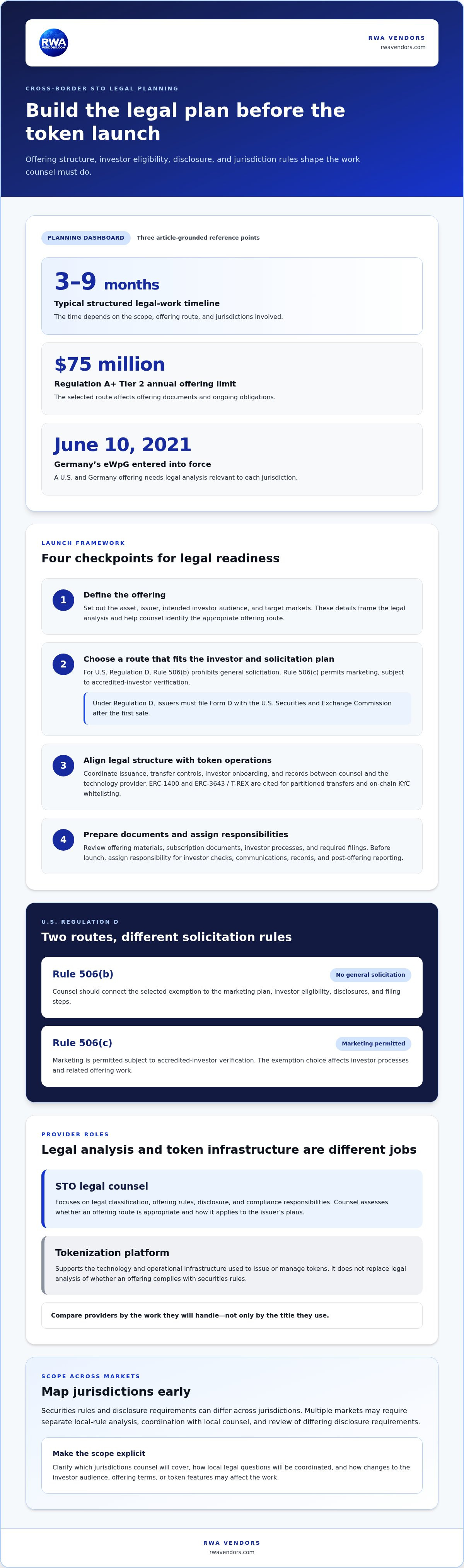
The specific exemption also changes the legal mission. Regulation D Rule 506(b) prohibits general solicitation, while Rule 506(c) permits marketing subject to accredited-investor verification. Under Regulation D, issuers must file Form D with the U.S. Securities and Exchange Commission after the first sale. Ask how counsel will connect the selected exemption to marketing, investor eligibility, disclosures, and filing steps.
Scope matters across borders, too. An issuer targeting the United States and Germany needs legal analysis relevant to each jurisdiction, not a technology provider’s general description of its platform. Germany’s Electronic Securities Act (eWpG) has been in force since June 10, 2021. Clarify which jurisdictions counsel will cover and how local legal questions will be coordinated.
Launching an STO With Legal Counsel
Start by defining the asset, issuer, intended investor audience, and relevant markets. These details frame the legal analysis and help counsel identify the appropriate offering route. For an offering in the United States, counsel can compare available structures with the issuer’s plans for solicitation, investor eligibility, disclosures, and reporting.
Next, align the legal structure with the token’s operation. Counsel and the technology provider need a shared understanding of issuance, transfer controls, investor onboarding, and records. Standards such as ERC-1400 and ERC-3643 / T-REX are cited for partitioned transfers and on-chain KYC whitelisting. Their technical use should fit the offering’s legal and operational design.
Then prepare and review offering materials, subscription documents, investor processes, and required filings. According to the U.S. Securities and Exchange Commission, Regulation A+ permits a Tier 2 offering of up to $75 million annually. The selected route affects the documents and ongoing obligations counsel must address.
Before launch, assign responsibility for investor checks, communications, records, and post-offering reporting. Structured legal work for a compliant STO typically takes 3-9 months. That period reflects the work’s scope, the offering route, and the jurisdictions involved; early decisions help keep legal, operational, and technology work aligned.
How much do STO legal advisory services cost in the United States?
There is no single price for legal work on a security token offering. Cost depends on the matter and is provided after a quote request. Key factors include the offering structure, jurisdictions, documentation, investor process, and counsel’s ongoing role. A United States-only project with a defined scope differs from an offering that also requires legal coordination across several markets.
What drives the scope of legal work?
Start by defining the security, issuer, and intended investors. Counsel needs these details to assess the offering route and identify the work required. For example, an issuer considering Regulation D must account for the selected rule, solicitation approach, investor eligibility, and related filings. Each decision affects the documents and review involved.
Jurisdiction matters, too. An offering aimed at investors in multiple markets may require separate analysis of local securities rules and coordinated advice. The number of legal regimes, the need to work with local counsel, and differences in disclosure requirements can expand the project’s scope. Identify target markets at the outset rather than adding them after drafting begins.
Technology can also shape the legal review. Counsel may need to understand token issuance, transfer controls, investor onboarding, and how the platform records transactions. A design involving restricted transfers, for instance, requires coordination between legal requirements and technical implementation. Documenting the proposed workflow clearly helps define the review.
How to assess a fee proposal
Ask for a written scope divided into stages. It should identify included tasks, such as initial structuring, offering documents, investor materials, filing support, and launch review. Then distinguish these from ongoing work, including reporting, disclosure updates, or advice on later changes. This makes proposals easier to compare on an equivalent basis.
Clarify how the firm bills for each stage. A proposal may use hourly billing, fixed fees for defined deliverables, or a combination. The key is to understand what triggers additional work. Ask how the firm handles changes to the investor audience, offering terms, or token features after drafting starts, since these may require new legal analysis and document revisions.
Before signing, provide counsel with a concise project brief covering the asset, fundraising plan, investor profile, target jurisdictions, technical design, and expected support. Request an itemized scope that separates launch work from ongoing advice. Legal providers serving STO issuers can also use a directory listing for legal services to improve their visibility among businesses seeking specialist support.
What steps are involved in launching an STO with legal counsel?
Launching an STO involves coordinating legal, business, and technical work. Legal counsel helps define the offering, document its terms, and coordinate decisions with the issuer’s technology and operations teams.
- Define the offering. Start with the asset, issuer, fundraising purpose, investor profile, and target jurisdictions. Gather ownership records, financial information, and details of the rights attached to the token. For example, a token representing an interest in a fund raises different structuring questions from one linked to real estate. Counsel uses these facts to frame the legal analysis.
- Map the legal structure. Identify the issuing entity, the security being offered, and the intended distribution model. List each market where investors may be approached, then assess the rules relevant to that offering. If the plan spans the United States and the European Union, counsel should distinguish each jurisdiction’s requirements and coordinate the analysis before marketing begins.
- Set offering terms and disclosures. Agree on the rights represented by the token, transfer conditions, investor eligibility, and material risks. Counsel can use those decisions to prepare offering documents and subscription materials. Issuer teams should provide consistent information about the asset, business model, use of proceeds, and token mechanics so that disclosures match the planned transaction.
- Align technology with legal requirements. Give the legal and technical teams a shared description of issuance, onboarding, transfers, and recordkeeping. Standards such as ERC-1400 and ERC-3643 / T-REX are cited for partitioned transfers and on-chain KYC whitelisting. The implementation should reflect the offering’s transfer controls and investor processes, rather than treating smart-contract settings as a substitute for legal review.
- Prepare launch operations. Assign responsibility for investor communications, eligibility checks, document execution, transaction records, and handling investor questions. Run through a sample subscription from initial interest to token allocation. This practical walkthrough can reveal mismatches between the offering documents, platform configuration, and the issuer’s actual procedures before the offering opens.
- Complete filings and maintain compliance. Confirm which filings and ongoing responsibilities apply to the selected offering route. Under Regulation D, issuers must file Form D with the U.S. Securities and Exchange Commission after the first sale. Establish an owner for filing records and post-launch obligations, and keep legal counsel informed if offering terms, investor access, or token functionality changes.
A structured process gives each team clear deliverables and decision points. Keep a central record of approved terms, document versions, technical settings, and assigned responsibilities. This helps counsel assess changes consistently and supports orderly administration after launch.
How do STO lawyers compare with tokenization platforms and general securities counsel?
These roles cover different parts of a security token offering. STO lawyers analyze legal structure and obligations; general securities counsel handles broader securities matters; tokenization platforms provide technical infrastructure. Define each party’s responsibilities before selecting providers, especially where legal decisions affect platform configuration.
STO-focused legal counsel
STO counsel works at the intersection of securities law, token design, and offering operations. The lawyer assesses how the issuer’s proposed rights, transfer model, and investor process fit the relevant legal framework. For example, a token that restricts transfers needs legal terms and operating controls that align. Counsel provides legal analysis and documentation, not technology development or operations.
Cross-border experience matters when an offering touches multiple regimes. The EU DLT Pilot Regime is relevant to security-token markets, while the UK Digital Securities Sandbox was introduced under the Financial Services and Markets Act 2023. These frameworks illustrate why an issuer should ask which jurisdictions counsel has considered and what specific work covers each market.
General securities counsel
General securities counsel can address corporate finance, disclosure, governance, and securities issues beyond token offerings. This broader remit may suit an issuer whose legal needs include conventional financing as well as digital securities. Identify who will analyze token-specific features, such as on-chain transfer restrictions, and who will review the underlying security and issuer disclosures.
Define the division of work in an engagement scope. Assign responsibility for offering classification, documentation, investor processes, token-related legal questions, and ongoing compliance. If one firm handles general securities matters while another brings token expertise, establish how they will reconcile advice and maintain a single set of approved offering terms.
Tokenization platforms
A platform provides technology for functions such as token issuance, investor onboarding, transaction records, and transfer administration, depending on its capabilities. It does not replace a lawyer’s interpretation of securities rules. For example, a platform may implement a restriction specified by counsel, while counsel determines its legal basis and the documentation required.
DORA imposes ICT risk-management and operational-resilience obligations on relevant financial entities from January 17, 2025. That makes it important to distinguish platform security and operational work from legal advice about an issuer’s regulatory responsibilities. The legal and technical teams should document which controls the platform supports and which compliance tasks remain with the issuer.
Compare providers by deliverables, jurisdictional scope, token-specific experience, and coordination practices. Request a responsibility matrix showing who decides, drafts, implements, and maintains each part of the offering. This practical test can reveal gaps between legal advice, platform functionality, and the issuer’s operating model before they disrupt execution.
What legal risks and penalties can arise from a noncompliant STO
A noncompliant STO can expose an issuer to regulatory action, investor disputes, and delays. Risks often begin when the offering’s legal route does not match its marketing, eligibility controls, or disclosures. A practical review traces each requirement from the legal analysis through to the documents and operating process.
Offering and marketing violations
In the United States, Regulation D Rule 506(b) prohibits general solicitation, while Rule 506(c) permits marketing subject to accredited-investor verification. Using broad public promotion under Rule 506(b), for example, conflicts with that rule’s stated restriction. A review should compare the selected exemption with actual advertising, investor outreach, and eligibility procedures.
Filing duties matter, too. Under Regulation D, issuers must file Form D with the U.S. Securities and Exchange Commission after the first sale. A missed filing can create a compliance issue that needs attention. Maintain a calendar, assign filing responsibility, and retain records of the sale date and submission.
Disclosure and investor claims
Offering materials create another area of risk. If statements about an asset, token rights, financial condition, or use of proceeds conflict with the transaction, investors may challenge the information they received. For example, promotional material that describes transfer rights differently from the governing documents can cause confusion and disputes. Reconcile the offering document, subscription materials, and marketing copy before launch.
Incomplete or inconsistent disclosures can also complicate later communications. Keep a record of approved versions and route material changes through legal review. When the issuer updates a statement about the underlying asset, check whether related investor materials and platform displays also need revision. This helps prevent different audiences from receiving conflicting descriptions.
Cross-border and operational exposure
Jurisdictional mistakes can compound these issues. An EU public offer exceeding €8 million generally requires a prospectus under the Prospectus Regulation. An issuer that overlooks this threshold may face a different legal path than expected. Map each target market, identify the applicable offering requirements, and align distribution plans with that analysis.
Operational gaps can undermine documented safeguards. If legal terms restrict transfers but platform settings permit them, the issuer’s controls may not match its stated process. Compare the approved terms with investor onboarding, transfer functions, and recordkeeping. Assign someone to investigate mismatches and preserve evidence of corrective steps.
Before launch, document a review of the offering route, marketing, filings, disclosures, jurisdictional scope, and platform controls. After launch, preserve records and review material changes before implementing them. This creates a clear basis for responding to investor or regulator questions without making unsupported claims about penalties or outcomes.
RWA Vendors: Vendor Directory Listing
RWA Vendors connects asset issuers with verified tokenization platforms and service providers through a global directory. If your STO needs legal, compliance, or technology expertise, use the directory to find providers relevant to your project and its jurisdictions.
A Vendor Directory Listing helps providers present their services to businesses seeking support across real-world asset tokenization. Founding Membership and Lead Generation and Referrals are also available to providers seeking visibility and connections in this market. For issuers, the directory is a practical next step after defining the legal and operational capabilities their STO requires.
Use RWA Vendors to discover providers; legal analysis and advice come from the relevant professionals. Visit rwavendors.com to explore the directory or contact RWA Vendors.
Move Your STO Plans Forward With the Right Connections
Choosing STO legal advisory services is one part of building a capable offering team. The next step is to turn your legal priorities into a clear map of the expertise your project needs, whether that means securities counsel, compliance support, or tokenization technology. Keep ownership of each workstream explicit so providers can coordinate around shared project objectives.
For issuers seeking providers, RWA Vendors connects asset issuers with verified tokenization platforms and service providers. Firms serving this market can use a Vendor Directory Listing, Founding Membership, and Lead Generation and Referrals to participate in the ecosystem. The directory helps bring issuers and specialist providers into closer contact, without replacing the legal advice an offering requires.
Take the next step by outlining your needs and exploring the right connection for your role in the market.
A clear path from legal planning to provider coordination gives your STO team a stronger foundation for its next decisions.
Frequently Asked Questions
What are STO legal advisory services?
They help issuers assess and address legal questions involved in offering securities as digital tokens. The work can include reviewing the issuer’s structure, intended investors, offering documents, and token-related processes. For example, counsel can map how rights described in offering materials correspond to the token’s transfer rules. The scope depends on the offering and the jurisdictions involved.
What legal services do attorneys provide for security token offerings?
Attorneys can advise on offering structure, prepare and review transaction documents, assess investor communications, and help organize compliance responsibilities. STO legal advisory services may also include reviewing how token terms align with the underlying asset or security. For instance, counsel can compare subscription terms with the rights described in an investor presentation and identify inconsistencies for the issuer to resolve. Define deliverables and workstream responsibilities in the engagement.
What U.S. securities laws apply to an STO?
The applicable U.S. securities framework depends on the offering structure and the exemption or registration route used. A token format alone doesn’t determine which requirements apply. For example, Regulation D includes Rule 506(b) and Rule 506(c), with different solicitation conditions. Issuers should also identify related filing and disclosure responsibilities. Counsel can map the chosen route against the offering’s audience, communications, documents, and operating procedures.
Which SEC registration exemptions can an STO use, such as Regulation D, Regulation A+, or Regulation CF?
Potential routes include Regulation D, Regulation A+, and Regulation CF, but they aren’t interchangeable. STO legal advisory services can help compare the issuer’s planned solicitation, investor base, offering structure, and disclosure needs against each route’s conditions. Regulation D Rule 506(b) prohibits general solicitation, while Rule 506(c) permits marketing subject to accredited-investor verification. Document why the selected route fits the distribution plan before promoting the offering.
What are the legal requirements for investor accreditation, disclosures, and transfer restrictions in an STO?
Requirements depend on the offering route and token design. Under Regulation D Rule 506(c), marketing is permitted subject to accredited-investor verification; Rule 506(b) prohibits general solicitation. Disclosures should consistently explain the security, associated rights, and material risks. Transfer controls should match the governing documents. For example, compare a whitelist configuration with the investor eligibility process and transfer terms described to purchasers.
What state securities laws and blue sky filings apply to U.S. STOs?
State securities rules may affect an offering alongside its federal route, so issuers should map purchaser locations and determine which state-level steps apply. The analysis can depend on the offering structure, investor locations, and applicable exemptions or notice procedures. Keep a state-by-state record of the legal analysis, required submissions, responsible owner, and filing status. This helps coordinate records with investor onboarding and the offering timeline.
Disclaimer
This article is provided by RWAVendors.com for general informational and educational purposes only. It does not constitute legal, financial, investment, tax, regulatory or other professional advice, or an offer, solicitation, recommendation or endorsement of any company, product, service, token, security or investment. RWAVendors.com is an informational vendor directory and does not sell, issue, broker, custody or facilitate transactions involving cryptocurrencies, digital tokens, tokenized assets, securities or investment products. Some vendor listings and references may involve paid advertising, sponsored placement or membership relationships. These relationships do not guarantee a vendor’s qualifications, regulatory status, performance or suitability. Information may be incomplete, outdated or subject to change. You should independently verify all information, conduct your own due diligence and consult qualified professionals before making any business or investment decision. RWAVendors.com is not responsible for the content, services, representations or actions of third-party vendors or linked websites.


