

A token’s blockchain does not determine who may buy it or how it can be transferred. RWA compliance solution providers help issuers align onboarding and issuance controls with the offering’s jurisdiction and regulatory route. In the United States, a Regulation D Rule 506(b) offering may include unlimited capital from accredited investors and up to 35 non-accredited investors, according to the U.S. Securities and Exchange Commission.
Jurisdictional fit matters because identity checks alone do not determine whether an investor is eligible for a particular offering. Issuers also need controls that connect screening results to investor records, wallet permissions, transfer restrictions, and ongoing monitoring.
This article explains how providers support jurisdictional compliance, institutional audit trails, identity and sanctions checks, wallet allowlisting, and RWA issuance. It shows how these capabilities fit together, what to assess across a vendor stack, and how to identify the support a project needs.
Key Takeaways
- Map the offering’s jurisdiction, investor eligibility, and distribution model before selecting compliance controls.
- Build audit trails that connect onboarding decisions, approvals, transfers, and investor records.
- Coordinate identity, business, sanctions, and ongoing screening with clear processes for handling status changes.
- Use wallet allowlisting and transfer controls to align on-chain activity with investor eligibility rules.
- Plan the full issuance workflow across legal, compliance, custody, payments, and tokenization capabilities.
Jurisdictional regulatory differences
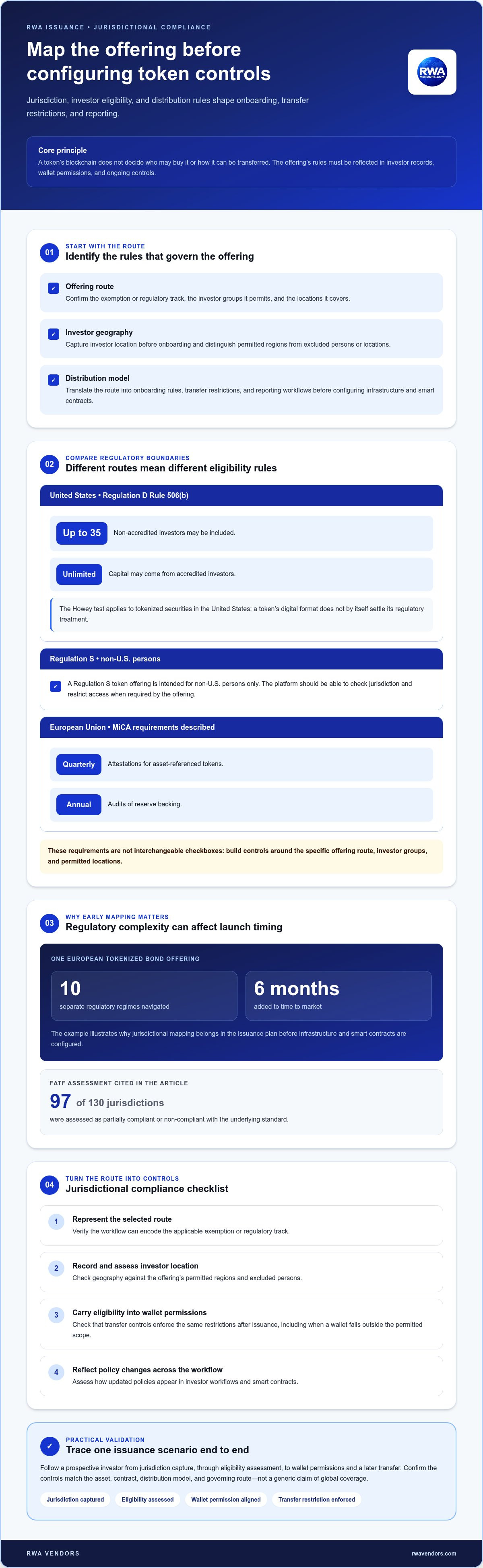
A token offering’s compliance design starts with its jurisdiction, investor base, and distribution model. A platform serving investors across borders must translate those choices into onboarding rules, transfer restrictions, and reporting workflows. One European tokenized bond offering navigated 10 separate regulatory regimes, adding six months to its time to market. That example shows why an issuance plan needs jurisdictional mapping before infrastructure and smart contracts are configured.
In the United States, the chosen offering route shapes investor eligibility. Under Regulation D Rule 506(b) in the United States, an offering may include up to 35 non-accredited investors, according to the U.S. Securities and Exchange Commission. It may also include unlimited capital from accredited investors, according to the same commission. The Howey test applies to tokenized securities in the United States, so the token’s digital format doesn’t by itself settle its regulatory treatment.
Other routes set different boundaries. A Regulation S token offering is intended for non-US persons only. Under the EU framework described, MiCA requires quarterly attestations for asset-referenced tokens and annual audits of their reserve backing. These requirements are not interchangeable checkboxes. A compliance model must reflect the specific exemption or regulatory track governing the offering, including the investor groups and locations it permits.
Jurisdictional variation also affects controls beyond investor eligibility. In the FATF assessment cited in the post, 97 of 130 jurisdictions were assessed as partially compliant or non-compliant with the underlying standard. For an issuer, the practical step is to map investor location before onboarding, then connect each permitted location to the applicable eligibility and screening workflow. A platform should explicitly check jurisdiction, particularly when an offering excludes US persons or limits access to selected regions.
Compare providers against the project’s defined regulatory route, not a generic claim of global coverage. Check how the infrastructure records investor location, applies eligibility rules, and restricts transfers when a wallet falls outside the offering’s permitted scope. Also assess how policy changes are reflected in investor workflows and smart contracts.
- Offering route: Can the workflow represent the selected exemption or regulatory track?
- Investor geography: Can onboarding distinguish permitted regions and excluded persons?
- Transfer controls: Can the system enforce the same restrictions after issuance?
Test a real issuance scenario from subscription through transfer. Trace how a prospective investor’s jurisdiction is captured, assessed against the offering rules, and reflected in wallet permissions. RWA compliance solution providers should support controls suited to the asset, contract, and distribution model, rather than assume one configuration fits every market. This comparison helps issuers identify gaps before onboarding and avoid mismatched compliance rules.
Institutional diligence and audit trails
Institutional diligence examines whether tokenization infrastructure supports accountable decisions throughout an asset’s lifecycle. A transaction hash alone cannot show why an investor passed onboarding, who approved an exception, or which policy applied. Institutions need records that connect off-chain decisions with on-chain activity, including subscriptions, transfers, redemptions, and servicing events. This lets operations teams reconstruct what happened and explain the decision path to internal reviewers.
Map each workflow to a responsible role. Identify who reviews investor records, approves wallet permissions, and handles escalations after monitoring flags activity. Record each action with its timestamp, decision-maker, relevant policy version, and supporting evidence. Preserve approvals and denials alike. Without the reason for a decision, an audit trail may show that a control ran without showing how it was applied.
Build the evidence trail across connected systems, not in isolated logs. A subscription record should link the investor’s approved identity file, eligibility decision, funding event, and receiving wallet address. A transfer record should show the sending and receiving addresses, the control applied, and the outcome. If a smart contract rejects a transfer, retain the rejection event and its cause alongside the related compliance record. This makes operational reviews more useful than a block explorer history alone.
Ongoing AML monitoring adds another layer of diligence. It can flag unusual transaction patterns, unusually large transfers, and activity connecting a wallet to addresses flagged elsewhere. Define how alerts enter a case workflow: assign ownership, record review steps, preserve supporting details, and document the resolution. Clear escalation paths help compliance and operations teams distinguish a genuine exception from a routine transfer while retaining the evidence behind their decision.
Third-party dependencies belong in the review too. In 2025, the Federal Reserve Bank of Dallas described how disruption at one third-party service provider could affect multiple banks simultaneously and create a potential single point of failure. For an issuer, the practical diligence step is to map which providers support identity, custody, payments, monitoring, and reporting. Record each dependency, its role, and the process for maintaining investor records if an integration becomes unavailable.
- Traceability: Can a reviewer connect an investor, decision, transaction, and wallet address?
- Accountability: Are approvals, overrides, and escalations assigned to clear roles?
- Continuity: Are provider dependencies and record-handling processes documented?
Use a sample investor journey to test these controls before issuance. Follow one subscription from identity review through payment, wallet approval, and a later transfer. Confirm that the evidence is searchable and consistent across systems. Providers can also make their institutional controls easier to assess through a structured provider profile that describes relevant capabilities clearly.
KYC and AML verification
For an RWA tokenization program, onboarding must establish an investor’s identity and whether participation fits the offering’s controls. A typical review checks identity documents and proof of address against sanctions and politically exposed person lists. The outcome should connect the verified person to an investor record, not just a wallet address. That link helps operations teams apply the appropriate access rules when the investor subscribes, transfers, or requests servicing.
Verification also needs a documented decision path. Capture what evidence was reviewed, when screening occurred, and whether a reviewer cleared or escalated a match. For example, a similar name on a sanctions list should enter a review workflow rather than become an unexplained approval or rejection. Keep the resolution and supporting rationale with the investor file so later reviews can reconstruct the decision.
AML controls extend beyond initial identity checks. Ongoing monitoring can flag unusual transaction patterns, unusually large transfers, and activity linking a wallet to addresses later flagged elsewhere. An issuer should define how alerts are triaged, who owns each case, and how outcomes affect account or wallet permissions. The process must connect monitoring findings to the investor record and relevant transaction history.
Assess providers by tracing a sample investor journey through these stages:
- Collect: Record the identity documents and proof of address submitted for review.
- Screen: Compare the investor against sanctions and politically exposed person lists, then preserve the result.
- Resolve: Route potential matches for review, document the decision, and retain its supporting evidence.
- Monitor: Link later alerts to the investor, transaction, and wallet, then record the case outcome.
Business customers need a related but distinct KYB workflow. It should identify the entity, capture its authorized representatives, and associate them with the organization’s investor account. For a corporate treasury subscription, the workflow should connect the company record, the individual acting for it, and the intended wallet. This helps prevent a verified person’s identity from being mistaken for verification of the entire business.
Data handling is part of the control design. Define which records each team can access, how screening outcomes move between connected systems, and how corrections reach the investor file. A 2025 BIS bulletin proposed using blockchain transaction history to assign each asset an AML score from 0 to 100, checked when converting the asset back to fiat. Treat that proposal as a distinct asset-level concept, not a substitute for investor identity checks. Compare systems by whether they keep investor, entity, transaction, and asset records clearly differentiated.
KYC, KYB, sanctions screening, and wallet allowlisting
Identity approval and wallet access are separate controls. A person may pass onboarding, but the platform still needs to connect that result to the address intended to hold a token. Before allowing a wallet to hold an asset, a compliant RWA platform should verify identity, sanctions status, and accreditation. The approval process should preserve the link between the investor record, approved address, and offering eligibility rules.
For a corporate investor, KYB adds an entity-level record to that chain. Consider a company subscribing through a treasury wallet: the system needs to associate the business account, its authorized representative, and the wallet address. If an employee later uses a different address, the platform should treat it as a distinct access request. This separation helps prevent one approved person or account from implicitly authorizing unrelated wallets.
Allowlisting turns compliance decisions into transfer controls. A smart contract can check each proposed transfer against approved addresses and reject one involving an unapproved wallet. This makes the list part of the transaction path, rather than a reference held only in an off-chain file. Review how the compliance system updates the allowlist and communicates changes to the token contract. A control that blocks an initial transfer but misses later status changes creates an operational gap.
Assess the workflow using a practical transfer scenario:
- Verify: Complete identity or business checks, then record sanctions and accreditation results against the relevant investor account.
- Associate: Link each approved wallet address to the correct person or entity and specific offering.
- Enforce: Have the contract check the sender and recipient addresses before processing a transfer.
- Update: When an investor’s compliance status changes, revise permissions and preserve the reason and record of that change.
Test permitted and rejected transactions. For a permitted transfer, confirm that the destination wallet is on the relevant approved list. For a rejected transfer, confirm that the platform records the reason and makes it available to compliance operations. These tests reveal whether the contract, screening workflow, and investor records use consistent information.
Pay particular attention to allowlist maintenance because an investor’s compliance status can change after onboarding. The platform should connect refreshed screening or eligibility decisions to wallet permissions through a defined review and approval path. Include a new wallet address, revised investor details, and a screening alert in testing. Compare providers on how clearly they show the status of each record, address, and transfer decision. This can reveal gaps before issuance and help keep transfer controls aligned with the project’s compliance framework.
RWA onboarding and issuance compliance
Issuance connects legal classification, investor eligibility, blockchain controls, custody, and payments. Assess the workflow from defining the asset and distribution model through post-issuance servicing.
Securities Law Compliance
The U.S. Securities and Exchange Commission treats tokenized securities as securities regardless of their issuance technology. Platforms should therefore support rules tied to the applicable offering route and investor eligibility, including accreditation checks where required. Evaluate how the system records the rule applied, onboarding outcome, and approval evidence. The contract and operational workflow should enforce consistent restrictions, rather than rely on token format alone.
Which RWA compliance platforms support securities-law compliance and investor accreditation checks? Look for platforms that configure eligibility checks to the offering, retain decision evidence, and connect approvals to wallet permissions. The workflow should distinguish investor types and preserve records for review.
How do you compare RWA compliance solution providers? Assess whether their stated capabilities, workflows, and integrations align with your offering’s jurisdictional, investor eligibility, screening, and recordkeeping requirements. The right fit depends on the project’s regulatory route and operating model.
How do RWA compliance providers integrate with blockchain networks, custodians, and tokenization platforms? They connect onboarding and compliance decisions to the tokenization platform, custody workflow, and blockchain through system integrations. Test whether an approved investor and wallet status can reach the relevant contract, and whether transaction outcomes return to operational records.
- Asset and jurisdiction: Define the asset, offering route, investor type, and distribution model.
- Technology connections: Map the tokenization platform, blockchain, custodian, and payment systems.
- Lifecycle operations: Include issuance, transfers, reporting, and ongoing investor servicing.
Selection Risks and Limitations
What risks and limitations should businesses evaluate when selecting an RWA compliance solution? A single platform rarely covers every jurisdiction, asset class, and investor workflow. Identify gaps across securities classification, accreditation, custody, and post-issuance servicing. Check whether integrations preserve data and permissions across systems, and whether exceptions can be documented without bypassing controls.
Asset workflows differ: real estate, private credit, and tokenized treasury funds can require distinct servicing, reporting, and investor access. Compare RWA compliance solution providers against a defined project workflow, not a broad feature list. A disconnected integration can leave the platform, custodian, and blockchain with inconsistent investor or transaction status. Map each dependency and assign responsibility for resolving mismatches before issuance.
Plan onboarding as an operational path, not a set of isolated tools. Tokenized asset infrastructure needs to work together because gaps can cause problems during onboarding, settlement, compliance review, or investor servicing. Map how decisions and records move among relevant systems, and confirm the necessary handoffs before issuance.
Institutional investor onboarding for tokenized assets typically takes 3 to 10 business days. Regulatory challenges for RWA tokenization include jurisdictional differences, AML and KYC compliance, asset classification, and smart contract legality. RWA projects should begin vendor-stack planning by defining the asset, jurisdiction, investor type, and distribution model. Use those parameters to assess whether the selected workflow addresses the project’s compliance needs and operational connections across its lifecycle.
RWA Vendors: Vendor Directory Listing
RWA Vendors connects asset issuers with vetted tokenization platforms and service providers through a global directory. Use it when your project requirements are defined and you need to explore providers across compliance, technology, and tokenization workflows. The directory helps issuers find companies working with real estate, funds, securities, and other assets. Browse relevant parts of the vendor ecosystem while assessing each provider against your project’s needs.
A Vendor Directory Listing gives providers a place to present their capabilities to issuers seeking tokenization support. Founding Membership and Lead Generation and Referrals are also available to businesses in the ecosystem. For issuers, the directory is a practical starting point for connecting project needs with relevant providers. Visit rwavendors.com to explore the directory or contact RWA Vendors.
Make your capabilities easier to discover
For RWA compliance solution providers, clear positioning can help issuers understand how your expertise fits their needs. Describe your capabilities in terms issuers can use: the asset types you support, the onboarding workflows you cover, and where your role fits within an issuance stack. Specific positioning helps prospective partners assess how your work relates to their project.
RWA Vendors offers providers a Vendor Directory Listing, Founding Membership, and Lead Generation and Referrals. These options support visibility and connections across the tokenization ecosystem. Consider which approach aligns with your organization’s priorities, whether that means presenting your services to issuers or building relationships across the market.
Clear positioning can make your expertise easier for relevant project teams to discover.
Frequently Asked Questions
Which providers offer compliance solutions for tokenized real-world assets in the United States?
For US projects, use a directory to identify RWA compliance solution providers across legal compliance, identity verification, and monitoring categories. RWA Vendors connects issuers with providers listed across tokenized capital markets; it does not perform compliance checks or provide legal advice. Compare each provider’s stated capabilities with your offering’s investor eligibility, screening, and recordkeeping requirements before building the workflow.
How do RWA compliance providers compare on KYC, AML, sanctions screening, and transaction monitoring?
Compare each provider’s scope and operational fit, not just its feature labels. Assess whether an institution can use the same workflow for individual investors and corporate entities, how screening outcomes are reviewed, and whether monitoring alerts can be linked to relevant transactions. Consider how teams access records and export case histories. These distinctions help show whether a solution fits your operating model.
What steps are required to onboard an RWA project with a compliance provider?
Onboarding typically moves from project definition to workflow configuration and testing. Prepare the asset and distribution model, expected investor types, relevant jurisdictions, and existing technology connections for the initial review. Then document responsibilities and configure the required checks. Before production, test an eligible investor, a rejected application, and an exception requiring review. Confirm each result reaches the systems and teams responsible for the next action.
Which RWA compliance providers serve institutional clients and support multiple jurisdictions?
Institutional buyers can use RWA Vendors’ global directory to discover providers across compliance, custody, blockchain infrastructure, and other tokenized capital markets categories. Browse and filter vendors globally, then narrow the search by required workflow and target markets. Compare each provider’s stated scope with your project’s operating needs, since listings do not establish that every provider serves institutions or covers every jurisdiction.
Disclaimer
This article is provided by RWAVendors.com for general informational and educational purposes only. It does not constitute legal, financial, investment, tax, regulatory or other professional advice, or an offer, solicitation, recommendation or endorsement of any company, product, service, token, security or investment. RWAVendors.com is an informational vendor directory and does not sell, issue, broker, custody or facilitate transactions involving cryptocurrencies, digital tokens, tokenized assets, securities or investment products. Some vendor listings and references may involve paid advertising, sponsored placement or membership relationships. These relationships do not guarantee a vendor’s qualifications, regulatory status, performance or suitability. Information may be incomplete, outdated or subject to change. You should independently verify all information, conduct your own due diligence and consult qualified professionals before making any business or investment decision. RWAVendors.com is not responsible for the content, services, representations or actions of third-party vendors or linked websites.


