

A tokenization failure can cause more than a technical setback: it can create legal, operational, compliance, and market-access problems. Avoiding common tokenization mistakes means treating tokenization as a coordinated business and governance decision, not simply a blockchain deployment. Weak planning can undermine investor confidence and disrupt a project before or after launch.
That risk is easy to underestimate. A token’s digital format does not change the economic or legal nature of the underlying asset, and successful issuance depends on decisions beyond the technology itself. Careful preparation helps businesses identify gaps early and make informed decisions about project structure and provider capabilities.
This article explains common tokenization mistakes and their potential business effects, from unclear legal structures and compliance gaps to inadequate testing, liquidity planning, and operational resilience. It also outlines what to consider when evaluating providers, so you can assess whether their capabilities fit your project’s requirements and long-term plans.
Key Takeaways
- Identify how a tokenizer treats punctuation, contractions, and hyphenated terms so important distinctions aren’t lost during processing.
- Preserve Unicode characters, accents, and emoji consistently to avoid unexpected differences in text representation.
- Compare word, character, and subword approaches by their trade-offs in vocabulary coverage, granularity, and handling of unfamiliar terms.
- Keep preprocessing and tokenizer settings aligned between training and inference to make model inputs consistent.
- Assess how technical choices can affect reliability and user experience, then evaluate provider capabilities against your project’s requirements.
3. What are the most common tokenization mistakes?
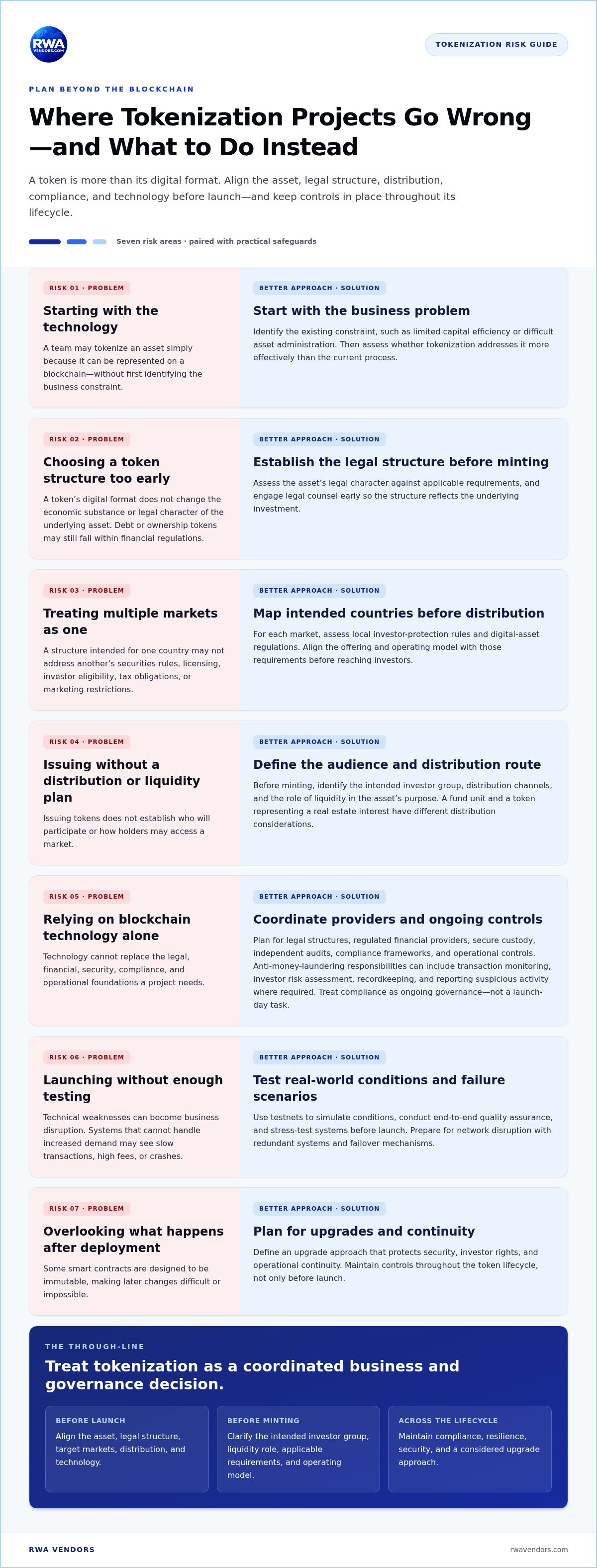
A common mistake is starting with the technology instead of the business problem. A team may plan to tokenize an asset simply because it can be represented on a blockchain. First, identify the existing constraint, such as limited capital efficiency or difficult asset administration. Then assess whether tokenization addresses it more effectively than the current process.
Another mistake is choosing a token structure before understanding the asset’s legal character. A token’s digital format does not change the economic substance of its underlying investment. For example, a token representing debt or ownership may still fall within financial regulations. Select an appropriate legal structure before minting, and engage legal counsel early to assess it against applicable requirements.
Projects also underestimate the work involved in entering multiple jurisdictions. A structure intended for one market may not address another market’s securities rules, licensing requirements, investor eligibility, tax obligations, or marketing restrictions. Map intended countries before distribution. For each market, assess local investor-protection rules and digital-asset regulations, then align the offering and operating model with those requirements.
Launching without a liquidity plan or distribution strategy creates another avoidable weakness. Issuing tokens does not establish who will participate or how holders may access a market. Before minting, define the intended investor group, distribution channels, and the role of liquidity in the asset’s purpose. A fund unit, for example, has different distribution considerations from a token representing a real estate interest.
Relying on blockchain technology alone is also a mistake. A project needs coordinated legal structures, regulated financial providers, secure custody, independent audits, compliance frameworks, and operational controls. Anti-money-laundering responsibilities can include transaction monitoring, investor risk assessment, recordkeeping, and reporting suspicious activity where required. Treat compliance as an ongoing governance function, not a launch-day task.
Insufficient testing can turn technical weaknesses into business disruption. Use testnets to simulate real-world conditions, conduct end-to-end quality assurance, and stress-test systems before launch. Plan for network disruption with redundant systems and failover mechanisms. A platform that cannot handle increased demand may experience slow transactions, high fees, or system crashes.
Finally, teams may overlook what happens after deployment. Some smart contracts are designed to be immutable, making later changes difficult or impossible. Define an upgrade approach that protects security, investor rights, and operational continuity. Avoiding common tokenization mistakes means aligning the asset, legal structure, distribution, compliance, and technology before launch, then maintaining controls throughout the token lifecycle.
4. How do tokenizers handle punctuation, contractions, and hyphenated words?
Text tokenizers split written input into units a model can process. Their rules determine whether punctuation stays attached, becomes a separate token, or is normalized. For example, a tokenizer might represent “Hello, world!” as “Hello”, “,”, “world”, and “!”. Another tokenizer may divide the same words differently. There is no universal rule across models.
Commas, periods, quotation marks, and parentheses can carry meaning. In “Let’s eat, teams,” the comma separates a direct address; removing it changes how the sentence reads. A tokenizer usually preserves punctuation as a token or as part of a neighboring token. The behavior depends on its vocabulary and preprocessing rules. Review actual token output rather than assuming punctuation is ignored.
Contractions create another choice. A word such as “don’t” might remain one unit, split into “do” and “n’t,” or divide into smaller subword pieces. “We’re ready” and “we are ready” express similar meanings, but their token sequences differ. That distinction matters when matching patterns, comparing text, or preparing data for a model. Keep contractions consistent if an application relies on exact text matching.
Hyphenated terms also vary by tokenizer. “Long-term” could remain intact, split at the hyphen, or become several subword units. A compound such as “real-world asset” may therefore have different boundaries across systems. Hyphens can distinguish meaning, connect a compound, or mark a line break. Avoid deleting them automatically, especially in names, technical terms, and identifiers.
For a practical review, use examples from the material your system processes. Compare output for “state-of-the-art,” “client’s,” “client’s records,” and “Version 2.1.” Include leading and trailing punctuation, such as “(asset)” and “asset.” These pairs reveal whether punctuation attaches to words and whether apostrophes or periods change the result. Record the tokenizer version and preprocessing settings alongside the test results.
Choose the behavior that fits the application. Search systems may normalize punctuation to improve matching, while document analysis may need original punctuation to preserve sentence structure. Keep the source text separately when transformations could remove distinctions. Then test edge cases during updates, because a changed vocabulary or preprocessing step can produce different token boundaries.
For tokenized-asset initiatives, a provider’s technical scope can include how its systems process transaction records, investor communications, and asset documentation. Organizations offering related services can use a tokenization vendor directory listing to present their capabilities to issuers evaluating providers.
Tokenizer decisions belong in a wider implementation plan: document what is normalized, what remains intact, and how changes will be reviewed. In related tokenization work, project teams should plan smart-contract upgrades and future changes so they do not compromise security, investor rights, or operational continuity. Keeping these concerns visible helps ensure a processing change is considered alongside the system’s broader requirements.
Where payment credentials are involved, merchants can ask token vault providers to handle retrieving and maintaining network tokens. That responsibility is distinct from text-token boundaries, so teams should clarify which kind of token they mean and who manages it. Clear terminology, documented handling choices, and review of changes can reduce ambiguity across technical and operational teams.
5. How should tokenization handle Unicode, accents, and emoji?
Unicode allows text from different writing systems to be represented consistently, but identical-looking text can have different character sequences. For example, “é” may use a single precomposed character or “e” followed by a combining accent. A tokenizer that treats those forms differently can create different tokens for visually equivalent input. Test both representations in the systems that receive your text.
Normalization can help, but the chosen form should fit the application. Unicode NFC combines characters where a composed form exists, while NFD represents characters through decomposed sequences. If a search index normalizes “café” consistently, users can find matching records more reliably. Keep the original text too when its exact representation matters, such as in a document archive or audit trail.
Accents should not be stripped automatically. “Resume” and “résumé” can refer to different things, and names such as “José” may lose important spelling information when converted to plain ASCII. For multilingual records, define whether matching should be accent-sensitive or accent-insensitive. Apply that rule deliberately to search or comparison fields, rather than changing every stored value.
Emoji require similar care. A visible symbol can include a base character, a skin-tone modifier, a variation selector, or joined characters. The family emoji “👨👩👧” uses a sequence joined with invisible characters; splitting that sequence can change how it is interpreted. Depending on its vocabulary and design, a tokenizer may represent the whole sequence as one unit or several pieces.
Build a test set that reflects the text your service actually receives. Include “naïve,” “São Paulo,” “東京,” “👋,” and a family emoji. Compare the original input with the normalized version, then inspect token output and downstream behavior. Look for dropped accents, replacement characters, unexpected splits, or emoji sequences that no longer render as intended.
Store text using a Unicode-capable encoding, and avoid converting it to ASCII as a routine cleanup step. Separate normalization from tokenization so each transformation has a clear purpose. For example, a customer-name field may need faithful spelling, while a search key may use a defined normalization rule. Document that distinction for every system handling the same text.
Finally, test real user input, not only curated examples. Copied text can contain combining marks or invisible joiners that are not obvious from keyboard entry. Review how the tokenizer handles accents and emoji after changes to preprocessing or vocabulary. This practical check helps teams preserve meaningful characters while producing consistent representations for their intended use.
4. What are the differences between word, character, and subword tokenization
Word, character, and subword tokenization divide text at different levels. Consider “tokenization supports new terminology.” A word tokenizer might produce four units, one for each word. A character tokenizer breaks the phrase into individual characters, including spaces or punctuation depending on its rules. A subword tokenizer splits words into familiar pieces. Each approach changes vocabulary size, sequence length, and how unfamiliar terms are represented.
Word tokenization treats each complete word as a unit. In “digital asset platform,” the tokenizer could produce three tokens. This makes results readable and supports word-level analysis, such as counting occurrences of “asset.” However, a new term like “assetization” may not be in its vocabulary. The system might mark it as unknown or require vocabulary updates, which can complicate the processing of specialized or evolving language.
Character tokenization represents text at a finer level. “Fund” becomes four character tokens, while “funds” becomes five. Because each character comes from a limited character set, unfamiliar words can still be represented without adding a complete word to the vocabulary. The trade-off is longer sequences and less direct access to word meaning. A model must interpret character patterns to connect “fund” with “funds.”
Subword tokenization splits words into reusable fragments. A system might represent “tokenization” as “token” plus “ization,” if those pieces exist in its vocabulary. Methods such as Byte Pair Encoding and WordPiece build subword vocabularies from text patterns. This approach can represent unseen words through known pieces, while usually producing fewer tokens than character-level processing.
Each method creates different operational trade-offs. A word-level system can be easier to inspect, but rare names and technical terms may fragment unpredictably or become unknown. Character-level systems handle novel spellings, but longer sequences can require more processing. Subword systems balance vocabulary reuse and sequence length, though their splits may be less intuitive when reviewing model output.
Choose based on the task and its input. For a fixed set of product labels, word tokens may support straightforward matching. For spelling variation or unfamiliar names, character or subword units can preserve more information. For multilingual text, test how the chosen tokenizer handles examples from each language, including compound terms and accents. The tokenizer’s output should suit the data, not just seem convenient.
Before adopting a method, compare outputs on representative records. Inspect a common term, a rare name, a new technical phrase, and a misspelling. Check whether the resulting units preserve the distinctions the application needs. Then use the same tokenizer and vocabulary wherever those records are processed. This comparison makes the practical consequences visible before token boundaries affect search, classification, or downstream decisions.
5. How can I preserve tokenization consistency between training and inference
Use the same tokenizer configuration during model training and inference. If training splits “real-world” into “real,” “-,” and “world,” inference must apply the same boundaries. A difference changes the model’s input, even when the original sentence appears unchanged. Treat tokenization settings as part of the model’s required operating configuration.
First, package the tokenizer with the model rather than recreating its rules separately. Preserve its vocabulary, merge rules, special-token definitions, normalization settings, and software version. For example, a revised vocabulary might split “tokenized” differently from an earlier release. Recording the exact configuration makes the source of such changes traceable.
Next, share one preprocessing pipeline across training and production. Apply the same Unicode normalization, whitespace handling, casing rules, and punctuation treatment. If training converts text to lowercase but inference preserves case, “Fund” and “fund” may produce different inputs. Document each transformation and apply them in the same order.
Keep sequence-length handling aligned, too. Training might truncate long input and pad shorter sequences, while inference processes the full text. That mismatch can shift positions or remove context the model learned to use. Define the truncation direction, padding value, and treatment of special tokens, then apply those choices consistently to examples such as long asset descriptions.
Use regression tests to compare token output between environments. Select representative inputs, including “café,” “real-world asset,” a rare issuer name, and a sentence ending in punctuation. Save the expected tokens for each sample. After a library update or configuration change, compare the new output with those reference results before deployment.
Test the complete path, not just the tokenizer function. Send the same input through the training pipeline and inference service, then compare token IDs, attention masks, and final sequence lengths. For example, “The fund’s units” should receive the same preprocessing and tokenization in both paths. A mismatch in any intermediate representation can change model behavior.
When a tokenizer must change, version it as a model dependency and evaluate the updated pipeline against the intended task. Do not silently replace vocabulary files or preprocessing code in a live system. Keep the previous configuration available for rollback, and record which model version uses each tokenizer. These controls make updates reviewable and help isolate input-related performance changes.
These choices should be checked against the training setup, not inferred from a tokenizer’s label. The bidirectional sequence-labeling model has 12,158,980 trainable parameters. The researchers cut training sequences after 256 characters and padded shorter sequences with EOS symbols. Reproducing those limits and padding behavior at inference helps preserve the input structure the model was trained to handle. The ACL Anthology corpus used in the study consists of scientific articles published from 1965 to 2012, so test samples should reflect the intended material and its text conventions.
In asset workflows, merchants can test network tokens with issuers on an adaptive and consistent basis to identify changes in issuer behavior; this monitoring is separate from keeping model tokenization stable. Tokenization changes the infrastructure used to administer assets, but it does not remove the legal, operational, regulatory, or investment risks present in capital markets. Keep these distinctions clear when documenting model inputs and related asset processes.
RWA Vendors: Vendor Directory Listing
RWA Vendors connects asset issuers with verified tokenization platforms and service providers. After identifying a project’s legal, operational, and technical requirements, issuers can use the directory to find vendors relevant to those needs. This is a practical next step when comparing capabilities in areas such as tokenization technology, compliance, and legal services.
The Vendor Directory Listing also gives providers a way to gain visibility among businesses exploring real-world asset tokenization. Clear information about your capabilities helps issuers assess fit across project stages, from infrastructure planning to ongoing operations. The directory supports discovery; project decisions still depend on the issuer’s requirements and each provider’s role.
Contact RWA Vendors to learn more about the Vendor Directory Listing.
Make your next tokenization decision with a clear plan
Tokenization decisions go beyond selecting a technical approach. Align your project’s requirements with the capabilities needed to support it, then define how you will assess potential providers. A structured process for avoiding common tokenization mistakes helps your team focus on fit, accountability, and evolving project needs.
For providers in the ecosystem, RWA Vendors offers a Vendor Directory Listing, Founding Membership, and Lead Generation and Referrals. These options support visibility and connections with asset issuers exploring tokenization services. Choose the next step that fits your role and objectives.
Build your next decision on a clear understanding of the work ahead. A deliberate approach helps your organization move from tokenization plans toward informed, well-coordinated action.
Frequently Asked Questions
What Tokenization Failures Mean for Businesses?
Tokenization failures can interrupt transactions, delay operations, increase support workload, and weaken customer trust. For example, when card tokenization fails, a payment may be aborted, requiring the customer to re-enter card details or use another payment method. In real-world asset projects, failures in technical processes or provider coordination can also disrupt issuance and administration. The business impact depends on where the failure occurs and how quickly operations can recover.
Disclaimer
This article is provided by RWAVendors.com for general informational and educational purposes only. It does not constitute legal, financial, investment, tax, regulatory or other professional advice, or an offer, solicitation, recommendation or endorsement of any company, product, service, token, security or investment. RWAVendors.com is an informational vendor directory and does not sell, issue, broker, custody or facilitate transactions involving cryptocurrencies, digital tokens, tokenized assets, securities or investment products. Some vendor listings and references may involve paid advertising, sponsored placement or membership relationships. These relationships do not guarantee a vendor’s qualifications, regulatory status, performance or suitability. Information may be incomplete, outdated or subject to change. You should independently verify all information, conduct your own due diligence and consult qualified professionals before making any business or investment decision. RWAVendors.com is not responsible for the content, services, representations or actions of third-party vendors or linked websites.


