

Compliance doesn’t move to the technology provider just because an asset is tokenized. The questions to ask a tokenization provider should establish how compliance responsibilities are divided, which securities exemption applies, and whether the platform can support the offering’s operational needs. In the United States, a Regulation D Rule 506(b) offering permits an unlimited raise and up to 35 non-accredited investors, but does not permit general solicitation, according to the U.S. Securities and Exchange Commission.
A tokenization provider should be able to explain how its platform supports compliance, but technology alone does not determine whether an offering meets legal requirements. The asset, investor jurisdictions, distribution method, and responsibilities assigned to each party all matter.
This guide outlines practical questions to ask a tokenization provider about its compliance approach, the basis for a securities exemption, and how issuer and provider responsibilities are divided. It also covers integration requirements and operational readiness, helping you assess whether a proposed setup fits the offering beyond the initial token issuance.
Key Takeaways
- Match the securities exemption to the offering’s investor eligibility and distribution approach before assessing the provider’s platform.
- Clarify who handles investor onboarding, token records, and the connection between tokens and underlying asset data.
- Assess how compliance processes extend beyond issuance to reporting, corporate actions, and ongoing recordkeeping.
- Map the provider’s integrations against your existing systems, workflows, and requirements for moving or using tokens.
- Evaluate operational readiness by looking beyond token creation to infrastructure capacity, settlement processes, and ongoing support responsibilities.
Question 3 - Which securities exemption governs the sale?
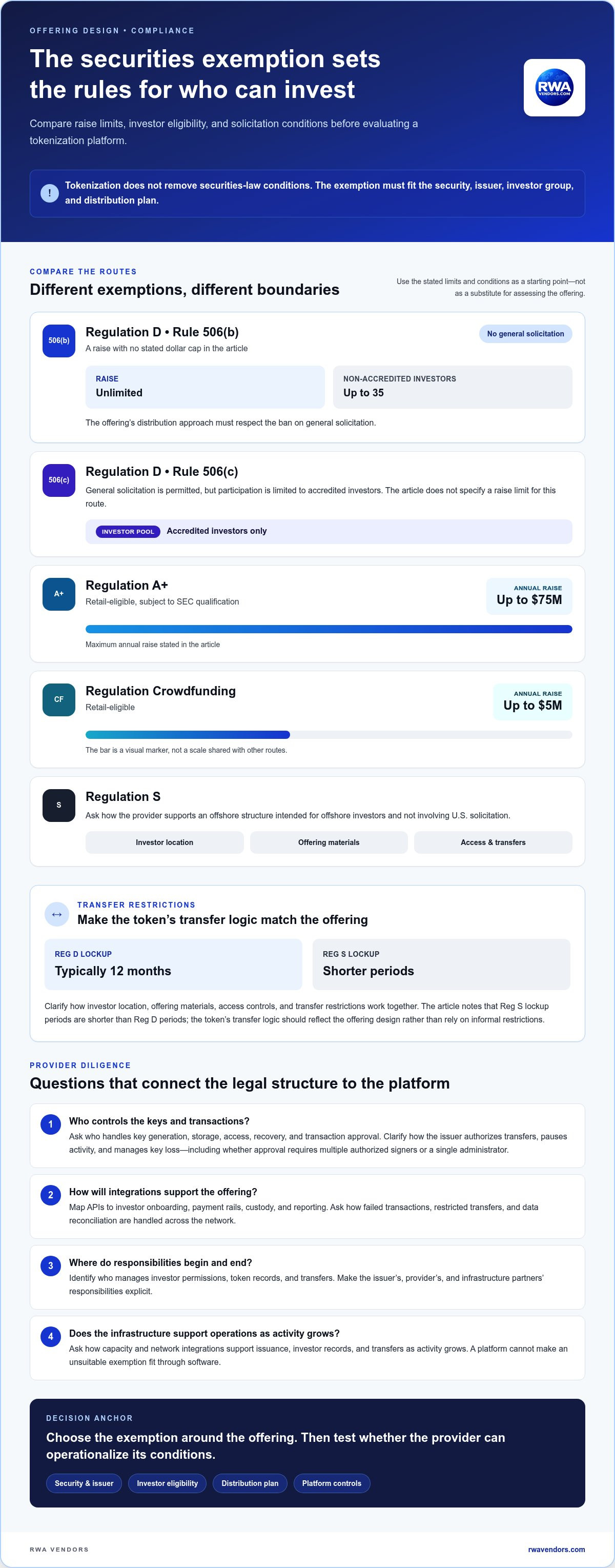
Ask the provider to identify the exemption for the specific security, issuer, investor group, and distribution plan. In the United States, a Regulation D Rule 506(b) offering permits an unlimited raise and up to 35 non-accredited investors, but does not permit general solicitation, according to the U.S. Securities and Exchange Commission. The exemption shapes who may participate and how the offering can be marketed. A token platform cannot make an unsuitable exemption fit through its software.
Match investor eligibility to distribution
Compare the intended audience with the exemption’s conditions before reviewing onboarding features. Rule 506(c) permits general solicitation but limits participation to accredited investors. Regulation A+ may raise up to $75M per year and is retail-eligible, subject to SEC qualification. Regulation Crowdfunding may raise up to $5M per year and is retail-eligible. These routes have distinct eligibility and distribution conditions; tokenization does not remove them.
For offshore offerings, ask how the provider supports a Regulation S structure intended for offshore investors and not involving U.S. solicitation. Clarify how investor location, offering materials, access controls, and transfer restrictions connect. Reg D lockup periods are typically 12 months, with shorter periods for Reg S. The token’s transfer logic should reflect the offering design rather than rely on informal restrictions.
Test security and integration capabilities
Ask who controls key generation, storage, access, recovery, and transaction approval. Request a clear explanation of how the issuer can authorize transfers, pause activity, and manage key loss. For example, establish whether approvals require multiple authorized signers or a single administrator. Ask how infrastructure capacity and network integrations will support issuance, investor records, and transfers as activity grows.
Distinguish security for digital securities from payment-card tokenization. In payment systems, a token service provider securely maps payment tokens to original card details and stores that mapping in a token vault. Ask whether merchants can retrieve or move token records if processors change. Tokens issued by a payment gateway or PSP may work only within that provider’s system, while third-party tokenization can support use across multiple processors.
PCI DSS is relevant when a provider handles payment-card data, but its controls do not establish securities-law compliance. Using a third-party tokenization provider does not eliminate the customer’s PCI responsibilities, though it can significantly reduce PCI scope. Ask which entity stores card data, which systems remain in scope, and how audits and annual recertification are handled. A clear data-flow example can show where merchant responsibilities begin and provider responsibilities end.
Ask how the provider’s APIs connect with investor onboarding, payment rails, custody, and reporting systems. Request an explanation of how failed transactions, restricted transfers, and data reconciliation are handled across the network. These answers help you assess whether the proposed infrastructure brings together the offering’s legal conditions, security controls, and operating model, rather than treating token issuance as a standalone technical task.
Token Service Provider roles and responsibilities
Providers may handle payment tokenization, asset tokenization, data tokenization, or a combination of these categories. In payment systems, a Token Service Provider securely maps payment tokens to original card details in a token vault.
Clarify the provider’s role in each system and responsibility. A payment service provider may manage payment credentials, while an asset-tokenization platform supports issuance and transfer workflows for issuers. Data tokenization replaces sensitive information with a token, helping limit exposure of the original data. These functions serve different purposes, so a provider’s label alone does not establish what its platform handles.
Ask which entity creates tokens, controls the mapping, authorizes transactions, and resolves errors. For a payment example, a merchant using Apple Pay needs to know which service provider handles the payment token and which systems receive it. For an asset example, identify who administers investor permissions and records transfers. A responsibility map can show which tasks belong to the issuer, the provider, and associated infrastructure partners.
Adoption also varies across financial services segments. Among surveyed firms, 44% of capital markets firms report tokenization live in production or scaled into operations, compared with 20% of asset managers and 9% of wealth managers. These differences make operating experience relevant: ask whether the provider’s ecosystem supports your asset type, investor workflow, and expected transaction patterns.
Uptime and Service Availability
Uptime and service availability describe how consistently a platform’s key functions remain accessible. This matters when an outage could interrupt investor onboarding, token transfers, or merchant transactions. Ask which functions the service-level agreement covers, how availability is measured, and how planned maintenance is communicated. For example, distinguish access to an investor portal from the availability of transaction processing or support channels.
Pricing and Commitments
Pricing and commitments define the charges and contractual obligations associated with using a service. Third-party tokenization providers commonly base pricing on usage, including transaction volume, stored token count, and selected add-on services. Ask for setup fees, transaction charges, minimum commitments, and the conditions that change each charge. A written fee schedule helps issuers compare the full operating model, not just the initial setup cost.
Support and Escalation Processes
Support and escalation processes define how service issues are reported, assigned, and resolved. Ask which support channels are available, what response targets the service-level agreement establishes, and who handles a critical incident. Confirm how an issue moves from frontline support to technical or operational escalation. A documented process should identify responsibilities for incidents affecting access, payment flows, or token records.
Clear role boundaries make provider comparisons more useful. Issuers mapping the wider tokenization vendor ecosystem can compare technology, compliance, and service-provider capabilities against the responsibilities identified here.
How does tokenization relate to compliance?
Tokenization changes how data and assets move, but it does not transfer every compliance duty to the platform. In the United States, residency and privacy requirements depend on the data, parties, contracts, and applicable rules, so map each data flow first.
Ongoing Compliance and Corporate Actions
Ongoing compliance covers the controls, reporting, and ownership events managed after issuance. It matters because an asset’s obligations continue when tokens are transferred or investor records change. Ask how the platform supports periodic reporting, reconciles ownership records, and records actions such as voting, distributions, or redemptions. For example, identify who approves a distribution and how the corresponding transaction appears in issuer and investor records.
Transfer Restrictions and Compliance Logic
Transfer restrictions determine whether a proposed token movement can proceed. They matter because investor eligibility, offering terms, and holding restrictions may apply after issuance. Ask which conditions the platform checks before a transfer, what data drives each check, and how exceptions are handled. A practical test is to trace a transfer from an eligible investor to an ineligible wallet, including how the rejection is recorded.
Compliance Support
Compliance support consists of the provider’s tools and processes for helping customers operate within their controls. A software solution can support compliance without taking on the issuer’s responsibilities. Ask what reports, audit trails, and control documentation the provider supplies. For payment-card data, PCI DSS is a relevant standard. Third-party tokenization can reduce PCI scope, but it does not remove the customer’s compliance responsibilities.
Data Residency and Privacy Requirements
Data residency and privacy requirements concern where information is stored, who can access it, and how it is protected. They matter when a platform handles investor identity records alongside token and transaction data. Map each data category to its storage location, access roles, retention process, and deletion workflow. Ask how the provider separates sensitive identity details from public on-chain records and documents that separation.
Use a data-flow map to connect each record with its responsible entity, system, and control. For example, trace an investor’s identity data from onboarding through storage, reporting, and deletion. Ask which records remain on-chain and which stay in controlled databases. Where payment data is involved, clarify how PCI DSS scope is assessed and how audits and annual recertification are managed.
Finally, review evidence rather than relying on a general compliance statement. Request sample audit logs, reporting outputs, and a responsibility matrix showing issuer and provider duties. For privacy controls, examine access permissions and encryption practices, including whether AES-256 is used. A defined process for policy changes, incident records, and corporate actions helps connect the platform’s technical controls to the financial and operational framework governing the offering.
Tokenization implementation and provider integration
Implementation connects the provider’s token platform with existing systems, workflows, and controls. Assess the full path from issuing an asset to recording transfers and reconciling investor data.
Implementation Planning
Implementation planning defines the systems, data, and operational steps needed to launch tokenization. It matters because an issuance may depend on several connected workflows, not just token creation. Map the sources of asset and investor records, identify which data is stored on-chain or off-chain, and assign an owner to each integration. For example, document how an approved subscription becomes an investor record and then a token allocation.
Ask the provider to outline the project sequence, dependencies, and acceptance criteria. Include identity checks, payment or settlement connections, issuance permissions, and exception handling. A test scenario should cover a rejected subscription and correction of an inaccurate record. This can reveal integration gaps before production activity begins, while the issuer can still align controls and operational teams.
API and SDK Integration
APIs and software development kits connect the provider’s functions to an issuer’s applications. Their quality matters because clear interfaces reduce friction between issuing, investor onboarding, and transaction records. Review API documentation, authentication methods, error responses, and version management. Ask whether the provider offers a sandbox and sample workflows demonstrating token issuance, transfer requests, and reconciliation.
Run a practical test: submit an issuance request, retrieve its status, and confirm the resulting records match across systems. Establish how failures are surfaced and whether the API supports safe retries without creating duplicate transactions. Review SDK compatibility with your development environment and the provider’s release process. These details help engineering teams estimate integration work without assuming every function is automated.
Interoperability Across Integrations
Interoperability describes how a token and its associated records work across networks, platforms, and service providers. It matters when an issuer needs to connect custody, investor management, transfer, or reporting systems. Ask which standards the platform supports and how it handles different data formats. ERC-7943 is identified as an industry standard for institutional real-world-asset tokenization.
Check whether token records can move between providers or remain tied to one platform. Payment tokens issued by a gateway or PSP may be valid only within that provider’s system, while third-party tokenization can provide tokens usable across multiple processors. This distinction affects portability for merchants and consumers, and shows why payment-token workflows should not be assumed to match asset-token workflows.
Ask how the provider connects to existing infrastructure instead of requiring a separate environment. Sixty-nine percent of surveyed respondents plan to hybridize existing infrastructure rather than build entirely separate environments. Discuss data mapping, reconciliation, and ownership of integration changes. A clear interface between the token platform and existing financial systems supports operational continuity while preserving the issuer’s established compliance processes.
Test a complete workflow with realistic records, not just a successful issuance. Include a transfer, a failed instruction, and reconciliation against the primary system of record. Record which system is authoritative for each field, such as investor identity, token balance, and transaction status. This exercise can expose mismatches early and give technical, compliance, and operations teams a shared integration baseline.
Competitive advantage and operational readiness
Operational readiness means the people, infrastructure, and processes can support a tokenized asset after launch. Assess the provider’s ability to handle routine activity and exceptions, not just a successful mint.
Minting is only one part of the work. Ongoing operations account for 90% of the total effort of a tokenization project. Ask how the provider supports subscription processing, investor servicing, transaction reconciliation, and corporate actions. For example, trace a subscription from payment receipt through allocation, record updates, and investor reporting. This reveals whether the proposed model covers the asset’s full operating lifecycle.
Test the operating model against realistic disruptions. Ask what happens when a payment fails, a transfer is rejected, or a transaction record needs correction. Identify who owns each resolution, which system holds the authoritative record, and how the issuer sees the outcome. The token service provider’s role should be clear during routine operations and exceptions, particularly when several vendors support the same workflow.
Infrastructure choices can affect performance under real demand. Assess whether the provider relies on premium infrastructure or free-tier bottlenecks, and ask how capacity changes as activity grows. Compare realistic settlement metrics with theoretical matching-engine maximums. A high transaction-processing figure alone does not show how quickly funds settle, records reconcile, or investor balances update. Request a scenario that reflects your offering’s expected transaction flow.
Operational readiness also depends on controls around custody and access. Walk through how authorized staff approve sensitive actions, how changes are recorded, and how access is removed when responsibilities change. For example, examine how an investor record can be corrected without creating conflicting ownership information. The provider’s incident procedures should explain how operations teams identify, escalate, and document problems affecting transactions or reporting.
Readiness gaps discovered after minting can take 2-4 months to fix. Before launch, review whether the provider’s operating procedures cover payment handling, investor communications, reconciliation, and ongoing reporting. Ask teams to rehearse a failed subscription and a delayed settlement. These exercises expose unclear handoffs between the issuer, the platform, and associated service providers while changes are still easier to coordinate.
Use these assessments to distinguish technical capacity from operational fit. A provider may support token issuance yet leave issuer teams to coordinate reporting, investor support, or transaction exceptions. Define those responsibilities, then compare each provider against the workflows your organization must maintain. This gives decision-makers a practical basis for assessing readiness and the operational advantages a provider can support.
RWA Vendors: Vendor Directory Listing
RWA Vendors connects asset issuers with verified tokenization platforms and service providers. Once you have defined your compliance, integration, and operational requirements, use the Vendor Directory Listing to find relevant providers across technology, legal, compliance, and tokenization categories.
This is a practical next step when you’re ready to compare capabilities for a real estate, fund, securities, or other asset project. Match provider categories to your project’s needs, then use the questions in this guide to structure discussions about responsibilities, infrastructure, and readiness. RWA Vendors also offers Founding Membership and Lead Generation and Referrals for businesses participating in the tokenized capital markets ecosystem.
Visit rwavendors.com to explore the directory or contact RWA Vendors.
Turn Provider Evaluation into a Practical Next Step
Selecting a tokenization partner also means deciding how your organization will work with technology, compliance, and operations over time. Give internal stakeholders a shared basis for comparing proposals, recording unresolved responsibilities, and deciding which capabilities matter most to the offering. This creates a more disciplined path from initial evaluation to implementation planning.
Use the questions to ask a tokenization provider as a decision record, not just a meeting checklist. Capture the provider’s explanations alongside your team’s requirements. This makes differences between proposals easier to assess and helps keep technical, compliance, and business teams aligned as the project advances.
For issuers seeking relevant companies, RWA Vendors offers a Vendor Directory Listing and connects asset issuers with verified tokenization platforms and service providers. Founding Membership and Lead Generation and Referrals also support participation in the tokenized asset ecosystem.
A considered evaluation gives your team a stronger foundation for moving forward with clarity and purpose.
Frequently Asked Questions
Question 2 - What wrapper holds the asset?
The wrapper is the legal or financial structure associated with the asset and the rights represented by its token. Identify the issuing entity, the asset it holds or references, and the documents connecting token ownership to investor rights. For example, ask whether a token represents an interest in an entity or a claim tied directly to an asset. The answer affects governance, transfer processes, and the records investors need.
What security certifications and compliance standards should a tokenization provider meet?
The relevant standards depend on what the provider handles. For payment-card data, ask how PCI DSS applies to its systems and your own environment. For information security controls, request the scope and current status of any SOC 2 report. GDPR and HIPAA are relevant where the service handles personal or health information under applicable obligations. Evaluate the evidence’s scope, covered systems, and exceptions, rather than relying on a certification label alone.
How does the provider protect and store token vaults, encryption keys, and sensitive data?
Look for documented separation between token records, sensitive source data, and key-management functions. Ask where each is stored, which roles can access it, and how access events are logged. AES-256 is an encryption standard to look for, but encryption alone doesn’t explain key custody or recovery. For example, request a walkthrough of how an authorized transaction is approved and how the provider responds to a compromised credential.
What are the provider's uptime, latency, and disaster recovery guarantees?
Compare the service-level agreement’s definitions, measurement windows, exclusions, and remedies. Uptime describes service availability; latency measures the delay between a request and response. Ask whether the agreement covers key functions separately, such as issuance, transfers, and reporting. For disaster recovery, review how data is restored, how transaction records are reconciled, and how responsibilities are assigned during an outage. These details clarify the operational commitments established by the contract.
How does the provider handle token portability, migration, and vendor lock-in?
Portability depends on token design, data access, and whether another platform can recognize the token and its associated records. Payment tokens from a gateway or PSP may work only within that provider’s system, while third-party tokenization can support multiple processors. Ask what export formats are available, how transfer history is preserved, and which dependencies could prevent migration. For asset tokens, discuss compatible standards such as ERC-7943 and the process for moving records.
How should businesses compare tokenization providers and evaluate them in a proof of concept?
Use the same evaluation scenarios and criteria for each provider. A proof of concept should test a representative workflow, such as investor onboarding, a rejected transfer, a record correction, and reconciliation with your system of record. Ask how each scenario is handled and documented. Score functional fit, integration effort, controls, documentation, and operational handoffs separately. Include technical, compliance, and operations stakeholders, then record gaps and dependencies.
Disclaimer
This article is provided by RWAVendors.com for general informational and educational purposes only. It does not constitute legal, financial, investment, tax, regulatory or other professional advice, or an offer, solicitation, recommendation or endorsement of any company, product, service, token, security or investment. RWAVendors.com is an informational vendor directory and does not sell, issue, broker, custody or facilitate transactions involving cryptocurrencies, digital tokens, tokenized assets, securities or investment products. Some vendor listings and references may involve paid advertising, sponsored placement or membership relationships. These relationships do not guarantee a vendor’s qualifications, regulatory status, performance or suitability. Information may be incomplete, outdated or subject to change. You should independently verify all information, conduct your own due diligence and consult qualified professionals before making any business or investment decision. RWAVendors.com is not responsible for the content, services, representations or actions of third-party vendors or linked websites.


