

The right tokenization consulting firm is defined by its mandate, not its label. Firms may describe overlapping services in different terms, making it hard to tell whether an engagement covers strategy, implementation, or work for regulated specialists. A broad scope can sound comprehensive while leaving ownership and handoffs unclear.
If you’re assessing support for a real-world asset (RWA) project, start by clarifying what each provider is responsible for and how its work fits the project lifecycle. This guide explains the roles tokenization consulting firms may take, distinguishes advisory mandates from tokenization platforms and specialist providers, and outlines capabilities to assess against your project’s needs. It also maps the wider provider ecosystem, from legal and compliance services to custody, trading, blockchain infrastructure, and payments. Use this framework to compare mandates and identify where each capability belongs in your delivery model.
Key Takeaways
- Define the mandate around the decisions and workstreams your RWA project needs, rather than relying on a firm’s title or broad service description.
- Use the tokenization lifecycle as a planning framework to identify where support may be needed, from feasibility through ongoing operations.
- Distinguish the roles of tokenization consulting firms, platforms, legal and compliance providers, custody services, and trading services before assigning responsibilities.
- Set clear objectives, deliverables, decision rights, dependencies, and reporting expectations to reduce ambiguity between consultants, internal teams, and specialist providers.
- Use a structured vendor ecosystem to explore distinct provider categories and find capabilities relevant to your project.
What Do Tokenization Consulting Firms Do for RWA Projects?
For a real-world asset (RWA) initiative, a tokenization consultant helps an organization frame the project, evaluate options, and coordinate decisions across business, operational, and technical teams. The mandate may cover the entire initiative or a single workstream. The firm’s label alone won’t tell you which.
A tokenization consulting firm advises on how to define and organize a tokenization project. That role does not automatically include building a platform, providing legal advice, or performing regulated services. The distinction matters because “tokenization” can refer to different processes. In data security, it commonly means replacing sensitive data with a substitute value, as described in Tokenization (data security). RWA projects use the term in a different context: representing an asset or associated rights digitally. A clear mandate should specify which meaning applies and what work is included.
Depending on the engagement, a consultant may contribute to:
- Strategy and use-case definition, including the business problem the initiative is intended to address.
- Asset and operating-model assessment, such as reviewing ownership records, workflows, and servicing needs.
- Solution design and implementation coordination across internal teams and external specialists.
- Defined workstreams, such as requirements development or launch planning, without managing the entire program.
Which organizations engage tokenization consultants?
Issuers, fund managers, financial institutions, and other businesses assessing an RWA initiative may seek consulting support. A common trigger is an unresolved decision: teams may be unsure how to define project scope, align stakeholders, or compare technical approaches. A consultant can structure those questions and help stakeholders understand the implications before they commit to a course of action.
Engaging a consultant does not establish that an asset or organization is suitable for tokenization. An assessment should make assumptions visible and identify issues that need specialist analysis. For example, a project sponsor may need to understand how ownership records, asset servicing, investor processes, and technology requirements interact before deciding whether to proceed.
What outcomes should a consulting mandate clarify?
A useful mandate defines decision outputs, not promised commercial results. It can set out the intended use case, project boundaries, proposed operating model, dependencies, and an implementation plan. It should also specify what the consultant will deliver, which decisions remain with the sponsor, and which matters require legal counsel, regulated providers, or technology vendors.
Make handoffs explicit. A responsibility map can show who owns each decision and who provides input, from internal teams to external specialists. This helps prevent advice from being mistaken for legal approval, technology delivery, or an operational service.
These deliverables can support informed planning, but they do not guarantee liquidity, fundraising, compliance, or commercial success. Their value is clarity: sponsors can see what has been assessed, what remains unresolved, and who is accountable for the next decision.
How Tokenization Consulting Firms Support the RWA Lifecycle
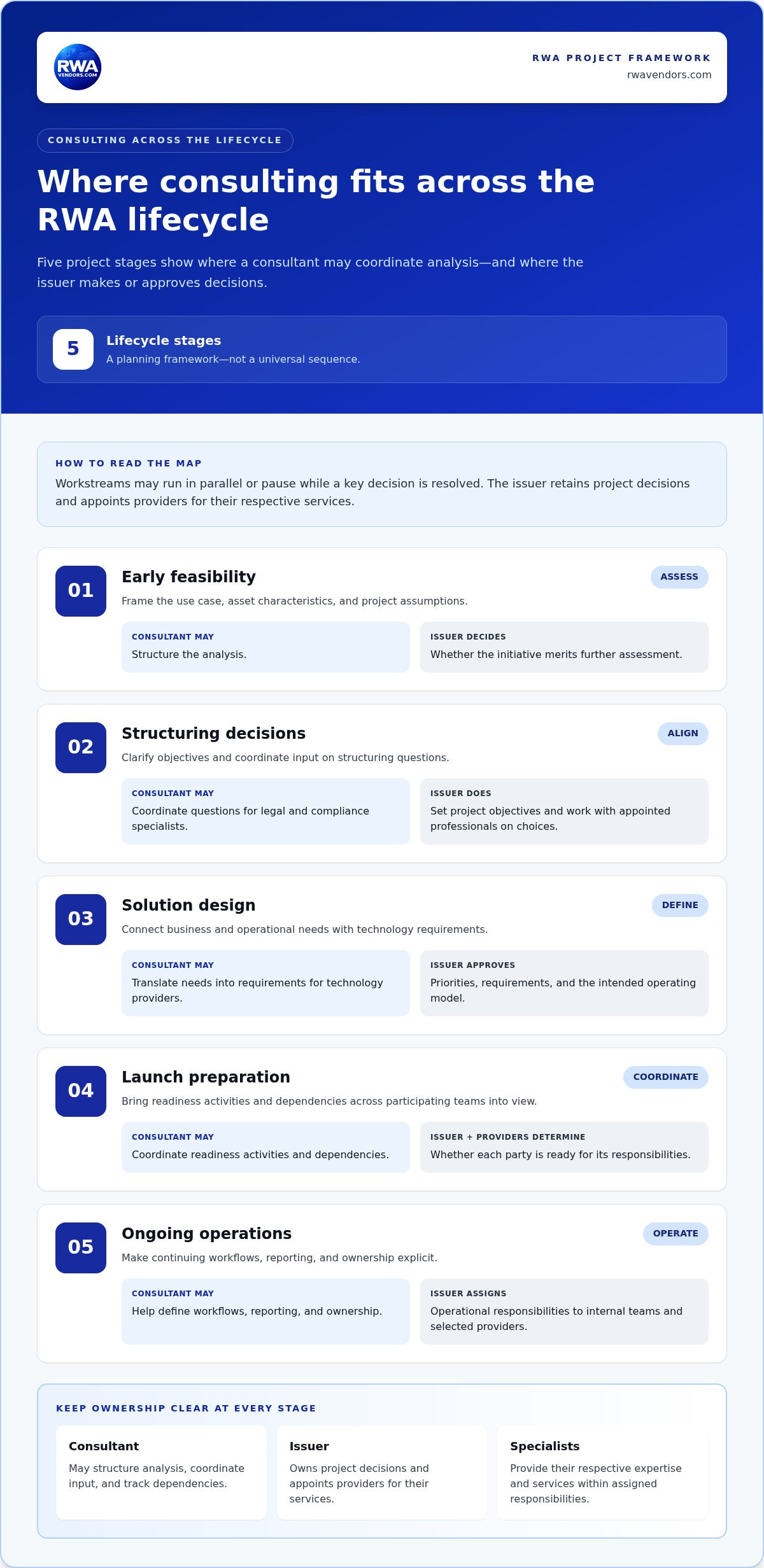
An RWA project can be planned in stages, but the sequence isn’t universal. Some workstreams proceed in parallel, while others pause until the sponsor resolves a key business or operational decision. A consultant may organize analysis, coordinate specialist input, and track dependencies. The issuer retains responsibility for project decisions and for appointing providers to perform their respective services.
Assign an owner to every project stage so that coordination doesn’t leave critical decisions or handoffs unassigned. The framework below shows where consulting support may fit and where the issuer needs to make or approve decisions.
- Early feasibility: A consultant may structure analysis of the use case, asset characteristics, and project assumptions. The issuer decides whether the initiative merits further assessment.
- Structuring decisions: The consultant can coordinate questions for relevant legal and compliance specialists. The issuer sets the project’s objectives and works with its appointed professionals on structuring choices.
- Solution design: A consultant may translate business and operational needs into requirements for technology providers. The issuer approves priorities, requirements, and the intended operating model.
- Launch preparation: The consultant may coordinate readiness activities and dependencies across participating teams. The issuer and its designated providers determine whether their respective responsibilities are ready for launch.
- Ongoing operations: A consultant may help define workflows, reporting, and ownership for continuing activities. The issuer assigns operational responsibilities to its internal teams and selected providers.
From asset assessment to project and operating-model design
Planning starts with the project’s objective, the asset’s characteristics and ownership, and the participants the issuer intends to serve. These factors shape the questions to resolve, including how existing processes will interact with the proposed model. A consultant can coordinate input from legal, compliance, and technology specialists while keeping the issuer’s decisions distinct from specialist advice. For additional regulatory context, the compliant asset tokenization guide explores considerations that may inform planning.
From technology planning to launch and lifecycle coordination
Technology planning can cover platform requirements, token design considerations, operational roles, and dependencies between implementation workstreams. A consultant may align these requirements and track handoffs, but that coordination is distinct from platform development, custody, trading, or administration. Those activities belong to the providers assigned to deliver them, under the issuer’s oversight. The digital asset infrastructure guide outlines relevant infrastructure roles.
A well-defined lifecycle mandate makes the consulting scope visible: which stages are included, what the consultant coordinates, and which decisions and services sit elsewhere. Consulting firms seeking visibility among organizations exploring RWA projects can explore a directory listing in the RWA Vendors ecosystem.
Consulting Firms, Tokenization Platforms, and Specialist Providers: What Differs?
RWA projects bring together capabilities that are related but not interchangeable. A consultant may help frame decisions and coordinate work; a platform supplies technology; and specialist providers deliver defined professional or operational services. The practical questions are who owns each decision, who performs the work, and where responsibility passes from one party to another.
| Role | Typical contribution | Decision owner | Handoff |
|---|---|---|---|
| Consulting firm | Project framing, requirements coordination, operating-model analysis, or selected advisory workstreams | Issuer or project sponsor | Recommendations and coordinated requirements go to the sponsor or designated delivery provider |
| Tokenization platform | Technology infrastructure and platform capabilities defined by the engagement | Issuer sets business priorities; platform provider owns its contracted technical delivery | Technical specifications, configuration, and operational interfaces connect with issuer teams and other providers |
| Legal and compliance providers | Legal, compliance, or related professional work within their engaged scope | Issuer makes project decisions with input from its appointed advisers | Advice and defined work products inform project design and implementation |
| Custody provider | Custody services within its agreed role and operating arrangement | Issuer selects and oversees the provider; provider owns its contracted service | Operational procedures and required interfaces connect with the platform and issuer |
| Trading service provider | Trading-related services within the agreed arrangement | Issuer determines its model and provider relationships | Trading workflows and technical or operational connections link to relevant project participants |
Consulting and advisory versus tokenization platforms
A consultant generally works across project questions: what the initiative is intended to achieve, which requirements matter, and how teams and providers should coordinate. A platform is technology infrastructure used to support defined functions. A platform may also provide advisory or implementation support, and a consulting firm may have technical capabilities. The contract and work plan, rather than the category label, establish what each party will do.
A platform may reduce the need for consulting support if the issuer already has the expertise and internal coordination to make project-wide decisions. But access to technology alone doesn’t resolve questions about objectives, operating responsibilities, specialist input, or dependencies. Neither model is automatically preferable or sufficient. Fit depends on the project’s needs and the issuer’s existing capabilities.
Where legal, compliance, custody, and trading specialists fit
These capabilities can intersect with consulting work without becoming part of the consultant’s own scope. Legal, financial, and tax advice belongs with appropriately engaged professional advisers. Compliance, custody, and trading arrangements also need clear ownership, defined deliverables, and coordination points with the wider project.
For example, a consultant may coordinate requirements for a transfer workflow. The issuer decides the intended process, its legal adviser addresses relevant legal questions, and the platform provider explains how its technology supports the approved requirements. If those handoffs aren’t assigned, a recommendation can be mistaken for legal advice or a technical capability for a complete operating service. The mandate should identify each role explicitly, including when one organization combines several capabilities.
How to Assess a Tokenization Consulting Mandate Before Work Begins
A useful mandate turns a broad offer of “end-to-end support” into a defined working arrangement. Before work begins, align on the project objective, expected outputs, decision authority, dependencies, and reporting. The right scope depends on project maturity and asset class. An early-stage initiative may need help clarifying its use case, while a project with established objectives may need focused coordination around specific workstreams.
A useful mandate names deliverables, owners, dependencies, and decision points.
Define objectives, deliverables, and decision ownership
Start by stating which decisions the engagement should help the organization make. Separate strategic recommendations from technical specifications, coordination duties, and implementation responsibilities. A consultant might be asked to develop a use-case assessment, requirements document, operating-model options, responsibility map, or project roadmap. These are possible deliverables, not a standard package. Specify the outputs that fit the engagement.
Then identify who reviews and approves material choices. A consultant can present options and implications, but the project sponsor should retain decision ownership unless governance assigns that authority elsewhere. Internal teams and specialist providers also need named responsibilities. For example, the mandate can distinguish who drafts platform requirements, who evaluates them, and who approves the selected approach.
Set interfaces, dependencies, and measures of progress
Map connections between workstreams before they become blockers. Legal and compliance input may inform project design; technology planning may depend on approved requirements; and operations may need to define how workflows will be managed. The mandate should identify which party supplies each input, what decisions depend on it, and how unresolved issues are escalated.
Agree on how progress will be reported. Milestones can track completed work products, decisions awaiting approval, dependencies, and open risks. They make activity visible, but don’t guarantee launch readiness or commercial results. If scope changes, record the requested change, its impact on deliverables and dependencies, and who is authorized to approve it under project governance.
- Objective: State the business question or project decision the work will address.
- Deliverables: Name the outputs and their intended use, such as options analysis or a requirements matrix.
- Decision rights: Identify who recommends, reviews, approves, and acts on each material choice.
- Dependencies: Record required input from internal teams and external legal, compliance, technology, operations, or market-access providers.
- Reporting and change control: Set a reporting format and define how scope adjustments are reviewed and authorized.
Tailor this framework rather than applying it as a universal checklist. An initiative still assessing feasibility may prioritize objectives and asset-related questions. A more developed project may need detailed specifications, provider interfaces, and implementation tracking. Asset characteristics also affect which specialist input and operational questions belong in scope. Clear boundaries help tokenization consulting firms coordinate effectively without absorbing responsibilities assigned to the issuer or other providers.
Discover Tokenization Consulting Firms Through a Structured Vendor Ecosystem
Defining a consulting mandate clarifies which capabilities a project needs. The next task is finding providers for those distinct workstreams. RWA Vendors is a global directory connecting asset issuers with vetted tokenization platforms and service providers. Issuers can use it to explore the ecosystem and identify providers whose capabilities may fit their requirements.
How a categorized directory supports provider discovery
RWA projects often involve capabilities beyond a consulting engagement. RWA Vendors organizes providers into categories such as legal and compliance, custody, trading, blockchain infrastructure, and payments. Browsing and filtering these categories globally can help teams identify relevant provider types without treating every firm as interchangeable.
For example, an issuer that has defined a consulting workstream can explore adjacent categories to map other capabilities its operating model may require. This makes the provider landscape easier to navigate alongside project planning. The project team still needs to define its requirements, make its own decisions, and assign selected providers their delivery responsibilities.
Use the categories to structure discovery around needs already identified by the project team:
- Advisory and consulting: Find firms whose stated capabilities relate to project framing, coordination, or defined advisory workstreams.
- Technology and infrastructure: Explore tokenization platforms and blockchain infrastructure providers in relation to the project’s technical needs.
- Professional and operational services: Identify provider categories such as legal and compliance, custody, trading, and payments that may connect to the intended operating model.
A directory is a starting point for discovery, not an endorsement of suitability for a specific project. A listing doesn’t guarantee leads, selection, or business outcomes. Organizations remain responsible for assessing providers against their scope, requirements, and decision process.
Build visibility for a tokenization consulting firm
For tokenization consulting firms, accurate categorization helps ecosystem participants understand the work a firm describes and where it may fit within a project. A clear profile can communicate relevant capabilities to issuers and other organizations exploring tokenized capital markets. Specific language about focus areas and expertise helps readers distinguish consulting support from platform infrastructure and specialist services.
As a global directory, RWA Vendors supports category-based discovery across the ecosystem. A listing is most useful when it represents the firm’s actual scope clearly, rather than relying on broad labels that may mean different things to different buyers.
Consulting firms seeking relevant industry visibility can explore a vendor listing.
Turn Your Project Scope Into a Clear Next Step
Provider discovery is most effective when it follows a defined project need. Use your mandate and internal planning to identify which capabilities are covered, which decisions remain open, and where external support could add value. That makes conversations with tokenization consulting firms more focused and keeps advisory, technology, and specialist responsibilities distinct.
RWA Vendors provides a global directory connecting issuers with vetted providers in tokenized capital markets. Its categories span legal and compliance, custody, trading, blockchain infrastructure, and payment solutions, giving organizations a structured way to explore different parts of the ecosystem. Use the directory to identify relevant provider types and shape a shortlist around your project’s priorities. A listing is a discovery resource, not a guarantee of selection or results.
Start your provider search with a clear project scope, then explore the RWA Vendors directory to discover relevant capabilities.
Frequently Asked Questions
What does a tokenization consulting firm do?
A tokenization consulting firm helps an organization plan and coordinate an asset-tokenization initiative. For example, a fund manager evaluating a digital representation of fund interests might need to clarify its use case, identify operational questions, and coordinate input from internal teams. The firm’s contribution depends on its engagement, so define the intended work products and boundaries rather than assuming every firm provides the same services.
Are tokenization consulting firms the same as tokenization platforms?
No. A consulting firm typically supports project planning and decisions, while a tokenization platform provides technology for functions such as issuing or managing digital asset representations. For instance, an adviser might help an issuer compare business requirements, while a platform provider explains how its system handles relevant workflows. Some organizations combine these capabilities, so assess the actual engagement and responsibilities, not just the provider’s label.
When should an issuer involve a tokenization consultant?
An issuer can engage a consultant when important questions remain open, such as how to define the initiative or coordinate teams before a technology procurement. Involving support before an RFP is finalized may help the issuer express requirements clearly. A project with an experienced internal team may instead need targeted support later. Timing depends on the decisions still pending and the expertise available within the organization.
Can one consulting firm support every stage of tokenization?
Some firms describe broad lifecycle capabilities, while others focus on a specific workstream. Even a firm with wide-ranging expertise may not perform every activity within a particular engagement. For example, a consultant may coordinate a project plan while a separately engaged provider handles platform delivery. Define the work products, provider interfaces, and issuer responsibilities in the mandate to make actual coverage clear.
What information should an issuer prepare before defining a consulting mandate?
Prepare a concise project brief with the asset or asset class, intended participants, business objective, and decisions already made. Add known operational constraints, relevant internal stakeholders, existing systems that may need to connect, and unanswered questions. For example, note whether investor onboarding workflows are established or still under consideration. This gives a consultant useful context without treating preliminary assumptions as approved project decisions or professional advice.
How do tokenization consulting firms work with legal and compliance providers?
Consultants may coordinate schedules, inputs, and project dependencies, while appropriately engaged legal and compliance professionals handle their respective work. A practical division is for the consultant to track when an assessment is needed, the professional provider to deliver its work, and the issuer to make project decisions using that input. Record the boundary in writing so coordination isn’t mistaken for legal, financial, or compliance advice.
How can tokenization consulting firms improve their visibility to RWA businesses?
Firms can improve discoverability by describing their capabilities clearly and associating them with relevant ecosystem categories. A profile that distinguishes project advisory from technology implementation, for example, gives issuers more useful context during provider discovery. RWA Vendors is a directory where businesses can browse tokenization-related providers. A listing supports visibility, but doesn’t guarantee inquiries, selection, or commercial results.
Disclaimer
This article is provided by RWAVendors.com for general informational and educational purposes only. It does not constitute legal, financial, investment, tax, regulatory or other professional advice, or an offer, solicitation, recommendation or endorsement of any company, product, service, token, security or investment. RWAVendors.com is an informational vendor directory and does not sell, issue, broker, custody or facilitate transactions involving cryptocurrencies, digital tokens, tokenized assets, securities or investment products. Some vendor listings and references may involve paid advertising, sponsored placement or membership relationships. These relationships do not guarantee a vendor’s qualifications, regulatory status, performance or suitability. Information may be incomplete, outdated or subject to change. You should independently verify all information, conduct your own due diligence and consult qualified professionals before making any business or investment decision. RWAVendors.com is not responsible for the content, services, representations or actions of third-party vendors or linked websites.


