

What if the most important part of the tokenizing debt instruments process happens before a token is created? It starts by defining enforceable rights and obligations, then aligning token design, compliance controls, and servicing operations with those terms. If these elements don’t fit together, issuance can create gaps between what the documents promise and what the technology records.
Tokenization may streamline some issuance and administration tasks, but putting debt on a blockchain doesn’t automatically simplify servicing or create a liquid market. Interest payments, maturity events, investor records, and transfer restrictions still need clear operational owners and reliable systems.
This guide follows the institutional workflow from structuring and documentation through token design, issuance, and ongoing servicing. It explains which decisions and dependencies to address before launch, where legal, compliance, technology, custody, and payment capabilities fit, and how to set realistic expectations for liquidity. Use it to map the process and identify the specialist provider categories that may support each stage.
Key Takeaways
- Follow the tokenizing debt instruments process from defining the instrument’s rights to issuance, administration, and maturity.
- Translate legal and economic terms into token parameters, investor rules, and operational events before launch.
- Assess where tokenization may improve coordination, visibility, settlement, or automation, while recognizing the dependencies that remain.
- Use a readiness sequence to align business objectives, eligibility requirements, technology design, servicing, and records.
- Map each lifecycle requirement to the relevant legal, compliance, technology, custody, trading, infrastructure, or payment provider category.
What Is the Tokenizing Debt Instruments Process, and What Does It Change?
The tokenizing debt instruments process represents debt-related rights or records through digital tokens recorded on a distributed ledger. A token is a digital layer associated with an underlying instrument, not a substitute for the agreement that establishes the borrower’s obligations. Its design must reflect the instrument’s economic terms, such as principal, interest, and maturity, alongside the legal framework that defines who holds rights and how they may be transferred.
This distinction sets the scope for an issuer. A blockchain can record token issuance and transfers, and software may support selected lifecycle events. But the borrower’s promise to repay, the source of payments, and the governing documents remain part of the underlying arrangement. A token record has only the meaning and effect assigned to it through the instrument’s documentation and operating structure.
Debt tokenization changes how specified rights and records are represented and managed; it does not replace the debt agreement, remove the borrower’s obligations, or guarantee repayment or liquidity. Make that boundary clear before token design begins. For background on offerings that use tokens to represent securities, see the Security Token Offering (STO) overview.
Which debt instruments can be represented as tokens?
Illustrative categories include bonds, private credit, loans, and asset-backed debt. Each has its own structure. A bond may define scheduled coupon payments and a maturity date, while a loan may include negotiated terms between borrower and lender. Asset-backed debt may also involve rights connected to an identified pool of assets. These examples are not a universal template. The instrument and its applicable requirements shape the documentation, token design, investor rules, and operational arrangements for each issuance.
What does a debt token represent?
A token may record or reference an ownership interest, transfer status, or contractual rights associated with a debt instrument. Its exact function depends on the legal documents and issuance structure. For example, a token record might identify a holder’s position, while the executed agreement sets out the payment obligation and related rights. The ledger record, legal documentation, and off-chain processes must remain consistent. That includes defining how the recognized holder is determined and how payment instructions are handled.
What changes, and what remains off-chain?
Tokenization can change the format and coordination of records, and may support automated actions when the relevant data and systems are connected. It doesn’t independently create a payment source, make a borrower creditworthy, or ensure that a token can be sold. Before proceeding, issuers need to define which records the token represents, how those records relate to the binding documents, and which parties maintain information and perform each operational task. Those decisions establish the boundary between on-chain representation and obligations that continue beyond it.
How the Tokenized Debt Lifecycle Moves from Terms to Maturity
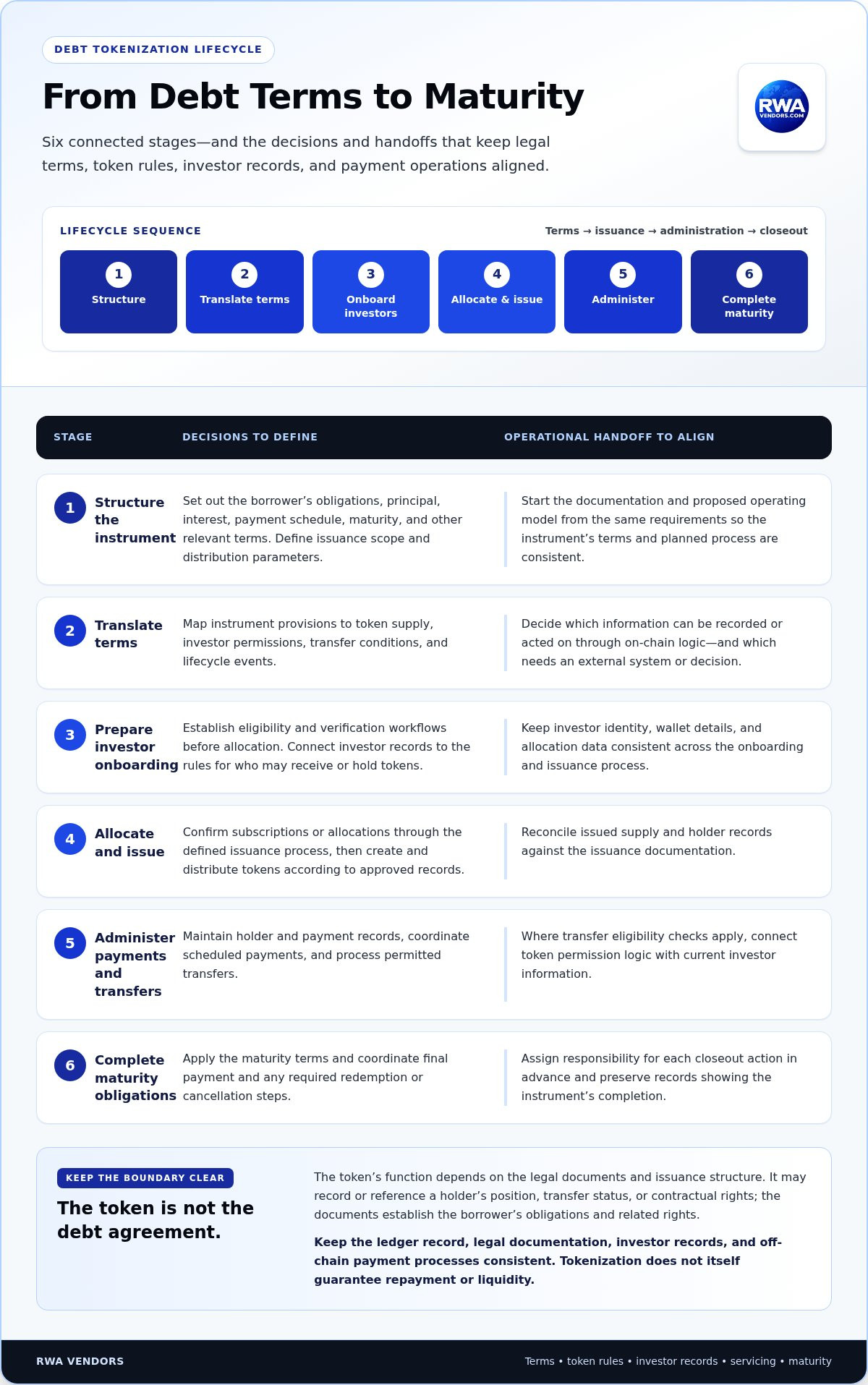
The tokenizing debt instruments process is a chain of decisions and handoffs, not a single act of minting. The lifecycle moves from structuring the instrument to translating its terms into token rules, onboarding and allocating to investors, issuing and recording tokens, administering payments and transfers, then completing maturity obligations. Each stage depends on accurate information passing between legal documentation, investor records, technology, and payment operations.
Use this sequence to identify the key handoffs:
- Structure the instrument. Define the borrower’s obligations, principal, interest, payment schedule, maturity, and other relevant terms. Set the issuance scope and distribution parameters so the documentation and proposed operating model begin from the same requirements.
- Translate terms into token and system requirements. Map instrument provisions to token supply, investor permissions, transfer conditions, and lifecycle events. Identify which information can be recorded or acted on through on-chain logic and which requires an external system or decision.
- Prepare investor onboarding. Establish the eligibility and verification workflow before allocation. Investor records must connect to the rules governing who may receive or hold tokens, with consistent information across investor identity, wallet details, and allocation data.
- Allocate and issue. Confirm subscriptions or allocations through the defined issuance process, then create and distribute tokens according to the approved records. Reconcile the issued supply and holder records against the issuance documentation.
- Administer payments and transfers. Maintain holder and payment records, coordinate scheduled payments, and process permitted transfers. Eligibility checks may apply at transfer, so the workflow must connect token permission logic with current investor information.
- Complete maturity obligations. Apply the maturity terms, coordinate final payment and any required redemption or cancellation steps, and preserve records showing the instrument’s closeout. Define responsibility for each action in advance.
From structuring and issuance to investor allocation
The handoff from instrument terms to issuance controls is a key design point. For a bond, the coupon rate, maturity date, and payment schedule can inform token parameters and administration calendars. Carry those details into the relevant systems without treating code as a replacement for the governing documents. Investor onboarding then feeds allocation: eligibility and identity records need to align with distribution rules, token delivery, and the official record of holdings.
From servicing and transfers to maturity
After issuance, scheduled payments, corporate actions, and maturity obligations require continuing administration. Payment calculations may draw on instrument terms and holder records, while the movement of funds can involve payment systems outside the ledger. External data, such as updated holder information or event inputs, also needs controlled coordination. A transfer may trigger an eligibility check before token records change. Smart contracts can support defined steps, but operational teams and off-chain processes may still be needed to validate inputs, resolve exceptions, and reconcile outcomes.
Clear stage ownership reduces the risk of mismatched records and missed handoffs. RWA Vendors helps issuers discover providers across legal, compliance, technology, infrastructure, and payment categories through its tokenization vendor directory listing.
What Tokenization Can Improve, and What It Cannot Resolve
Tokenization may change how debt records are shared and how defined operational steps are coordinated. The effect depends on the transaction design, participants’ systems, and the quality of the information those systems use. Evaluate each proposed improvement alongside its continuing dependencies rather than treating a digital ledger as a complete replacement for existing processes.
| Conventional workflow | Potential tokenization change | Continuing dependency |
|---|---|---|
| Participants maintain records in separate systems and reconcile them across handoffs. | An authorized shared ledger may give participants a consistent view of recorded token activity. | Access permissions, data quality, and reconciliation with authoritative records still need governance. |
| Settlement involves coordinated instructions and processes across parties. | A transaction may be designed to coordinate token and payment steps, potentially using synchronized settlement logic. | Payment rails, counterparties, and transaction rules must support the design; a ledger alone doesn’t complete settlement. |
| Servicing teams process recurring events using operational procedures. | Programmable rules may support repeatable actions, such as calculating or initiating scheduled events. | Accurate inputs, exception handling, oversight, and actual payment execution remain necessary. |
| Transfer records and eligibility checks may be handled across separate systems. | Token rules may help apply defined transfer controls and record permitted changes. | Legal transfer rights, investor eligibility, and current records must align with the technical controls. |
Where distributed ledgers may streamline debt operations
A shared ledger can help authorized participants coordinate around a common transaction record, reducing the need to compare multiple versions of token activity. Programmable rules may support repeatable lifecycle actions when the relevant terms and inputs are clearly defined. Settlement automation is also possible when the transaction design connects token movements with payment processes and participating systems. The technology can coordinate steps, but it can’t ensure every dependency is ready.
Where legal, compliance, and market limits remain
A token may be technically transferable while the instrument’s terms restrict who can hold it or how a transfer occurs. Legal enforceability and compliance obligations remain tied to the instrument and its governing framework, not simply to code. Issuers also need clear servicing accountability, oversight, and procedures for errors or exceptions. Automation can support governance, but it doesn’t replace it or substitute for qualified professional advice.
Tokenization can change how debt records and workflows are coordinated, but it doesn’t eliminate credit, operational, legal, or market risk, and it doesn’t create automatic liquidity. A functioning transfer mechanism is not the same as an active secondary market. Buyers, permitted transfers, and appropriate market infrastructure still matter. For issuers, the practical question is whether a proposed on-chain process improves a defined workflow without weakening the controls and responsibilities around it. This distinction is central to evaluating the tokenizing debt instruments process.
A Practical Readiness Sequence for Tokenizing a Debt Instrument
Start preparation with the business case, not a platform demonstration. A disciplined tokenizing debt instruments process turns the issuer’s objectives into clear requirements, assigns decisions to the right functions, and sets a launch gate before production issuance. Use the sequence below to expose dependencies early.
- Set the objective and scope. Define what the issuer expects tokenization to change, such as issuance coordination or recordkeeping. Specify the debt type, proposed investor population, distribution model, and markets in scope.
- Map the instrument lifecycle. Identify payment dates, reporting events, permitted transfers, amendments, and maturity steps. Assign an accountable function to each event, including exception handling and record reconciliation.
- Confirm the legal and economic terms. Legal advisers should establish how the instrument’s rights and obligations are documented and represented. Record assumptions that need legal, tax, or compliance review by qualified advisers before encoding requirements.
- Define investor and distribution controls. Compliance and distribution teams should determine applicable eligibility and onboarding workflows, then document how those decisions affect allocations, transfers, and investor records.
- Translate approved terms into system requirements. Issuer, technology, and operations teams should map approved terms to token parameters, platform functions, data inputs, permissions, and interfaces with payment and recordkeeping systems.
- Assign ownership across providers and internal teams. Identify who maintains investor and issuance records, processes payments, monitors lifecycle events, and resolves discrepancies. Make handoffs explicit rather than assuming one platform covers every function.
- Set a launch gate. Require documented approval of the instrument mapping, control workflows, system responsibilities, and test results before production use. If a critical process has no owner or reliable record, resolve that gap before issuance.
Define the instrument and operating requirements
Make the scope specific enough to guide implementation. A bond, for example, may require a defined coupon schedule, payment process, reporting cadence, transfer conditions, and maturity workflow. Map each requirement to an accountable issuer function and its supporting systems. Broader regulatory context can inform planning through this compliant asset tokenization guide. Project-specific legal, tax, and compliance questions remain with qualified advisers.
Align technology, controls, and launch readiness
Technology design should follow approved instrument terms, not force the terms into a platform’s default settings. Specify identity and eligibility checks, recordkeeping standards, access permissions, and how teams handle failed payments, rejected transfers, or inconsistent records. Test representative issuance, servicing, and transfer scenarios before production, including exceptions and reconciliation between on-chain activity and operational records. Issuer, legal, compliance, operations, and technology teams should sign off on their respective dependencies.
Build the Debt Tokenization Ecosystem, and Find the Right Provider Categories
A debt issuance depends on more than a tokenization platform. The tokenizing debt instruments process can involve specialist capabilities across legal and compliance, technology, custody, trading, infrastructure, and payments. Map these roles to specific lifecycle responsibilities so each handoff has a clear owner, from instrument design and issuance through servicing and distribution.
Match provider categories to lifecycle responsibilities
Start with the work to be done, then identify the provider category that supports it. Responsibilities may be split across several organizations, while the issuer remains accountable for coordinating the overall operating model.
- Legal and compliance providers support instrument structuring, documentation, investor eligibility requirements, and compliance processes. Their work informs how rights and operating controls are reflected in the issuance design.
- Tokenization technology providers support token creation, platform workflows, permission logic, and connections to investor or servicing records. Their technical design needs to map to approved instrument terms.
- Custody providers support digital asset safekeeping and related operational arrangements. Their role should be distinguished from the issuer’s legal records and other parties’ responsibilities.
- Infrastructure providers support the underlying blockchain and connected systems. Their capabilities may affect how participants access transaction records and coordinate required data flows.
- Trading providers support distribution or transfer workflows within the relevant market structure. Technical transfer functionality alone doesn’t establish legal transfer rights or create market demand.
- Payment providers support cash-flow processes, including the movement of funds associated with issuance or servicing. Payment operations must connect to the instrument’s schedule and accurate holder information.
For example, a scheduled payment may depend on the instrument’s documented terms, accurate servicing and holder records, a payment workflow, and clear responsibility for resolving exceptions. Don’t assume a single provider category performs every step.
Use a directory to discover relevant ecosystem providers
RWA Vendors is a global directory connecting asset issuers with tokenization platforms and service providers for tokenized capital markets and digital securities. Browse and filter provider categories to match a defined requirement, such as compliance support or payment infrastructure, with a relevant provider type. The directory also gives service providers a place to present their capabilities within the wider ecosystem. It connects market participants; it doesn’t tokenize debt, provide custody, or replace legal, compliance, or operational responsibilities.
For additional context on the supporting technology stack and broader institutional ecosystem, explore the digital asset infrastructure guide and the institutional digital asset partners guide. These perspectives can help issuers relate process needs to provider categories without confusing a technology function with a legal or operational one.
Relevant service providers can apply for an RWA Vendors directory listing to make their capabilities discoverable within the tokenization ecosystem.
Turn Readiness into a Coordinated Launch Plan
Make the next step an ownership map. For each requirement in the tokenizing debt instruments process, identify who makes the decision, which capability supports it, and how completion will be recorded. This creates a practical basis for sequencing work and surfacing gaps before they affect issuance or ongoing operations.
Service providers also need clear visibility within the debt-tokenization ecosystem. Issuers need to understand where a firm’s capabilities fit in the wider process, from structuring and controls to technology and lifecycle support. A well-defined directory profile can help communicate that role to organizations assessing their ecosystem needs.
RWA Vendors connects issuers with specialist providers across tokenized capital markets. If your firm supports this ecosystem, apply to make its capabilities discoverable to relevant market participants.
Clear responsibilities and relevant provider connections give your organization a stronger foundation for coordinating the work ahead.
Frequently Asked Questions
Is tokenized debt the same as cryptocurrency?
No. Tokenized debt is a digital representation of rights or records tied to a debt instrument, while a cryptocurrency doesn’t inherently represent a borrower’s obligation to repay principal or interest. The distinction lies in the underlying arrangement, not simply in the use of blockchain. A debt token’s meaning depends on the relevant documentation and structure. Tokenization alone doesn’t change the borrower’s existing obligation or guarantee that payments will be made.
Can an existing loan or bond be tokenized?
Potentially, but there’s no automatic conversion process that applies to every loan or bond. The route depends on the instrument’s terms, who holds relevant rights, any limits on transfer or amendment, applicable requirements, and the proposed operating design. For example, an existing holder register and payment workflow may need to coordinate with token records. Establish how the digital representation relates to existing agreements and records before proceeding.
How are coupon payments handled for tokenized debt?
Coupon payments follow the bond’s payment terms, whether instructions are processed manually, through connected systems, or with some automation. A smart contract might support a calculation or trigger a payment instruction, but that instruction isn’t the payment itself. The issuer or responsible servicing parties still need to arrange funds, use accurate holder and payment information, and address exceptions such as incorrect records or failed transfers. The instrument’s terms govern the payment obligation.
What happens if a borrower misses a payment on tokenized debt?
The consequences depend on the governing documents and applicable processes, not on token code alone. The instrument may specify how a missed payment is recorded, whether notices or cure periods apply, and what remedies may be available. Operational teams may need to update records, communicate with relevant parties, and follow the stated procedures. A smart contract can’t make a borrower pay or determine legal consequences beyond the rules and authority built into the arrangement.
Does tokenizing a debt instrument guarantee that investors can sell it?
No. A token may support a technical transfer, but that doesn’t guarantee a buyer, a completed sale, or an active secondary market. Transfers may be limited by instrument terms, investor eligibility, platform rules, or applicable requirements. Liquidity depends on market participation and the availability of a suitable trading environment. Issuers should distinguish the ability to record a transfer from an investor’s ability to find an eligible buyer on acceptable terms.
How much does it cost to tokenize a debt instrument?
There’s no single cost that applies to every issuance. Project scope, instrument structure, jurisdictions, technology requirements, and ongoing operations all affect the work involved. Costs may also depend on how existing records and payment processes connect to the proposed system, and whether the project requires additional servicing or operational support. Define the requirements and responsibilities first, then develop a project-specific budget with the relevant professionals and service providers.
Which blockchain is best for tokenizing debt?
There’s no universal best blockchain for every debt issuance. Assess whether the network and supporting platform can meet the project’s requirements for access controls, record visibility, reliability, interoperability, and integration with investor, payment, and servicing systems. Governance and the ability to maintain consistent records also matter. Let the instrument and operating model guide the network choice, rather than the other way around. Compare options against documented requirements before selecting an approach.
Disclaimer
This article is provided by RWAVendors.com for general informational and educational purposes only. It does not constitute legal, financial, investment, tax, regulatory or other professional advice, or an offer, solicitation, recommendation or endorsement of any company, product, service, token, security or investment. RWAVendors.com is an informational vendor directory and does not sell, issue, broker, custody or facilitate transactions involving cryptocurrencies, digital tokens, tokenized assets, securities or investment products. Some vendor listings and references may involve paid advertising, sponsored placement or membership relationships. These relationships do not guarantee a vendor’s qualifications, regulatory status, performance or suitability. Information may be incomplete, outdated or subject to change. You should independently verify all information, conduct your own due diligence and consult qualified professionals before making any business or investment decision. RWAVendors.com is not responsible for the content, services, representations or actions of third-party vendors or linked websites.


