

What if issuing tokens is the easiest part of a commercial real estate tokenization project? A sound plan must define what investors hold, how property operations connect to investor rights, and whether there is a realistic path to market demand. This commercial real estate tokenization guide focuses on the decisions behind the technology, not just the act of creating tokens.
Tokenization can modernize access and recordkeeping, but a token does not automatically confer direct ownership of a building or create liquidity. Its meaning depends on the legal structure and the rights attached to it. Resale, in turn, depends on market participation and demand.
Use this guide to understand the project lifecycle, identify the legal, operational, and technical capabilities a project may need, and separate technology functions from legal, financial, and investment considerations. We cover asset strategy, tokenholder rights, issuance, ongoing administration, and market readiness. For vendor discovery, RWA Vendors connects issuers with verified providers across tokenization technology and professional-service categories.
Key Takeaways
- Map the project lifecycle from asset strategy and legal structure through issuance and ongoing administration, adapting the sequence to the project’s requirements.
- Define tokenholder rights and supporting governance processes before selecting an issuance model.
- Use this commercial real estate tokenization guide to identify the legal, compliance, technology, custody, payments, and trading capabilities a project may need.
- Assess the asset thesis, operational readiness, and investor rationale to decide whether tokenization fits the project.
- Translate project requirements into vendor capabilities, then use a global directory to discover relevant tokenization platforms and professional-service providers.
What commercial real estate tokenization represents, and what it does not
Commercial real estate tokenization creates a digital representation of specified rights or interests associated with a property or an entity connected to it. The token is the digital record; the governing documents and applicable legal framework determine what interest it represents and how that interest can be exercised. The distinction is fundamental: creating a token is not the same as establishing ownership, defining investor rights, or enabling a secondary market.
Keep these project elements distinct:
- Ownership structure: Who holds title to the property, and what legal entity or arrangement sits between the property and investors?
- Investor rights: What economic, governance, information, or transfer rights are documented for holders?
- Token issuance: How are digital records created, allocated, and administered to reflect the intended interests?
- Secondary trading: What arrangements, if any, permit transfers or trading, and under what conditions?
These elements need to align, but they are not interchangeable. A blockchain entry can record token issuance or transfers within a system. On its own, it does not establish that a holder owns the building or replace the authoritative records used to evidence property title.
What can a commercial property token represent?
The answer depends on the documented structure and applicable jurisdiction. A token might represent a direct property interest where the relevant framework and records support that arrangement. Alternatively, it could represent an interest issued by an entity that owns or holds rights connected to the property. Neither model is a universal template.
Consider a hypothetical office building held by a special purpose entity. The entity could issue digitally represented interests, with governing documents setting out the associated rights and limitations. In that design, a tokenholder’s interest would relate to the entity, not automatically amount to direct title to the building. Another project could use a different structure. The decisive question is what the signed documents establish, not what a token’s label suggests.
Translate each proposed right into clear documentation. Specify who may receive distributions, participate in decisions, obtain information, or transfer an interest. The token’s technical design should reflect those rules rather than serve as the source of the rights.
What tokenization does not guarantee
Digitization alone does not establish legal compliance, investor protection, or the validity of an offering. Issuing a token also does not ensure that holders can transfer it, trade it on a secondary market, or find buyers. Transfer rules, market access, and participation depend on the project’s structure and operating arrangements.
Before evaluating technology, map each token function to the documents and processes that support it. A digital record may help administer an interest, but it cannot clarify an unclear ownership structure, strengthen a weak investment case, or substitute for authoritative property records. The token is one component of the framework, not the framework itself.
How a commercial real estate tokenization project moves from asset to issuance
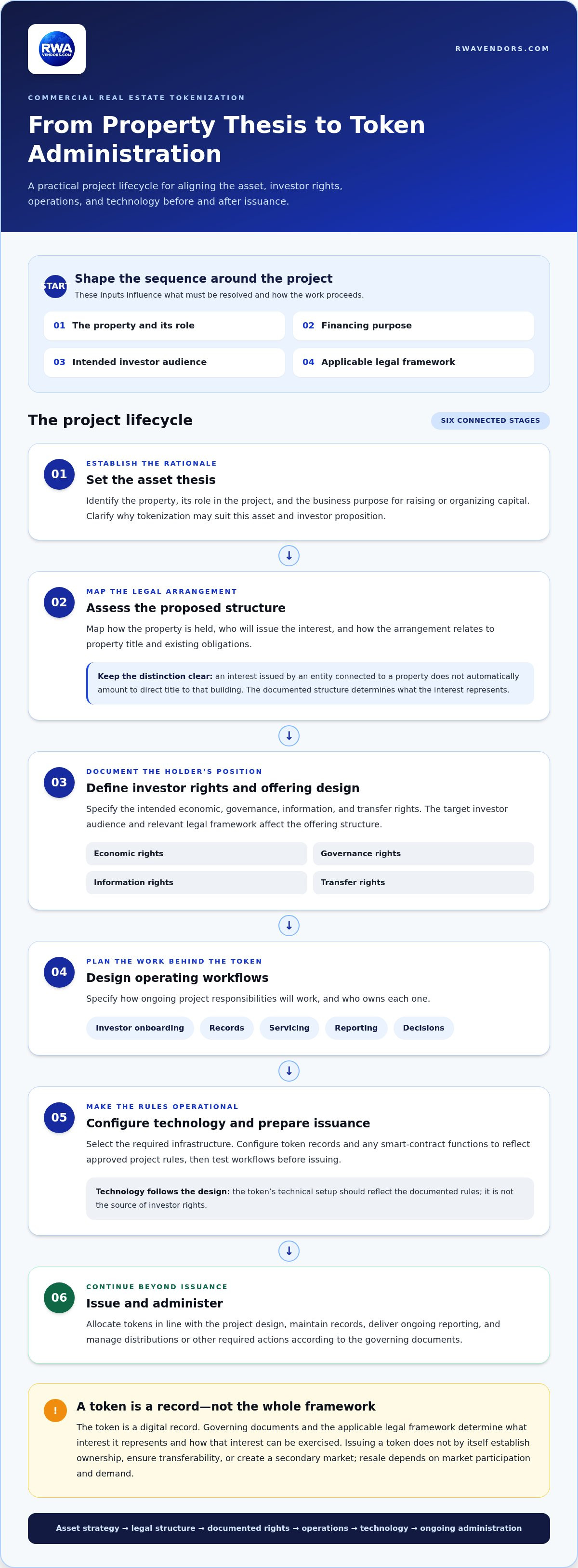
Tokenization is a coordinated legal, operational, and technical process for representing and administering defined interests digitally. Start with the project rationale, not a token standard or platform. The asset, intended investor audience, financing purpose, and applicable legal framework shape the sequence and determine what needs to be resolved before issuance.
A practical lifecycle typically includes these stages:
- Set the asset thesis. Identify the property, its role in the project, and the business purpose for raising or organizing capital. Clarify why tokenization may suit this asset and investor proposition.
- Assess the proposed structure. Map how the property is held, who will issue the interest, and how the arrangement relates to title and existing obligations.
- Define investor rights and offering design. Document intended economic, governance, information, and transfer rights. The target investor audience and relevant legal framework affect the offering structure.
- Design operating workflows. Specify how investor onboarding, records, servicing, reporting, and decisions will work, including who owns each responsibility.
- Configure technology and prepare issuance. Select the required infrastructure and configure token records and any smart-contract functions to reflect approved project rules. Test workflows before issuing.
- Issue and administer. Allocate tokens in line with the project design, maintain records, deliver ongoing reporting, and manage distributions or other required actions according to the governing documents.
From asset thesis to rights and issuance design
Start with a clear project brief: describe the asset, financing purpose, and intended investor audience. Then translate the proposed arrangement into documented rights and responsibilities. An office property, for example, might be held through an entity that issues interests, but that is only one possible structure. Entity and offering choices require jurisdiction-specific analysis by qualified professionals. Business teams define the rationale; legal and compliance professionals assess the structure and applicable obligations.
Keep business decisions distinct from technical implementation. The issuer sets the project’s objectives and operating model. Professional advisers analyze legal, financial, and compliance questions. Technology providers configure systems to support the resulting requirements. Software should not decide what rights investors receive.
From issuance to ongoing administration
Issuance is a milestone, not the end of the work. Establish how investor information is collected and maintained, how servicing requests are handled, and how reports reach holders. Define processes for distributions, voting, changes to project information, and other corporate actions where relevant. Assign accountable owners and keep operational records consistent with the governing documents.
Smart contracts may automate defined functions, such as applying specified transfer rules or recording a process step. They do not replace governance, resolve exceptions, or determine who is authorized to make decisions. Treat technology selection as one part of a broader operating plan. Providers supporting these workflows can explore a tokenization vendor directory listing to connect with issuers seeking project capabilities.
Which vendors and infrastructure does a property tokenization project need?
Build the vendor map around the project’s operating model, not a generic technology checklist. The capabilities below may come from separate providers or, in some cases, one provider. Combining functions does not remove the need to define accountability, how systems exchange information, and where each provider’s responsibility ends.
| Capability | Project function | Key dependency |
|---|---|---|
| Legal and compliance | Analyze the proposed structure, offering framework, and applicable obligations. | Asset location, issuer structure, intended investors, and offering design. |
| Investor onboarding | Support subscription workflows, identity-related checks, eligibility processes, and investor records. | Applicable rules, investor criteria, and documented operating procedures. |
| Tokenization technology | Issue and administer digital records, with smart contracts supporting defined functions. | Approved rights model, integration needs, and governance procedures. |
| Custody | Support the safekeeping or control arrangements for relevant digital assets, where required by the project design. | Asset type, control model, security requirements, and responsibility allocation. |
| Payments | Facilitate designated payment flows, such as subscriptions or distributions. | Chosen payment methods, reconciliation, and the issuer’s servicing process. |
| Trading infrastructure | Provide systems for eligible transfers or secondary transactions where the project permits them. | Transfer restrictions, market arrangements, and participant access. |
Legal, compliance, and investor operations
Legal and compliance specialists help assess how the structure and offering relate to relevant requirements. Their work informs the documents and controls that technology and operations must support. Investor onboarding is a separate but connected capability. Define processes for collecting information, applying relevant checks, maintaining records, and handling exceptions. The workflow depends on the project and its applicable framework.
This section is educational, not legal or financial advice. A vendor directory can help issuers map relevant provider categories, but a profile or listing is a discovery starting point, not a determination of suitability for a particular project.
Technology, custody, payments, and trading
Blockchain infrastructure records transactions and supports token systems. Smart contracts can execute specified rules, but they do not replace project governance or resolve matters outside their programmed scope. Custody and payment capabilities address distinct control and money-movement needs; neither performs the same function as token issuance.
Trading infrastructure can support a permitted transfer or transaction process. It cannot create buyers, trading volume, or liquidity on its own. Treat market access as a separate project dependency. For a broader view of provider roles across the ecosystem, see the institutional digital asset infrastructure guide. Connect each vendor capability to a defined project requirement, owner, and operating dependency.
How to assess readiness, risks, and project fit before tokenizing property
Tokenization can change how defined interests are recorded or administered, but it cannot repair a weak asset, unclear rights, or an investment case that does not make sense to its intended audience. Before committing resources, test whether the project has a sound purpose and the people, processes, and controls to support it over time. Treat readiness as a decision gate, not a technology checklist.
Use these questions to structure an initial assessment:
- Asset thesis: Is the property and its role in the project clearly understood, including the reason to consider tokenization?
- Rights: Can the proposed holder interests and their limits be explained in plain language and reflected in governing documents?
- Governance: Are decision rights, escalation paths, and responsibilities for investor communications assigned?
- Operations: Are servicing, recordkeeping, reporting, and asset management adequately resourced after issuance?
- Investor rationale: Is there a credible reason the intended audience may value the structure, without relying on assumed demand or liquidity?
Test the investment and operating rationale
Ask what the project is meant to improve beyond digitizing existing records. The intended benefit might relate to investor access, administration, or transfer processes, but each is a hypothesis to assess, not a guaranteed outcome. Compare the proposed model with the current process: identify what changes, who benefits, and what new work or dependencies the model introduces.
Assess the asset and its investment case on their own merits. Tokenization does not remove property-level risks such as vacancies, market changes, or maintenance needs, and it does not create investor demand. Confirm that the issuer can sustain reporting, investor servicing, and asset oversight throughout the project, not just during fundraising or issuance.
Plan controls, governance, and compliance
Document who can approve changes, access sensitive records, reconcile data, and respond to incidents. Assess transfer restrictions, cybersecurity exposure, data integrity across systems, and operational continuity if a key system or service becomes unavailable. Define escalation and recovery procedures before launch. A technical record is useful only when the underlying processes remain reliable.
Regulatory and tax analysis depends on the project’s structure and jurisdictions involved. Qualified professionals should review the relevant requirements; general guidance cannot determine how they apply to a specific offering. For broader context on structuring compliance considerations, consult this compliant asset tokenization guide.
A project is better positioned to proceed when its asset rationale, rights, controls, and ongoing responsibilities are coherent. If key answers remain unresolved, address those gaps before selecting infrastructure or scheduling issuance. Providers supporting tokenization projects can pursue a directory listing.
Find commercial real estate tokenization partners by capability, not category alone
Translate the project plan into specific responsibilities and dependencies before beginning partner discovery. A provider category is only a starting point. Identify the work required, the decisions and information each role depends on, and how outputs pass between providers. This makes it easier to compare relevant capabilities without assuming one provider or platform can meet every project need.
For example, legal and compliance work informs the structure and controls. Tokenization technology implements approved requirements, while custody, payments, and trading capabilities address separate operational needs. Give each function a defined scope, an accountable owner, and clear interfaces with the issuer and other providers. A single firm may cover more than one function, but combining roles does not remove the need to map responsibilities.
Organize the partner search around project responsibilities
Group potential partners by what the project requires: legal and compliance, blockchain infrastructure, tokenization technology, custody, payments, and trading. Then document dependencies. Technology implementation may rely on an approved rights model; payment workflows may depend on investor records and servicing procedures; trading arrangements may depend on transfer rules and market access. This focuses the search on capabilities relevant to the project rather than category labels alone.
Use the institutional digital asset partners guide for broader partner discovery context. This commercial real estate tokenization guide can help issuers build an initial capability map, but a directory profile is a discovery aid, not proof that a provider suits a specific project. Assess project requirements, scope, and provider responsibilities in context.
Connect providers with tokenized real estate opportunities
RWA Vendors connects asset issuers with tokenization platforms and professional-service providers across tokenized capital markets. Its global directory helps issuers discover providers for real estate projects and related asset initiatives, including technology, legal, compliance, custody, trading, blockchain infrastructure, and payment capabilities. Use the directory to compare the vendor landscape with the responsibilities identified in the project plan.
For service providers, a directory listing helps build visibility among businesses developing tokenized capital-market projects. Clear profile information about capabilities helps issuers understand the role a provider may support as they map requirements and explore potential partners. A listing does not establish suitability for a particular transaction or replace project-specific assessment.
With the project capability map in hand, use the directory as a structured starting point for discovery, then align potential provider roles with defined scopes and dependencies.
Turn project requirements into the next conversation
Convert defined project requirements into focused partner conversations. Specify the outcomes each role supports, the information providers need, and how their work connects with the rest of the project. This clarifies capability discussions and keeps responsibilities visible as plans develop.
For service providers, this commercial real estate tokenization guide offers a useful lens for describing how your capabilities fit issuer needs. RWA Vendors is a global directory for tokenized capital-markets providers, spanning legal compliance, custody, trading, blockchain infrastructure, and payments. A clear profile can help businesses discover your expertise as they map project requirements and explore potential partners.
Build visibility with a RWA Vendors directory listing and connect your capabilities with businesses exploring tokenized capital-market projects.
Frequently Asked Questions
What is commercial real estate tokenization?
Commercial real estate tokenization digitally represents specified property-related rights or interests, with their meaning defined by the project’s documents and structure. The practical question is how those records connect to ownership arrangements, investor administration, and transfers. For example, an issuer might use digital records to track interests in a property-holding entity, while the entity’s documents explain what holders are entitled to.
Does tokenizing a property mean investors own the building directly?
No. A token does not automatically give its holder direct title to the building. A project may instead issue tokens representing interests in an entity associated with the property, depending on its structure and applicable framework. For instance, an entity could hold a commercial building while issuing interests to investors. The property’s official ownership records and the offering documents remain important for understanding who owns the asset and what tokenholders’ rights are.
How does a commercial real estate tokenization project work?
A project starts by identifying a clear business purpose and deciding how the property, issuer, and intended holders fit together. The issuer then develops the documented structure and operating processes, followed by technology configuration, testing, and issuance. A practical test is whether a change in occupancy, a distribution, or an investor record update has an assigned owner and reliable process. The sequence varies with the asset, audience, and applicable framework.
Can tokenized commercial real estate be traded on a secondary market?
Potentially, if the project’s terms, transfer rules, and market arrangements allow it. A token may be technically transferable while still being subject to restrictions or lacking a venue where eligible buyers and sellers can transact. For example, a project may require transfer checks before a holder can move an interest. Distinguish system capability from actual market activity: a trading interface alone does not establish buyer demand or liquidity.
What vendors are involved in tokenizing commercial real estate?
Provider needs depend on the project’s design and may include legal and compliance specialists, tokenization technology, blockchain infrastructure, custody, payments, and trading capabilities. Some providers may cover more than one function, but the issuer still needs clear scopes and accountable owners. For example, a technology provider may configure token records while another party handles investor onboarding. RWA Vendors helps issuers discover providers across these capabilities through its tokenized capital markets directory.
Is commercial real estate tokenization regulated?
It may be subject to legal and regulatory requirements based on the rights being offered, the project structure, participants, and jurisdictions involved. Using blockchain does not determine or remove those obligations. Requirements can concern offering documentation, investor eligibility, disclosures, and transfers. Because the answer depends on project-specific facts and local rules, issuers should obtain qualified legal and compliance review in every relevant jurisdiction.
Does tokenization guarantee liquidity or lower investment costs?
No. Tokenization does not guarantee that a holder can sell an interest quickly, find a buyer, or pay lower overall costs. Liquidity depends on factors such as permitted transfers, market access, and actual buyer and seller participation. Costs depend on the complete project, including its legal structure, technology, servicing, and ongoing administration. Evaluate these elements against the project’s purpose and operating resources rather than assuming digitization alone will improve the economics.
Disclaimer
This article is provided by RWAVendors.com for general informational and educational purposes only. It does not constitute legal, financial, investment, tax, regulatory or other professional advice, or an offer, solicitation, recommendation or endorsement of any company, product, service, token, security or investment. RWAVendors.com is an informational vendor directory and does not sell, issue, broker, custody or facilitate transactions involving cryptocurrencies, digital tokens, tokenized assets, securities or investment products. Some vendor listings and references may involve paid advertising, sponsored placement or membership relationships. These relationships do not guarantee a vendor’s qualifications, regulatory status, performance or suitability. Information may be incomplete, outdated or subject to change. You should independently verify all information, conduct your own due diligence and consult qualified professionals before making any business or investment decision. RWAVendors.com is not responsible for the content, services, representations or actions of third-party vendors or linked websites.


