

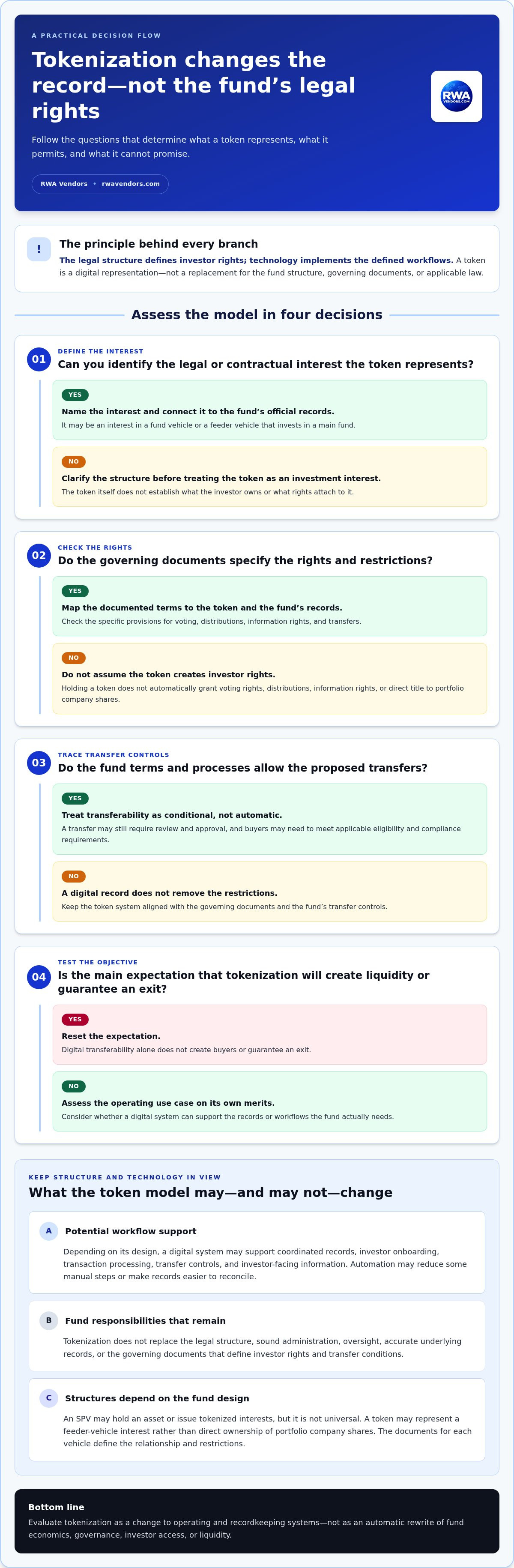
A token can change how a fund interest is recorded and transferred. It can’t, by itself, rewrite investor rights or create a liquid market. That distinction is central to the tokenization of private equity funds. The technology may streamline parts of fund operations, but the legal structure, governance and transfer restrictions still matter.
If you’re weighing tokenization, the practical question is whether it changes how the fund operates or simply creates a digital representation of familiar interests. The answer depends on the fund’s structure, the rights represented by the token and how transfers are controlled.
This article explains common tokenized fund structures, the investor rights they represent, and the potential benefits alongside legal, governance, operational and liquidity constraints. It also covers the capabilities needed across the fund lifecycle, from issuance and investor onboarding to administration, custody and secondary transfers.
You’ll find a framework for assessing the model as a whole: where technology can support existing processes, where conventional fund arrangements remain essential, and which provider categories may fit the operating model.
Key Takeaways
- Identify the fund interest a token represents and how the governing documents define investor rights and transfer conditions.
- Map the full operating lifecycle, from fund structuring and issuance to administration, transfers and reporting.
- Assess the tokenization of private equity funds without assuming digital transferability will create buyers or guarantee an exit.
- Separate essential readiness requirements, including investor servicing, technology and oversight, from optional features and future ambitions.
- Map the provider roles a tokenized fund may require across compliance, custody, infrastructure, payments and trading.
What Does Tokenization of Private Equity Funds Actually Mean?
The tokenization of private equity funds means using digital tokens to represent specified interests in a fund. The rights and restrictions attached to those interests are determined by the fund documents and applicable law. A token is a digital representation, not a replacement for the legal structure that defines the investment. For context on how a conventional private equity fund is structured, its underlying arrangements help clarify what a token may represent.
A tokenized private equity fund interest is a digitally recorded representation of a defined legal or contractual interest in a fund. It is not automatically a cryptocurrency or direct ownership of the fund’s portfolio assets. A token may use blockchain technology, but its identity and function depend on the documents and systems that connect it to the underlying interest. The technology doesn’t create new economic or governance rights on its own.
What does a token represent in a private equity fund?
The token’s meaning comes from its legal and contractual structure. It might represent an interest in a fund vehicle or in a feeder vehicle that invests in a main fund. Governing documents establish what that interest entails. The token system may record or facilitate transactions associated with it. The connection between the digital record and the legally recognized interest needs to be clear and consistently maintained.
This distinction also separates a fund interest from ownership of a portfolio company. If a fund holds shares in a private company, a token representing an investor’s fund interest doesn’t, by itself, give that investor direct title to the company’s shares. Holding the token also doesn’t automatically grant voting rights, distributions, information rights or an unrestricted ability to transfer. Those outcomes depend on the applicable documents and arrangements.
Why are private equity managers exploring tokenization?
Managers may consider tokenization to modernize how fund interests are recorded and related workflows are handled. Depending on the design, a digital system may support coordinated records, investor onboarding, transaction processing, transfer controls and investor-facing information. Automation may reduce some manual steps or make records easier to reconcile, but it doesn’t remove the need for sound administration, oversight and accurate underlying records.
These operational aims are distinct from claims about investor access. A digital representation may make certain processes more convenient, but it doesn’t automatically broaden eligibility or change who can invest. Private fund terms, applicable requirements and transfer restrictions continue to shape participation. A transfer may still require review and approval, and buyers may need to meet applicable eligibility and compliance requirements.
- Operational question: Which records or workflows could benefit from a digital system?
- Rights question: What interest does the token represent under the governing documents?
- Access question: Which eligibility and transfer conditions still apply?
Keeping these questions separate helps fund teams assess tokenization on its actual merits: as a potential change to operating and recordkeeping systems, not an automatic rewrite of fund economics, governance or investor access.
How Does Private Equity Fund Tokenization Work Across the Fund Lifecycle?
Tokenization is one part of a fund’s operating model, not a replacement for the fund structure, administration or oversight. The chosen structure determines what the token represents, which records establish ownership and how digital records stay aligned with the fund’s official books. The legal structure defines investor rights; technology implements the defined workflows.
A tokenization platform may support issuance and transfers, but it doesn’t independently handle every task required to operate a fund. Fund teams need coordinated processes for formation, investor onboarding, servicing, record maintenance and reporting.
How do SPVs and fund interests relate to tokenized ownership?
A special purpose vehicle (SPV) may hold an asset or issue interests represented by tokens, but it isn’t a universal requirement. A token could represent an interest in a feeder vehicle that invests in a main fund rather than direct ownership of portfolio company shares. The governing documents for each vehicle define the rights, restrictions and relationship between the interest and underlying assets.
That distinction affects operational design. For example, a master-feeder arrangement may place investors in a feeder whose interests are tokenized, while the feeder holds an interest in the main fund. Some tokenized feeder structures may require the commitment to be contributed upfront rather than funded through later capital calls. This can affect investor cash flow and the fungibility of tokens. The terms and records need to reflect the chosen arrangement.
Which operational steps continue after token issuance?
Issuance is a milestone, not the end of the work. A typical lifecycle includes:
- Structure the fund. Define the issuing entity, the interest being represented, investor rights, transfer conditions and how legal and digital records will correspond.
- Onboard investors. Collect and verify required investor information, complete applicable eligibility and compliance checks, and connect approved investors with permitted wallet addresses where the design uses whitelisting.
- Issue tokens and reconcile records. Create tokens according to subscription and allocation records, then establish processes to reconcile the digital register with the fund’s official ownership records.
- Administer the fund. Continue subscriptions, capital activity, distributions, investor communications and record updates under the fund’s terms. Smart contracts may automate defined steps, such as restricting transfers to approved addresses, but accountable teams still oversee exceptions and accuracy.
- Process transfers and report. Apply the fund’s transfer rules before recording an eligible transfer, update relevant registers, and provide investors with reporting consistent with the fund’s records and obligations.
For fund teams mapping this lifecycle, a directory of tokenization service providers can help organize provider capabilities across the ecosystem. Assign responsibility at each stage: technology can execute configured workflows, while fund managers and designated service providers remain responsible for the functions they perform.
Do Tokenized Private Equity Funds Improve Access or Liquidity?
The tokenization of private equity funds can change how an interest is recorded and how a transfer is processed. It doesn’t ensure a transfer is permitted, a buyer is available or an investor can exit on demand. Tokenization may support transfer workflows, but liquidity depends on market demand and permissions.
Distinguish the processes a digital system may facilitate from outcomes that depend on fund terms, investor eligibility and market infrastructure:
| Potential process change | Outcome requiring independent conditions |
|---|---|
| A digital register may help record token ownership and related transactions. | The register must align with recognized fund records; a digital entry alone doesn’t establish an unrestricted right to sell. |
| Configured workflows may help route transfer requests or restrict transfers to approved wallet addresses. | The fund documents must permit the transfer, required approvals must be obtained, and the buyer must meet applicable eligibility requirements. |
| Digital distribution may reduce some administrative friction in investor-facing processes. | Broader access depends on offering terms and applicable rules, not merely on the ability to distribute information or tokens digitally. |
| Trading infrastructure may provide a venue or process for eligible transactions. | Liquidity requires willing buyers and sellers, workable market arrangements, and transfers permitted under the relevant terms. |
Can tokenization make a private equity fund liquid?
Technical transfer capability is not the same as an active secondary market. A token might be designed to move between approved wallets, but that functionality doesn’t create demand or guarantee an exit. Buyers, sellers, market arrangements and the fund’s transfer permissions all matter. Private equity retains its underlying investment characteristics; tokenization doesn’t turn a long-term fund interest into cash on demand.
Assess liquidity by tracing the full transaction path: who can buy, what approvals apply, how a permitted transfer is recorded, and whether a market exists to match parties. If any link is missing, a technically transferable token may still be difficult or impossible to sell.
Does tokenization automatically broaden investor access?
No. Digital distribution may simplify certain onboarding or servicing steps, but it doesn’t override eligibility criteria, offering restrictions or transfer limits. A wider technical reach is not the same as wider legal access. The same distinction applies to secondary transactions, where a prospective buyer may need to meet the fund’s conditions and complete applicable checks before a transfer can proceed.
Access rules vary by structure and jurisdiction. Fund teams should have qualified legal professionals review the relevant offering terms, investor eligibility conditions and transfer processes for each applicable jurisdiction. Treat broader access as a possible outcome only where the structure and rules support it, not as an automatic feature of issuing tokens.
The practical test is to identify which steps tokenization can make easier, then separately verify the permissions, counterparties and market arrangements needed to achieve the intended access or liquidity outcome.
What Should Fund Teams Evaluate Before Tokenizing a Private Equity Fund?
Readiness starts with the fund’s objectives, not a feature list. The tokenization of private equity funds should address defined operating needs, such as improving record reconciliation or supporting controlled transfer workflows. Set out the intended outcome first, then separate essential requirements from optional features and hoped-for future benefits. A secondary trading venue, for example, doesn’t replace clear investor servicing and accountable administration.
- Objectives: Identify the specific processes tokenization is intended to support and how success will be assessed.
- Governing documents: Map investor rights, transfer conditions and governance procedures to the proposed digital workflows.
- Investor servicing: Define how onboarding, inquiries, notices, transactions and reporting will be handled.
- Technology: Specify requirements for issuance, access controls, record reconciliation, interoperability and ongoing support.
- Oversight: Assign responsibility for approvals, exceptions, record accuracy and issue escalation across the fund and its service providers.
How should teams assess legal and governance readiness?
Review the fund documents, investor rights, transfer rules and governance procedures with qualified counsel. Then map each proposed workflow to the controls and records it affects. If a transfer needs approval, identify who grants it and how the decision is recorded. No single legal structure fits every fund or jurisdiction, so the analysis must reflect the specific arrangement and applicable rules.
This review should also establish how discrepancies are resolved. For instance, teams need a defined process for addressing a mismatch between a digital record and the fund’s authoritative register. Evaluate investor onboarding, eligibility controls, transfer restrictions and reporting as connected parts of the operating model, rather than treating token issuance as a standalone compliance task.
Which technology and service-provider capabilities matter?
Map responsibilities across tokenization platforms, fund administration, compliance, custody, trading, payments and blockchain infrastructure. Assess each capability against the fund’s requirements, including how systems exchange information and support activity throughout the lifecycle. Infrastructure choices should enable controlled operations and reliable recordkeeping. Optional features without a clear operational purpose can add complexity without resolving a core need.
Make accountability explicit. A responsibility map can show who owns each function, who approves changes and who handles exceptions:
- Fund team: Governing decisions, investor terms and oversight.
- Administrator: Fund records, servicing workflows and reporting responsibilities.
- Technology and infrastructure providers: Configured systems, integrations and technical support within agreed roles.
- Compliance and custody functions: Their defined controls and responsibilities within the operating arrangement.
Use this map to distinguish minimum launch requirements from capabilities that can be considered later. A directory spanning technology, legal and compliance, custody, trading, infrastructure and payment categories can help teams organize provider options around those responsibilities.
How Can the Right Provider Ecosystem Support Tokenized Private Equity?
A tokenized fund depends on more than a platform that creates tokens. Its operating model may involve specialists in issuance, investor and fund administration, compliance, custody, blockchain infrastructure, payments and trading. Each function addresses a different need. Clear ownership helps prevent gaps between digital processes and the fund’s established operations.
Provider roles don’t replace fund governance or qualified professional advice. The fund team remains responsible for its decisions and oversight, while legal and compliance professionals support their defined functions. Technology providers implement agreed workflows; administrators maintain relevant records and servicing processes. Accountability should remain clear when several providers’ systems connect.
Which provider categories support a tokenized fund?
Start with the fund’s design and operating requirements, then map the capabilities needed to support them. Tokenization technology handles functions such as token issuance and configured transaction workflows. Blockchain infrastructure is a separate layer that supports the network and technical environment on which those workflows operate.
- Legal and compliance providers support fund structuring, documentation, investor eligibility processes and compliance controls within their professional scope.
- Fund administrators support fund records, investor servicing and reporting processes.
- Custody providers support the safekeeping arrangements defined for relevant assets or digital instruments.
- Payment providers support the movement and processing of funds where required by the operating design.
- Trading providers may support secondary-market processes where transfers are permitted and suitable market arrangements exist.
The appropriate mix varies. A fund with no planned secondary transfers may have different requirements from one designed to support permitted transfers. A category’s presence in the ecosystem doesn’t mean every fund needs that service, or that a provider takes responsibility for the fund’s governance.
How can issuers and service providers navigate the ecosystem?
Issuers can start with a requirements map: list each lifecycle function, the accountable party, the systems it depends on and the handoffs between teams. Then browse provider categories that match those needs. RWA Vendors is a global directory where businesses can browse and filter listings across tokenization technology and professional service categories.
This category-based view helps fund teams understand how capabilities fit together without treating any one platform as the entire operating model. It also gives providers a way to present their services within a broader ecosystem that includes legal and compliance, custody, trading, blockchain infrastructure and payments.
Relevant service providers can explore a directory listing to present their capabilities to businesses in the tokenization ecosystem.
Turn Your Tokenization Strategy into an Operating Plan
The next step in any tokenization of private equity funds initiative is to turn its objectives into a practical sequence: identify the operational need, assign accountable owners and define how the model will be assessed before expanding it. A focused plan helps separate capabilities required for launch from enhancements that can wait until the core workflow is working as intended.
For issuers, mapping requirements to relevant specialist categories can make a complex ecosystem easier to navigate. RWA Vendors connects issuers with providers across tokenization technology and professional services through a global directory with legal compliance, custody, trading, infrastructure and payment categories. Service providers can use the directory to present their capabilities to businesses exploring real-world asset tokenization.
Set clear priorities for the operating model and refine them as the fund’s needs develop. A disciplined approach supports informed decisions and responsible implementation.
Explore RWA Vendors to find or list providers for your tokenization-related needs.
Frequently Asked Questions
What is tokenization of a private equity fund?
Tokenization of a private equity fund is the digital representation of an interest in a fund or related vehicle. The token’s legal meaning comes from the fund’s structure and documents, not simply from the technology used to create it. Unlike a cryptocurrency designed to function as a digital asset in its own right, a fund token is tied to a defined investment interest and its specific terms.
How does a tokenized private equity fund work?
A tokenized fund links digital records to an investment interest through defined documents, systems and operating procedures. For example, after an investor subscribes, the fund’s records can be updated alongside a token register that reflects the investor’s position. The fund needs a process for reconciling the records and handling changes, such as a permitted transfer or distribution, so the digital record remains consistent with fund administration.
Does tokenization make private equity funds liquid?
No. A token may make it technically possible to transfer an interest through a defined process, but that doesn’t ensure a buyer, an approved transfer or an active secondary market. For example, a token could be restricted to approved wallets while the fund’s documents require consent before a sale. Private equity investments can remain long-term and difficult to sell, regardless of how ownership records are maintained.
Can tokenization lower the minimum investment in a private equity fund?
It may support smaller denominations or fractional interests, but it doesn’t automatically reduce a fund’s minimum investment. The fund’s offering terms, subscription process, investor eligibility conditions and administrative design still determine how investors participate. A smaller digital unit has practical value only if the fund’s structure permits it and the related servicing and recordkeeping processes can support it. Treat a lower entry threshold as a design choice, not an inherent result.
What rights does a tokenized private equity fund investor have?
An investor’s rights are the rights attached to the underlying interest under the governing documents and applicable arrangements. These may address distributions, voting, information and transfer procedures, but holding a token doesn’t automatically add rights. For instance, a token transfer may update a digital record without giving the holder direct voting rights in a portfolio company. Investors should identify which documents define their rights and how those rights are administered.
Is a tokenized private equity fund subject to securities regulation?
If the token represents a security, using a digital format doesn’t by itself remove securities-law obligations. In January 2026, the U.S. Securities and Exchange Commission clarified that federal securities laws aren’t determined by a security’s issuance format or ownership-recording method. The analysis depends on the instrument and relevant jurisdiction. Fund teams should have qualified legal professionals assess the structure, offering and transfers under applicable rules.
What providers are involved in tokenizing a private equity fund?
The provider mix can include tokenization technology, blockchain infrastructure, legal and compliance services, fund administration, custody, payments and trading capabilities. Each supports a distinct function, and the fund’s design determines which are relevant. RWA Vendors helps issuers discover providers through a global directory where users can browse and filter listings across tokenization and professional-service categories. The directory connects businesses with providers; it doesn’t replace fund governance or professional advice.
Disclaimer
This article is provided by RWAVendors.com for general informational and educational purposes only. It does not constitute legal, financial, investment, tax, regulatory or other professional advice, or an offer, solicitation, recommendation or endorsement of any company, product, service, token, security or investment. RWAVendors.com is an informational vendor directory and does not sell, issue, broker, custody or facilitate transactions involving cryptocurrencies, digital tokens, tokenized assets, securities or investment products. Some vendor listings and references may involve paid advertising, sponsored placement or membership relationships. These relationships do not guarantee a vendor’s qualifications, regulatory status, performance or suitability. Information may be incomplete, outdated or subject to change. You should independently verify all information, conduct your own due diligence and consult qualified professionals before making any business or investment decision. RWAVendors.com is not responsible for the content, services, representations or actions of third-party vendors or linked websites.


