

The best tokenization platform for an asset isn’t necessarily the one with the most advanced blockchain. For issuers, how to choose a tokenization platform starts with a more practical question: what must it support across the asset’s lifecycle and your operating model? The decision can feel difficult because search results use “tokenization” to describe both issuing digital representations of assets and protecting sensitive payment or customer data.
That distinction matters. A tool designed to secure payment data isn’t necessarily built to issue and administer tokenized real-world assets. A long feature list also won’t tell you whether a platform fits your asset, investor base, distribution plans, or existing service partners. Technology is only one part of the operating model. Compliance, custody, and lifecycle functions may involve separate providers.
This guide offers a requirements-led framework for comparing platforms, covering asset and issuance needs, integrations, lifecycle support, and long-term considerations. You’ll learn how to distinguish RWA platforms from data and payment tokenization tools, define essential capabilities before reviewing vendors, and map providers across the tokenized capital markets ecosystem. RWA Vendors’ global directory helps issuers discover verified providers by category as they build that map.
Key Takeaways
- Start with your asset, users, and operating model to define what an RWA tokenization platform must support.
- Map requirements across issuance, onboarding, administration, transfers, and reporting. Separate essential capabilities from optional features.
- Compare build, buy, and modular approaches by assessing chain support, interoperability, controls, integrations, and upgrade responsibilities.
- Classify each requirement as essential, preferred, or out of scope before comparing vendors. This makes how to choose a tokenization platform a structured decision, not a feature-list exercise.
- Map the wider provider ecosystem around your requirements, including technology, legal and compliance, custody, trading, infrastructure, and payments.
How to Choose a Tokenization Platform for Real-World Assets
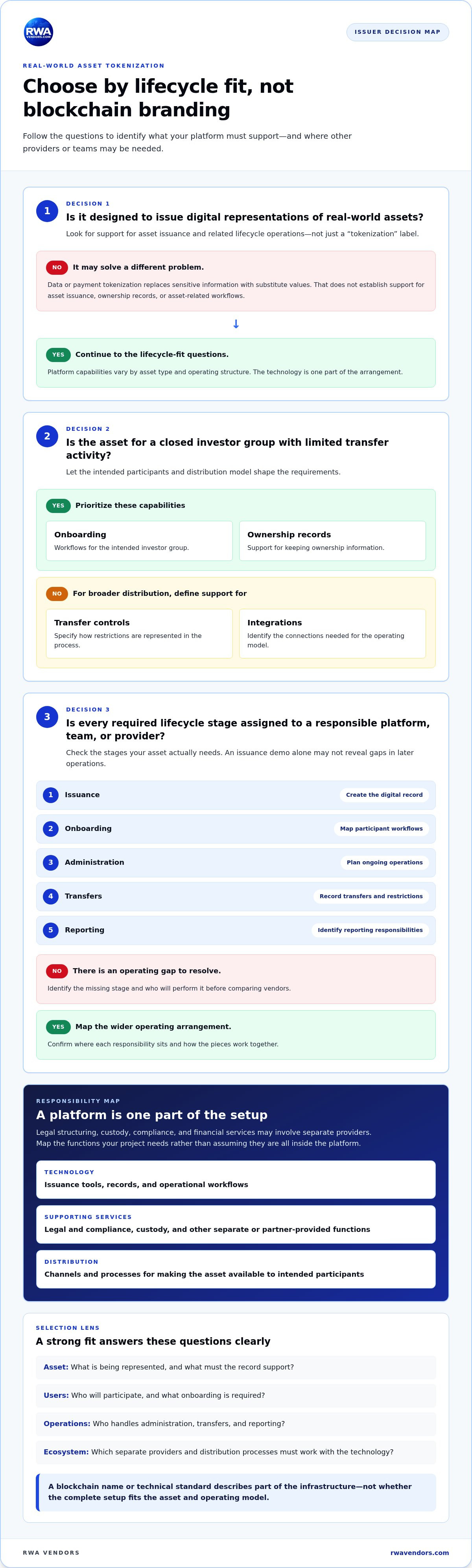
For an issuer, the decision isn’t simply which blockchain to use. It’s which infrastructure can support the asset’s digital issuance and the operating model around it. A platform that works for a fund interest may not suit a real estate structure or the workflows needed to manage ownership over time. Start by defining the asset, its intended participants, and the activities the system must support. That gives you a practical basis for how to choose a tokenization platform before comparing technology labels or feature counts.
An RWA tokenization platform is technology that supports issuing digital representations of real-world assets and managing related lifecycle operations. Depending on its scope, it may support token creation, ownership records, investor onboarding workflows, transfers, and reporting. Capabilities vary by platform, asset type, and operating structure. The platform is one part of a broader arrangement, not a substitute for legal structuring, custody, compliance, or financial services. Those functions may sit with separate providers and need to work coherently with the technology.
What does an RWA tokenization platform do?
Think in terms of workflows, not just issuance. A platform may help create the digital record associated with an asset, maintain ownership information, and support operational actions such as recording a transfer or producing reports. The specific responsibilities depend on how the issuer has designed the arrangement and which services the technology provider supplies.
For example, tokenizing a real estate interest involves more than generating a token. The issuer needs a defined relationship between that digital representation, the relevant ownership records, and the processes used to administer it. A platform’s technical capabilities alone don’t establish that relationship or determine the legal rights attached to the asset.
Asset tokenization versus data tokenization
The word “tokenization” also describes replacing sensitive information, such as payment-card details or personally identifiable information, with substitute values. That is a data-protection function. RWA tokenization creates a digital representation associated with an asset or interest, such as a real estate interest or fund interest. The two uses share a term, but solve different problems.
This distinction changes what to evaluate. Payment-tokenization criteria, including PCI scope, concern the handling of payment data. They don’t establish whether a platform can support asset issuance, ownership records, or asset-related workflows. A data-tokenization product may be useful within an issuer’s broader technology environment, but it isn’t automatically an RWA issuance platform.
Blockchain branding isn’t proof of suitability either. A network name or technical standard describes part of the infrastructure, but doesn’t show whether the complete setup supports the issuer’s operating responsibilities, service partners, or intended distribution model. Identify the functions and relationships your project requires, then determine where each belongs:
- Technology: issuance tools, records, and operational workflows.
- Supporting services: legal and compliance, custody, and other functions provided separately or through partners.
- Distribution: the channels and processes through which the asset is made available to its intended participants.
Use this map as the starting point for the platform requirements you’ll assess next.
Map Tokenization Platform Requirements to the Asset Lifecycle
Once you’ve defined the asset and operating model, translate them into requirements for each stage of the asset’s lifecycle. A platform may handle issuance well but offer limited support for later administration, transfers, or reporting. For every stage, identify the system, team, or external provider responsible. This prevents an appealing issuance demo from obscuring operational gaps that emerge after launch.
Lifecycle fit means covering the operating stages an asset requires, from issuance and onboarding through administration, transfers, and reporting. Not every issuer needs the same coverage. A closed investor group with limited transfer activity may prioritize onboarding and ownership records. An asset intended for broader distribution may need more defined transfer controls and integrations. Treat a capability as essential only when it supports the asset, its users, or a necessary operating responsibility.
Issuance, onboarding, and compliance workflows
Start with the path from an eligible participant to an issued asset record. Map the steps for collecting and reviewing onboarding information, applying eligibility controls, approving participation, and completing issuance. Then identify which steps the platform supports, which the issuer performs, and which depend on a separate service provider. The workflow should reflect the intended operating model rather than assume software makes every decision.
Document how relevant jurisdictional rules and transfer restrictions are represented in the process. For example, specify where restrictions are recorded, how a proposed transfer is handled, and which party is responsible for review. The details depend on the asset and applicable requirements, so don’t treat a platform setting as a legal determination. Platform features can support workflows, but they don’t replace the issuer’s legal and compliance responsibilities.
Administration, transfers, and reporting
After issuance, list the recurring actions the asset requires. Use this checklist to separate lifecycle needs from optional features:
- Ownership records: define how holdings and updates are recorded, reconciled, and accessed by authorized parties.
- Distributions and corporate actions: identify how payment instructions, notices, and event-related records are handled, including which provider performs each task.
- Transfers: specify who can initiate or approve a transfer, which restrictions apply, and how the process fits the intended secondary-market and investor-access model.
- Reporting: define the records and outputs needed for internal administration, investors, and relevant service partners.
Next, map dependencies. A custodian may handle asset safekeeping, a transfer agent may maintain or support ownership records, and payment providers may support cash movements. Other specialists may be involved depending on the structure. Clarify the handoffs and information each workflow requires. An integration matters when it connects to a real operating need.
Classify each capability as essential, preferred, or out of scope. This keeps optional automation from competing with basic lifecycle coverage. Providers supporting a defined stage can also create a tokenization vendor listing so issuers mapping these requirements can discover their services.
Compare Tokenization Platform Models, Controls, and Integrations
With lifecycle requirements mapped, compare how different technology models assign responsibility. An issuer can build core infrastructure internally, adopt a platform, or assemble a modular stack of specialist components. Each approach affects who maintains the system, governs changes, owns integrations, and resolves operational issues. Don’t compare only which model offers the most control. Assess whether your organization has the expertise and capacity to manage the responsibilities that come with it.
Build, buy, or assemble a modular stack?
Building can give an issuer more control over design, but it also puts development, maintenance, security updates, and technical governance on internal teams. Buying a platform may provide established capabilities, while still requiring the issuer to manage configuration, integrations, and operating procedures. A modular stack combines components from different providers. It can match distinct needs, but requires clear ownership of interfaces and handoffs. No model is universally less costly or more compliant.
Assess each option against your internal expertise and the responsibilities your team is prepared to retain. Identify who approves software changes, coordinates upgrades, monitors integrations, and manages incidents. If those roles are split between the issuer and vendors, document the boundaries before selection. This makes the build-versus-buy decision an operating-model choice, not just a technology preference.
Assess control, interoperability, and security
Public, permissioned, and multi-chain designs serve different requirements. A public network may fit one distribution model, while a permissioned environment or multiple networks may better align with another. Decide based on intended users, transfer processes, integrations, and governance needs. Chain support or a recognized standard can inform the technical assessment, but neither proves the complete setup is suitable for the asset.
Technical flexibility is the ability to configure or connect systems. Operational and legal suitability depends on whether the full arrangement fits the issuer’s responsibilities and use case. Compare requirements in a structured way:
| Area | What to assess |
|---|---|
| Chain support | Whether the supported network or networks align with the intended asset workflows and distribution model. |
| Interoperability | How the platform exchanges information with other systems, and who maintains those connections. |
| Controls | How role-based permissions, transfer controls, auditability, and data governance map to issuer processes. |
| Integrations | Requirements for custody, identity, payments, reporting, and trading, including ownership of each interface. |
| Upgrades | Who plans, approves, implements, and communicates changes to the platform or its connected components. |
For each row, define the required outcome, accountable party, and evidence needed to evaluate it. For example, don’t stop at confirming that custody or identity integrations exist. Establish what information must pass between systems and who maintains the workflow. This turns how to choose a tokenization platform into a comparison of practical capabilities, governance, and clear operating ownership.
Use a Tokenization Platform Evaluation Scorecard Before Selection
A scorecard turns project requirements into a consistent basis for comparison. Before reviewing vendor presentations, define the asset, map its workflows, set the required controls, and assess integrations. Then classify every requirement as essential, preferred, or out of scope. This helps show whether a platform addresses a real operating need or simply offers an appealing feature.
Build a requirements-led shortlist
Record the asset type, intended investor profile, relevant jurisdictions, issuance model, and lifecycle needs. Translate each item into a capability and an evidence request. For example, if a workflow requires restricted transfers, specify the control you need and request documentation or a demonstration of how that workflow is supported. Leave legal and regulatory interpretation to qualified legal and compliance professionals.
Use this sequence to build the scorecard:
- Define the asset and model. Document what is being represented, who the intended users are, and how issuance is expected to operate.
- Map the workflows. Identify required activities from onboarding through ongoing administration, transfers, and reporting.
- Set controls. Record access, approval, transfer, and recordkeeping needs, along with who owns each decision.
- Assess integrations. List the systems and service providers that must exchange information, and specify what each connection needs to do.
For each requirement, note its priority, accountable owner, and the evidence needed to evaluate it. Tie essential items to a defined project requirement. Preferred items may improve usability or flexibility, but shouldn’t outweigh a gap in an essential workflow. Mark capabilities unrelated to the asset or operating model as out of scope so they don’t distort the comparison.
For regulatory background, use the Compliant Asset Tokenization: 2026 Institutional Guide alongside qualified professional advice. A general guide can frame the issues, but it doesn’t determine how rules apply to a specific asset, jurisdiction, or issuance structure.
Validate operational readiness and dependencies
Include the people and processes needed to run the platform in your selection, not just its technical functions. Map responsibilities across the issuer, platform, custodian, and other service providers. Record who owns implementation, configuration, governance approvals, support coordination, incident response, and business continuity planning. This clarifies dependencies and exposes unclear handoffs before they become operational problems.
Include an exit plan in the evaluation. Identify which records and data the issuer needs to retrieve, which parties would support a transition, and how connected workflows could be maintained during a change. The Institutional Guide to Digital Asset Infrastructure Providers in 2026 offers broader infrastructure context. Together, these steps make how to choose a tokenization platform a disciplined assessment of requirements, evidence, ownership, and long-term readiness.
Technology providers can get listed as a tokenization provider so issuers researching the ecosystem can discover their services.
Find Tokenization Platform and Ecosystem Providers Through RWA Vendors
A tokenization project rarely depends on one technology provider alone. The platform may sit alongside legal and compliance specialists, custody providers, trading services, blockchain infrastructure, and payment providers. Mapping these categories against your evaluation scorecard helps clarify which capabilities need a dedicated provider, where integrations matter, and which responsibilities belong to the issuer.
Map the provider landscape around your requirements
Start with the requirements you marked essential. If you need issuance technology, identify the tokenization platform category. If your operating model also depends on custody, investor onboarding, transaction support, or payment flows, add the relevant provider categories to your project map. Tie each category to a defined need rather than treating a long vendor list as a plan.
RWA Vendors is a global directory where issuers can browse and filter verified provider profiles by category. Its ecosystem includes:
- Technology and tokenization platforms for digital issuance and related workflows.
- Legal and compliance services relevant to a project’s professional-service requirements.
- Custody and trading providers that may form part of the operating and distribution model.
- Blockchain infrastructure and payments that may support connected systems and processes.
This category view helps issuers research providers for distinct project needs without assuming one company covers every function. It also adds context to how to choose a tokenization platform: evaluate the platform within the wider set of relationships and handoffs your operating model requires. For a broader partner-selection perspective, consult the Institutional Digital Asset Partners: A 2026 Directory and Selection Guide.
Directory discovery is a starting point for research, not a replacement for issuer due diligence. A listing doesn’t determine whether a provider fits a specific project, establish regulatory compliance, or guarantee a successful launch. Compare provider information with your requirements, responsibilities, and evaluation evidence, and involve the appropriate internal and professional teams in the selection process.
Next steps for issuers and technology vendors
For issuers, keep the scorecard current, document the asset and operating requirements, then map each need to a provider category. This gives internal stakeholders a shared view of what the project needs and helps organize research across tokenization technology and complementary services.
For technology and professional-service providers, directory visibility can make your offering discoverable to issuers researching the tokenized capital markets ecosystem. A clear profile helps communicate the category your company serves and the project requirements it addresses. Get listed with RWA Vendors.
Turn Your Requirements Into the Next Decision
The most useful next step isn’t another feature comparison. Convert your priorities into a decision record: what the platform must enable, who owns each operating responsibility, and what evidence will support selection. This gives your team a shared basis for moving from research to implementation planning while keeping unresolved assumptions visible.
For issuers, RWA Vendors’ global directory offers verified provider profiles and category-based discovery to support research. Use it to identify relevant parts of the ecosystem around your requirements, then apply your own due diligence and professional review. How to choose a tokenization platform becomes more manageable when selection is grounded in documented needs rather than headline features.
Technology providers can use the directory to build visibility with issuers and service partners across the RWA ecosystem. A clearly positioned profile helps prospective partners understand where your offering fits and which needs it addresses.
Stay focused on fit, ownership, and the outcomes your infrastructure needs to support. Get listed with RWA Vendors to make your tokenization services discoverable to issuers researching providers.
Frequently Asked Questions
Is an RWA tokenization platform the same as a blockchain?
No. A blockchain is the underlying network for recording and processing transactions, while a tokenization platform is an application or set of services that may use one or more networks. For example, a platform can provide issuer-facing tools and connect operational workflows to a blockchain. Compare the platform’s functions separately from the network’s characteristics. Choosing a network alone doesn’t establish whether the complete solution fits your project.
Can a tokenization platform support both primary issuance and secondary transfers?
Yes, some platforms can support both, but the scope and workflow may differ. Issuance might be handled within the platform, while later transfers depend on configured controls, connected services, or a separate trading venue. Ask for a walkthrough of the specific path from initial issuance to a proposed transfer, including approvals and record updates. This shows whether the capabilities work together or require additional systems and processes.
What happens if an issuer needs to change platforms after launch?
A platform change requires a planned transition, not simply moving a file or switching a software account. The issuer needs to understand how ownership records, transaction history, permissions, and connected workflows will be preserved or reconciled. Before launch, document data export options, access to records, transition responsibilities, and dependencies on other providers. The process and implications depend on the asset structure, platform design, and applicable agreements.
How long does it take to implement a tokenization platform?
There’s no single implementation timeline that applies to every issuer. Scope can depend on the asset structure, workflow configuration, integrations, internal approvals, and coordination with external providers. A limited pilot with few connected processes may involve different work from a broader production deployment. Build a project plan around milestones such as requirements approval, integration testing, operational readiness, and launch authorization rather than relying on a generic duration.
How are tokenization platform costs typically structured?
Costs may include platform setup or configuration, recurring software or service charges, usage-based fees, and integration or support work. Separate platform charges from expenses for legal structuring, compliance operations, custody, audits, and distribution services, since these may involve different providers. Ask for a breakdown of one-time and ongoing items, and model costs against the planned operating lifecycle. Relevant categories and amounts vary by scope and provider.
Does using a tokenization platform remove an issuer’s compliance responsibilities?
No. Technology can support controls and recordkeeping, but it doesn’t transfer the issuer’s responsibilities or determine how requirements apply to its asset and operating model. For example, a platform may apply access rules, while the issuer and its qualified advisers remain responsible for establishing appropriate policies and oversight. Define who owns each decision, review, and record, and obtain qualified legal and compliance guidance for the relevant jurisdictions.
Can a tokenization platform work with external custody and payment providers?
Yes, a platform may connect with external custody and payment providers through integrations or coordinated processes. Compatibility depends on the systems involved, the information they need to exchange, and how responsibilities are divided. For example, document how payment instructions, confirmations, and related records move between parties. Include integration ownership, testing, exception handling, and reconciliation in planning so the overall workflow is clear before it is relied upon.
Disclaimer
This article is provided by RWAVendors.com for general informational and educational purposes only. It does not constitute legal, financial, investment, tax, regulatory or other professional advice, or an offer, solicitation, recommendation or endorsement of any company, product, service, token, security or investment. RWAVendors.com is an informational vendor directory and does not sell, issue, broker, custody or facilitate transactions involving cryptocurrencies, digital tokens, tokenized assets, securities or investment products. Some vendor listings and references may involve paid advertising, sponsored placement or membership relationships. These relationships do not guarantee a vendor’s qualifications, regulatory status, performance or suitability. Information may be incomplete, outdated or subject to change. You should independently verify all information, conduct your own due diligence and consult qualified professionals before making any business or investment decision. RWAVendors.com is not responsible for the content, services, representations or actions of third-party vendors or linked websites.


