

What makes a tokenization transfer agent provider a good fit: its blockchain branding, or how well it supports your issuance’s recordkeeping needs? The distinction matters because technology claims can blur regulated transfer agency responsibilities with platform capabilities. The SEC’s September 1, 2026 proposal would allow blockchain or other distributed ledger technology to serve as the official master securityholder file, while keeping control of that file with the registered transfer agent.
Choosing a provider means identifying who maintains ownership records and who supplies issuance software, compliance workflows, or trading infrastructure. This guide explains transfer agents’ roles in a tokenized securities lifecycle, how those roles differ from related services, and which capabilities to compare against your operational and integration requirements. It also maps provider types across the tokenized-capital-markets ecosystem. Use RWA Vendors’ global directory to discover technology and professional-service providers, define the scope you need, and focus your search on lifecycle fit rather than blockchain branding alone.
Key Takeaways
- Define the ownership-record and securityholder administration functions your issuance needs before comparing providers.
- Distinguish transfer agency responsibilities from the technology platforms that issue or manage digital representations.
- Compare tokenization transfer agent providers by functional scope, supported workflows, integration requirements, and relevant jurisdictions.
- Build a shortlist by mapping your issuance lifecycle, separating required capabilities from optional ones, and identifying adjacent provider needs.
- Use RWA Vendors’ global directory to discover providers across technology, legal and compliance, custody, trading, and payments.
Why tokenization transfer agent providers matter to an issuance
An issuer planning a digital securities offering has to connect two operational layers: ownership servicing and the systems used to issue and manage digital representations. A tokenization transfer agent provider supports ownership records and related securityholder administration for an issuance. The role matters because the issuer needs a defined process for recording who holds the security, handling ownership changes, and coordinating investor servicing over time.
These responsibilities extend beyond launch. Depending on the offering and service arrangement, workflows may include updating holder records after transfers, maintaining information used for investor communications, and coordinating records around lifecycle events such as distributions or other issuer actions. When those processes involve separate systems or providers, document who owns each step and how information passes between parties. The goal is a coherent servicing model, not simply an added digital layer.
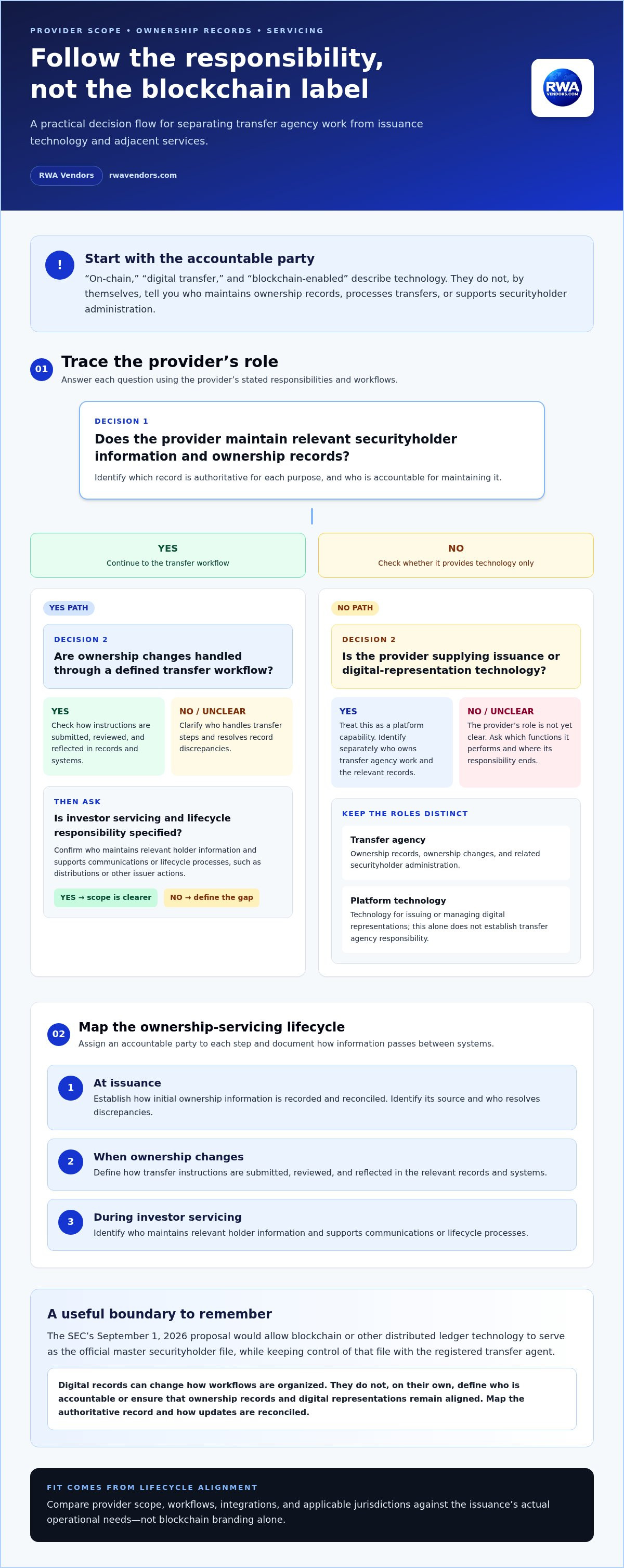
- At issuance: Establish how initial ownership information is recorded and reconciled. Identify the source of the information and who is responsible for resolving discrepancies.
- When ownership changes: Define how transfer instructions are submitted, reviewed, and reflected in the relevant records and systems.
- During investor servicing: Identify who maintains relevant holder information and supports communications or lifecycle processes.
What changes when securities are represented digitally?
A digital record may connect with established ownership and servicing processes, but the operating model depends on how the issuance is structured. Systems may need to exchange or reconcile information so that ownership records and digital representations remain aligned. That can change how workflows are organized, but it does not establish a particular processing speed, lower costs, or ensure compliance. Map which record is authoritative for each purpose and how updates are reconciled across systems.
A tokenization transfer agent provider supports ownership records and related securityholder administration within the operational lifecycle of a tokenized security.
Why provider fit is more useful than blockchain branding
Start with the asset, intended investor base, and servicing requirements. A fund issuance, for example, may involve different servicing workflows from another type of security. List the ownership events and investor interactions the project must support, then assign an accountable party to each operational responsibility.
Terms such as “on-chain,” “digital transfer,” or “blockchain-enabled” describe technology, not necessarily the full scope of transfer agency or servicing. They don’t show which records a firm supports, how transfers are handled, or where its responsibilities stop. Compare capabilities against the issuance’s actual lifecycle needs. No provider model is automatically suitable for every project.
This distinction gives issuers a practical starting point for provider discovery. Separate the core ownership-record function from adjacent platform and servicing needs. Then compare providers’ stated scope, workflows, integrations, and applicable jurisdictions against those requirements.
What tokenization transfer agent providers do, and where their role ends
Provider descriptions can combine recordkeeping, token issuance, compliance, and investor services under broad digital-asset language. These functions may connect, but they are not interchangeable. Separating them helps an issuer identify who is responsible for official ownership records, who supplies the technology, and how information passes between the two. Assess tokenization transfer agent providers by their operational responsibilities, not by assuming a platform’s blockchain capabilities include transfer agency work.
Core transfer agency functions in a tokenized securities context
In traditional securities markets, transfer agents support functions such as maintaining ownership records and processing changes in ownership. The SEC’s Investor.gov overview of the Role of transfer agents provides a baseline for understanding those responsibilities. In a tokenized issuance, the technology used to represent or update ownership may differ, while the project still needs defined recordkeeping and securityholder administration processes.
Depending on the instrument and service arrangement, a transfer agent’s work may involve:
- Maintaining relevant securityholder information and ownership records.
- Processing ownership changes through the project’s defined transfer workflow.
- Supporting administration connected to holder records and lifecycle events.
These examples describe categories of work, not a standard package offered by every provider. A fund and another type of security may have different servicing requirements. Map each expected event, from initial record creation through subsequent ownership changes and ongoing administration, then assign responsibility for every step.
How transfer agents relate to platforms and adjacent providers
A tokenization platform generally supplies technology for issuing or managing digital representations. That technology may support record updates or connect with other systems, but platform functionality alone doesn’t establish who performs transfer agency work or maintains the relevant ownership records. Define how each provider’s role fits into the workflow and where accountability sits.
- Transfer agent: Supports ownership recordkeeping and related securityholder administration.
- Tokenization platform: Provides technology for creating or managing digital representations and associated workflows.
- Custody provider: Supports safekeeping of assets or keys, according to its service scope.
- Trading venue: Supports trading activity; it does not automatically take on transfer agency responsibilities.
- Compliance or fund administrator: May support separate compliance or fund-administration workflows, depending on the structure.
These parties may need coordinated data flows, defined handoffs, and clear responsibility boundaries. For a wider view of connected providers, see the institutional digital asset infrastructure guide. The compliant asset tokenization guide offers further regulatory context without treating technology as a substitute for the project’s applicable obligations.
Clear role definitions also make provider discovery more precise. Issuers can use category-based directories to map transfer agency against adjacent infrastructure needs, while service providers can seek visibility in the tokenized-capital-markets ecosystem.
How to compare tokenization transfer agent providers
Start your comparison with the work the issuance needs, not a provider’s blockchain terminology. Apply the same capability categories to each candidate, and record whether a function is required, supported directly, delivered by a partner, or out of scope. This makes gaps and handoffs visible before they become operational dependencies. Compare tokenization transfer agent providers against consistent project requirements rather than treating broad capability claims as equivalent evidence.
A practical provider comparison matrix
Use the following checklist as a working template. Add project-specific details, then record each provider’s status for every capability. For anything marked “partner-delivered,” name the dependency. For anything “out of scope,” record the gap. Note the relevant instrument and jurisdictions alongside the checklist, since provider coverage and requirements can vary by project.
- Recordkeeping: Required: [yes/no]. Supported: [direct/partner/out of scope]. Note how ownership information is maintained and reconciled.
- Transfer workflows: Required: [yes/no]. Supported: [direct/partner/out of scope]. Map the steps for submitting, reviewing, and recording ownership changes.
- Investor servicing: Required: [yes/no]. Supported: [direct/partner/out of scope]. Specify which securityholder information or servicing processes are included.
- Integrations: Required: [systems and data flows]. Supported: [direct/partner/out of scope]. Note how the provider connects with issuance technology and other project systems.
- Reporting: Required: [reports and recipients]. Supported: [direct/partner/out of scope]. Record how relevant ownership or servicing information is made available.
Keep the project’s instrument and jurisdiction in the same review file. These details can affect which services are relevant and what operational coverage is appropriate. Distinguish a demonstrated capability from a partner dependency or an unanswered question. A general “supported” label can hide important differences between them.
Signals of institutional and operational fit
Look for clearly defined service boundaries, described workflows, and integration information detailed enough to map responsibilities. Materials explaining how records move between parties are more useful than general claims of blockchain expertise. Assess whether governance, auditability, and operational controls are addressed in relation to the service being offered. A label alone does not establish the quality or suitability of those controls.
Separate evidence from positioning. A provider’s stated experience with a relevant instrument or workflow can inform your evaluation, while phrases such as “end-to-end” need to be translated into named functions, accountable parties, and handoffs. Avoid unsupported rankings based on speed, scale, or technology branding. Record what the provider describes, what depends on another firm, and what falls outside scope. This creates a more useful shortlist for internal review.
For providers serving tokenized capital markets, a clear directory profile can help issuers identify relevant service categories and understand where firms fit within the wider ecosystem. Get listed in the RWA Vendors directory to make your organization’s capabilities discoverable to issuers comparing providers.
How issuers can build a transfer agent provider shortlist
Build a focused shortlist by defining the issuance and its operating requirements before searching for providers. Then use those requirements to identify firms that may cover the work directly or through connected providers. This sequence keeps a broad technology search from obscuring essential servicing functions. For a wider view of how institutional projects assess connected firms, consult the institutional digital asset partners guide.
Define the project before searching
Prepare a short project brief that captures the asset or instrument, intended investor profile, expected lifecycle, and operating model. List the transfer agency functions the issuance needs, including which responsibilities must sit with a direct provider and which could be coordinated through another service. Record jurisdictional and structural questions for appropriate professional review. A provider search does not replace that work.
Divide capabilities into two groups: those required for the issuance to operate and optional improvements that could be considered later. This distinction gives the search a practical boundary and helps the team compare tokenization transfer agent providers consistently. A defined process for ownership updates might be essential; a particular integration approach might be optional if the operating model can support an alternative.
Turn requirements into a searchable shortlist
Use the project brief to search for transfer agency capabilities, then expand discovery into relevant technology and professional-service categories. One provider may handle part of the lifecycle while another supports adjacent infrastructure. Search across categories to reveal these connections, not to assume every listed firm has the same role or scope.
For each candidate, capture the same core details in a shortlist record:
- Stated role: Which ownership, servicing, or technology functions does the provider describe?
- Workflow coverage: Which required steps are supported directly, and which rely on partners?
- Integration context: What systems or provider relationships are described as part of the workflow?
- Project dependencies: Which instrument, structural, or jurisdictional factors need further review?
- Open questions: What information is needed to distinguish a clear capability from a general claim?
Keep the shortlist focused. Remove firms whose stated scope does not match a required function, and retain candidates whose service boundaries align with the project or its planned provider network. RWA Vendors’ global directory connects issuers with providers across tokenization technology and related capital-market categories, helping broaden discovery beyond a single technology segment. Use directory discovery to organize the market landscape, then assess each candidate against the same project criteria.
For providers supporting tokenized capital markets, directory visibility can help issuers discover relevant capabilities while building their shortlist.
Find tokenization transfer agent providers through RWA Vendors
Finding a suitable provider can mean looking beyond a single technology category. Issuers need to understand how ownership administration connects with issuance systems and other capital-market services. RWA Vendors is a global directory connecting issuers with vetted tokenization platforms and service providers, with listings across the broader tokenized-capital-markets ecosystem.
Use category-based discovery across the RWA lifecycle
Explore providers involved in tokenization alongside connected technology and professional-service categories. Depending on your project requirements, relevant areas may include legal and compliance, custody, trading, and payments. Viewing these categories together can help you identify where different firms may fit across issuance, management, and trading workflows, rather than assuming one provider covers every operational need.
This broader view is useful when a project spans multiple provider types. For example, an issuer may be searching for ownership-related services while also mapping technology integrations or supporting infrastructure. Category-based discovery helps organize that search and surface firms for further consideration. A directory is a starting point, not a substitute for project diligence: assess each firm’s stated role, service scope, jurisdictional permissions, and fit with the specific issuance.
Move from discovery to a focused review
Let your project requirements guide the search. Begin with the transfer agency responsibilities the issuance needs, then explore adjacent categories where the operating model depends on additional providers. As you identify potential firms, capture their described capabilities and compare them against your requirements. This keeps discovery connected to the project’s actual needs instead of turning into an open-ended search through digital-asset terminology.
The directory’s global scope supports discovery across tokenization and related capital-market services. It can help issuers broaden their view of available providers and map potential connections across the lifecycle. Use your own evaluation and diligence process to determine whether a particular firm fits the project structure and its requirements.
A clear next step for providers
For firms supporting tokenized capital markets, directory visibility provides a way to present services to businesses searching across the ecosystem. A clear description of your organization’s role helps issuers understand where it fits among tokenization technology and professional-service providers. Providers can apply for directory visibility through RWA Vendors.
Turn your provider search into a stronger operating model
Make provider selection part of the issuance’s wider operating design. Keep responsibilities, handoffs, and system connections clear as the project develops. This gives stakeholders a shared basis for discussing how tokenization transfer agent providers fit within the operating model, and keeps technology choices connected to the functions the issuance must support.
Issuers can use RWA Vendors to discover firms across the tokenized-capital-markets ecosystem. Providers can build a clear directory presence to help businesses developing tokenized markets find and understand their organization’s role.
Build your next step with a clear view of the provider landscape and the responsibilities your project needs to support.
Frequently Asked Questions
Can traditional transfer agents support tokenized securities?
Yes, some traditional transfer agents are extending their services to digital-asset workflows, while others may work alongside technology partners. For example, a project might use an established firm for ownership administration and a separate platform for digital issuance. Compare each party’s stated responsibilities, relevant integrations, and jurisdictional coverage with the planned operating model. Experience in conventional securities alone doesn’t establish that a firm supports every digital structure or workflow.
Does tokenization eliminate the need for a transfer agent?
No, representing a security digitally doesn’t by itself remove the need to administer ownership information or related securityholder processes. The operating model depends on the instrument and project structure. For example, a team designing a transfer workflow should identify which party records an approved ownership change and how connected systems reflect it. Consider those responsibilities separately from the technology that creates or manages the digital representation.
Can one provider supply both transfer agency and tokenization technology?
Yes, some offerings may combine both functions, while other issuances rely on separate firms. Even when one provider presents a combined service, map each responsibility separately. For a workflow involving an investor request, review, and record update, document which organization handles each stage and what information passes between systems. This clarifies accountability and helps you assess how the arrangement would operate if a partner or system changes.
How do transfer agents interact with blockchain platforms?
The interaction depends on the project architecture and the responsibilities assigned to each party. A blockchain platform may support digital issuance or asset management, while transfer agency work may involve ownership records and related administration. Map which system receives a transfer instruction, which party processes it, and how the resulting record information is reconciled. Don’t assume a platform performs every function simply because it supports on-chain workflows.
Are tokenized securities automatically transferable between investors?
No, a token’s digital form doesn’t establish unrestricted transferability or guarantee liquidity. Transfer conditions depend on the instrument’s terms, applicable requirements, and the project’s processes. Before designing a transfer workflow, identify restrictions that may affect who can hold or receive the security, and determine how the process reflects them. The technology and responsible service providers need to support the intended controls; tokenization alone doesn’t settle those questions.
What information should an issuer prepare before searching for providers?
Prepare a short requirements brief before searching for tokenization transfer agent providers. Include the asset or instrument, intended investor profile, expected lifecycle events, relevant jurisdictions, and systems the project may need to connect. Separate essential capabilities from optional ones, such as a preferred reporting format. This gives the team a consistent way to compare provider descriptions and highlights where a requirement depends on another firm or needs project-level professional review.
Disclaimer
This article is provided by RWAVendors.com for general informational and educational purposes only. It does not constitute legal, financial, investment, tax, regulatory or other professional advice, or an offer, solicitation, recommendation or endorsement of any company, product, service, token, security or investment. RWAVendors.com is an informational vendor directory and does not sell, issue, broker, custody or facilitate transactions involving cryptocurrencies, digital tokens, tokenized assets, securities or investment products. Some vendor listings and references may involve paid advertising, sponsored placement or membership relationships. These relationships do not guarantee a vendor’s qualifications, regulatory status, performance or suitability. Information may be incomplete, outdated or subject to change. You should independently verify all information, conduct your own due diligence and consult qualified professionals before making any business or investment decision. RWAVendors.com is not responsible for the content, services, representations or actions of third-party vendors or linked websites.


