

The faster launch isn’t automatically the lower-cost choice over time. For teams weighing in-house vs white-label tokenization solutions, custom platform development often takes 4-9 months, while a white-label platform is described as launching in 3-8 weeks.
It’s easy to focus on the initial build: an in-house platform offers greater control, while white-label infrastructure can reduce development work and speed up launch. But the first-year comparison is only part of the decision. White-label platforms are almost always cheaper in the first year, while subscriptions and other costs can shift the balance over 3-5 years.
This comparison explains how platform capabilities, development and transition costs, launch timelines, technical requirements, and long-term ownership shape the decision. You’ll learn what each approach involves and how to weigh the trade-offs against your operating model, internal expertise, and platform plans.
Key Takeaways
- Compare platform capabilities against your operating model to identify which built-in modules you need and where customization matters.
- Account for development, maintenance, integration, and transition work, not just the initial build or subscription.
- Assess the technical expertise each approach requires, including smart contract development, security audits, and ongoing platform operations.
- Use a multi-year total cost view to see how control, customization, and recurring costs affect the long-term decision.
- Match the platform approach to your launch priorities and ownership goals before committing to an infrastructure model.
White-label platform capabilities and built-in modules
In the U.S., requirements for securities, AML, KYC, and money transmission depend on the asset structure and the platform’s role. Token issuance, investor onboarding, payment handling, and marketplace operations can each affect the analysis. Platform software alone does not determine which requirements apply.
White-label platforms can present security and operational risks, including weaknesses in shared infrastructure, unclear responsibility for incidents, and dependence on a vendor’s systems. Lock-in can also complicate migration if data, smart contracts, integrations, or operating processes are difficult to move.
A white-label tokenization platform provides a ready-built foundation that a business can brand and configure without developing all the underlying code. Customization may cover the investor interface, selected features, and business model, while the vendor-hosted platform provides the core infrastructure.
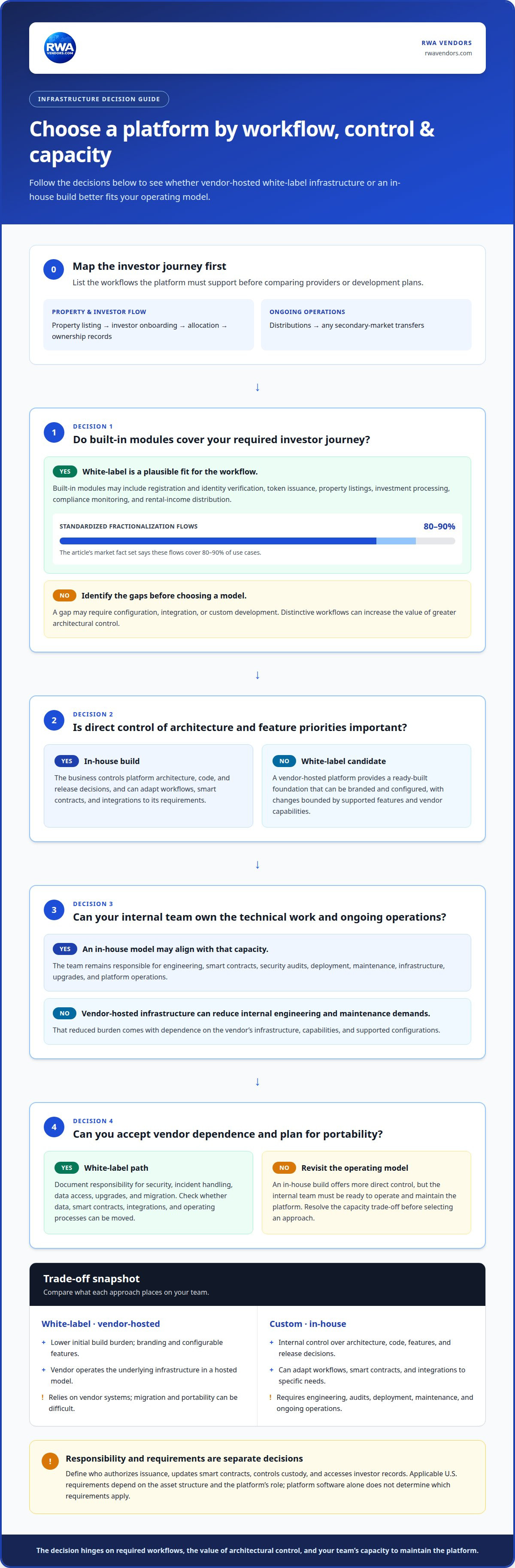
For real estate tokenization, built-in modules may support investor registration and identity verification, token issuance, property listings, investment processing, compliance monitoring, and rental-income distribution. Pre-configured smart contracts can automate activities such as ownership management and investor allocations. Standardized fractionalization flows cover 80-90% of use cases, according to the market fact set.
This foundation can reduce development work, but it also sets the initial boundaries. Map each required investor journey before comparing platforms: property listing, onboarding, allocation, ownership records, distributions, and any secondary-market transfers. Identify gaps that may require configuration, integration, or custom development.
Regulatory change remains part of platform planning. The transitional period for existing crypto-asset service providers under MiCAR ended on 1 July 2026, according to the European Union. MiCAR is an EU framework, so that date does not answer which U.S. requirements apply to a particular offering.
Building from scratch gives a business direct control over architecture and feature priorities, while making its team responsible for development and ongoing operations. A vendor-hosted white-label system can reduce the initial engineering burden, but the business depends on the vendor’s infrastructure and supported configurations. In either model, clearly assign responsibility for security, data access, upgrades, and incident handling.
| Option | Customization | Development work | Operational dependence |
|---|---|---|---|
| White-label, vendor-hosted | Branding and configurable features | Lower initial build burden | Relies on vendor infrastructure |
| Custom, in-house build | Architecture and features controlled internally | Engineering, smart contracts, audits, deployment, and maintenance | Internal team operates the platform |
Choose based on the required investor workflows, the value of architectural control, and your team’s capacity to maintain custom software. For example, a business testing a standard property-investment process may prioritize built-in modules, while one with distinctive workflows may value greater control.
Applicable requirements depend on the asset structure and the platform’s role. Issuing tokens, onboarding investors, handling payments, and operating a marketplace can each affect the analysis. Providing platform software alone does not determine which requirements apply.
In-house development versus ready-built infrastructure
Deployment determines who operates the platform and where control sits. In either model, contracts and system architecture allocate responsibility for token issuance, smart contracts, custody, and data access. Scalability, maintenance, and ongoing costs depend on those choices and the internal team’s capacity.
In-House Infrastructure
With an in-house deployment, the business is directly responsible for platform architecture, code, and release decisions. Its team can adapt real estate tokenization workflows, smart contracts, and integrations to specific operational requirements. That control also means maintaining infrastructure, arranging security audits, and managing upgrades internally. Custom blockchain platform development can take many months or even years, depending on complexity and regulatory requirements.
Ready-Built White-Label Infrastructure
A white-label deployment uses a vendor’s existing platform, configured for the business’s brand and workflows. In a hosted model, the vendor operates the underlying infrastructure while the business determines how to use the available features. This can reduce internal engineering and maintenance demands, but scalability and changes depend partly on the vendor’s capabilities. Integration needs, data portability, and upgrade processes also affect ongoing operational costs.
Neither model automatically determines custody or data ownership. Define responsibilities in the operating model: who authorizes issuance, who can update smart contracts, who holds or controls assets, and who can access investor records. For example, a project might assign issuance approvals internally while using a separate custody arrangement. Document each role before deployment.
MiCAR and MiFID II are not interchangeable labels for tokenized securities. Start with classification: assess the token’s rights and structure, then determine whether it is treated as a financial instrument or falls within MiCAR’s crypto-asset scope. ESMA issued guidelines on classifying crypto-assets as financial instruments in March 2025. That classification shapes the regulatory analysis for the platform and its activities.
To assess scalability, compare the work required to add asset types, investor workflows, and integrations. An in-house team can prioritize changes directly but must build and maintain them. A white-label system may support expansion through existing modules, while the vendor’s roadmap and configuration boundaries affect delivery. Ongoing costs can therefore include internal staffing and maintenance, or vendor fees, integrations, and transition work.
Use a deployment review to clarify the practical differences. Map each workflow, from investor onboarding to ownership records and distributions. Then assign a technical owner, an operational owner, and data access rights to each one. Compare those responsibilities with your team’s skills and the need for global operations. Choose in-house infrastructure for control over distinctive systems, or hosted infrastructure when existing capabilities fit the workflow.
Three-year cost planning and transition costs
Compare the full cost structure, not just the initial build or platform subscription. For a three-year plan, include implementation, integrations, operations, maintenance, and any work involved in transferring between systems.
In-House Build Costs
An in-house tokenization platform requires investment in software engineering, smart contract development, security audits, user experience, infrastructure, and maintenance. For a real estate issuance, the budget should also cover automation for investor onboarding, ownership records, distributions, and reporting. These costs fall to the business, along with the staffing needed to operate and update each component.
List each workstream, assign an internal owner, and forecast its effort across the three-year period. Separate initial development from recurring costs such as infrastructure operations, security reviews, and contract changes. A custom issuance workflow may need further development if the asset structure or investor process changes, adding work beyond the initial release.
White-Label Provider Costs
A white-label model replaces much of the initial platform build with provider charges, implementation, configuration, and integration work. White-label platforms are almost always cheaper in the first year, while subscription fees and other costs can shift the balance over 3-5 years. The comparison depends on which modules are included and what the business must add.
Create separate cost lines for recurring platform charges, configuration, integration, and internal administration. For example, a real estate platform may need payment processing and property-management connections beyond its standard issuance workflow. Include these additions in the same period as the subscription, rather than treating them as isolated launch expenses.
Model transition costs separately. Moving between platforms can involve exporting investor and issuance records, mapping data fields, reconnecting payment or reporting systems, and testing smart-contract workflows. If contracts or data formats differ, teams may need to convert and validate them before the new platform can support ongoing operations.
For a three-year comparison, prepare a ledger with separate columns for each year and model. Include development or implementation, integrations, security work, operations, upgrades, and transition tasks. Then identify which costs recur, which decline after launch, and which arise only if the platform changes.
- In-house: Track engineering, audits, infrastructure, and internal operations.
- White-label: Track subscriptions, configuration, integrations, and administration.
- Both: Include regulatory work, issuance changes, and transfer planning.
Use the same issuance volume, asset structure, investor workflow, and automation requirements for both models. This keeps the three-year comparison focused on the cost of delivering the same operating outcome, rather than comparing different platform scopes.
Launch timelines and technical requirements
Launch speed depends on what needs to be built, integrated, tested, and approved internally. A useful schedule separates platform configuration from readiness for investor onboarding, ownership records, distributions, and reporting.
Custom development schedule
Custom tokenization platform development often takes 4-9 months, depending on complexity and regulatory requirements. That estimate covers more than writing code. Engineering teams must design the architecture, build smart contracts, create the investor interface, deploy infrastructure, and arrange security audits.
Break the schedule into deliverable-based stages:
- Requirements: map investor journeys, asset structures, and portfolio reporting needs.
- Build: develop issuance workflows, ownership records, and distribution logic.
- Integration: connect identity checks, payments, and internal reporting systems.
- Testing: validate contract behavior, access controls, and transaction records.
- Launch: prepare support processes and confirm operational handoffs.
Each stage depends on earlier decisions. For example, changing ownership rules after smart contract development can require code revisions and additional testing. Delayed payment or reporting integrations can also postpone launch, even when the core platform is ready.
White-label configuration schedule
White-label tokenization platforms can provide a ready-to-deploy starting point, though launch timing depends on the configuration and integration work required. They start from existing infrastructure, so teams focus on configuration, branding, integrations, and testing instead of developing every core component. A real estate issuer still needs to map its investor process and confirm that built-in modules support its intended issuance and reporting workflows.
Vendor-hosted infrastructure can reduce the work involved in deploying and maintaining core systems, but it does not eliminate implementation tasks. Teams still need to configure access, connect relevant services, test investor journeys, and prepare internal processes for distributions and ownership reporting.
Technical readiness requires named owners for every launch dependency. Assign responsibility for smart-contract review, data mapping, identity workflows, payment connections, and reporting outputs. For a property portfolio, test how an investor record moves from registration to allocation, ownership updates, and distribution reporting.
Compare schedules using the same launch scope. List the required asset types, investor functions, integrations, and reporting outputs, then identify which components already exist. Custom builds suit requirements that call for distinct architecture; white-label deployment may fit workflows supported by existing modules. The key scheduling question is which unfinished dependency determines the launch date.
White-label platforms may reduce technical and development workload, though launch timing depends on the scope and unfinished dependencies.
Three-to-five-year total cost of ownership
Total cost of ownership includes the costs required to operate a tokenization platform after launch. Compare in-house and white-label models across a consistent 3-5-year horizon, including development, recurring operations, upgrades, and transition needs.
White-label platforms are almost always cheaper in the first year, while subscription fees and other costs can shift the balance over 3-5 years. The initial comparison therefore doesn’t predict the full ownership cost. Model recurring charges and internal work alongside implementation.
Build a comparable cost model
Use the same asset scope and operating assumptions for both options. A real estate portfolio with investor onboarding, identity checks, ownership records, and rental-income distribution needs comparable functions in each scenario. If one model omits a workflow, its projected cost will not represent the same operating outcome.
Separate costs into categories that show who performs and pays for each task:
- Platform creation: engineering, smart contracts, audits, and deployment for an in-house build.
- Platform access: subscriptions, configuration, and integrations for a white-label model.
- Operations: staff time, infrastructure maintenance, support processes, and system administration.
- Change management: upgrades, new asset workflows, and data or contract migration.
Record each category by year, then mark it as recurring, one-time, or conditional. For example, a new portfolio reporting requirement may trigger in-house development or a paid configuration request with a white-label provider. This distinction makes assumptions for later years clear.
Account for ownership and change
An in-house platform can accumulate maintenance work as blockchain components, smart contracts, and integrations change. Assign internal owners to each system and include their ongoing effort in the model. A white-label platform shifts some infrastructure work to the vendor, but subscriptions and configuration needs remain part of operating costs.
Model a platform transition separately instead of hiding it within routine maintenance. Switching platforms may require exporting investor data, mapping ownership records, changing integrations, and testing contract workflows. Even if a business expects to keep its existing systems, identify which data and processes would need to move.
Use two views: a 3-year operating comparison and a 5-year ownership comparison. The shorter view highlights launch and early operating demands; the longer view exposes recurring subscriptions, internal maintenance, and possible transition work. Keep assumptions consistent across both horizons.
| Cost area | In-house model | White-label model |
|---|---|---|
| Initial platform work | Build and deploy | Configure and integrate |
| Ongoing ownership | Internal maintenance | Subscription and administration |
| Change or exit | Internal redevelopment | Configuration or migration |
Choose the model whose full-period cost profile matches the value you place on control, internal capacity, and predictable platform operations.
RWA Vendors: Vendor Directory Listing
RWA Vendors helps asset issuers move from comparing platforms to finding relevant providers. Its Vendor Directory Listing connects issuers with verified tokenization platforms and service providers across the real-world asset ecosystem.
Use the directory once you have defined your requirements and need to explore providers for technology, compliance, or other tokenization needs. For example, an issuer comparing infrastructure options can find companies supporting real estate, funds, securities, and other assets. The directory helps organize the search, while your own assessment determines whether a provider fits a specific project.
Visit rwavendors.com to explore the directory and identify relevant providers.
Turn your platform decision into a practical next step
A disciplined decision about in-house vs white-label tokenization solutions starts with a clear ownership model. Define which capabilities are strategically important to retain, which can rely on external infrastructure, and how your requirements may change as your asset program develops. This framework can guide conversations with potential providers.
Before engaging vendors, document your operating priorities, technical dependencies, and expectations for control. Use these criteria to focus discussions on platform fit, not presentation alone. RWA Vendors connects asset issuers with verified tokenization platforms and service providers. Its Vendor Directory Listing, Founding Membership, and Lead Generation and Referrals provide different ways to participate in the tokenized capital markets ecosystem.
Use the next conversation to clarify your requirements and identify relevant connections. A considered platform decision can help guide your team from planning to execution.
Move forward with a clear brief and a platform strategy aligned with your goals.
Frequently Asked Questions
What is the difference between in-house and white-label tokenization solutions?
Choosing between in-house vs white-label tokenization solutions means deciding who controls platform development and operation. In-house software puts design and technical priorities under your organization’s control; a white-label model starts with a vendor’s existing infrastructure. An issuer with a specialized investor approval process may need more internal development, while a standard issuance workflow may suit a configurable platform. Compare responsibilities as well as features.
How long does it take to launch an in-house or white-label tokenization solution?
Custom development often takes 4-9 months, while white-label platforms are described as launching in 3-8 weeks. These estimates depend on scope and readiness. A project with complex workflows, pending integrations, or extensive testing may require more implementation work. To plan a target date, identify dependencies such as identity checks, payment connections, investor communications, and ownership reporting, then sequence them alongside platform configuration or development.
What technical expertise and infrastructure are needed to build a tokenization platform in-house?
An in-house build requires software engineering, smart contract development, security testing, user experience design, and infrastructure deployment. The team also needs operational ownership for maintenance and upgrades. For example, an engineering plan should assign responsibility for contract changes, access controls, transaction records, and integrations. Map those skills against the platform’s required workflows before choosing an architecture, so technical gaps surface during planning rather than after development begins.
Which features and customization options do white-label tokenization providers offer?
White-label platforms may offer configurable branding, investor management, smart contracts, and compliance tools. Available workflows can include investor registration, identity verification, issuance, ownership management, and distribution processing. The practical question is how each module handles your asset and investor journey. For example, compare the platform’s standard allocation process with the rules your offering requires, then identify which steps can be configured and which need integration or custom work.
When should a business choose an in-house tokenization platform instead of a white-label solution?
Choose an in-house platform when distinctive workflows, architecture, or control requirements justify building and maintaining custom systems. When comparing in-house vs white-label tokenization solutions, consider whether your issuance model depends on specialized ownership logic or integrations that existing modules cannot accommodate. Assess internal engineering capacity, security responsibilities, and planned platform changes together. If the workflow is standard and deployment speed is a priority, white-label infrastructure may be a more practical fit.
Disclaimer
This article is provided by RWAVendors.com for general informational and educational purposes only. It does not constitute legal, financial, investment, tax, regulatory or other professional advice, or an offer, solicitation, recommendation or endorsement of any company, product, service, token, security or investment. RWAVendors.com is an informational vendor directory and does not sell, issue, broker, custody or facilitate transactions involving cryptocurrencies, digital tokens, tokenized assets, securities or investment products. Some vendor listings and references may involve paid advertising, sponsored placement or membership relationships. These relationships do not guarantee a vendor’s qualifications, regulatory status, performance or suitability. Information may be incomplete, outdated or subject to change. You should independently verify all information, conduct your own due diligence and consult qualified professionals before making any business or investment decision. RWAVendors.com is not responsible for the content, services, representations or actions of third-party vendors or linked websites.


