

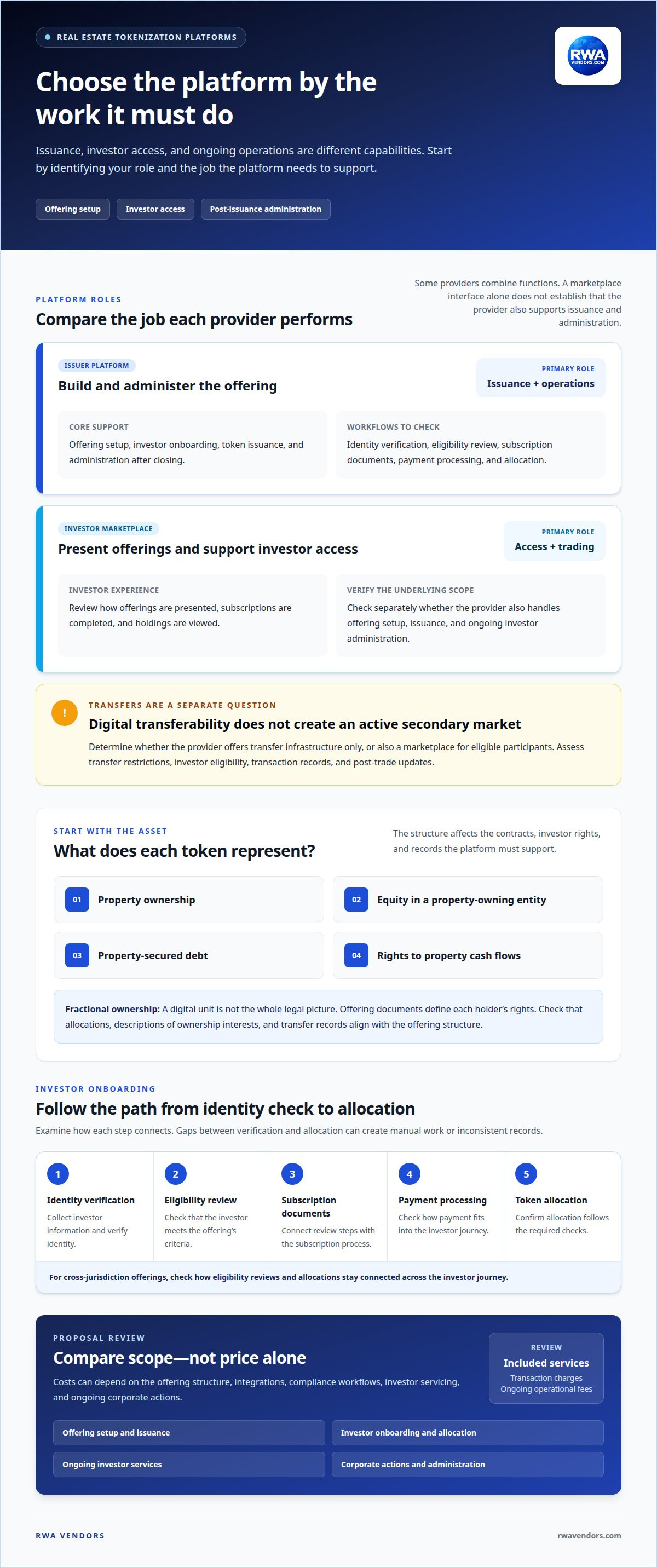
Real estate tokenization platform providers serve different needs. Issuer platforms support offering setup, investor onboarding, issuance, and ongoing administration, while investor marketplaces focus on presenting offerings and supporting access and trading. Digital transferability alone does not create an active secondary market, so the right fit depends on whether you are structuring an offering, investing in one, or managing assets after issuance.
It is reasonable to expect a single platform to cover the full lifecycle, but capabilities vary across issuance, investor access, and ongoing operations. This guide explains how to compare platform types, assess compliance options across jurisdictions, evaluate proposals and cost drivers, and plan for post-issuance services. It also covers the questions that help reveal who a platform is actually designed to serve.
Key Takeaways
- Match the platform to your role: issuance and investor administration require different capabilities from investor access and trading.
- Align network permissions and compliance rules with the offering’s jurisdictions, investor eligibility criteria, and legal structure.
- Compare proposals by scope as well as price, including issuance, onboarding, ongoing investor services, and corporate actions.
- Assess how transfers and secondary-market access work; digital transferability alone doesn’t create an active market.
- Use RWA Vendors’ directory to identify verified tokenization platforms and service providers relevant to your project.
Choosing between issuer platforms and investor marketplaces
Start with your role. An issuer needs infrastructure to structure an offering, onboard investors, issue tokens, and administer them after closing. An investor marketplace focuses on presenting offerings and enabling investor access. Some providers combine both functions, but a marketplace interface alone does not show whether its underlying systems also support issuance and ongoing administration.
Next, identify what each token represents. Real estate tokens can represent property ownership, equity in a property-owning entity, property-secured debt, or rights to property cash flows. Those structures affect the contracts, investor rights, and records a platform must support. For example, an issuer selling an equity interest needs workflows that reflect the entity’s rights and distributions, not just a token balance.
For fractional ownership, distinguish the digital unit from the legal interest behind it. Fractional access can let investors participate in a real estate offering without acquiring an entire property, but the offering documents define each holder’s rights. Compare how the platform records allocations, describes ownership interests, and handles transfers. A dashboard showing fractional units is useful only if its records align with the offering structure.
Investor onboarding is another key distinction. A platform may digitize onboarding and KYC, collect information, and support eligibility checks before an issuer allocates tokens to approved investors. Examine how the steps connect: identity verification, eligibility review, subscription documents, payment processing, and allocation. Gaps between verification and allocation can create manual work or inconsistent records, especially when an offering serves investors across jurisdictions.
Secondary-market functions require separate evaluation. Tokenization can enable digital transferability, but it does not create active buyers or a functioning secondary market. Determine whether the provider offers transfer infrastructure only or also a marketplace for eligible participants. Then assess how transfer restrictions, investor eligibility, transaction records, and post-trade updates fit together. Treat liquidity as a market outcome, not a feature guaranteed by token issuance.
Compare platform proposals against the same operating requirements:
- Issuer: Map support for offering setup, onboarding, allocation, and investor administration.
- Investor: Review how offerings are presented, subscriptions completed, and holdings viewed.
- Transfers: Separate token transfer capability from actual marketplace access and trading activity.
Compare pricing and investment minimums as offering terms, not universal platform figures. Costs can depend on the chosen structure, integrations, compliance workflows, investor servicing, and ongoing corporate actions. Minimums may reflect the issuer’s capital-raising plan, asset economics, and subscription terms. Review proposals for included services, transaction-based charges, and ongoing operational fees, then compare them with your requirements. Issuers need a platform that supports the lifecycle; investors need access and records suited to the offering.
Permissioned networks and custom compliance rules
Choose issuance and distribution jurisdictions before configuring the platform. Tokenized real estate equity is treated as a security in most jurisdictions, so the instrument’s legal structure shapes investor eligibility, disclosures, and transfer controls. Legal advisers or law firms can help structure the instrument for each intended market. A platform should support those decisions, not substitute for legal analysis.
Map the investor journey from identity checks to asset allocation. KYC and AML workflows typically collect identity information, screen investors, and preserve review records. The platform’s role is to connect these steps with subscription documents and issuance controls. For example, an investor who has not passed the required eligibility checks should not proceed to an allocation intended only for approved participants.
Permissioned networks can restrict participation to authorized accounts. Custom rules may govern who can hold or transfer assets, which actions require approval, and how restrictions apply in a secondary market. Translate the offering’s legal obligations into system requirements before issuance. This helps align permissions with the instrument, investor categories, and distribution jurisdictions instead of relying on generic settings.
Ask how rules operate throughout the asset lifecycle, not just at initial issuance. Relevant workflows may include investor onboarding, token allocation, transfer requests, distribution records, and corporate actions. A portfolio with multiple offerings may need distinct eligibility rules or permissions for each asset. The platform should make those differences manageable and keep records of the actions taken.
Compliance-focused tokenization software can provide configurable onboarding, permissions, and issuance workflows. Assess how configuration changes are controlled, recorded, and tested. Establish which party manages investor reviews, updates eligibility records, and handles exceptions. Clear responsibilities matter because software can enforce configured rules, but it cannot determine whether the underlying legal structure fits a jurisdiction.
Security review should cover access controls, administrative permissions, transaction records, and the handling of sensitive investor information. Ask how the platform separates user roles and records approvals. For secondary-market transfers, understand how restrictions travel with the asset and what happens when a transfer conflicts with configured rules. These controls support operational discipline, but they do not create legal ownership rights or guarantee a market.
Allow three to six months for real estate tokenization. Use that period to coordinate legal structuring, compliance design, platform configuration, and issuance readiness. If you provide tokenization or compliance services, present your compliance capabilities to issuers seeking qualified infrastructure partners.
Comparing proposals, costs, and ongoing operations
Compare proposals against the same scope, not just the headline launch fee. Separate offering expenses, platform licensing, investor distribution, and ongoing administration. A low initial quote may exclude recurring support or reporting work. For example, a proposal covering token issuance may not include investor communications or distribution processing. List each required function before comparing providers, then match each function to a stated deliverable.
Offering structure affects legal and setup costs. The work depends on the instrument, jurisdictions, disclosure requirements, and distribution plan. Request a scope that identifies document preparation, review, updates, and coordination with platform configuration. This clarifies which work sits within the offering budget and which requires separate legal engagement.
Compare platform licensing and support separately. Identify whether charges are fixed, transaction-based, or tied to active offerings. Check what the agreement includes for implementation, smart contract deployment, integrations, maintenance, and technical support. Also identify charges for changes after launch. A provider supporting one issuance may price differently from a system configured for a global distribution program with several investor groups.
Operating expenses continue after issuance. Investor servicing can include account administration, communications, payment records, reporting, and corporate actions. This is why transaction volume, holder count, payment frequency, and network choice belong in operating-cost projections. No single rate applies to every asset or platform.
Ask each proposal to describe the operational workflow behind its estimate. For a rental property, trace rent receipt through reconciliation, allocation, payment, and investor reporting. Then identify who handles exceptions, corrections, and records. If a secondary market is part of the plan, separate its setup and trading costs from issuance. Digital transferability alone does not establish active trading or reduce ongoing servicing requirements.
Use a consistent comparison table before selection:
- Launch: Record setup, integrations, smart contracts, and implementation deliverables.
- Licensing: Separate recurring platform access from transaction-based charges.
- Operations: Include investor servicing, payment administration, reporting, and corporate actions.
- Changes: Clarify support scope for configuration changes, upgrades, and additional offerings.
Test the proposal against expected operations, not an idealized launch. Model the asset’s distribution schedule, investor communications, reporting needs, and potential transfer activity. Ask for costs to be assigned to those activities, with assumptions stated beside each estimate. This helps issuers compare total operating requirements while keeping platform, legal, and asset-level expenses distinct.
Real estate tokenization platforms
Real estate tokenization platforms combine issuance tools, investor onboarding, asset administration, and, in some cases, secondary trading. They can collect investor information, support eligibility workflows, issue and allocate tokens, and manage investor services and corporate actions. The key distinction is whether the platform also provides a venue for eligible transfers, rather than issuance infrastructure alone.
Start with what the token represents. It may represent property ownership, equity in a property-owning entity, property-secured debt, or a right to property cash flows. These are distinct economic and legal interests, even when each is represented digitally. For example, a token linked to an entity’s equity does not automatically represent direct title to its building. The offering structure and records establish what holders receive.
Examine the full operating chain. A platform may connect investor onboarding with identity checks, subscription documents, allocation, and account records. After issuance, it may support distributions, investor reporting, and corporate actions. Ask how these functions share data. If investor approvals sit in one system and allocations in another, operations may require reconciling the records. A complete workflow should make responsibilities and handoffs clear.
Secondary trading requires separate assessment. Tokenization can enable digital transferability, but it does not create buyers, trading activity, or liquidity by itself. A platform may support transfers, operate a marketplace, or integrate with a separate trading venue. These are distinct capabilities. Determine how eligibility controls apply to transfers and how ownership records update after a permitted transaction. Treat liquidity as a market condition, not a software feature.
Market growth makes this distinction material. Tokenized real estate assets surpassed $10 billion in value in 2025, while on-chain real estate was estimated at roughly $1-3 billion by mid-2026. These figures describe different measures and periods. They don’t show whether a specific asset can trade readily. Evaluate each platform against the intended asset, investor base, and operating model, rather than market-wide totals.
Use a practical feature map to compare platform scope:
- Issuance: Identify supported asset structures, token creation, allocation, and records.
- Onboarding: Trace investor information and eligibility through subscription and approval.
- Administration: Map distributions, reporting, and corporate actions after launch.
- Transfers: Distinguish technical transfer capability from marketplace access and actual liquidity.
Assess the underlying infrastructure and format. A public or permissioned network affects how assets move and how access is controlled, while the token’s format determines how rules and records are represented digitally. Neither choice replaces the offering’s legal structure. Select a platform by matching its documented functions to the asset’s rights, investor process, and planned post-issuance operations.
What risks should property owners and investors consider when choosing a real estate tokenization provider?
Begin by separating the token from the underlying property rights. In the United States, a token is not legally considered proof of ownership; traditional property deeds determine ownership. If a token represents an interest in a property-owning entity, examine how the offering documents describe that interest and how the records connect it to the entity. A mismatch between token records and legal documents can create uncertainty about holder rights.
Resale restrictions can also affect an investor’s exit options. Privately placed securities may have a Rule 144 holding period of six months or one year before resale. The applicable period depends on the offering and the seller’s circumstances. A platform’s transfer function doesn’t remove restrictions or ensure a buyer is available. Review the transfer process alongside the offering terms, rather than treating a displayed trading feature as guaranteed liquidity.
For issuers, jurisdiction and compliance design create execution risks. The offering’s structure, investor eligibility rules, and distribution plan need to align with the platform’s workflows. For example, a token transfer that bypasses required eligibility controls could conflict with the intended offering process. Define who approves investors, manages exceptions, and updates records. Assign these responsibilities before issuance, especially when assets target investors in multiple jurisdictions.
Review technology and operations separately. Ask how administrative access is controlled, how smart-contract changes are managed, and how transaction records can be reconciled with investor records. Consider a distribution error: the response process should identify the affected transaction, correct the record, and document the resolution. For ongoing operations, clarify how investor communications, payment records, and corporate actions are handled.
Assess market-access risk independently. A secondary market requires eligible participants and actual trading activity; token transferability alone creates neither. If an investment plan depends on resale, identify the platform’s role, the transfer restrictions, and the intended trading venue. Property owners should assess whether the proposed market supports the asset’s investor base and distribution jurisdictions.
Use this risk review before selecting a provider:
- Rights: Match token terms to deeds, entity documents, and offering disclosures.
- Resale: Review applicable restrictions, including any Rule 144 holding period.
- Controls: Map eligibility approvals, permissions, and exception handling.
- Operations: Trace payments, reporting, record corrections, and corporate actions.
- Market access: Distinguish transfer capability from available buyers and trading.
A provider comparison should document each risk owner and operating process, not just technical features. For issuers, this makes gaps visible before launch. For investors, it clarifies the rights, transfer limits, and service model attached to an offering. Use these findings to distinguish platform capabilities from legal rights and market conditions.
RWA Vendors: RWA Vendors connects asset issuers with verified tokenization platforms and service providers
RWA Vendors helps issuers move from platform requirements to relevant provider discovery. Its directory connects asset issuers with verified tokenization platforms and service providers across technology, legal, and compliance categories. Use it to identify partners for issuance infrastructure, investor workflows, or ongoing asset operations.
For issuers, the directory offers a focused way to explore providers by their role in a tokenization project. Investors can also use it to understand the service ecosystem behind an offering. RWA Vendors facilitates connections; it does not provide tokenization, legal advice, or investment products.
Contact RWA Vendors to discuss finding relevant tokenization providers for your project.
Turn platform requirements into a clear next step
Move from evaluating options to defining the operating model your project needs. Set out the asset structure, intended investor base, target jurisdictions, and responsibilities that must be covered from issuance onward. This project brief gives discussions with real estate tokenization platform providers a practical starting point and helps distinguish technical capabilities from legal and investment decisions.
RWA Vendors can help issuers identify verified tokenization platforms and service providers through its directory and marketplace. Providers can explore a Vendor Directory Listing, Founding Membership, and Lead Generation and Referrals to build visibility and connections in the tokenized capital markets ecosystem.
Bring your project requirements or provider profile to the next conversation. A well-defined brief can make the search more focused and productive.
Frequently Asked Questions
Who Is This Platform Actually For?
A tokenization platform can serve asset issuers, sponsors, and investors, but each needs different functions. Issuers and sponsors need infrastructure to structure offerings, manage investor access, and administer assets. Investors use platform tools to review offerings, complete onboarding, and access their holdings. For example, a sponsor preparing an offering should prioritize issuance workflows, while an investor comparing opportunities needs clear offering information and account access.
What are the leading real estate tokenization platform providers in the United States?
No single provider leads across every platform function. As a starting point, the RWA Vendors directory features firms such as DigiShares and Polymath Research, which provide tokenization technology or infrastructure. tZERO is listed for regulated financial infrastructure and an alternative trading system for tokenized securities. Compare providers by their role, supported workflows, and geographic reach rather than treating these examples as a universal ranking.
Which real estate tokenization platforms serve property owners, sponsors, and investors?
Platforms serving these groups may combine issuer tools with investor-facing workflows, while others focus on one side. The RWA Vendors directory includes a Real Estate Tokenization Firms category with 70 listings. For example, a property sponsor can look for issuance and investor-management capabilities, while an investor may prioritize offering access and account tools. The platform’s stated role and services indicate which participants it is designed to support.
How do real estate tokenization providers compare on fees, minimum investment, and supported asset types?
Compare written proposals by separating platform charges, implementation, integrations, ongoing servicing, and transaction costs. Minimum investments are set through offering terms, so they can differ even when providers support similar assets. Confirm that the platform’s workflows fit the proposed structure, such as entity equity, property-secured debt, or rental cash-flow rights. A like-for-like comparison should use the same asset, investor process, and operating scope.
How do real estate tokenization platforms handle KYC, AML, custody, and investor accreditation?
Platforms may connect identity verification, AML screening, investor eligibility, and issuance workflows, while custody may involve a separate provider. These are distinct functions, so identify which system performs each task and how records move between them. For instance, an onboarding provider may collect identity information, while custody infrastructure manages asset access. Accreditation checks support eligibility workflows; they do not replace the offering’s legal requirements or determine suitability.
Which real estate tokenization providers operate in specific U.S. states or support state-specific compliance?
State coverage depends on the provider’s operating scope and the offering’s jurisdictions. Compare support for the property location, issuer structure, and intended investor locations, then identify which workflows address them. A provider may support global issuance infrastructure without offering identical services in every state. The RWA Vendors directory lets users browse and filter vendors globally, helping identify providers by category and stated geographic reach.
Disclaimer
This article is provided by RWAVendors.com for general informational and educational purposes only. It does not constitute legal, financial, investment, tax, regulatory or other professional advice, or an offer, solicitation, recommendation or endorsement of any company, product, service, token, security or investment. RWAVendors.com is an informational vendor directory and does not sell, issue, broker, custody or facilitate transactions involving cryptocurrencies, digital tokens, tokenized assets, securities or investment products. Some vendor listings and references may involve paid advertising, sponsored placement or membership relationships. These relationships do not guarantee a vendor’s qualifications, regulatory status, performance or suitability. Information may be incomplete, outdated or subject to change. You should independently verify all information, conduct your own due diligence and consult qualified professionals before making any business or investment decision. RWAVendors.com is not responsible for the content, services, representations or actions of third-party vendors or linked websites.


