

Tokenization changes how an interest is represented, but it does not automatically change its tax character. Tokenization tax advisory firms assess what a token represents: equity distributions and sales generally follow dividend and capital-gain rules, while debt payments are generally treated as interest. For cross-border projects, obligations depend on the asset, the rights attached to the token, and the jurisdictions involved.
That distinction matters because a token holder’s legal and economic rights may differ from those of someone who directly owns the underlying asset. Tax analysis connects those rights to reporting and compliance, and helps identify how new transaction types or changes to an asset’s legal form could create unintended consequences. Specialized advisers can also assess cross-border exposure and risk, using records that support tax reporting.
Key Takeaways
- Assess the legal and economic rights a token conveys before determining its tax treatment; the underlying asset alone may not tell the full story.
- Cross-border analysis should account for how jurisdictions treat the asset, income, transactions, and reporting obligations.
- According to the Internal Revenue Service, brokers will generally report sales of many tokenized securities on Form 1099-DA; transaction records help support accurate reporting.
- When evaluating U.S. accounting and law firms, look for relevant tax, securities, and tokenization experience aligned with the project’s structure and jurisdictions.
- Use a vetted vendor directory to identify tokenization and professional-service providers for the project’s needs.
Cross-border legal and tax compliance
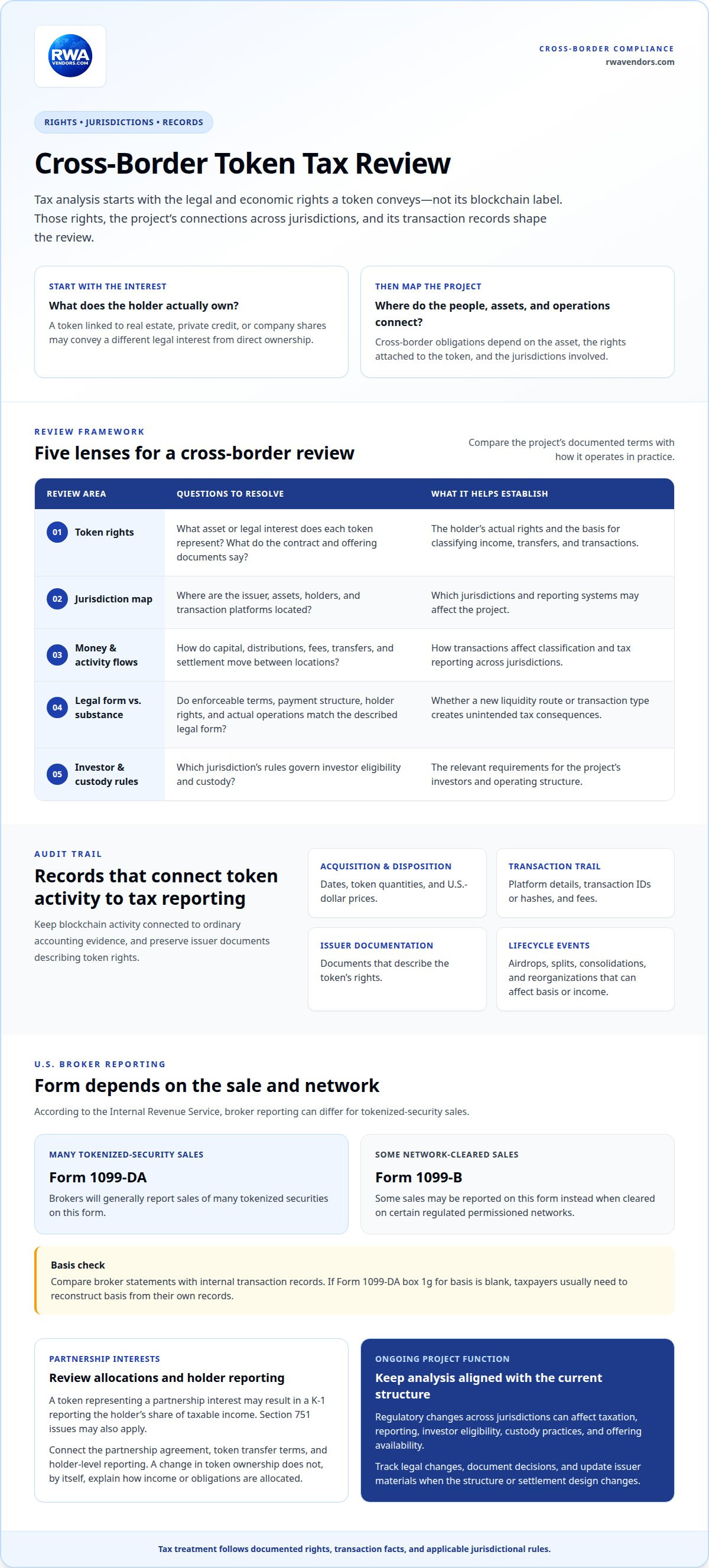
Cross-border tax analysis starts with the rights represented by each token, not its blockchain label. A token linked to real estate, private credit, or company shares may convey a different legal interest from direct ownership. The contract, offering documents, and issuer structure help establish what the holder actually owns. Those details shape how income, transfers, and transactions are classified across jurisdictions.
Map the project’s legal and operational connections before assessing tax exposure. Identify where the issuer is organized, where assets are located, where holders reside, and where platforms operate. Trace the flow of capital, distributions, fees, and settlement between those points. This jurisdiction map helps advisers identify which rules and reporting systems may affect the project, rather than treating global activity as one uniform tax question.
Compare the token’s economic substance with its documented legal form. A new liquidity route or transaction type can produce unintended tax consequences, especially if it differs from the form commonly used in tax analysis. For example, an interest described as debt in offering materials may have rights that call for closer classification. Tax analysis should follow enforceable terms, payment structure, and holder rights, not marketing language alone.
A useful cross-border review separates connected but distinct questions:
- What asset or legal interest does each token represent?
- Where are the issuer, assets, holders, and transaction platforms located?
- How do transfers, distributions, and settlement affect tax reporting?
- Which jurisdiction’s rules govern investor eligibility and custody?
- Do offering documents match the token’s actual rights and operations?
Build transaction records that connect blockchain activity with ordinary accounting evidence. Preserve acquisition and disposition dates, token quantities, U.S.-dollar prices, platform details, transaction IDs or hashes, and fees. Keep issuer documents that describe the token’s rights. Record airdrops, splits, consolidations, and reorganizations, as these events can affect basis or income. A complete audit trail helps reconcile wallet movements with the legal and financial records used for reporting.
For U.S. reporting, the form can depend on the transaction and network. According to the Internal Revenue Service, brokers will generally report sales of many tokenized securities on Form 1099-DA. According to the Internal Revenue Service, some tokenized-security sales may be reported on Form 1099-B instead of Form 1099-DA when cleared on certain regulated permissioned networks. Compare broker statements with internal transaction records. If Form 1099-DA box 1g for basis is blank, taxpayers usually need to reconstruct basis from their own records.
Partnership interests require a separate review of allocation and reporting mechanics. A token representing a partnership interest may result in a K-1 reporting the holder’s share of taxable income. Section 751 issues may also apply to tokenized partnership interests. Advisers should connect the partnership agreement, token transfer terms, and holder-level reporting. A change in token ownership does not, by itself, explain how income or obligations are allocated among holders.
Treat compliance as an ongoing project function. Regulatory changes across jurisdictions can affect taxation, reporting, investor eligibility, custody practices, and offering availability. Changes to settlement or exchange design can also alter the transaction record supporting tax treatment. Assign responsibility for tracking legal changes, documenting decisions, and updating issuer materials. This keeps tax analysis aligned with the tokenized assets’ current structure.
Which U.S. accounting and law firms advise on tokenization tax issues?
No single professional title identifies the right U.S. adviser for every tokenization project. Start by separating the work into tax accounting, legal structuring, securities compliance, and operational controls. An accounting firm can analyze tax classification, basis, income allocation, and reporting. A law firm can examine enforceable rights, offering documents, entity structure, and securities issues. Some projects need coordinated advice across both disciplines.
For a project involving tokenized shares, ask whether the engagement covers the interest represented by the token, not just the blockchain system. The SEC Investor Advisory Committee has recommended disclosure of tokenized equity investors’ voting rights, dividend entitlements, and participation rights in corporate actions. Those rights affect legal analysis and can inform tax characterization. Counsel should compare the token’s terms with issuer documents and actual holder entitlements.
Accounting capability should match the asset and transaction design. A tokenized partnership interest raises different questions from a debt instrument or corporate share. For partnership interests, the analysis may include allocations, holder reporting, and Section 751 issues. A token representing a partnership interest may also lead to a K-1 reporting the holder’s share of taxable income. Ask the accounting team to explain how it will reconcile these mechanics with token transfers and records.
For U.S. transaction reporting, include broker statements in the adviser’s scope. According to the Internal Revenue Service, brokers will generally report sales of many tokenized securities on Form 1099-DA. Some sales may instead be reported on Form 1099-B when cleared on certain regulated permissioned networks. A qualified team should be prepared to reconcile these forms with the project’s transaction data, including basis records and network activity.
Use a structured assessment to compare firms. Request a written scope identifying the responsible professionals, work products, assumptions, and jurisdictions covered. Then assess whether the team can address:
- Asset classification: How the analysis distinguishes equity, debt, and partnership interests.
- Document review: Whether token terms, offering materials, and entity documents are considered together.
- Reporting: How tax calculations connect to broker forms and holder-level records.
- Cross-border coordination: How the firm handles differing rules for issuers, assets, and investors.
- Technology understanding: Whether blockchain transactions can be reconciled with accounting evidence.
Test the proposed approach against a concrete transaction. For example, ask how the team would analyze a token transfer involving a partnership interest, a holder’s income allocation, and a later sale. The response should identify the controlling documents, records supporting the calculation, and issues requiring legal analysis. Clear boundaries matter: tax advice, securities counsel, and technical implementation are related, but they are not interchangeable workstreams.
Assess how the firm will handle changes after launch. A revised transfer process, new settlement route, or altered token rights can affect assumptions used in earlier analysis. Ask for a process to document material design changes and reassess their effects. The goal is a consistent record linking legal terms, accounting treatment, and transaction activity, rather than a one-time memorandum disconnected from operations.
For tokenization tax advisory firms, practical fit depends on the project’s asset, structure, transaction model, and investor jurisdictions. Accounting and legal practices seeking issuer connections can use a tokenization vendor directory listing to present their services to RWA projects.
Ask how the firm will analyze tax treatment across the jurisdictions relevant to the project, and whether it can coordinate with counsel and the accounting team. Find out which documents and transaction records its conclusions will depend on, and how it will flag assumptions that may need review if token terms or operating arrangements change. Clear responsibilities can help prevent gaps between legal interpretation, tax calculations, and holder reporting.
Retain issuer or offering documents that describe what a token represents. Advisers use these materials to understand the rights and interests being analyzed and to identify which documents informed their work. For projects involving stablecoins, ask whether the scope addresses relevant risks associated with the token and its issuer. Stablecoins pegged to assets such as the U.S. dollar carry risks tied to the issuer’s ability to maintain the peg, manage reserves, and comply with evolving regulatory standards. A firm should explain how those risks fit within its engagement, what information it needs from the issuer, and whether its tax analysis relies on assumptions about the token’s backing or operation. Compare firms by the specificity of their answers, not simply the range of services they list. A strong fit is a team whose written scope connects the token’s documented features to the work it will perform.
Asset tokenization
Asset tokenization creates digital representations of rights connected to conventional or digital assets. A blockchain can record token ownership and support transfers, but the token’s code does not establish the holder’s full legal position. The underlying contract and issuer documents define what the token represents. For a real estate interest, that could mean economic exposure without the same rights as direct property ownership.
The asset class shapes a project’s structure. Tokenization can represent liquid assets, including cash and bonds, as well as illiquid assets such as private credit and private equity. Fractional trading may broaden access to markets that were previously difficult to enter, while also creating new transaction patterns. For example, a smaller purchase of a token linked to a multifamily apartment could represent an interest connected to a larger property.
This distinction matters for tax analysis because a token and its underlying asset are not always identical. A holder’s rights may differ from those of a direct owner. A wrapped token linked to a public company, for example, may not carry the same voting or bankruptcy rights as a native token. Before classifying income, advisers need to establish whether the token conveys ownership, a contractual claim, or another economic interest.
Tokenization can also affect when income is recognized, where it is sourced, or how an asset’s character is assessed. The tax treatment of a tokenized security depends on the economic substance of the interest. Equity distributions and sales generally follow dividend and capital-gain rules, while debt payments are generally treated as interest. A product combining asset exposure with contractual payment rights therefore needs careful review of its actual terms.
For each project, map the token design against its economic and legal functions:
- Underlying asset: Identify whether the token relates to property, debt, equity, or another asset.
- Holder rights: Record voting, distribution, redemption, transfer, and information rights.
- Payment flows: Trace income from the asset through the issuer and platform to holders.
- Transfer mechanics: Describe how a sale, exchange, or settlement changes ownership records.
- Supporting documents: Compare smart-contract behavior with enforceable contracts and offering materials.
These distinctions matter when a project introduces new liquidity or transaction types. A token may be exchangeable on a blockchain while the underlying asset remains difficult to sell. That difference can affect how the project describes liquidity and how advisers analyze a transaction. For instance, a transfer between holders may represent a disposition of an interest, even though the property itself has not changed hands.
Operational design also affects the evidence available for accounting. A project may have on-chain transaction records alongside off-chain agreements, payment instructions, and issuer records. Reconcile these sources so each transfer corresponds to the right holder and economic event. If corporate actions change token quantities or entitlements, preserve the supporting records and connect them to the project’s accounting treatment.
Tokenization can support trading outside traditional market hours, including 24-hour, seven-day activity for some tokenized assets. That capability makes governance and recordkeeping important across the full transaction lifecycle. Define who can authorize transfers, update asset information, and resolve discrepancies. For an issuer, a clear operating model helps keep token records aligned with the asset, contractual rights, and financial reporting.
Tokenization can support financial products and services based on digital representations of conventional illiquid assets or new digital assets such as NFTs. Financial-services projects may involve banks, asset managers, lenders, payment providers, corporate treasurers, and finance departments tokenizing real-world assets such as deposits, securities, and commodities. These examples show how tokenization can apply across different asset types and financial activities. Fractional trading may expand investor access to illiquid assets that were previously difficult to access in smaller portions, a relevant consideration for products built around those assets.
A token may be linked to an underlying asset through a contract specifying enforceable terms. In the article’s illustrative example, an investor spends $100 on a token linked to a multifamily apartment in New Orleans. The purchase amount describes the example’s token investment; the holder’s legal position still depends on the token’s terms and supporting documents. The structure and terms of tokenized private-credit loans may vary, so buyers and borrowers should assess each arrangement on its own terms. These examples highlight the range of arrangements tokenization can support, from fractional interests in illiquid assets to credit products, while leaving the economic and contractual character of each particular token to be assessed on its own terms.
RWA Vendors: Vendor Directory Listing
RWA Vendors connects asset issuers with verified tokenization platforms and service providers through its Vendor Directory. Use the directory to discover providers across technology, legal, compliance, and tokenization categories for projects involving real estate, funds, securities, or other assets.
For an issuer coordinating tax, legal, and technical workstreams, the directory helps identify providers involved at different stages of RWA tokenization. It does not replace professional tax or legal advice; it helps projects discover relevant firms and platforms. Providers can use RWA Vendors’ Vendor Directory Listing, Founding Membership, and Lead Generation and Referrals to build visibility and connect with issuers.
Visit rwavendors.com to explore the directory and discover providers relevant to your project.
Build Tax Readiness Into the Project’s Next Phase
Make tax analysis part of ongoing project governance, rather than a document separate from product decisions. When token rights, transfer processes, or participating jurisdictions change, assign clear responsibility for reviewing the impact and updating project records. This discipline keeps advisory work connected to operational reality.
For issuers, the next step is to match project needs with professionals whose experience aligns with the asset, structure, and markets involved. Firms offering tax, legal, compliance, or technology services can use RWA Vendors to connect with RWA issuers. Its offerings include Vendor Directory Listing, Founding Membership, and Lead Generation and Referrals. A relevant listing can help issuers discover providers as they assess tokenization tax advisory firms and related expertise.
Build a provider profile around the work your firm supports and the project stages where it contributes. Clear information helps issuers understand how your expertise fits their tokenization plans.
Take the next step with a clear understanding of your project’s needs and the expertise required to support them.
Frequently Asked Questions
What tax advisory firms specialize in digital asset tokenization in the United States?
In the United States, look for accounting and tax firms with digital-asset experience, alongside law firms familiar with tokenized securities. RWA Vendors’ directory displays 170 Tax Advisors and 83 Accounting Firms. It also lists Dickinson Wright PLLC as legal counsel for digital securities and tokenized assets, but that listing alone doesn’t establish tax specialization. Treat tokenization tax advisory firms as a cross-disciplinary search, matching each firm’s expertise to the asset and project structure.
What tax services do tokenization advisory firms offer?
Tax advisory work can include written analysis of a project’s tax positions, transaction-flow diagrams, and a responsibility matrix for issuer, platform, and holder reporting. For example, an issuer preparing a new token transfer feature could commission an assessment of how the change affects existing assumptions and documentation. Advisers may also help define the records finance teams need to retain and create an issues log for open tax questions, giving project leaders clear items to resolve.
How do tax advisory firms compare on tokenization expertise, fees, and services?
Compare firms by whether their experience fits the asset and transaction structure, and whether their services cover tax classification, document review, reporting, cross-border coordination, and blockchain-record reconciliation. Request a written scope identifying the responsible professionals, work products, assumptions, and jurisdictions covered.
Disclaimer
This article is provided by RWAVendors.com for general informational and educational purposes only. It does not constitute legal, financial, investment, tax, regulatory or other professional advice, or an offer, solicitation, recommendation or endorsement of any company, product, service, token, security or investment. RWAVendors.com is an informational vendor directory and does not sell, issue, broker, custody or facilitate transactions involving cryptocurrencies, digital tokens, tokenized assets, securities or investment products. Some vendor listings and references may involve paid advertising, sponsored placement or membership relationships. These relationships do not guarantee a vendor’s qualifications, regulatory status, performance or suitability. Information may be incomplete, outdated or subject to change. You should independently verify all information, conduct your own due diligence and consult qualified professionals before making any business or investment decision. RWAVendors.com is not responsible for the content, services, representations or actions of third-party vendors or linked websites.


